Radio City Music Hall, New York City. September 14, 1984.
The first MTV Video Music Awards. No one knows yet what this night will become, what the award will mean in five years, in ten, in forty. Tonight it is new and relatively unscripted.
The opening credits announce it as “the greatest rock and roll extravaganza of the last 2,000 years.” Some of the talent in the room: Van Halen’s David Lee Roth, Duran Duran’s Simon Le Bon, Tina Turner, Huey Lewis, ZZ Top, Herbie Hancock, Hall and Oates, Billy Idol, and Michael Jackson’s pet chimpanzee Bubbles.
Co-hosts Bette Midler and Dan Aykroyd are enthusiastic, dressed up in astronaut gear. Aykroyd is fresh off Ghostbusters, the year’s biggest film. Midler surveys the room and delivers her verdict: “Here I am standing in front of the hippest crowd in the history of the world, and I look exactly like a baked potato.”
Rod Stewart opens the show with “Infatuation.” After nearly three hours of performers and presenters, and a room recovering from Madonna’s performance of “Like a Virgin,” Eddie Murphy and Joe Piscopo walk out to announce “Video of the Year.”
The nominees for Video of the Year: Michael Jackson’s “Thriller.” The Police’s “Every Breath You Take.” Cyndi Lauper’s “Girls Just Want to Have Fun.” Herbie Hancock’s “Rockit.” The Cars’ “You Might Think.”
It will be the night’s highest honour.
When they read the winner, it is not the 14-minute short film “Thriller.”
It is a band from Boston, and a video that nearly broke the machines that made it: “You Might Think” by The Cars.
MTV had been built on a deliberate philosophy. Fred Seibert, the network’s first creative director, wanted the channel to feel something. “Shouldn’t we just prove that we’re in motion all the time,” he said, “and that music is always changing?” Co-founder Bob Pittman had one mandate for the brand. Judy McGrath, who would later become CEO of MTV Networks, remembered it clearly. “Bob Pittman called me up and said, ‘Judy, I want MTV to be the star. Not Rod Stewart, not any of these other guys.'”
The VMAs were not the first attempt to highlight music videos. The Grammys had recognized them with categories for Best Video Short and Best Video Album. In April 1984, Casey Kasem had hosted a syndicated programme called “The American Video Awards.” But those shows were built for a different audience. Scripted and expected.
MTV vice president John Sykes’ declaration about what the VMAs were meant to do set the stage ahead of the show. “We hope to do to the awards show what we did to New Year’s Eve and Guy Lombardo,” he said. MTV wanted to replace the old guard of tuxedos with something that felt alive, unexpected.
That night, accepting the Special Recognition Award, Quincy Jones singled out Pittman by name. “Along with Bob Pittman, whose vision has made MTV the innovator that I think most imitators will have to follow for a long, long time.”
The votes came from 1,500 music industry insiders, not fans. Video directors, record executives, radio programmers, recording artists. They had watched 677 videos play on MTV between May 2, 1983 and May 2, 1984, whittled down to 81 nominees across 15 categories. Five of those 81 were nominated for the Best Video of the Year award.
They knew exactly what they were looking for: a music video that felt like the future of the medium, not the past of another one. The five nominees for Video of the Year each represented something distinct.
Michael Jackson had not attended the ceremony. Diana Ross walked to the stage and accepted his three awards on his behalf. But Jackson had been clear about what he wanted the horror-themed “Thriller” to accomplish. “I wanted to be a pioneer in this relatively new medium,” he stated. “I wanted something that would glue you to the set, something you’d want to watch over and over.”
“Thriller” was ambitious and had a cast, a narrative, makeup by an Academy Award winner, and a premiere. His producer Quincy Jones had seen it coming. “Michael, I think this is going to be the Citizen Kane of the videos,” Jones told him. “It’s going to be the most revolutionary thing in the history of the videos.”
The Police’s “Every Breath You Take” was shot in black and white in a darkened ballroom. Sting described the song as “a nasty little song, really rather evil. It’s about jealousy and surveillance and ownership.”
Cyndi Lauper’s “Girls Just Want to Have Fun” won Best Female Video that night. Chaotic and joyful, the video had Lauper’s real mother, pro wrestler Captain Lou Albano, and a dancing Conehead. “We got every racial group of girl mixed, Spanish, white, black, Asian, everybody,” Lauper said, “so that every little girl who looked at that video would want to join our club and understand that every young woman, older woman, every person is entitled to a joyful experience.”
Herbie Hancock’s “Rockit” introduced turntable scratching to mainstream America through a video of dancing mechanical robots, with Hancock himself appearing only on a screen within the video. That was deliberate. Hancock told directors: “I don’t want it to look like a ‘black guy’ video. I want it to look like something that could have been made by Duran Duran or the Police. I wanted Godley and Creme to do whatever they needed to do to get it on MTV.” His strategy worked. For many it was the first time they heard a record being manipulated on a turntable to the beat. That night Hancock won more awards than any other artist, including Best Concept Video, Most Experimental Video, Best Special Effects, Best Art Direction, and Best Editing.
And then there was “You Might Think” by The Cars.
Lead singer Ric Ocasek had strong opinions about what a music video should and shouldn’t do. “I like videos as long as they don’t sort of betray the lyrics verbatim,” he said. “As long as it’s sort of mood setting and don’t distract you from the song. I just don’t want them to depict the lyrics. If they don’t do that, I think they’re fine.”
“You Might Think” drove that line. The production behind it, however, was anything but smooth.
Director Jeff Stein initially said no. “I had worked with the Who, the greatest live act ever,” he recalled. “I was going to turn in my badge.” What changed his mind was a Charlex campaign for the National Enquirer using animated celebrity cutouts. “I heard the Cars’ ‘You Might Think’ and thought I could make the first cartoon with real people.”
Stein described the concept: the band in a medicine chest, on a bar of soap, Ric as a fly. One of them replied: “Why don’t we all just play on a turd in the toilet bowl?” But he wasn’t stopped. Stein built the video around pop-culture imagery: Ocasek as King Kong on the Empire State Building, the band replacing the presidential faces on Mount Rushmore, references to Incredible Shrinking Man and Ed Wood’s Glen or Glenda. “I wanted them to make fun of themselves and be self-effacing.”
Charlex was a New York production company, founded by Charlie Levy and Alex Weil, that made a name in advertising by pushing video technology. Robin Sloane, head of video at Elektra Records, the label behind The Cars, brought Stein to them.
Charlex shut down their entire operation to make it. “They had no income coming in, and it took months to make. Animation takes a long time and no one had ever done anything like this. Everyone was up all night, every night, for months,” said Sloane.
“Everything had to be matted properly,” Ocasek recalled. “When we shot it in real time we would have to stand in different positions to line up with the screen and do all that business. Like for a video which usually takes a couple of days, this took like three weeks and two weeks of editing. They went over time actually, but they sort of gave it to us for what our budget was.”
Charlex charged Elektra Records $80,000 when the average video of the time was about $30,000, and gave “the band a $1,000,000 film in the process.”
“When Charlex finished, they came up to Elektra and wouldn’t let us have the video. They wanted more money,” said Sloane. “One of the guys who worked for Charlex had the video in an attaché case handcuffed to his wrist. I kid you not.”
Sloane said that Ocasek hated the video. He thought it made fun of the way he looked.
“That video completely changed their image,” she said. “It took a band that was not visually dynamic and made them incredibly visually dynamic.”
The video received six nominations at the first MTV Video Music Awards. Ocasek said it caught him off guard. “I thought ‘You Might Think’ was a very good video and I know it took a lot of time to do and it was well thought out,” he said. “But as far as the awards go and all that business, I never gave it a second thought.”
Stein felt the same way. By the time the Video of the Year award was announced, “You Might Think” had lost every category it was nominated in. “So I was asleep in the audience at Radio City Music Hall when Eddie Murphy announced the Cars for Best Video of the Year,” Stein recalled.
Ocasek took the stage. “Quite a surprise,” he said, “but I’d like to thank Jeff Stein here, and Charlie and Alex, people, Charlie and Alex, for all their time.”
It was the inaugural Video of the Year award, the first winner of what would become MTV’s most prestigious form of recognition. The jury of insiders looked for a music video that felt like the future of the medium. “You Might Think” was built for the channel it lived on, in the room it lived in. Three minutes. A continuous shot. Embedded pop-culture references.
Fred Seibert, MTV’s own first creative director, had not seen it coming. “You Might Think,” Seibert wrote, “cleaned our clocks.”
To understand how that happened, take a road trip back to Boston. The mid-1970s.
The Cars assembled piece by piece, with a little help from a disc jockey.
Maxanne Sartori, a Boston-based WBCN-FM disc jockey, met Ric Ocasek in early 1976 when he played in a band called Cap’n Swing. “I met Ric that spring at a concert he played on Boston’s Newbury Street and we started hanging out. We tooled around in his VW Beetle and went to hear bands at Boston’s Rathskeller,” said Sartori. “That fall, after Cap’n Swing played Max’s Kansas City in New York, I suggested that Ric shift Ben Orr from singing lead vocal to playing bass and sharing lead vocals with Ric. I also suggested that Ric hire drummer David Robinson, who had more of a pop feel.”
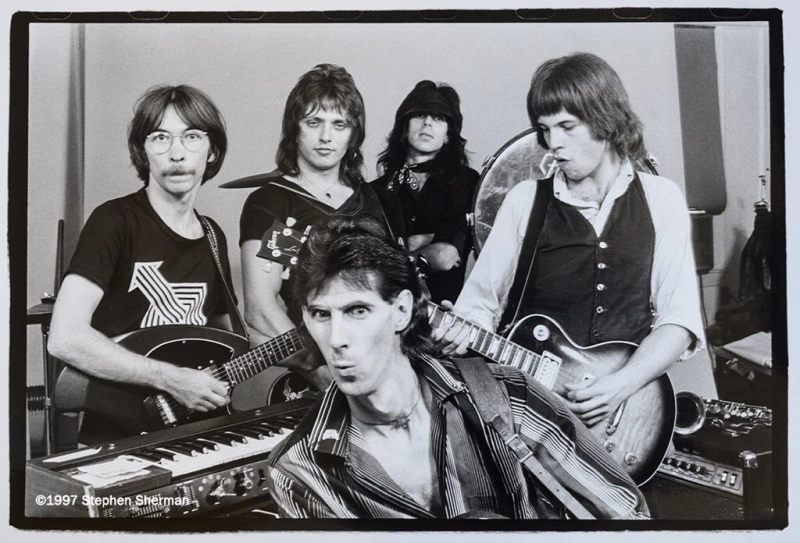
By late 1976, Benjamin Orr on bass, Elliot Easton on lead guitar, Greg Hawkes on keyboards, David Robinson on drums, and Ocasek on rhythm guitar came together to form The Cars. Both Orr and Ocasek shared lead vocals.
“We came up with lists of names. On my list was ‘The Cars.’ It was easy to remember and it wasn’t pegged to a specific decade or sound. The name was meaningless and conjured up nothing, which was perfect,” recalled Robinson. “Ric liked the name. It also was easy to spell and impossible to forget. Funny thing is I didn’t even own a car at the time.”
The band played its first gig as The Cars in December 1976 and recorded a demo tape in February 1977 at Northern Studios in Maynard, Massachusetts. Sartori put the demos on the air. “The new band had a punchier, more cohesive sound. I began playing the demos of ‘Just What I Needed’ and ‘My Best Friend’s Girl’ in March during my weekday slot, from 2 to 6 p.m. Calls poured in with positive comments. The Cars’ sound was fresh,” stated Sartori.
“Like all FM DJs, Maxanne had to keep an official log of songs played on the air. Those logs made it into trade publications, where the source for our demo songs was listed as ‘tape,'” said Ocasek.
The Cars were unsigned, and “Just What I Needed” drove interest from record executives at several labels. The band signed with Elektra Records. “Every artist I loved was on Elektra, the Doors, Jackson Browne, the Incredible String Band and so many others,” recalled Ocasek.
Elektra paired the Cars with British producer Roy Thomas Baker, who had produced Queen’s first five albums, including A Night at the Opera, which featured “Bohemian Rhapsody.” “We toured for much of ’77 to build an audience. Then Elektra paired us with Roy Thomas Baker. He wanted to record our first album at George Martin’s AIR Studios in London,” said Ocasek. “We were thrilled. I had never been on a plane before. Everything about London was magical and cool. We recorded The Cars album in 12 days in February 1978.”
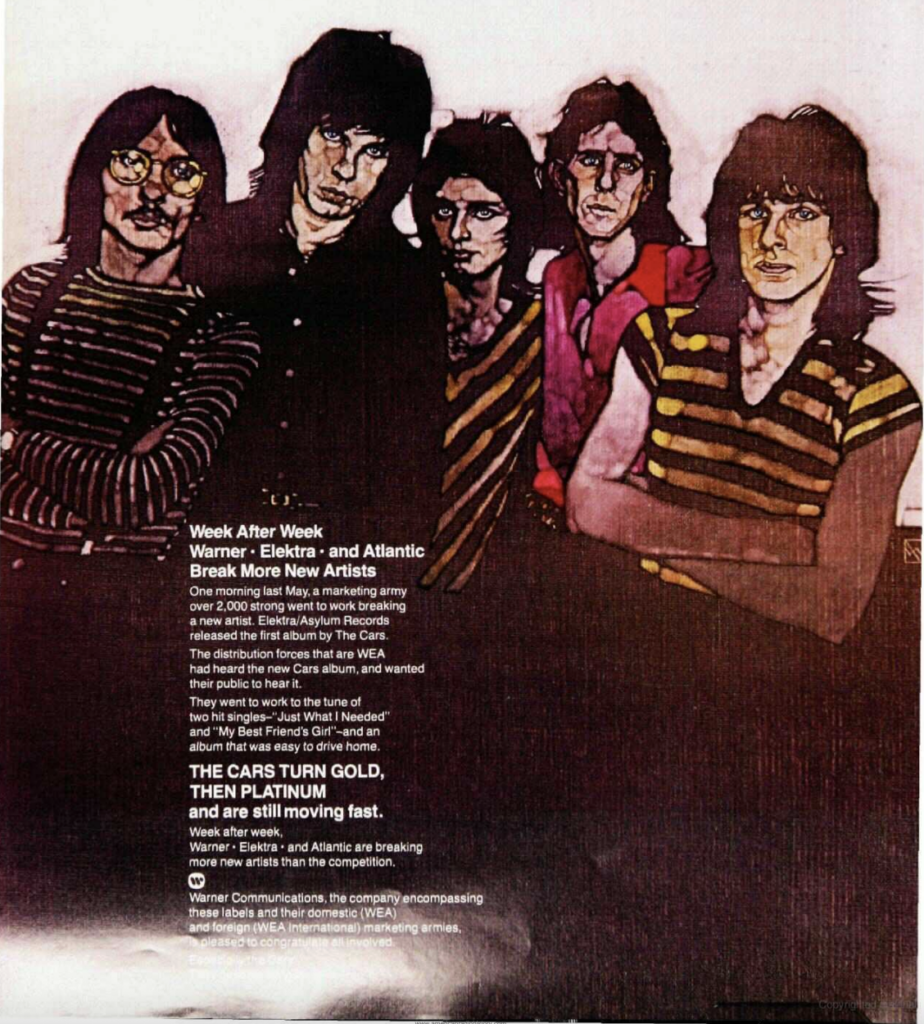
Their debut single, “Just What I Needed,” was released on Monday, May 29, 1978, about a week before their self-titled debut album came out on Tuesday, June 6, 1978. The song peaked at number 27 and spent 17 weeks on the chart. Billboard‘s review read, “A driving, propulsive beat energizes this spirited rocker, produced by Queen’s former mentor. There are also some feisty rock guitar lines throughout and group has a winning harmonic vocal style.”
The Cars released three albums over the next four years: Candy-O in 1979, Panorama in 1980, and Shake It Up in 1981. All performed well commercially and the title track “Shake It Up” reached number 4 on the Billboard Hot 100, their first top 10 pop hit.
Following their 1982 tour, the Cars took a break. Ocasek released his debut solo album Beatitude and keyboardist Greg Hawkes followed with Niagara Falls. When the band got back together in 1983, they were ready to create something different. For their fifth album they reached out to producer Robert John “Mutt” Lange, known for his work with AC/DC’s Back in Black and Def Leppard’s Pyromania, to drive the band somewhere new.
“I thought that the combination of the sound he gets and what we do would mingle pretty nicely,” Ocasek said. “Mutt’s never done a band like us; he’s done a lot of heavy metal. But I thought the two could mix.”
“We were just looking for his sonic touch to give us a great-sounding record,” said Easton.
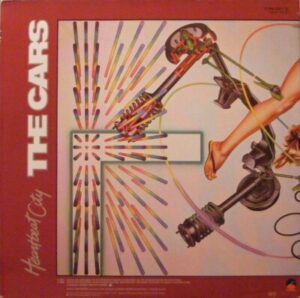
Recording sessions happened between July 1983 and January 1984, primarily at Battery Studios in London, England. The result was Heartbeat City, written entirely by Ocasek and co-produced with Lange.
The lead single “You Might Think” was released with a music video on Monday, February 27, 1984, just over two weeks before the album’s release on Tuesday, March 12, 1984.
Rolling Stone called it “a calculatedly exquisite balance of crowd-pleasing rock and the latest experiments in studio sound,” describing Ocasek’s approach as “a painter’s approach to producing, the layering of sound, the taste for use-’em-once studio gimmicks.” The magazine summed it up with one phrase: “high-propane pointillism.”
Billboard called the album “a set of distinctive uptempo pop/rock,” noting that “several of the cuts have the quirky technopop sound of Styx’s ‘Mr. Roboto’ and should make strong singles.”
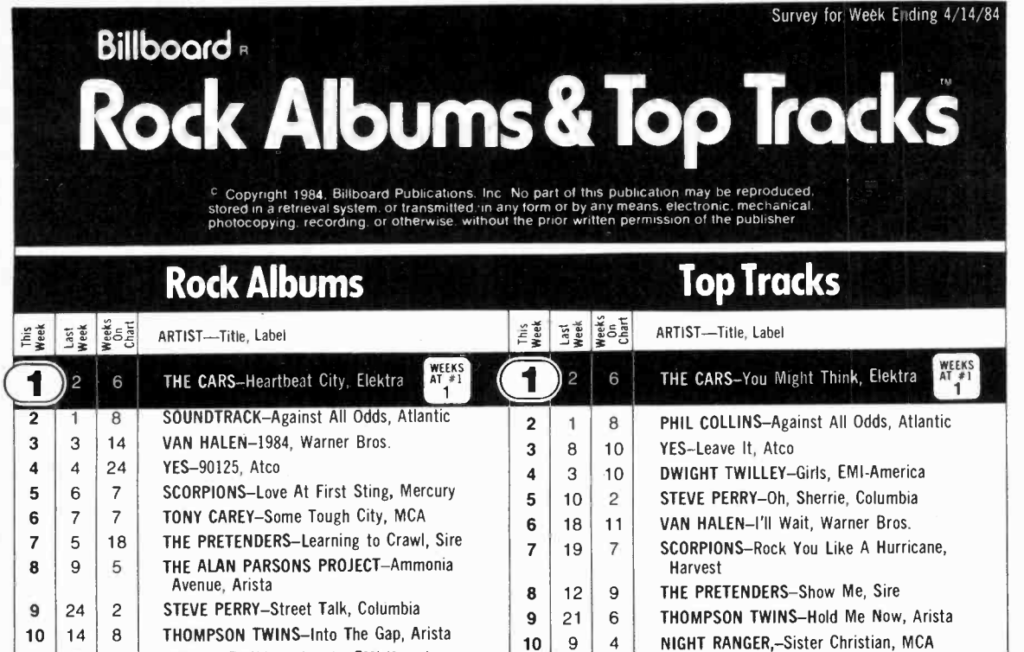
The single debuted on the Billboard Hot 100 on March 10, 1984, peaked at number seven on April 28, and spent 17 weeks on the chart. On the Billboard Rock Tracks chart, it went all the way to number one, with Heartbeat City sitting at number one on the Rock Albums chart at the same time.
Lyrically: You Might Think by The Cars
Ocasek was private about the specific meanings of his songs. “Most of my songs are written about those kinds of things, you know, relationships between people rather than politics or whatever,” said Ocasek. He described his lyrical approach as “manipulated contradictions,” where the meaning is left open and the listener decides what is true. Rolling Stone would describe his lyrics as “crypto-poetic.”
In the spring of 1984, a Radio & Records columnist noticed something unusual about the pop charts. The Thompson Twins were asserting “Hold Me Now.” Van Halen was telling you to “Jump.” In a landscape full of directives, “You Might Think” was alone on the road. The columnist called it “absolutely spineless hesitation.” He meant it as a criticism, but it was actually the song’s greatest strength. “You Might Think” opened with a question to ponder and left the answer to the listener.
Oh well, uh, you might think I’m crazy
To hang around with you
Or maybe you think I’m lucky
To have somethin’ to do
Lyrically, the opening verse of “You Might Think” arrives mid-thought with a casual “oh well, uh.” The conversation begins with one person asking whether the choice of spending time together seems “crazy,” then flips with a lack of self-confidence that perhaps it is just “lucky” to have something to do at all.
But I think that you’re wild
Inside me is some child
Two lines, two directions. The first looks outward, drawn to someone wild and unpredictable. The second looks inward. Being around this person brings out something childlike, a youthfulness in spirit and energy.
You might think I’m foolish
Or maybe it’s untrue
(You might think) You might think I’m crazy
(All I want) All I want is you
The chorus builds through self-realization. Foolish. Crazy. Each label is offered up before anyone else can deliver it. “All I want is you” removes any doubt about their intentions.
You might think it’s hysterical
But I know when you’re weak
You think you’re in the movies
And everything’s so deep
The balance of the song shifts here. The opening verses have been turned inward and “I know when you’re weak” changes that. There is a claim of seeing past the theatrics that most people do not see. The attraction is not despite these qualities. It is because of them.
But I think that you’re wild
When you flash that fragile smile
This is an example of the “manipulated contradictions” that Ocasek penned. The contradiction is the point. It is what makes the other person impossible to look away from.
You might think it’s foolish
What you put me through (You might think)
You might think I’m crazy (All I want)
All I want is you
“You might think it’s foolish” first reads as another self-label. But “what you put me through” is the first sign of frustration and belongs to the situation. Quickly resolved with a return of the declaration: “All I want is you.”
And it was hard, so hard to take (So hard to take)
There’s no escape (There’s no escape)
Without a scrape (Without a scrape)
But you kept it going, till the sun fell down
You kept it, going
The frustration turns to difficulty. “So hard to take,” “no escape,” “without a scrape” arrive one after another. There is no way out that does not leave an emotional mark. Yet despite the pain, the other person keeps drawing them back in, day after day.
Oh well uh, you might think I’m delirious
The way I run you down
But somewhere, sometimes
When you’re curious
I’ll be back around
The conversational “oh well, uh” returns, but the self-labelling has evolved. Crazy has become delirious. Crazy is casual. Delirious is consuming. The escalation is deliberate. The pursuit continues. Somewhere, sometimes, when curiosity presents itself, the other person will come right back.
Oh, I think that you’re wild
And so uniquely styled
The words “uniquely styled” are the most specific compliment in the song. Something singular. Styled in a way that belongs to no one else.
You might think it’s foolish
This chancy rendezvous
(You might think I’m crazy)
You might think I’m crazy (All I want is you)
All I want is you, ah-oo
All I want is you (All I want is you)
All I want is you
“Chancy rendezvous” reframes the song. The encounters were never guaranteed. They were always unplanned. Yet, regardless of how or when, the declaration does not waver. “All I want is you” repeats until it is the only thing remaining.
“I think a lot of the songs will grow on repeated listening to all of a sudden surface in your mind. Which I think is good because I don’t think you should be able to get it immediately. Because I think that the quicker you get it, the quicker it goes away actually,” said Ocasek. “The longer it takes to get it, the longer it lasts.”
With “You Might Think,” The Cars pulled ahead as one of the defining new wave bands of the 1980s. Their set at Live Aid on July 13, 1985 was seen by an estimated 1.9 billion people across 150 countries. The band was inducted into the Rock and Roll Hall of Fame in 2018. “You Might Think” was the first music video placed in the permanent collection of the Museum of Modern Art.


What does this song mean to you?
Share your thoughts on this song.