Boston, 1972. Karen Nussbaum is a clerk-typist at the Harvard Graduate School of Education. She is eating lunch at her desk when a student walks through the office door, looks her dead in the eye, and asks: “Isn’t anybody here?”
Nussbaum is sitting right there.
She is invisible.
“It was a kind of job where you were just not seen,” Nussbaum recalled. “You were just part of the wallpaper.”
Eight years later, Dolly Parton would write a song about it on her fingernails.
The 9to5 Movement
Karen Nussbaum and Ellen Cassedy met as students at the University of Chicago in the late 1960s. Nussbaum came from a family of anti-Vietnam War protesters. “My family was concerned about social justice,” she said. “I learned there was strength in numbers.” Cassedy remembered thinking Nussbaum was “a little scary” when they first met. Both ended up in Boston. Cassedy found work in the same department as Nussbaum at Harvard. They were doing the same job, under the same conditions.
“Office workers were invisible, but we were the largest sector of the workforce. There were 20 million women office workers. One out of three women worked in an office in those days, but there had been no cultural depictions of women in this job,” said Nussbaum.
“The bosses acted as if women were unqualified to do anything except type, file, staple papers, collate, alphabetize and make photocopies and coffee,” said Cassedy. “Worse, when they weren’t treating us like decorative objects, they treated us as if we were invisible.”
“The most common task for most clerical workers was probably getting coffee for the boss,” said Nussbaum. “This notion that you were there as the office wife, to do anything that was asked of you — we didn’t know how to express what was wrong with that, but we sure felt like it was wrong. People were quietly seething.”
“If we don’t fight for dignity and respect on the job, who’s going to fight for us?” Nussbaum said.
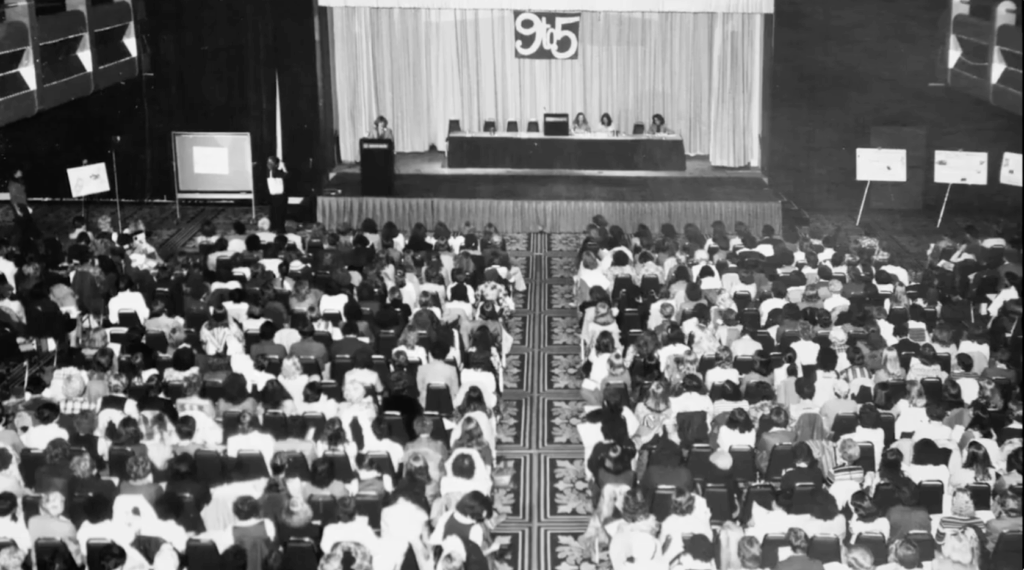
Nussbaum and Cassedy decided to publish a newsletter aimed at Harvard clerical workers, but it landed in silence and they gave up. Then, at a Women’s Action Project convention in Boston in the spring of 1972, they heard other women across the city describing the same working conditions. A group of frustrated secretaries had begun looking at Bureau of Labor Statistics studies and found that Boston had the highest cost of living in the country, and its clerical workers were among the lowest paid of any comparable city. The problem was not Harvard. It was everywhere.
Nussbaum and Cassedy quit their jobs. They joined eight other Boston office workers and started again.
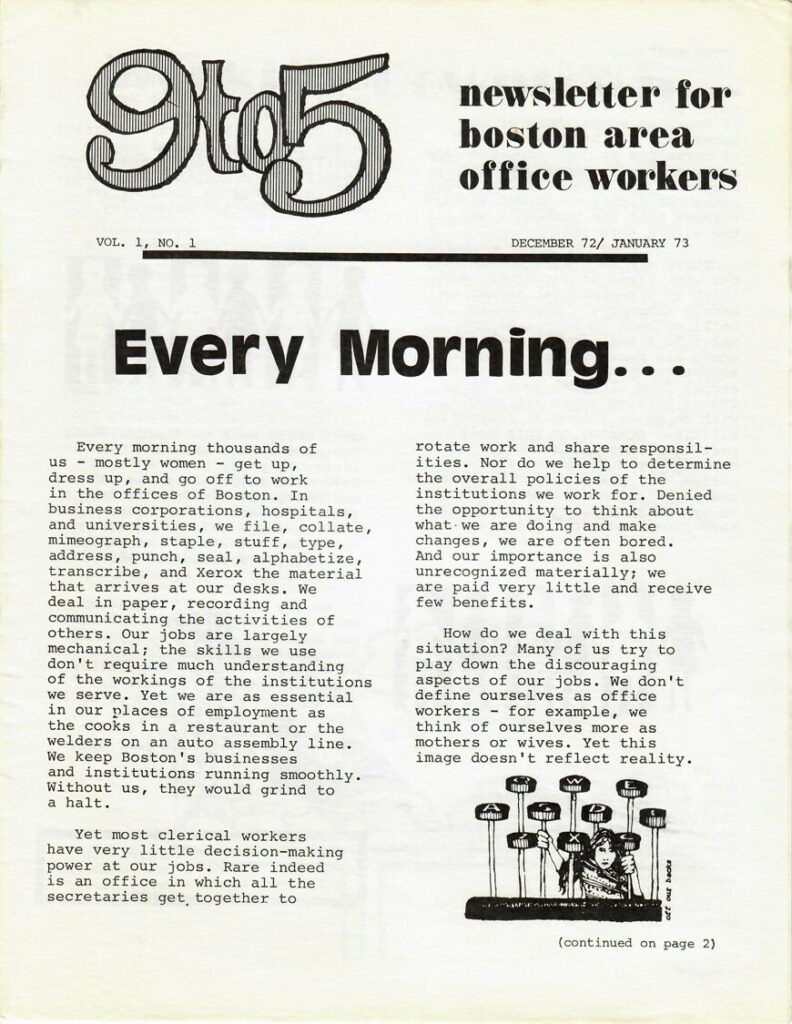
In December 1972, Nussbaum and Cassedy published the first issue of 9to5: Newsletter for Boston Area Office Workers. The lead article was titled “Every Morning…” Its argument was direct: “Without us, they would grind to a halt.” The tone was deliberate. Cassedy remembered it was “more of a ‘let’s share a cup of coffee’ tone than ‘women of the world unite’ tone.” It was a way to say to thousands of women: “Talk to us, is this happening to you? Well, you’re not alone,” Nussbaum said. They handed copies to women at subway exits on their way to work. Women responded by writing back. Nussbaum’s favourite reader letter said it plainly: “We are referred to as ‘girls’ until the day we retire without pension.”
Within a year, a newsletter had become an organization and opened its first office on the seventh floor of the Boston YWCA. At Nussbaum’s urging, Cassedy completed a six-week organizer training course in Chicago. The newsletter had found its audience. Now it had a strategy. From those ten people, 9to5 grew into an organization that visibly affected the lives of 200,000 women office workers in greater Boston.
To expose the conditions women faced, 9to5 held annual “Petty Office Procedures” contests, inviting women to submit the most demeaning tasks their bosses had asked them to perform. The 1977 winner was a man who had his secretary sew up a rip in the seat of his pants while he was still wearing them. Second prize went to a store manager who required his clerks to dress as bumble bees to attract customers.
Jane Fonda, one of Hollywood’s biggest stars and a political activist, knew Nussbaum through their shared involvement in the anti-Vietnam War movement during the early 1970s. When the war ended in 1975, Fonda shifted her attention to the women’s workplace movement and decided the most impactful contribution she could make was a film about women’s labour rights, and she set out to make one.
“Women work as they have to. They are getting angry, and they’re beginning to organize all around the country, and I support them, and I’m gonna make a movie,” stated Fonda about her intentions before the film shot a single scene.
“I knew Jane Fonda from my days in the peace movement. We were in the same organization, and then in 1975 when the war ended, Jane wanted to make a contribution to the work of 9to5 in the best way she knew how, which was to make a major motion picture,” said Nussbaum. “And so we talked for a couple of years about what that would look like, and she met with a lot of our members… Jane Fonda understood and tapped into — and that also the way her genius about this was understanding that it had to be real. It had to really reflect the way women talked, what their issues were, how they felt about it, and it couldn’t be didactic. That it had to be a comedy — that the only way you could bring people into it was by poking fun.”
“Jane was asked, ‘Are you lighting a fire under the desks and the offices of America?’ and she said, ‘No, secretaries are lighting those fires, and we are just fanning the flames,'” stated Cassedy.
“There’s already an eruption in the offices of America,” said Fonda. “There’s a very powerful movement growing among secretaries… We’re trying to reflect in the film the fact that the work that clerical workers do is important work. You can run a company without a boss but not without a secretary. Women feel their work is important. They know that it’s skilled work, and they want to be treated with respect. What’s unusual about our film is that it deals with this very serious subject as a comedy.”
The cast came together naturally. “My producing partner Bruce Gilbert and I decided we wanted to make a movie about it, and then one night I saw Lily Tomlin in her one-woman show and I basically fell in love. And I said, ‘I can’t make a movie about secretaries unless she’s one of the secretaries.’ And this is a true story: on the way home I turned on the radio, and Dolly Parton was singing ‘Two Doors Down,’ and my hair stood on end. She’d never made a movie. I thought, ‘Oh my lord, Dolly, Lily, and Jane.’ Okay, but it’s gonna have to be a comedy, and I’m gonna have to have the least interesting role. It took a year to convince them to do it,” said Fonda.
Fonda was not going to make a film that tiptoed around workplace discrimination. She wanted the argument to land hard. The comedy was the vehicle. “Nothing is fun if it’s not controversial,” stated Fonda. “The movie was married to a movement.”
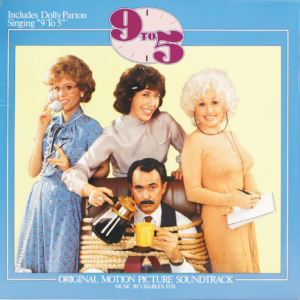
The film 9 to 5 cast Fonda, Tomlin, and Parton as three office workers who take control of their workplace after kidnapping their boss, whom they describe as a “sexist, egotistical, lying, hypocritical bigot.” Tomlin’s character had spent years training new employees without advancing in her own career. Her boss, whom she had trained herself, was stealing her ideas while sending her for coffee. The changes the three women put in place, including equal pay, flexible working hours, an on-site daycare centre, and job-sharing programs, reflected the real demands of the 9to5 movement.
“It just completely changed the debate in the country,” said Nussbaum. “Women walked into the movie theatre without a political agenda. And you walk out of the movie theatre and you think: ‘That’s outrageous.’ You’re no longer questioning whether there’s such a thing as discrimination. You’re past that, and you’re ready for solutions.”
Acrylic nails clicking together sound like a typewriter
“I want to be a star. I would like to be a superstar,” Parton told Barbara Walters during a 1977 interview. Walters asked whether that would happen within five years. “Yes,” said Parton.
When she joined the cast of 9 to 5, Parton was already one of country music’s biggest stars, but she had never made a film. She had signed a three-picture deal with 20th Century Fox in the mid-1970s but had gone through hundreds of scripts without finding one she wanted to do. The 9 to 5 project came separately, when Fonda contacted her manager directly. Parton agreed to play Doralee Rhodes on one condition.
“I said, ‘Well, this is a good opportunity, but I’ll only do it if I can write the theme song,'” said Parton.
“Lily and Jane were very helpful. Jane is the one who got me in the movie. She was thinking, ‘Dolly will get us the South.’ I told her later as a joke, ‘Well, I might get you some North and East and West, too,’ because I had a lot of fans. I memorized the whole script. They thought that was the funniest thing they’d ever heard. But it helped them, because I was feeding them lines when they didn’t remember theirs,” said Parton.
In one scene, Parton’s character sits alone at lunch, avoided by everyone in the office. Tomlin remembered that a childhood friend of Parton’s who was on set had to leave in tears. It was too close to the truth of how Parton had been treated growing up in Tennessee. The girl who had been invisible was now playing it for the world to see.
“Jane said, ‘Don’t worry about acting. Just be yourself. The director will tell you what to do, and you’ll learn.’ Dabney Coleman [who played ‘Mr. Hart’] taught me a lot, too. He’s a Texas guy, and we had a great connection. They all knew it was my first time in the movies, so they were all helpful. People are generous,” said Parton.
“What I found the hardest, most difficult to deal with, was all the time that it takes and those long hours… But I started putting my time to use, and I started writing songs and reading a lot, so it worked out okay. I wrote some good songs. I wrote the theme song, by the way, on the set,” said Parton.
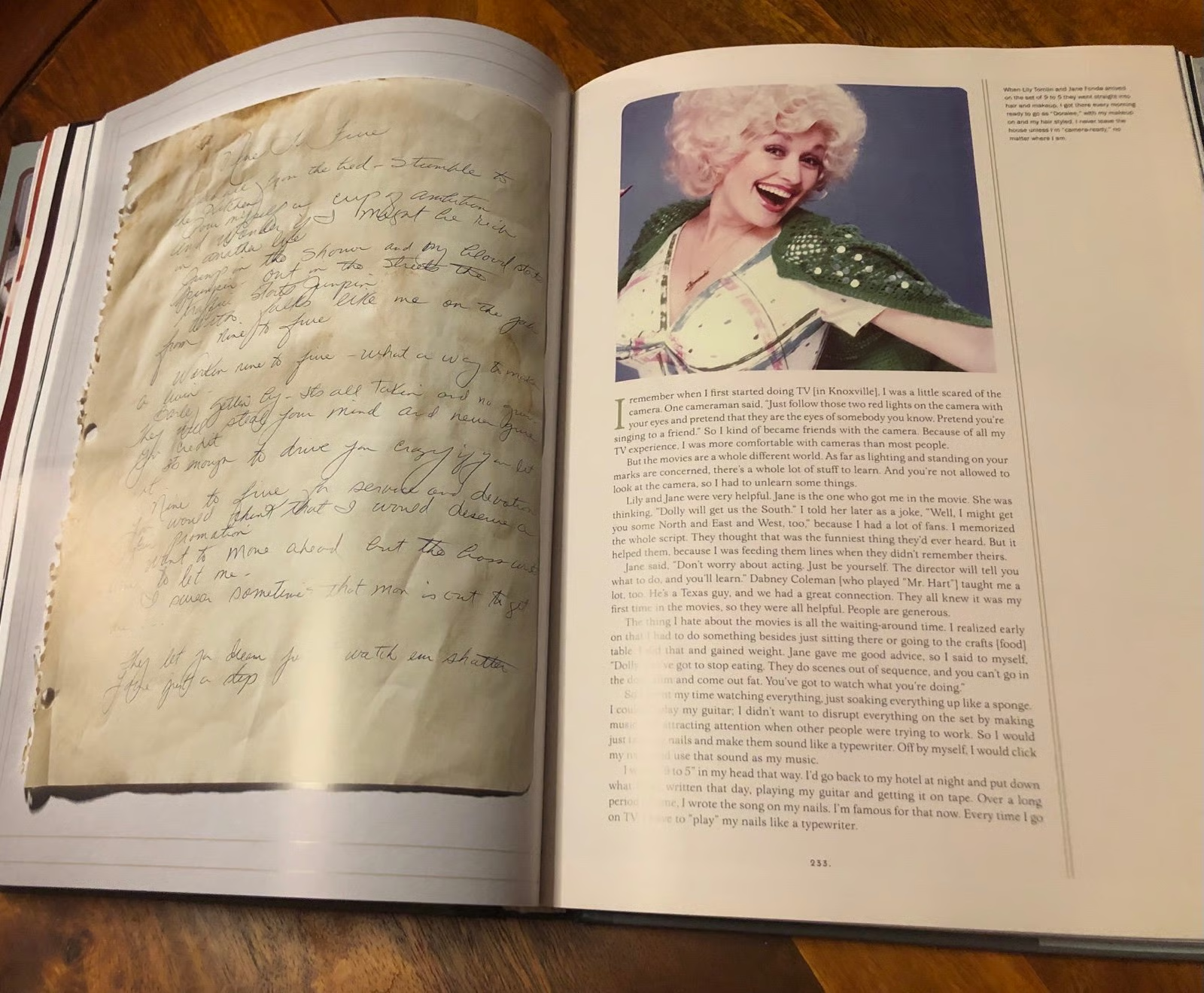
“I spent my time watching everything, just soaking everything up like a sponge. I couldn’t play my guitar; I didn’t want to disrupt everything on the set by making music or attracting attention when other people were trying to work. So I would just play my nails and make them sound like a typewriter. Off by myself, I would click my nails and use that sound as my music,” said Parton.
“I wrote ‘9 to 5’ in my head that way. I’d go back to my hotel at night and put down what I’d written that day, playing my guitar and getting it on tape. Over a long period of time, I wrote the song on my nails.” “After we recorded the song, I brought all the girls down that was on the show and I played my nails. So I have a credit on the back of the album that says, ‘nails by Dolly.'”
“Jane Fonda and I were just flabbergasted; we thought it was so great,” Tomlin said. “I said to Jane, ‘This will make the movie a hit, if nothing else.'”
The song “9 to 5” was released as a single on November 3, 1980, about six weeks before the film’s U.S. release, where it plays over the opening credits. Billboard noted that “clever production, including typewriter sounds, emphasizes the 9 to 5 daily workgrind theme.” The typewriter sounds the reviewer heard were Parton’s acrylic nails, captured on tape.
RCA ignites a blitz
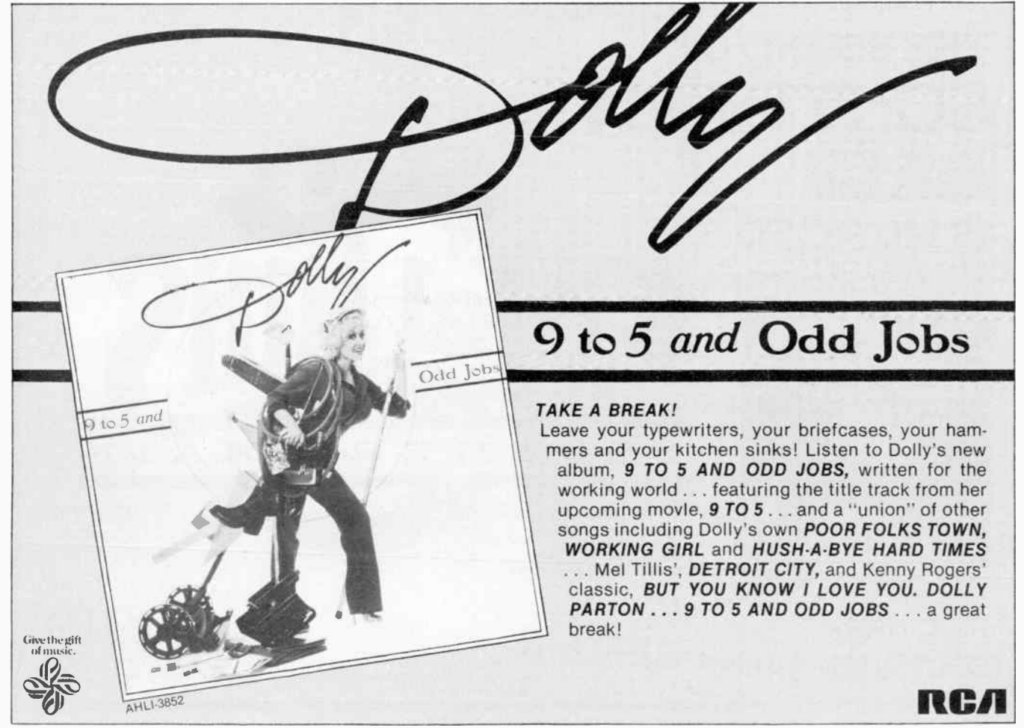
RCA Records, Parton’s label since her earliest days in Nashville, sent the single to pop, country, and adult contemporary radio simultaneously. Billboard reported a nationwide push combining both RCA’s country and pop divisions, with radio contests offering listeners promotional items including “9 to 5” coffee mugs, clock radios, and coffee pots, in-store displays, and 60-second spots saturating the country. Dave Wheeler, RCA’s Nashville director of marketing services, confirmed that 10,000 display pieces had been manufactured for retail placement nationwide. A “secretaries contest” offered membership in an official “9 to 5 Club,” with benefits including a limousine to and from work for the day and a paid vacation from the office.
Joe Galante, RCA’s Nashville division vice president of marketing, told Cash Box the campaign was running at a “feverish pace” and called it “one of the biggest of the year for the Nashville division, and perhaps in the long run for RCA Records overall.”
Parton was booked across the full television circuit: “20/20,” Merv Griffin, Mike Douglas, Phil Donahue, “Barbara Mandrell and the Mandrell Sisters,” and two appearances within the month on “The Tonight Show.” The label’s strategy was to leave no format unclaimed.
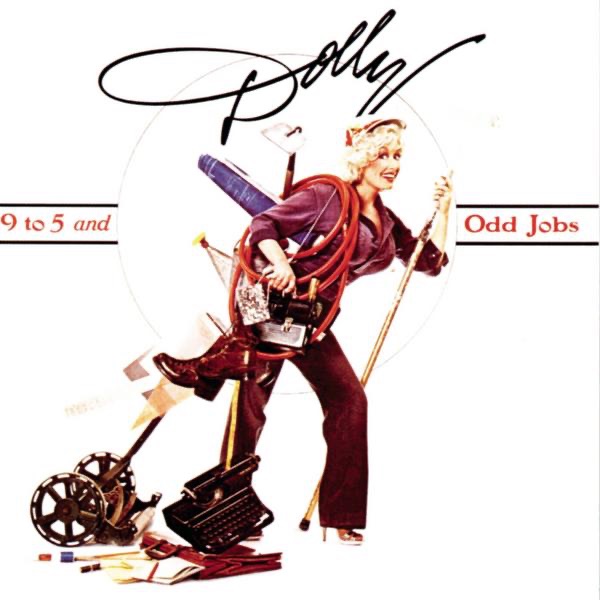
In November 1980, RCA also released the album 9 to 5 and Odd Jobs. The record was not a film soundtrack. It was a full studio album built around a working-class concept. Billboard called it “a landmark for Parton,” representing “an ideal balance between her progressive pop and country talents.” Cash Box called it “a hymn to the working class” and declared Parton “country music’s first lady.”
On December 5, 1980, RCA Records hosted the Nashville premiere of 9 to 5 at the Roy Acuff Theatre at Opryland. More than 1,200 guests attended, including RCA president Bob Summer, nearly 100 deejays from across the country. Guests arriving for the evening screening punched tickets designed like time cards on a regulation time clock.
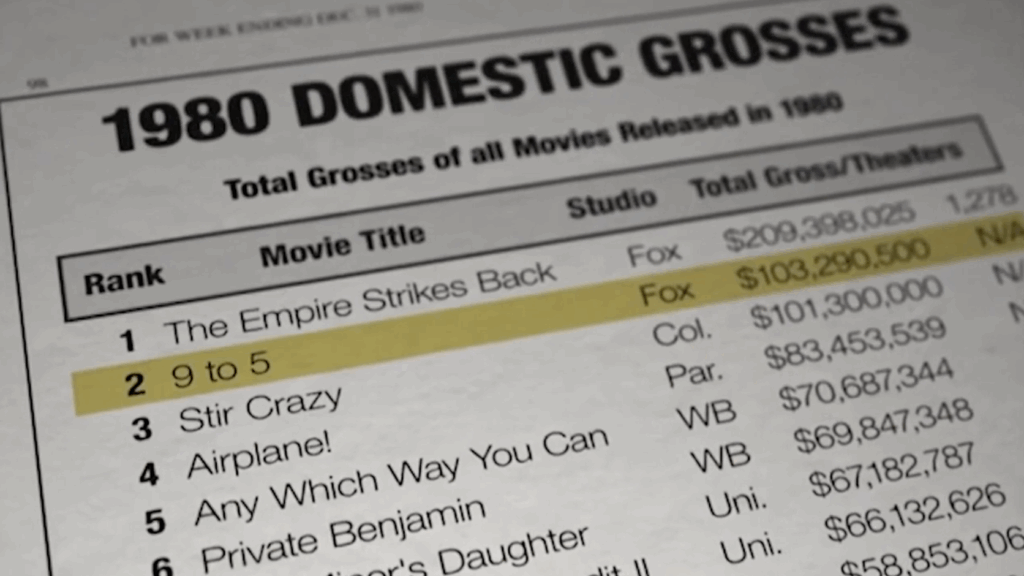
The film opened nationally on December 19, 1980, in more than 900 theatres. It earned approximately $103.3 million worldwide, making it the second highest-grossing film of 1980, behind only The Empire Strikes Back. One New York critic found fault not with the performances but with Parton’s wardrobe, claiming she wore enough polyester to make a small parachute. Parton had predicted the film probably would not win any awards. She was right on that count, with one exception: “9 to 5” received the film’s only Academy Award nomination, for Best Original Song, and the screenplay earned a Writers Guild of America nomination for Best Comedy Written Directly for the Screen.
“The film was huge. It was the greatest thing that could ever have happened to us. The film ended the debate over whether there was discrimination. At the beginning, we had to have conversations with people about whether there was discrimination. By the time the film had happened, that wasn’t true anymore. The question was, ‘Now, what do we do about it?’ I remember being on the bus one time after the movie came out, and I heard one woman saying, ‘So I said to him, “No, I will not make your coffee, I just saw 9 to 5,”‘” said Cassedy.
Lyrically: 9 to 5 by Dolly Parton
“It just popped in my head one day, and it was when we did our first scene. I was writing this song. We were waiting in the Xerox room the first time we were together,” said Parton.
Nussbaum, who had spent years organizing the women the song was written about, heard it and identified its architecture immediately. “I love how the song begins with pride — ‘Pour yourself a cup of ambition,'” she said. “And then it goes to grievances — barely getting by, they always take the credit. It then goes to class conflict — you’re just a step on the boss man’s ladder. And then it ends with collective power — you’re in the same boat with a lot of your friends. So in the space of this wildly popular song with a great beat, Dolly Parton just puts it all together, all by herself.”
Tumble out of bed
And stumble to the kitchen
Pour myself a cup of ambition
And yawn and stretch and try to come to life
Jump in the shower
And the blood starts pumpin′
Out on the streets, the traffic starts jumpin’
For folks like me on the job from 9 to 5
The opening is physical and establishes the morning routine of the working-class: tumbling, stumbling, pouring, yawning, stretching.
The song begins in the body, then moves to the mind and then to the system.
Workin′ 9 to 5
What a way to make a livin’
Barely gettin’ by
It′s all takin′ and no givin’
They just use your mind
And they never give you credit
It′s enough to drive you
Crazy if you let it
The chorus identifies what the body has been doing all morning. The mind is an asset and is being used but not credited. This frustration is not a complaint about one bad boss but a description of how the workplace operates. The final two lines give the worker a choice: this situation has the power to break you, but only if you allow it.
9 to 5
For service and devotion
You would think that I
Would deserve a fat promotion
Want to move ahead
But the boss won’t seem to let me
I swear sometimes that man is
Out to get me, hmmm
These verses are personal and immediate. Fonda had spent months meeting with 9to5 members before production began. The first person in the lyrics is not a fictional character. The worker has given service and devotion and expects recognition. The boss blocks it and the frustration slips into paranoia: “that man is out to get me.” The individual is up against a specific person in a specific office.
They let you dream
Just a watch ′em shatter
You’re just a step on the boss man′s ladder
But you got dreams he’ll never take away
The third verse suggests the worker is just a step on the corporate ladder for the boss to use. The final line is the turn: the system has limits. It can block advancement. It cannot reach their dreams.
In the same boat with a lot of your friends
Waitin’ for the day your ship′ll come in
And the tide′s gonna turn
And it’s all gonna roll you away
The fourth verse is where the collective power lands. A shift from “I” to “your friends” builds momentum. One voice becomes many.
Yeah, they got you were they want you
There′s a better life
And you think about it, don′t you?
The verse acknowledges the trap and then opens a door. The final line turns to the listener directly. The verse speaks the way the newsletter did: it names what you already know and asks you to confirm it.
It’s a rich man′s game
No matter what they call it
And you spend your life
Putting money in his wallet
The final verse names who benefits from the system. The worker spends a life filling someone else’s wallet. The cycle continues until it is disrupted. Fonda, Tomlin, Nussbaum, Cassedy, and Parton did this. Collectively, the tide turned.
“9 to 5” reached number one on the country charts in February 1981 and also topped both the pop and adult contemporary charts. Billboard had seen it coming. The November single review predicted spillover activity across every format. It earned four Grammy nominations and won two: Best Country Song and Best Country Vocal Performance, Female.
“We didn’t know that 9 to 5 was going to be a box office smash, we didn’t know it was going to become an iconic movie that was probably the most successful political movie ever made. And we certainly didn’t have any idea of how the song would become an anthem for the entire women’s movement,” said Nussbaum.
Parton herself maintained careful distance from that framing throughout production. “I still take the music part of my life more seriously than I’ll ever take movies,” she told Country Music magazine in November 1980. “I’m just using them as another outlet.” She wrote the song because she was on a film set with time on her hands and nothing to play. The movement adopted it.


What does this song mean to you?
Share your thoughts on this song.