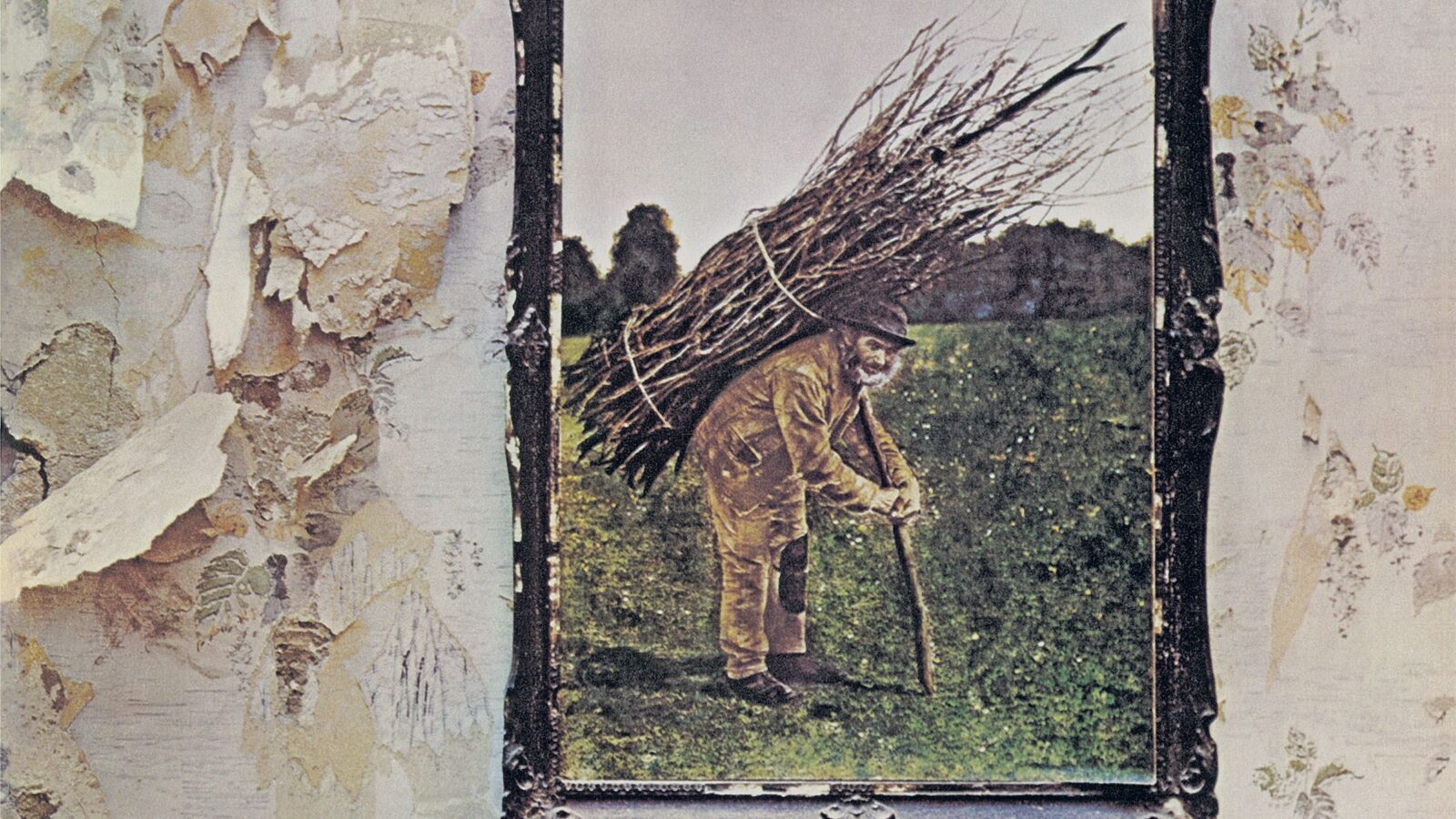
New York City. October 1971. A month before release, Atlantic Records told the trade press what buyers would find. Or rather, what they wouldn’t. No band name on the jacket. No title. Nothing on the spine. The label’s own vice president admitted to Billboard that there was “nothing on the jacket, not even on the spine, to give a clue to the product.” Just four symbols, one chosen by each member of Led Zeppelin, on the shrink wrap.
Then Atlantic asked for a single to carry it onto the radio. “We told them to forget it,” said guitarist Jimmy Page.
So on November 8, 1971, the record arrived with no words on it. Not the band’s name, not a title, nothing on the spine. Just a photograph of a man bent under a load of sticks, hung on a peeling wall. But open it, and on the inner sleeve, handwritten in script on what looks like aged parchment, are the full lyrics to a single song. Eight minutes long. A treatment no other track on the album received.
This is the story of “Stairway to Heaven.”
“Stairway to Heaven” is poetic, musically and lyrically, and approximately eight minutes in duration. It’s a new song every time you hear it.
This song opens up as soon as it starts, with the wind blowing like a whisper until it absolutely doesn’t. Jimmy Page enters tranquil on the guitar, and John Paul Jones drifts in on the recorder. Then lead singer Robert Plant starts revealing the story around the 53-second mark, which is when I begin to wonder, just as the lyrics say.
I always want to start over and understand what’s happening in this folklore. But I respect the art, continue to listen until the end, then play it again, only to be lost in thought until John Bonham’s drums arrive near the halfway mark. This is when the walking ends and running on the path begins.
“Bloody hell, this is earth-shattering”
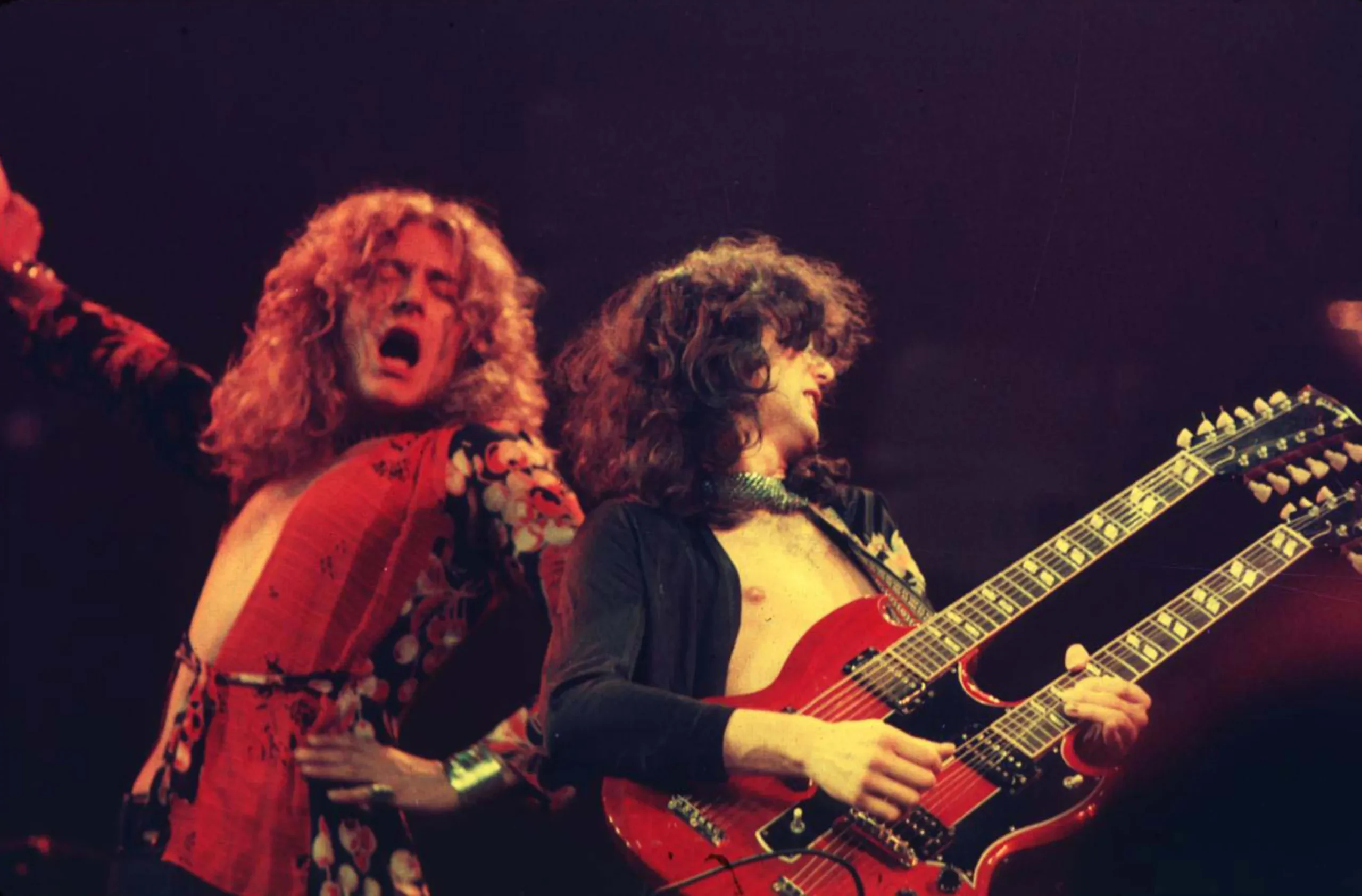
Led Zeppelin formed in 1968 around founder and lead guitarist Jimmy Page. Robert Plant sang lead vocals, John Paul Jones played bass and keyboards, and John Bonham held down the drums.
By 1970 they had three albums out, all of them gold, and a reputation as one of the biggest live draws in the world. But when Led Zeppelin III arrived that October, mainly acoustic sounds brought mixed reviews. The reaction stung. Page’s answer was to give the critics nothing to hold onto. The next album would have no title and no band name, just four symbols, one chosen by each member, and let the music speak for itself.
They recorded it in late 1970 and early 1971, most of it at Headley Grange, a Victorian house in Hampshire where the Rolling Stones’ mobile studio sat parked in the driveway. It was in that house, sitting on the floor with his back against the wall, that Plant wrote the words to “Stairway to Heaven.”
After the album was completed, one night in the autumn of 1971, Bonham was at a Trapeze show in Birmingham. He was friends with Glenn Hughes, Trapeze’s bassist. Bonham was in the crowd, jumped on stage, and started playing with the band. After the show, Bonham suggested they carry the party back to his house.
“It’s about three or four in the morning,” Hughes recalled, “and he says: ‘I want to play you something. It hasn’t been released yet, it’s an acetate of the fourth Led Zeppelin album, it hasn’t been mastered yet.’ He plays me the entire record and it comes to Stairway to Heaven, and of course I’m only 19 years old, and I’m thinking: ‘Bloody hell, this is earth-shattering.'”
When the album reached the press in November, Melody Maker, reviewing the record the week of release, singled out the song by name: “To complete the goodies on side one is ‘Stairway To Heaven,’ one of the band’s best songs, and another splendid performance by Robert.”
“Stairway to Heaven” closes side one, the last song a listener hears before flipping the record, its lyrics waiting on the inner sleeve, asking you to join them.
Was the Piper holding the pen?
Page had been chasing this song for over a year. In April 1970, 18 months before the album came out, he told NME about an idea: “It sounds corny, but we’ve got something we want to try out but I don’t want to tell you about it in case it doesn’t come off. It’s an idea for a really long track on the next album… well, we want to try something new with the organ and acoustic guitar building up and building up to the electric thing. It will be probably a 15 minute track and I’m really looking forward to doing it. I can’t really tell you more about it in case it doesn’t work out. But I think it will.”
He got his long track, and the words came fast. Page watched it happen. “We’re running through it, and it’s taking a lot of concentration, but we’re getting the movement in and the sections are really starting to gel,” he recalled. “I remember vividly Robert was sitting on the floor, back against the wall, writing, while this was going on. We had another couple of run-throughs and then he walks over and he starts singing along. From my recollection he had a good 90% of it then.”
“He said it was like someone was guiding his hand,” Page added.
Plant remembers it the same way. “I was holding a pencil and paper, and for some reason I was in a very bad mood,” he recalled. “Then all of a sudden my hand was writing out the words, ‘There’s a lady who’s sure all that glitters is gold / And she’s buying a stairway to heaven…’ I just sat there and looked at the words and then I almost leapt out of my seat.”
The imagery came from his reading. He’d been going through Lewis Spence’s The Magic Arts in Celtic Britain, a study of old Celtic folklore, and later cited it as one source for the song. “My contribution was to write lyrics and to sing a song about fate and something very British, almost abstract,” he said.
The song reached a stage before it reached a store. Its first public performance came on March 5, 1971, at Ulster Hall in Belfast, eight months before the album was released. The crowd, waiting on songs they already knew, didn’t know what to make of it. John Paul Jones remembered them “bored to tears,” though by the last chord they were applauding and cheering. This was also the first public performance of Black Dog, Going to California, and Rock and Roll.
Lyrically: Stairway to Heaven by Led Zeppelin
The opening verse is magical, transportive, and takes you toward the one place people really want to experience, which is Heaven, and whatever and wherever that is to you.
There’s a lady who’s sure all that glitters is gold
And she’s buying a stairway to Heaven
When she gets there she knows if the stores are all closed
With a word she can get what she came for
Ooh-ooh, ooh-ooh, and she’s buying a stairway to Heaven
Whoever this lady is, she has confidence and power, along with the ability to get whatever she wants with a single word, even if the stores are closed. In this case, the glittery facade of happiness that materialism brings.
Plant said the opening lyrics were “some cynical aside about a woman getting everything she wanted all the time without giving back any thought or consideration. The first line begins with that cynical sweep of the hand… and it softened up after that.”
There’s a sign on the wall, but she wants to be sure
‘Cause you know sometimes words have two meanings
In a tree by the brook, there’s a songbird who sings
Sometimes all of our thoughts are misgiven
The emotional shift happens quickly. Despite having everything, doubt creeps in with that sign on the wall. What does it say? It makes me wonder. Then comes the sage wisdom: sometimes words have two meanings. A choice must be made to move forward.
“Sometimes all of our thoughts are misgiven” resonates. We question, we doubt, we worry about outcomes that may never come. That’s the tension within “Stairway to Heaven.” It keeps you wondering. Then, just before you get too deep, an image of hope arrives during uncertainty: a songbird in a tree by the brook, a feeling that something is with you, guiding you along the way.
Ooh, it makes me wonder
Ooh, makes me wonder
There’s a feeling I get when I look to the West
And my spirit is crying for leaving
The inner voice arrives. “There’s a feeling I get when I look to the West.” “My spirit is crying for leaving” is a pull toward something more, and the West has long stood for new beginnings.
In my thoughts I have seen rings of smoke through the trees
And the voices of those who stand looking
Something is starting, momentum is building. Others are waiting there, calling to join them on this journey.
Ooh, it makes me wonder
Ooh, really makes me wonder
The tension builds again. Plant himself is still wondering, stating: “Depending on what day it is, I still interpret the song a different way, and I wrote it.”
And it’s whispered that soon if we all call the tune
Then the piper will lead us to reason
The awakening. A reverse on “he who pays the piper calls the tune.” The piper, a mythological or spiritual guide, will lead us to reason, but only if we call the tune. The “tune” is the understanding that material pursuits do not lead to lasting happiness.
And a new day will dawn for those who stand long
And the forests will echo with laughter
This journey requires patience and discipline. Stand long enough and the reward comes: a new day to experience. Those forests where uncertainty once gathered now echo with joy.
If there’s a bustle in your hedgerow, don’t be alarmed now
It’s just a spring clean for the May queen
A hedgerow is “a strip of densely planted trees, shrubs and other plants forming a border,” common in Britain. The “bustle in your hedgerow” may represent the transition between the old self and new self. “Don’t be alarmed now” is a reminder not to be stressed, just continue to call the tune.
“It’s just a spring clean for the May queen” points to renewal and a fresh start. The May Queen is a symbol of spring, appearing on the May Day holiday on May 1st in many countries, particularly in Europe. She was a young woman chosen by a village to represent the hopes and potential for the coming year. The “spring clean” is preparation for her arrival, clearing away the old to welcome the new.
May 1st is roughly the halfway point between spring and summer, symbolizing the time when nature is in full bloom. The May Queen arrives at the halfway point of the song. Then Bonham, who has waited the whole way, comes in on the drums and the piece shifts.
Yes, there are two paths you can go by, but in the long run
There’s still time to change the road you’re on
The long run demands self-discipline and patience. Regardless of your choices, you can always change the path you’re on.
Your head is humming, and it won’t go, in case you don’t know
The piper’s calling you to join him
There’s a recurring thought that won’t leave you alone. “The piper’s calling you to join him” is the reminder that when purpose fades and doubt sets in, the guidance is still there to lead you back to reason.
Dear lady, can you hear the wind blow? And did you know
Your stairway lies on the whispering wind?
Heaven can’t be bought. Her stairway to it comes through listening and acting on reasoned guidance, not through materialism. And now the wind returns. The song opened on it, a whisper before anything else, and here it is again, carrying her stairway. The wind is everything materialism is not. It can’t be bought, held, or owned. It’s ever present. But the stairway she’s buying is built on nothing she can stand on.
The crescendo
The music and Plant’s vocals elevate, almost drilling the message into you:
And as we wind on down the road
Our shadows taller than our soul
There walks a lady we all know
Who shines white light and wants to show
How everything still turns to gold
And if you listen very hard
The tune will come to you at last
When all are one, and one is all
To be a rock and not to roll
As we wind down the road of combined decisions and outcomes, “Our shadows taller than our soul” reveals how our past experiences cast a heavy influence over us. Shadows linger and pull us back, even when we’re trying to move forward.
Then the familiar lady reappears, shining white light from all the materialism she’s accumulated, showing off to anyone who passes.
But there’s another way. Listen hard enough and the tune will arrive when we come together, “When all are one, and one is all.” Stand strong, side by side. Don’t roll ahead in self-interest searching for the next shiny thing. “To be a rock and not to roll.”
Then the final line: “And she’s buying a stairway to Heaven.” She’s still on the same path, chasing gold. Forever on repeat, never arriving.
Everything, once
Page has always talked about the song in almost physical terms. “This one plays with you more,” he said. “It plays with your emotions, entices you in. Stairway’s almost seductive.” Of the ending, he put it plainly: “It’s like an orgasm at the end. It’s whatever you want it to be.”
Plant felt the same about how open it was, stating, “‘Stairway’… was something that had been really crafted. The lyrics were fantastic. The wonderful thing is that, even with the lyrics in front of you, you know how you listen to something, and you might not quite get what the words are but you get your own impression? With this, the lyrics were there but you still got your own.”
That was the point of printing them. The lyrics to “Stairway to Heaven” were the first ever reproduced on a Led Zeppelin sleeve, the band said, “so that people could really concentrate on it.”
The bet paid off fast. Atlantic certified the album gold on November 20, 1971, twelve days after release, the fourth Led Zeppelin album to go gold.
Atlantic got its single eventually too: in December it issued “Black Dog,” cut down from the album version. But the record had already gone gold without one, and the song the band singled out was never sold as a single at all. “Stairway to Heaven” reached its audience the way Page wanted, through the album.
Led Zeppelin was inducted into the Rock and Roll Hall of Fame in 1995. “Stairway to Heaven” was inducted into the Grammy Hall of Fame in 2003.
On December 10, 2007, at the O2 Arena in London, Page, Plant, and Jones, alongside John Bonham’s son Jason, played a benefit concert in memory of Ahmet Ertegun, co-founder of Atlantic Records, the label that had backed the band from the beginning. At the end of the song, the audience stood in awe, and Plant looked up and out of the arena and said: “Hey Ahmet, we did it!”
It makes me wonder. What is this “it?”


What does this song mean to you?
Share your thoughts on this song.