Monday, November 7, 1966. London. A basement gallery off Mason’s Yard.
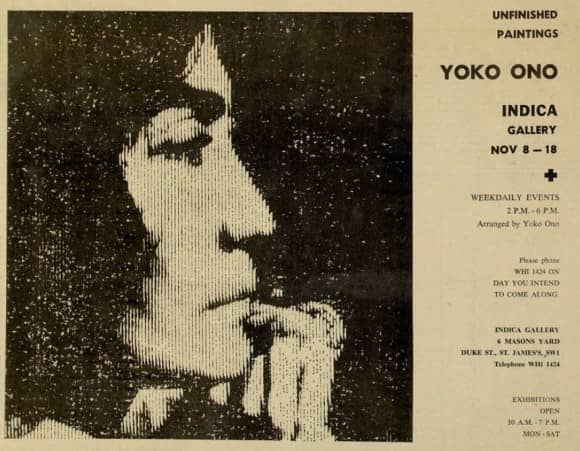
John Lennon is twenty-six years old, the de facto leader of the most famous band on Earth, and has arrived alone at the Indica Gallery. His friend John Dunbar, who co-owns the gallery, said something unusual was happening. A Japanese artist named Yoko Ono is previewing her show, Unfinished Paintings and Objects. Lennon came to have a look.
He walks in. A couple of art students are lying around, helping set up. Not a head turns.
There is a fresh apple on a stand. Two hundred pounds to watch it decompose. Then he sees the ladder.
It stands near the door, leading up to a painting fixed to the ceiling. A chain hangs from it. At the end of the chain, a spyglass. He climbs, holds the glass up, and finds a single word painted in tiny letters: YES.
He comes down. The word stays with him.
Dunbar insists Ono go talk to him. She does not know who he is. He does not know who she is. She walks over and hands him a small card. It says: Breathe.
He looks at it. Then at her. Then he breathes.
Lennon spots another piece nearby. A board. A hammer. A card that reads: Hammer a nail in.
He turns to her. “Can I hammer a nail in?”
She says no. The show does not open until tomorrow.
Dunbar intervenes. He tells her the man asking is worth listening to. He’s a millionaire, Dunbar says. He might buy it. She considers it. Then she makes him an offer: five shillings for the nail.
Lennon looks at her. “I’ll give you an imaginary five shillings,” he says, “and hammer an imaginary nail in.”
She gets it immediately.
“That’s when we really met,” Lennon would later say. “That’s when we locked eyes and she got it and I got it and that was it.”
He does not understand yet what it means that he came here tonight. He will not understand it for five more years, when he is sitting at a piano in the master bedroom of an English country estate, writing the song that will follow him for the rest of his life.
By 1966, John Lennon had seen the world. He just did not know yet what he wanted to say about it.
John Lennon was born October 9, 1940, in Liverpool. His parents separated when he was five, and he was raised by his Aunt Mimi. His mother Julia lived nearby and visited often. It was Julia who introduced him to music. She played records, taught him songs by Elvis Presley, Fats Domino, Buddy Holly, and Little Richard, and showed him how to play the banjo. When Lennon was sixteen, she walked him into the local music store, Frank Hessy’s, and bought him his first guitar for £17.
The following year, Julia was struck and killed while crossing a road near Mimi’s house. Lennon was seventeen. His mother helped him find music and now she was gone. The loss would stay with him.
“When I was a kid, I was a fan of Elvis Presley and Little Richard and Chuck Berry. I was just interested in the music and how to do it. How can I do that? And I studied the records. What are they saying? How are they doing it? How do they make this music? What is it that they’re doing that excites me that I want to do it?” said Lennon.
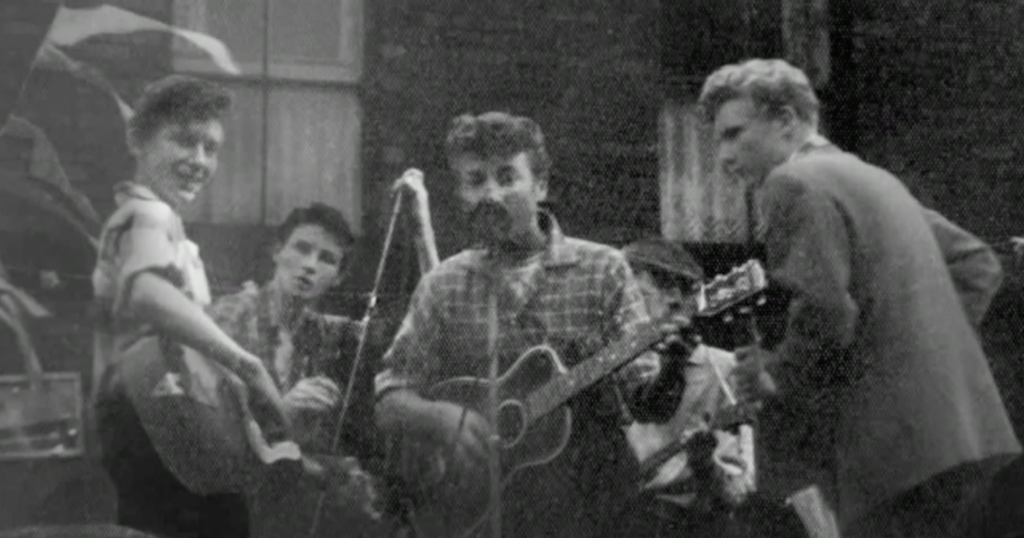
That same year, Lennon formed a group with his schoolmates from Quarry Bank High School called The Quarrymen. On July 6, 1957, they played a summer fair at St. Peter’s Church in Woolton, first in the afternoon sun, then inside the hall.
A fifteen-year-old named Paul McCartney was there. His schoolmate Ivan Vaughan had brought him along. McCartney watched from the crowd as Lennon held the audience, making up lyrics to songs he barely remembered.
Backstage, Vaughan made the introduction. McCartney asked for a go on Lennon’s guitar. He showed Lennon how to tune it properly, flipped it upside down to play left-handed, and delivered Eddie Cochran’s “Twenty Flight Rock” word perfect from memory. Then he sat down at the hall piano and played Jerry Lee Lewis.
Lennon was sixteen and the undisputed leader of his group. He recognized immediately that McCartney was good, possibly better than him. “Was it better to have a guy who was better than the people I had in, obviously, or not?” Lennon would later say. “And that decision was to let Paul in to make the group stronger. And I turned around to him right then on the first meeting and said, ‘Do you want to join the group?; And I think he said yes the next day.”
“Now George came to Paul,” said Lennon. “I said, well, I’ve got this friend who’s really good, you know.” McCartney arranged a tryout on the top deck of a late night bus, empty except for the three of them. “He said, ‘go on, George, get your guitar out,'” McCartney recalled. “And he got it out. Sure enough, note perfect. Raunchy. You’re in.”
George Harrison was fourteen years old.
For two years, with a rotating cast of musicians around them, Lennon, McCartney and Harrison played wherever they could, still figuring out their sound. They left skiffle behind for rock and roll. Toward Buddy Holly, Chuck Berry, Little Richard, and Elvis.
Lennon and McCartney began writing their own songs together. “Instead of going to school, I’d go down to his place,” Lennon recalled. “He had a piano, and if I’d started something, or he’d started something, we’d say, ‘Here, I’ve got this,’ and he’d say, ‘I’ve got this,’ and we’d start helping each other write our own songs like that. So any combination of the two of us writing, that’s how we wrote.”
In early 1960, Lennon’s art school friend Stuart Sutcliffe joined on bass, having just sold a painting and bought himself an instrument he barely knew how to play.
Lennon wrote about it the only way he knew how. “On discovering a fourth little even littler man called Stuart Sutcliffe running about them they said, quote ‘Sonny get a bass guitar and you will be alright’ and he did — but he wasn’t alright because he couldn’t play it. So they sat on him with comfort ’til he could play,” Lennon wrote in the first issue of Mersey Beat in July 1961.
The band name kept changing too. The Quarrymen became Johnny and the Moondogs, then the Silver Beetles, then the Silver Beatles. “John and Stuart had this flat in a place called Gambier Terrace, right near the Liverpool Institute, the College of Art,” Harrison recalled. “And I remember one day they came up. John was all excited, saying, ‘Oh, I’ve thought of this name, The Beatles.'”
“I was looking for a name like the Crickets that meant two things,” Lennon said, “and from Crickets I got to Beatles. When you said it, people thought of crawly things, and when you read it, it was beat music.”
Lennon explained in Mersey Beat: “It came in a vision. A man appeared on a flaming pie and said unto them ‘From this day on you are Beatles with an A’. Thank you, Mister Man, they said, thanking him.”
The Beatles played local halls, parish clubs, and the occasional dance. Hamburg came next, arranged by a Liverpool club owner and the Beatles’ first manager, Allan Williams. Lennon explained it with characteristic economy in Mersey Beat: “A man with a beard cut off said — will you go to Germany and play mighty rock for the peasants for money? And we said we would play mighty anything for money.”
Before they could go, they needed a drummer. “We grew one in West Derby in a club called Some Casbah,” Lennon wrote, “and his trouble was Pete Best.”
Hamburg changed everything. “We had to play all the tunes for hours and hours on end. Every song lasted 20 minutes and had 20 solos in it. We’d be playing about 8 or 10 hours a night. And that’s what improved the playing,” Lennon said. “We thought we were the best in Hamburg and Liverpool before anybody else had heard us. We thought we were the best. Just a matter of time before everybody else caught on. And believing that is what made us what we were.”
Hamburg made them. But not all of them made it back. The Beatles were deported in late 1960 after Harrison was found to be underage and McCartney and Best were accused of setting fire to a condom in their lodgings. Sutcliffe stayed behind in Hamburg. He had fallen in love with a German photographer named Astrid Kirchherr and wanted to paint. He died in Hamburg in April 1962, aged twenty-one, before the Beatles ever made a record.
Back in Liverpool the Beatles began a residency at the Cavern Club, where a local record store manager named Brian Epstein walked in one afternoon and could not believe what he was hearing.
“I was amazed by this sort of dark, smoky, dank atmosphere, this beat music playing away, and the Beatles were then just four lads on that rather dimly lit stage, somewhat ill-clad, and the presentation was, well, left a little to be desired as far as I was concerned because I’d been interested in the theatre and acting for a long time,” said Epstein. “But amongst all that, something tremendous came over, and I was immediately struck by their music, their beat, and their sense of humour, actually, on stage. And even afterwards, when I met them, I was struck again by their personal charm. And it was there that really it all started.”
“He wanted to manage us, and we weren’t going anywhere anyway, so we said yes, might as well,” Harrison recalled. “Straight away, he got us some jobs, got us a bit more money, and then started getting us radio shows and things like that. He talked us out of the leather suits.”
“Brian was a beautiful guy,” Lennon said. “An intuitive, theatrical guy, and he knew we had something and he presented us well. Brian contributed as much as us in the early days, although we were the talent and he was the hustler.”
Epstein believed in them enough to take them to London. On January 1, 1962, the Beatles auditioned for Decca Records, playing fifteen songs in a studio in West Hampstead. Decca passed. “Dick Rowe, the man who didn’t sign us, the head of Decca, he said, ‘Guitar groups are on the way out, Mr. Epstein,'” recalled Harrison.
Epstein kept trying, shopping their demo across London. He had found his way to Parlophone Records, a label under EMI. The producer assigned to them was George Martin, a classically trained musician known for comedy records who had never worked with a rock band. On June 6, 1962, the Beatles walked into Abbey Road Studios for an audition, and Martin heard something nobody at Decca had been willing to hear.
“Even though they had nothing really behind them, they were still fairly irreverent even in those days, which I loved,” Martin said. “I like a little bit of rebellion in people and I like their sense of humour. I think they had tremendous charisma.”
“We did a reasonable audition, not very good,” McCartney recalled. “But the thing he didn’t like was our drummer. We really started to think we needed the great drummer in Liverpool.”
On August 16, 1962, Epstein called Pete Best into his office and told him the band was moving on without him. Ringo Starr, who had been drumming for a Liverpool band called Rory Storm and the Hurricanes, got the call instead.
“It was a Wednesday and Brian called, would you join the band?” Starr recalled. “And I said, what do you mean? He said, no, really join the band. And I said, sure, yeah, when? And he said, now. And I said, no, I can’t do that. Because we’ve got these other four guys here that we’ve got a gig for months and I can’t just pull out now and it’ll all end. So I said, I’ll join you Saturday.”
“Ringo is a much better drummer and he can smile,” Martin said, “which is a bit more than Pete could do.”
They were ready. “We were performers in Liverpool, Hamburg, and on the dance halls, you know, and what we generated was fantastic. And there was nobody to touch us in Britain,” said Lennon.
“We never stopped anywhere. If we were in Elgin on a Thursday and we needed to be in like Portsmouth on Friday, you would just drive,” recalled Starr. “We didn’t know how to stop this band.”
“Love Me Do” was released on October 5, 1962. The singles came fast after that. “Please Please Me” in January 1963. “From Me to You” in April. “She Loves You” in August, which hit No. 1 in the UK within weeks.
Liverpool had become London. London was becoming everywhere.
“We were doing countries: we’d conquered Sweden, we’d conquered France, we conquered Spain and Italy; but we were worried about America,” said Starr.
Before the Beatles, the pop culture pipeline flowed one way, with Americans like Elvis Presley and Buddy Holly dominating the British charts.
Americans first experienced “a new sound” on November 18, 1963, a pre-taped report on NBC’s Huntley-Brinkley Report. “The hottest musical group in Great Britain today is the Beatles; that’s not a collection of insects, but a quartet of young men with pudding bowl haircuts,” said reporter Edwin Newman. “It’s anybody’s guess why the Beatles emerged from its cellar nightclubs to national prominence, but emerged they did.”
“Whenever the Beatles are to perform, great gangs of young people queue up for tickets. These children camped out all night to catch the opening of the box office. Those who study such things say that, at last, the British juvenile has someone immediate to identify with—not some distant American rock and roll hero,” said Newman.
No British act had ever taken over and conquered America for a sustained period of time. Cash Box said it plainly in January 1964: “The British sound didn’t fare very well in the States. A few vocal artists came through on rare occasions. Frank Ifield, Anthony Newley, and a few others clicked big in America. But they were exceptions rather than the rule.”
This shift was more than musical; it was a cultural takeover. An American reporter for the Cash Box recounted an “interesting story” from London where a performance of a Shakespearean play at the Old Vic was interrupted. When a lead actor said the words “she loves you,” a fan in the crowd couldn’t help but respond with a soft “yeah, yeah, yeah,” a phrase the reporter noted was being “heard throughout the deck.”
“As the Beatles’ ‘I Want to Hold Your Hand’ rocketed to No. 45 in the American hit parade this week, bids for the group to tour the States flooded into the office of their manager, Brian Epstein,” reported Melody Maker. “I have had a stack of offers for tours, one-night-stands, concerts and so on. I am not accepting any at present. This is principally because we haven’t got time, and also because I consider it better to concentrate on the American TV shows next month,” said Epstein.
The “new sound” had earned itself a name. The first time “Beatlemania” arrived on TVs in American households was another pre-taped report on CBS Morning News with Mike Wallace on November 22, 1963. “Beatleland, formerly known as Britain, where an epidemic called ‘Beatlemania’ has seized the teenage population, especially female,” said reporter Alexander Kendrick.
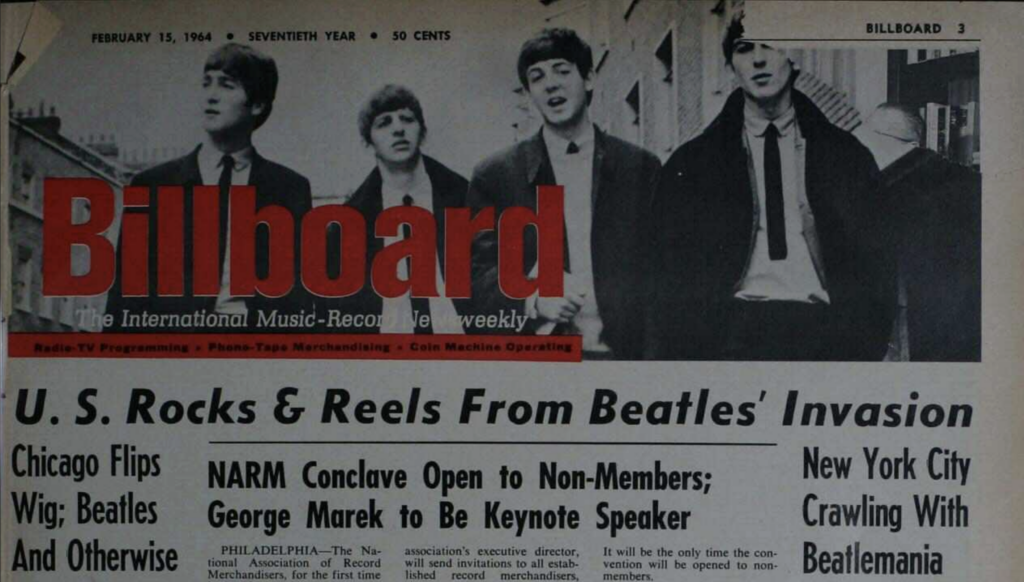
“Thousands of teenagers in every city and town stand in line all night to get tickets for their touring show. Girls faint when the tickets run out.”
During the same broadcast, reporter Josh Darsa interviewed the Beatles and asked if they “have any fears that your public eventually will get tired of you and move on to a new favourite?” Lennon responded, “They probably will, but you know. Depends how long it takes for them to get tired.” McCartney stated, “It’s stupid to worry about things like that because I mean, it could happen tomorrow and it could, you know, we could have quite a run. We just hope we are going to have quite a run.”
“The Beatles are said by sociologists to have a deeper meaning. Some say they are the authentic voice of the proletariat. Some say they are the authentic heart of Britain in revolt against the American cult of pop singers, represented by Elvis Presley and the long line of his British imitators,” said Kendrick. “Some say the Beatles represent authentic British youth, or British youth as it would like to be: self-confident, natural, direct, decent, vital, throbbing. The Beatles themselves seem to have no illusions. They symbolize the 20th-century non-hero as they make non-music, wear non-haircuts, and give non-mercy.”
The band held off on traveling to the United States until they had a hit there. American audiences got their first glimpse on January 3, 1964, when The Jack Paar Show aired a clip of the band performing “She Loves You” to a screaming crowd in Bournemouth.
“Now, we’ve never, in my seven years at NBC, ever on The Tonight Show, on this show, ever had a rock and roll act. But I’m interested in the Beatles as a psychological, sociological phenomenon. And I want to show them to you tonight,” said Paar. “I’d like to show you now, for the first time, what it looks like in an audience in England when the Beatles are about to perform. I understand science is working on a cure for this.”
Paar announced that the Beatles’ first live American performance would take place on The Ed Sullivan Show in February. “I do know that England has finally risen to our cultural level,” said Paar.
“I Want to Hold Your Hand” topped the American charts on January 25, 1964. Thirteen days later, on February 7, 1964, the Beatles landed at John F. Kennedy Airport to thousands of unhinged fans.
On February 9, 1964, over 50,000 requests flooded in for 728 seats in Studio 50.
The show went live at 8:00pm Eastern Time. “You know, something very nice happened, and the Beatles got a great kick out of it. We just received a wire, they did, from Elvis Presley and Colonel Tom Parker wishing them a tremendous success in our country,” said Ed Sullivan.
After a short introduction, approximately four minutes later, Sullivan swept his arm toward the stage curtains in a gesture that welcomed the “British Invasion” into American homes. “Now tonight, the whole country is waiting to hear England’s Beatles, and you’re gonna hear them, and they’re tremendous ambassadors of goodwill. Yesterday, and today, our theaters have been jammed with newspapermen and hundreds of photographers from all over the nation, and these veterans agree with me that the city never has witnessed the excitement stirred by these youngsters from Liverpool, who call themselves the Beatles,” said Sullivan. “Now tonight, you’re gonna twice be entertained by them, right now and again in the second half of our show. Ladies and gentlemen, the Beatles!”
Over seventy-three million Americans tuned in to watch the Beatles live on The Ed Sullivan Show, nearly forty percent of the population.
The reaction was immediate and divided. The New York Times sent a musicologist and a television critic to report what had happened. The musicologist concluded the Beatles displayed “a very, very slight touch of British countryside nostalgia, with a trace of Vaughan Williams.” The television critic noted that “the boys hardly did for daughter what Elvis Presley did for her older sister or Frank Sinatra for mother,” and dismissed the whole affair as “a fine mass placebo.” Columnist Paul Jones was less measured. “There is nothing attractive about the looks or the sounds of the Beatles,” he wrote two days later. “Shorn of their mop-like hair-dos they would look and sound like many other inferior rock ‘n’ roll groups.” A fifteen-year-old girl offered her truth: “We haven’t had an idol in a few years. The Beatles are different, and we have to get rid of our excess energy somehow.”
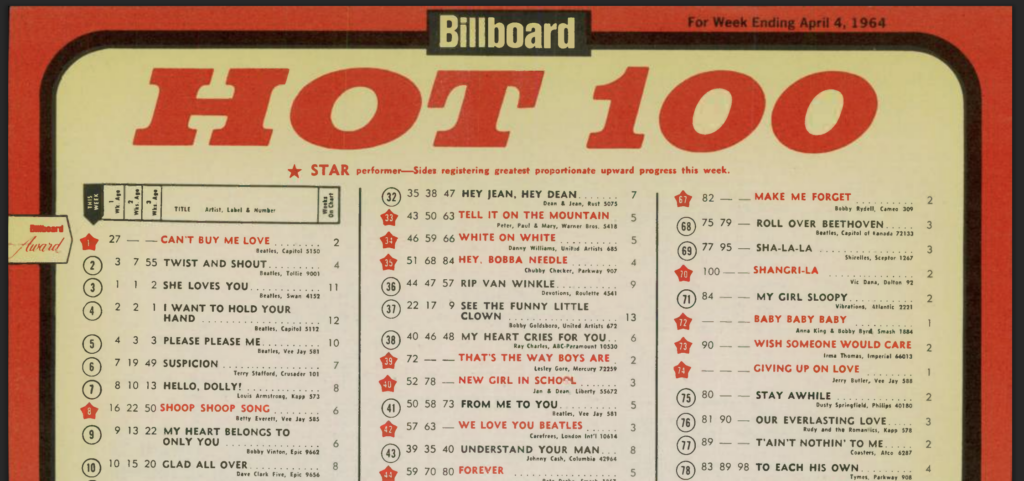
The Beatles dominated the music charts. By April 1964, Billboard was reporting that “just about everyone is tired of the Beatles. Disk jockeys are tired of playing the hit group, everyone,” the magazine noted, “except the listening and buying public.” That same week, the Beatles held the top five positions on the Billboard Hot 100 simultaneously. No artist had ever done it before. None has done it since. Their records were reported to be selling at a rate of 10,000 copies per hour.
Between 1964 and 1966, the Beatles responded to an unprecedented global demand that reshaped the entertainment industry. Their travels took them across the United States and Canada and throughout Europe, where they visited Italy, France, Spain, West Germany, the Netherlands, Denmark, Sweden, and Austria. “Beatlemania” reached Asia and Oceania, spanning Hong Kong, Australia, New Zealand, the Philippines, and Japan. Beyond the concert stage, the band filmed Help! in the Bahamas, and passed through Delhi, India.
By 1966 the Beatles were exhausted. Their music had taken them around the world and on every stage, in every city, the noise of the crowd had grown so loud that the four of them could no longer hear themselves play.
In March 1966, Lennon told journalist Maureen Cleave of the Evening Standard something that would follow him for the rest of the tour. “Christianity will go,” he said. “We’re more popular than Jesus now; I don’t know which will go first, rock ‘n’ roll or Christianity.” The comment went unnoticed in Britain. In America, reprinted four months later in a teen magazine just before their summer tour, it detonated. Radio stations banned their records. Churches burned their albums. Death threats arrived at every venue.
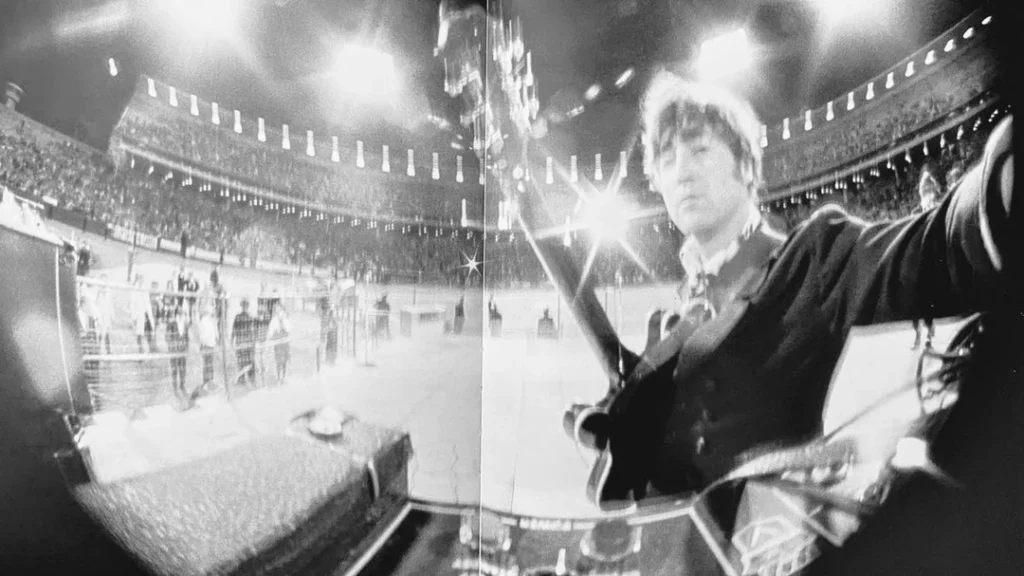
On August 29, 1966, the Beatles played their last touring concert. Candlestick Park, San Francisco. They knew before the final song that it was over. “Before one of the last numbers, we actually set up this camera, I think it had a fisheye, a wide-angle lens,” Harrison recalled. “We set it up on the amplifier and Ringo came off the drums, and we stood with our backs to the audience and posed for a photograph, because we knew that was the last show. There was a certain amount of relief.”
Epstein tried to manage the news carefully. “There’s no real question of the Beatles retiring,” he told Disc and Music Echo in October 1966. “Let’s face it, what is happening at the moment is that they’re simmering down. Making films, writing music, making records. That’s their future. Be sure the Beatles themselves like singing and playing to a public, but it’s become so difficult and so tense that their enjoyment and pleasure is taken away. Their future together really lies as far as the moon.”
The same article reported where each Beatle had gone: John Lennon in Spain filming his solo film debut in How I Won The War. George Harrison in Bombay, India, to study the sitar and explore Indian culture. Ringo and his wife Maureen on holiday in Spain. Paul McCartney in London.
On November 7, ten weeks after Candlestick Park, having seen the world, Lennon walked into the Indica Gallery off Mason’s Yard.
The long way to each other
Lennon left the Indica Gallery with two things on his mind. The word YES. And the woman who put it there.
He had frequented galleries during his days off, and most avant-garde shows he had seen in London had been designed to alienate their audience. Ono’s said something different. “It’s the first show I’ve been to that’s said something warm to me,” Lennon recalled. Ono understood this. “The rest of the avant-garde was trying to alienate the audience, trying to play mean and spiteful games in the world,” she said. “But I was trying to say ‘YES’. I was trying to communicate. I was trying to say ‘love’ and ‘peace’ and ‘yes’.”
The offer of the imaginary five shillings to hammer an imaginary nail had deeper meaning. “Her whole trip is this,” Lennon said: “‘Imagine this. Imagine that.'” Ono felt understood. “It was almost like a Zen meeting,” she recalled. “Oh, here’s a guy who’s playing the same game I’m playing. I was really shocked. Who is it?”
Speculation about a breakup had been circulating since Candlestick Park, but the band, meanwhile, went back to work. On November 24, 1966, they began recording what would become Sgt. Pepper’s Lonely Hearts Club Band. The shift from constant touring to dedicated studio time created space for the album to be completed over five months. This time also allowed for a transformation. The mop tops were gone. The matching suits were gone. In their place, four different men in psychedelic military uniforms.
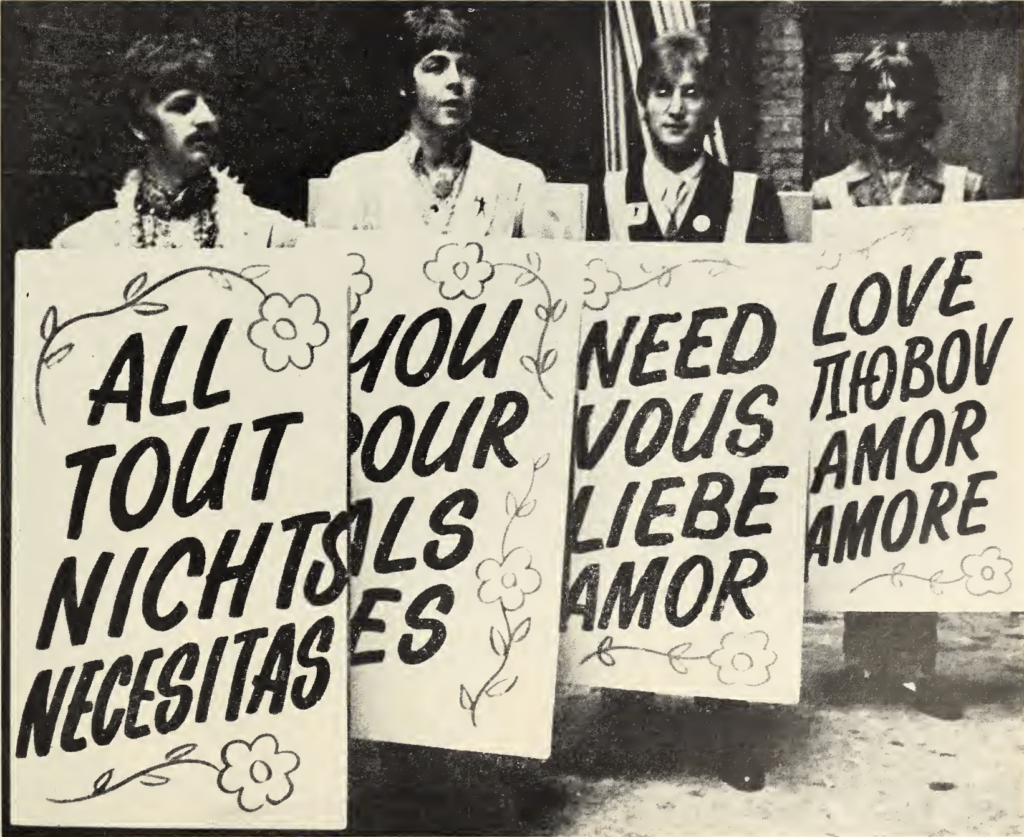
The album was released June 1. “All You Need Is Love” was showcased on Our World, the first live global satellite television broadcast, watched by an estimated 400 to 700 million people, the largest television audience in history at the time.
Lennon was at the centre of all of it. And he could not stop thinking about Yoko Ono. The two, while both married with children, maintained contact throughout 1967.
In September of that year, Ono sent Lennon a copy of her book, Grapefruit: A Book of Instructions and Drawings, which he kept by his bedside. The following month, Lennon provided funding for her Half a Wind exhibition at the Lisson Gallery.
“After I first met Yoko, I sort of blasted open in my head. She encouraged me to make films, make more far-out music, gallery exhibitions, make more of the art I was doing privately. Anything I was doing, she encouraged me to do it,” said Lennon.
“We’re both very shy, you know, so the next time we met was a Claes Oldenburg opening with a lot of, you know, like soft — what was it — objects, like cheeseburgers made out of rubber and garbage like that,” recalled Lennon. “And we met again then and sort of made eye contact.”
After manager and “Fifth Beatle” Brian Epstein’s death in August 1967, the Beatles traveled to India in February 1968 with their wives and partners to study Transcendental Meditation with Maharishi Mahesh Yogi.
Cynthia, Lennon’s wife, had hoped the trip would bring them closer. Things turned out to be the opposite. She stated, “John was becoming increasingly cold and aloof toward me. He would get up early and leave our room. He spoke to me very little, and after a week or two he announced that he wanted to move into a separate room to give himself more space. From then on, he virtually ignored me, both in private and in public.”
Lennon brought Ono with him in the only way he could. “I was thinking about her all the time in India,” he recalled. She wrote him letters. One read, “Look up at the sky and when you see a cloud think of me.” He visited the local post office every morning to look for them.
India was also extraordinarily productive for the band. “We wrote about thirty new songs between us. Paul must have done about a dozen. George says he’s got six, and I wrote fifteen,” said Lennon. Some would become part of the self-titled album commonly known as the White Album, including “Dear Prudence,” “Julia,” and “Revolution.”
Not everyone stayed. Ringo left on March 1 after only ten days, citing the spicy food and his wife Maureen’s fear of insects. Paul followed on March 24, having written new material but feeling the need to be back in London. Upon his return he held a press conference where he stated, “we are not suddenly going to become crusaders. We are going on making records and will just try to do what we can to help peace. If we started crusading, people would only say we were doing it for the money.”
Lennon and Harrison remained the longest until April 12, when they departed abruptly after allegations surfaced that the Maharishi had made sexual advances toward women in the group.
He came back to London with clarity.
“Imagine two cars of the same make heading towards each other and they’re gonna crash, head-on. Well, it’s like one of those scenes from a film — they’re doing 100 miles an hour, they both slam their brakes on and there’s smoke everywhere on the floor and they stop just in the nick of time with their bumpers almost touching but not quite. That’s what it was like from the first time I got to know her,” said Lennon. “Yoko and I were on the same wavelength right from the start, from that first night. I had to drop everything. I had no doubt I’d met ‘The One’. That first night convinced me.”
“I’d have to end my marriage to Cyn. There was nothing basically wrong with my marriage to Cyn. It was just like an amber light. It wasn’t on go and it wasn’t on stop. I suppose that me being away so much during the early years of our marriage, I never did feel like the average married man,” said Lennon.
“I always had this dream of meeting an artist woman I would fall in love with. Even from art school. And when we met and were talking I just realized that she knew everything I knew. And more, probably. And it was coming out of a woman’s head. It just sort of bowled me over. It was like finding gold or something. To have exactly the same relationship with any male you’d ever had, but also you could go to bed with it, and it could stroke your head when you felt tired or sick or depressed,” said Lennon. “So that’s why when people ask me for a precis of my story, I put, ‘Born, lived, met Yoko.’ Because that’s what it’s been about.”
“As she was talking to me, I would get high and the discussion would get to such a level that I would be going higher and higher and when she’d leave, I’d go back into this sort of suburbia. Then I’d meet her again and my head would go off like I was on an acid trip. I’d be going over what she’d said and it was incredible — some of the ideas and the way she was saying them. And then once I got a sniff of it, I was hooked. Then I couldn’t leave her alone. We couldn’t be apart for a minute from then on,” said Lennon.
In May 1968, while Cynthia was on holiday in Greece, Ono visited Lennon’s home in Surrey.
“When we got back from India, we were talking to each other on the phone. I called her over, it was the middle of the night and Cyn was away, and I thought, ‘Well, now’s the time if I’m going to get to know her any more.’ She came to the house and I didn’t know what to do; so we went upstairs to my studio and I played her all the tapes that I’d made, all this far-out stuff, some comedy stuff, and some electronic music. There were very few people I could play those tapes to. She was suitably impressed, and then she said, ‘Well, let’s make one ourselves,’ so we made Two Virgins. It was midnight when we finished, and then we made love at dawn. It was very beautiful,” said Lennon.
“When I fell in love with Yoko, I knew, my God, this is different from anything I’ve ever known,” Lennon said. “This is more than a hit record, more than gold, more than everything.”
On May 30, the Beatles began recording what would become the White Album. Lennon arrived with Yoko Ono. She sat beside him throughout every session, breaking the band’s unspoken rule that wives and partners stayed away. McCartney, Harrison, and Starr said nothing publicly. Everyone in the room understood that something had changed and there was no going back.
Lennon filed for divorce from Cynthia in June 1968, which was finalized later that year. Ono divorced her husband, Anthony Cox, in February 1969. Lennon and Ono married on March 20, 1969, in Gibraltar.
The Beatles performed together in public for the last time on January 30, 1969. They set up on the rooftop of the Apple Corps building in London and played for forty-two minutes until the Metropolitan Police shut it down. Passers-by stopped in the street below. It was unannounced. And then it was the end.
Get Back in bed
Shortly after their marriage, from March 25 to 31, 1969, Lennon and Ono staged their first bed-in protest at Amsterdam’s Hilton Hotel. They wore pajamas and sat in bed with signs saying “Hair Peace” and “Bed Peace” to protest the Vietnam War. The event drew media attention but was dismissed as a publicity stunt.
“The Beatles had turned me into a puppet. It was OK, but once we’d made it so big, the fun had gone and so had my own strength,” said Lennon. “But when I met her, I had to drop everything. It was ‘Goodbye to the boys in the band!’ I’ve had two partners in my life — Paul McCartney and Yoko. That’s not a bad record, is it?”
By this time, Lennon admitted he was no longer making conscious creative decisions, describing recording with the Beatles as a routine job.
“I wasn’t consciously making any decisions. It was all sort of subconscious, and I just made the records of the Beatles like one goes to one’s job at nine in the morning, you know. I mean, Paul or whoever would say it’s time to make a record. I’d just go in and make a record, you know, not think too much about it. Always sort of enjoy the session if it was a good session, you know. If we got our rocks off playing, it was fine. If it was a drag, it was a drag,” said Lennon. “But it was becoming, it’d become a job.”
Being a Beatle had become ordinary. Lennon found purpose.
With Ono, they staged a second Bed-In for Peace, this time in Montreal from May 26 to June 2, 1969, at the Queen Elizabeth Hotel. Journalists and guests were invited to their hotel suite to speak about peace and protest the ongoing Vietnam War. It was during this bed-in that Lennon recorded “Give Peace a Chance,” which became an anthem for the anti-war movement.
Lennon increasingly distanced himself from the Beatles. He was creatively unsatisfied and detached. On September 20, 1969, he told his bandmates he was leaving, saying he wanted a “divorce.” This marked the true end of the Beatles and the beginning of Lennon’s solo career.
McCartney said, “The point of it really was that John was making a new life with Yoko. John had always wanted to sort of break loose from society because, you know, he was brought up by his Aunt Mimi, who was quite repressive, so he was always looking to break loose.”
Removed from the pressures of Beatlemania and the band’s internal struggles, Lennon focused on creating music that reflected his vision of peace and social change.
Seven years
In early 1971, Lennon and Ono were living at Tittenhurst Park, their seventy-two acre estate in Ascot, England. One morning, in the master bedroom, Lennon sat down at a Steinway piano and wrote “Imagine.” Ono watched as he composed the melody, chord structure and almost all the lyrics, nearly completing the song in one brief writing session.
“The idea for a song like ‘Imagine’ came out of Yoko’s influence regardless of what the format of that song was. Half the way I’m thinking, musically, philosophically and every other way is her influence both as a woman and as an artist,” said Lennon.
“‘Imagine,'” Lennon said, “should be credited as a Lennon/Ono song because a lot of it, the lyric and the concept, came from Yoko. But in those days I was a bit more selfish, a bit more macho, and I sort of omitted to mention her contribution. But it was right out of Grapefruit, her book. There’s a whole pile of pieces about ‘imagine this’ and ‘imagine that.’ And give a credit now long overdue.”
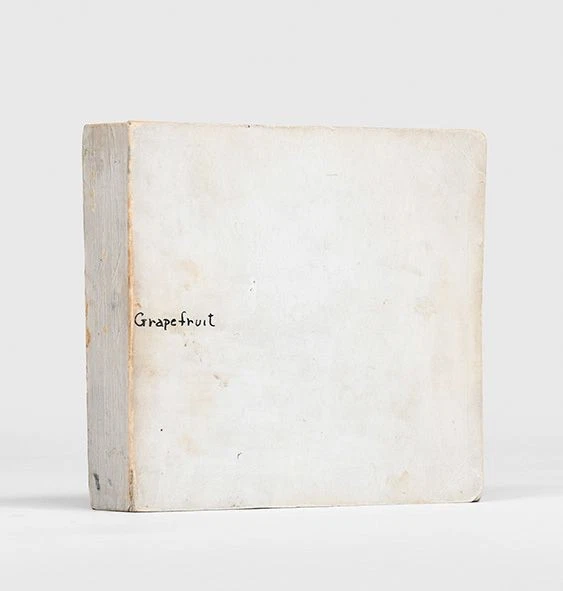
Grapefruit is an instructional book of living, written between 1952 and 1964 and originally self-published in Tokyo on July 4, 1964, then reissued by Simon and Schuster in 1970. “When I was about four years old, I had all these ideas,” said Ono. “Why don’t you just take one seed from a fruit and another seed from another fruit, and halve it and put it together and bury it? It might grow something really strange. And that’s the kind of thing that was going on from the beginning. I had decided that whenever I get an idea I have to show it to the world.”
Ono stated that “Grapefruit is a book of doing things. It’s not adjective or noun, but verb. That’s why it’s better than the Bible. To understand the pieces, you must do them. Even doing them in your mind is making a step part of the way along the road to better communication with yourself.”
“You see, we live and we die. In between that we eat and sleep and walk around,” said Ono. “But that’s not enough for us. We have to act out our madness in order to be sane.”
Lennon had been absorbing this philosophy since Ono sent him a copy of Grapefruit in September 1967 and he placed it beside his bed. Between 1968 and 1969 he and Ono released three experimental albums together, Unfinished Music No. 1: Two Virgins, Life with the Lions, and Wedding Album. His first proper solo studio album, John Lennon/Plastic Ono Band, arrived in December 1970. Billboard called it “self-determination music,” predicting it would “be as much analyzed as ‘Sgt. Pepper’ over the years.”
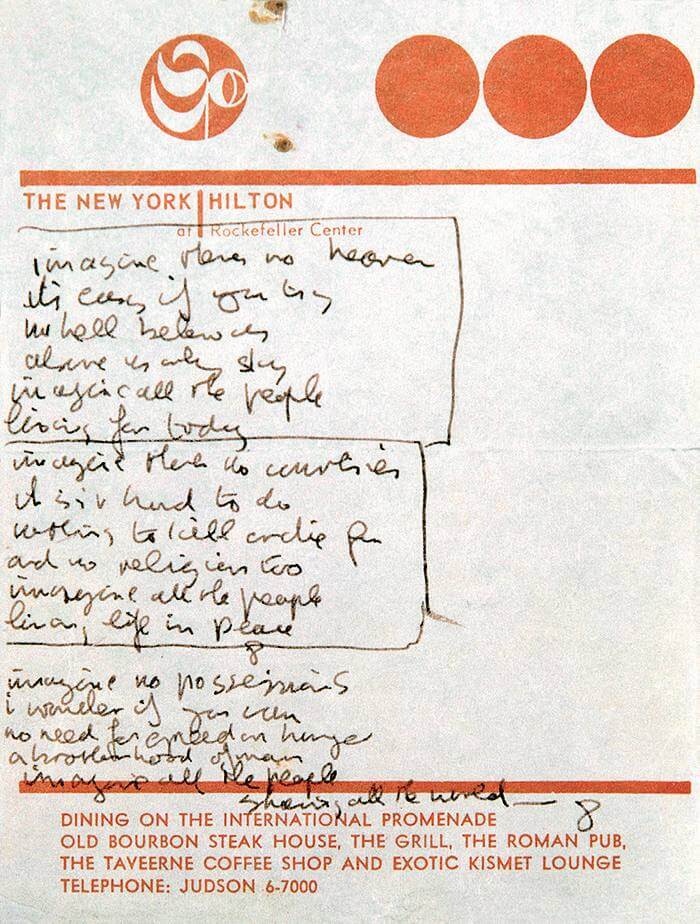
“The last album I made was very much the same as Yoko’s poetry,” Lennon said. “There weren’t many words to it. It was pretty simple and so is the one I’ve just made which is called ‘Imagine’.”
Lennon also acknowledged another source of inspiration: a Christian prayer book given to him in 1969 by entertainer and civil rights activist Dick Gregory. Lennon said it gave him a concept that helped shape “Imagine,” stating, “Dick Gregory gave Yoko and me a little kind of prayer book. It is in the Christian idiom, but you can apply it anywhere. It is the concept of positive prayer. If you want to get a car, get the car keys. Get it? Imagine is saying that. If you can imagine a world at peace, with no denominations of religion — not without religion but without this my-God-is-bigger-than-your-God thing — then it can be true.”
On Sunday, May 23, 1971, Lennon recorded a demo of “Imagine” at his home studio, Ascot Sound, at Tittenhurst Park. It was just his vocals and piano, captured in a single take. Four days later, on May 27, he recorded the master.
On July 4, 1971, the Flux Fiddlers, members of the New York Philharmonic, added orchestral strings at the Record Plant in New York, completing the song. It was exactly seven years to the day after the first edition of Grapefruit was published. The seed was planted in 1964, harvested in 1971.
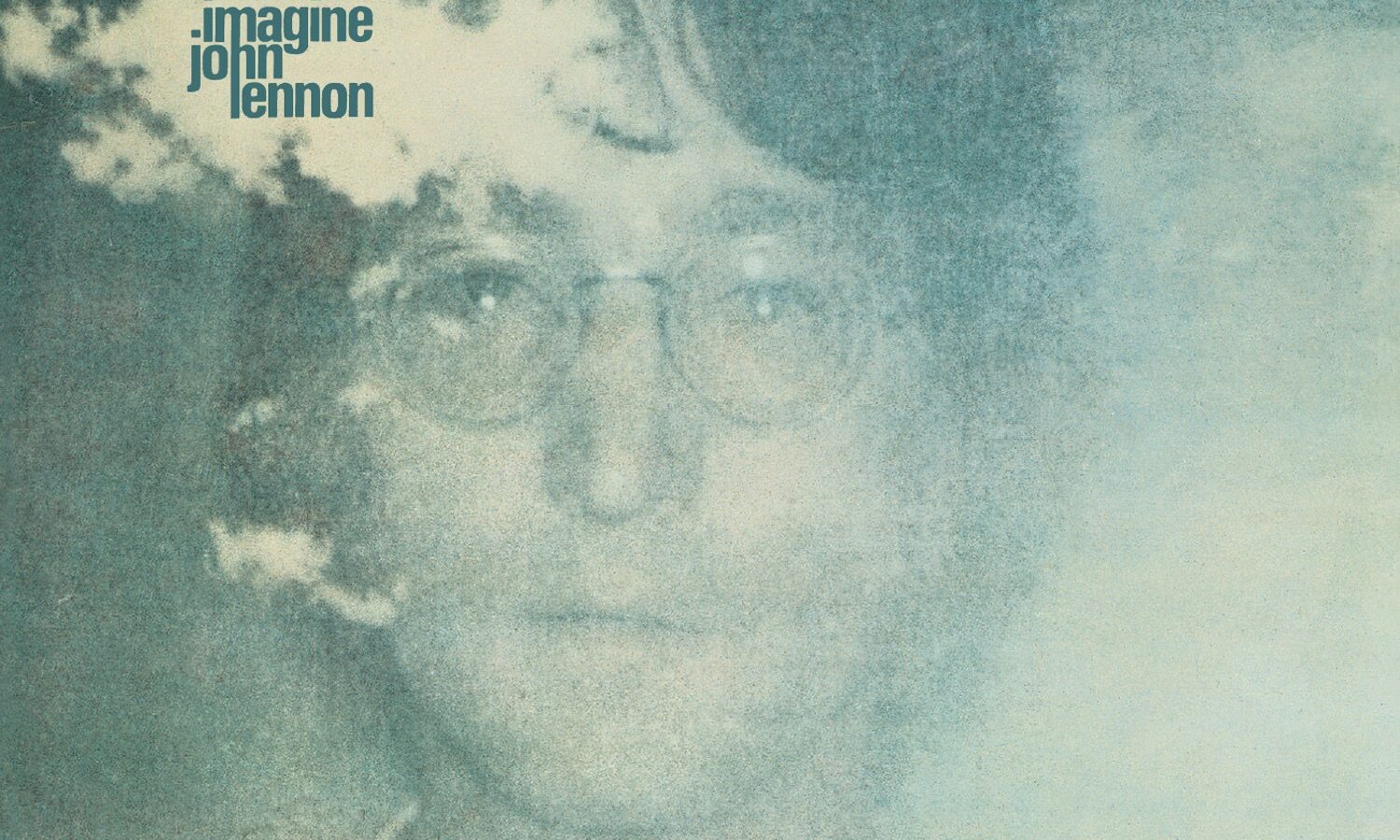
Imagine was released September 9, 1971 on Apple Records. It reached number one in the United Kingdom and peaked at number three on the Billboard Hot 100. In its September 11, 1971 review, Billboard called Lennon “the real British Dylan, chronicling his own personal search for self-expression with that of the times,” and closed with a single line of verdict: “Move over Sgt. Pepper.”
That same month, Cash Box praised what it called “the cruel genius that is Lennon’s alone,” noting the album is “precise and hard hitting.”
In a December 1971 Cash Box interview, Lennon described the album’s approach in plain terms: “The ‘Imagine’ album is the same story as the first one, but with sugar coating. The ‘Imagine’ song to me is like ‘Working Class Hero‘ with sugar on it.”
“Working Class Hero” shows the world as it is. “Imagine” asks what it could be.
Lyrically: Imagine by John Lennon
By 1971, John Lennon had seen more of the world than almost anyone alive. He had played stadiums on four continents and been present in rooms with heads of state. He had watched a cultural revolution happen partly because of music he helped make. Most people form opinions about the world from a distance. Lennon had spent a decade helping shape it.
“‘Imagine’ is a song conceived in my head without melody. The first verse came to me very quickly in the form of a childlike street chant ‘da da da da da dee dee, da dee da ee a eeeh.’ The piano intro I’ve had hanging around in my head for a few years — the chords and melody followed naturally from this,” said Lennon.
Imagine there’s no heaven
It’s easy if you try
No hell below us
Above us, only sky
The song opens with an invitation. To imagine, for a moment, a world without a destination based on deeds. No heaven as reward. No hell as punishment. Just the non-judgment of the sky. Open and above us. Shared by everyone.
These lyrics connect directly to Ono’s poem “Cloud Piece” from Grapefruit, which reads: “Imagine the clouds dripping. Dig a hole in your garden to put them in.”
Imagine all the people
Livin’ for today
Ah
No heaven or hell means no waiting. Just the present. “You are here,” Lennon said in 1971. “Live for the day, minute by minute. That’s the essential way.”
The single syllable “Ah” is the sound of an exhale, a breath released. Similar to what Lennon had done years before in the basement of the Indica Gallery in London, holding a card that said Breathe.
Imagine there’s no countries
It isn’t hard to do
Nothing to kill or die for
And no religion, too
“First of all, conceive of the idea of no nation, no passport. If you’re not defending a nation, there’s nothing to fight about. We’ve said it a million times. We’re not the first to say ‘Imagine No Countries’ or ‘Give Peace a Chance’, but we’re carrying that torch, like the Olympic torch, passing it hand to hand, to each other, to each country, to each generation… and that’s our job,” said Lennon. “We were early pioneers of that movement to project a future where we can have goals that we can reach. Right? People project their own future. So, what we wanted to do was say, ‘Let’s imagine a nice future.’”
Imagine all the people
Livin’ life in peace
You
After two verses building a world, Lennon asks you to be part of it.
You may say I’m a dreamer
But I’m not the only one
I hope someday you’ll join us
And the world will be as one
Lennon shifts from “imagine” to “I.” He is one person, a “dreamer,” but not alone in his thinking. He is hoping out loud that you will join him, and if you do, the world will be as one.
Imagine no possessions
I wonder if you can
No need for greed or hunger
A brotherhood of man
This verse had a source. At the Indica Gallery in November 1966, the night Lennon climbed the ladder and read YES, Ono had written in her exhibition notes: “I think it is nice to abandon what you have as much as possible, as many mental possessions as the physical ones, as they clutter your mind.” Five years later Lennon wrote the same idea into a melody. “Imagine no possessions. I wonder if you can.”
“No need for greed or hunger. A brotherhood of man” is Lennon bringing awareness to the masses from inside his imagination. “I am a revolutionary artist, not a politician,” said Lennon.
Lennon wrote the third verse in the sky. “I think it works as a song. Of course, there is always room for improvement – otherwise I wouldn’t make any more. The third verse came to me in an eight-seater plane. It’s a song for children,” said Lennon.
Imagine all the people
Sharing all the world
You
Here is when Lennon reaches a collective, a world where divisions are gone and people become one. The vision has shifted from one person to a community, including you.
You may say I’m a dreamer
But I’m not the only one
I hope someday you’ll join us
And the world will live as one
The song closes with “And the world will live as one.” The shift from “be” to “live” moves the message from a dream to a daily practice. A world where all the people choose peace.
“The light is the truth. All any of us are trying to do is precisely that: turn on the light,” said Lennon. “It’s one world, one people. And it’s a statement as well as a wish. We’re one world, one people whether we like it or not. We can pretend we’re divided into races and countries, and we can carry on pretending that until we stop doing it.”
“John and I were both artists and we were living together, so we inspired each other. And the song ‘Imagine’ embodied what we believed together at the time. John and I met, he comes from the West and I come from the East, and still we are together. We have this oneness and ‘the whole world would eventually become one’ is the sense that we will all be café-au-lait colour and we will all be very happy together,” stated Ono.
“When I first heard the finished version of this song, I was in a room in Ascot in England with John and my first thoughts were that it would be a hit,” said Ono. “The lyrics were just so beautiful. We both liked the song a lot, but we honestly didn’t realize it would turn into the powerful song it has, all over the world. We didn’t realize it would be that big. We just did it because we believed in the words and it just reflected how we were feeling.”
“Imagine” was released as a single in the United States on October 11, 1971, reaching number three on the Billboard Hot 100. The song was released as a single in the UK in 1975, where it peaked at number six. Following Lennon’s death on December 8, 1980, “Imagine” re-entered the UK chart and spent four weeks at number one in January 1981.
Rolling Stone included “Imagine” on its list of the “500 Greatest Songs of All Time,” and the song earned a Grammy Hall of Fame Award and was inducted into the Rock and Roll Hall of Fame’s “500 Songs that Shaped Rock and Roll.”
In 2017, forty-six years after the song was released, Yoko Ono was officially granted a co-writing credit on “Imagine.”
The song is one of the most influential peace anthems of the 20th century. Lennon described “Imagine” as “‘Working Class Hero’ with sugar on it,” and later explained its enduring appeal plainly. “Anti-religious, anti-nationalistic, anti-conventional, anti-capitalistic,” he said, “but because it is sugarcoated it is accepted. Now I understand what you have to do. Put your political message across with a little honey.”


What does this song mean to you?
Share your thoughts on this song.