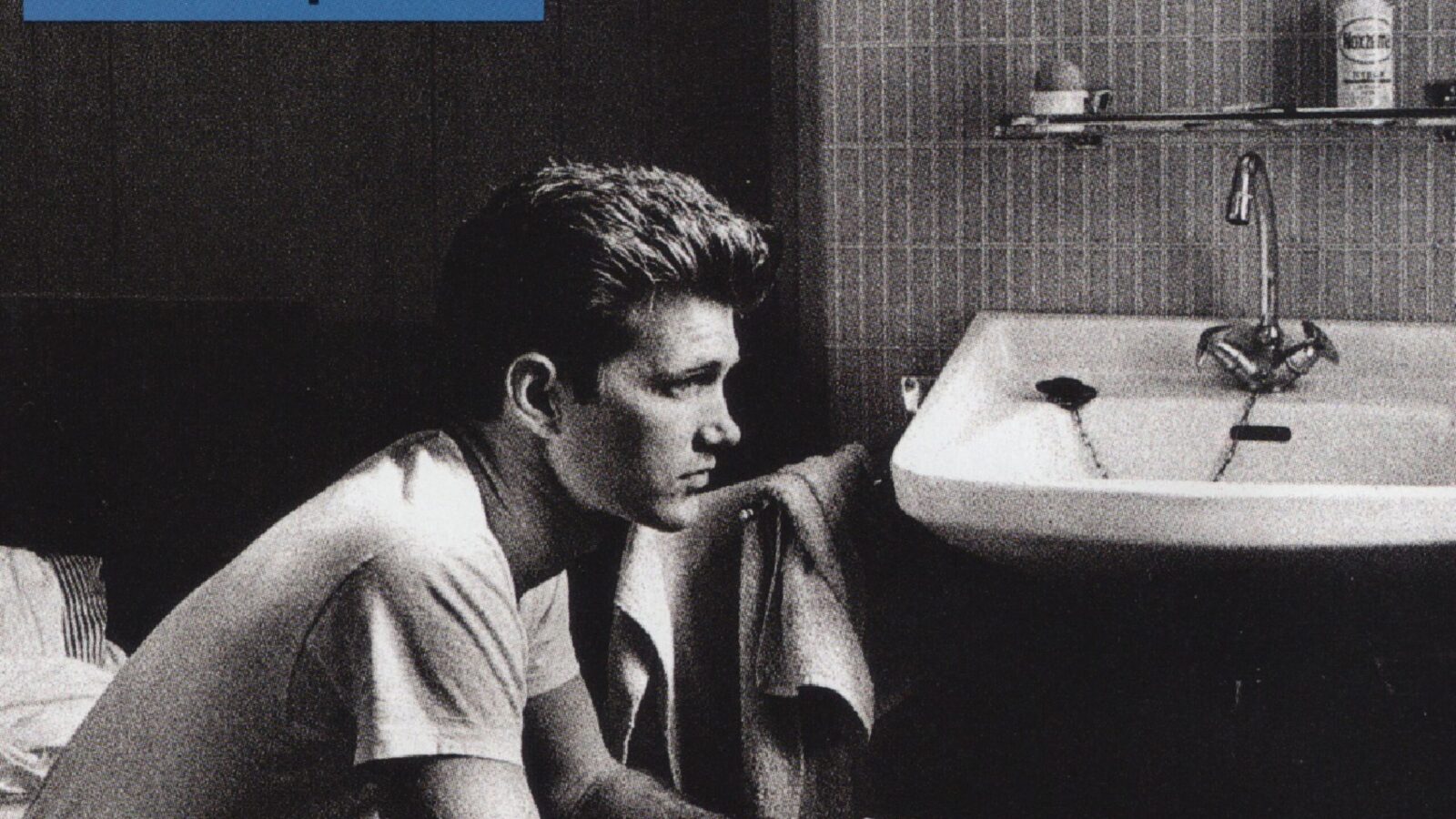
September 1990. Atlanta, Georgia. Lee Chesnut, the music director for Top 40 radio station WAPW Power 99, walked out of a movie theater for the third time. Same film. Same scene. Same song. The slow, dreamlike sound wouldn’t leave him alone.
“I saw the David Lynch film, Wild at Heart, where they used an instrumental version of the song. I saw the movie three times, and every time I saw it, the melody really stuck in my head, so finally, I dug out the soundtrack to the movie. When I found the song, it had vocals to it and I thought, ‘This is a hit record. I just know that it is,'” recalled Chesnut. “So, I went to the Program Director and said, ‘Let’s just play it for a few days. If nothing happens, we can take it off. But I know in my gut that this is a hit song.'”
The song was “Wicked Game” by Chris Isaak.
“Sure enough, about two days later it was our number one request, and record stores were going crazy calling us trying to find out where to get the album. From there, I called the label and convinced them to release ‘Wicked Game’ as a single. In the meantime, I personally got about twelve other stations to start playing it to see if the same thing would happen for them. Each station that put it on got the same reaction. About six or eight weeks later, the label finally released it as a single, and six months after that, it went Top 10.”
But how did this song end up in a David Lynch film in the first place?
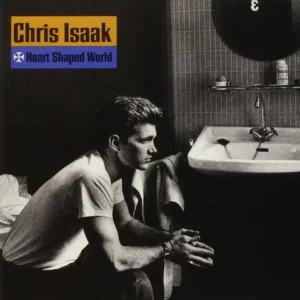
In the spring of 1989, Warner Bros. executives flew to San Francisco to hear Chris Isaak’s third album, Heart Shaped World. His manager and producer, Erik Jacobsen, had believed in the record from the start. The reception in that room deflated every bit of that optimism.
“Not a favourable word was spoken,” said Jacobsen. “It was just the most deadly reaction that I have ever seen to anything in my life. As for getting it on the radio, all they said was ‘Tough, very tough, extremely tough.'”
Heart Shaped World was released on June 13, 1989, and the first single, “Don’t Make Me Dream About You,” went nowhere on the charts. A month later, a Warner Bros. executive delivered the news to Jacobsen about the record and Isaak, declaring, “the ship has sailed. The ship has already sailed.”
“Everybody convinced us we were a failure,” said Jacobsen. “We were sitting there, wondering: ‘Is it the record company? Is it the production? Is it the songs?'”
Isaak continued to play in clubs. “Everywhere we played, we noticed when it came to that song, people would pay attention,” recalled Isaak. “We felt we had something.” He went to Warner Brothers and requested a meeting, something he almost never did, and sat down with chairman and CEO Mo Ostin.
“I never had meetings with anybody at Warner Bros. because I didn’t want them to remember that I was on their label because I thought they’d drop me,” recalled Isaak. “I went in and said, ‘Mo, I think we should do a video for “Wicked Game,” and he said, ‘It’s been out like a year. Maybe we’ll do a video for the next one, but not this.'”
The label had spoken.
Then, months after Warner Bros. had abandoned Heart Shaped World, a call came from David Lynch’s office.
Lynch, the Oscar-nominated director behind The Elephant Man and the TV series Twin Peaks, had a history with Isaak. He had used two songs, “Gone Ridin'” and “Livin’ for Your Lover,” from Isaak’s 1985 debut album Silvertone in his movie Blue Velvet. Neither made it onto the official soundtrack.
Lynch decided to bring a Barry Gifford novel to the screen. “Wild at Heart is a love story that barrels along down a strange highway through the twisted modern world,” said Lynch.
“When you’re working on anything, you want magical things to happen where the whole is greater than the sum of the parts. But for that to happen, you have to have all the parts just right,” said Lynch. “My favourite films make you feel a sense of place and mood… And music plays a huge role in creating that sense of place and mood. Another one of those elements that you have to try to get right so that the whole thing jumps up into the stratosphere.”
When Lynch was looking for music for Wild at Heart, he called Isaak and asked if he had anything new. Isaak pointed him toward his third album Heart Shaped World, the album Warner Bros. had written off.
Lynch listened, and liked two songs, “Blue Spanish Sky” and “Wicked Game.” Isaak told Lynch he could use them however he wanted and gave him both vocal and instrumental versions of the songs.
“I’d half-speed them, and it was this unreal, beautiful sound,” Lynch said. “You can sometimes just find pure, magical stuff.”
“Wicked Game” took hold of him. “It’s very soulful, and it creates a mood,” Lynch said. For the film, he chose to use only the instrumental version. “It’s very hard to use lyrics in a film,” he explained. “They fight a scene with dialogue.”
“And he didn’t use the lyrics. Just the track. I liked it,” said Isaak. “That’s what I probably would have done too. It works better. If all of a sudden a voice comes in, you start listening. ‘What are the words saying, how do they relate to this scene?’ I don’t think you want that, you just want the emotion.”
Lynch placed the song in one of the film’s most intimate scenes where Sailor, played by Cage, and Lula, played by Dern, are driving through the desert at night toward California, with a confession passing between them.
But Lynch’s connection to the song went deeper than the film itself. “Lynch said, ‘I’m using this song in a movie. Hey, why don’t we have a video?’ I said, ‘David, because I don’t have any money,'” recalled Isaak.
Lynch’s response, as Isaak later recalled, was immediate.
“You wanna do a video? I got you, brother. We can do a video for ‘Wicked Game.’ I got it,” recalled Isaak. “And he shot the first video for ‘Wicked Game.’ So God bless David Lynch.”
Wild at Heart premiered at the Cannes Film Festival on May 19, 1990, where it won the Palme d’Or, before its U.S. theatrical release on August 17, 1990. The Lynch-produced video was raw and simple, featuring Isaak and his band performing between clips from the film. It was packaged with the Wild at Heart VHS release and began getting airplay on MTV. But as Isaak recalled, “they would only play it while the movie was in the theaters. It played for a while, and the record was doing well, but they pulled it. By that time, it had caught on to some radio stations.”
Chesnut was at one of those stations.
“At the time, I was at WAPW. The album had been out almost two years, and ‘Wicked Game’ had not been released as a single, and there were no plans to do so. I think the label had given up on it,” recalled Chesnut.
In mid-October, Chesnut put the song on the air. When the song played, his station’s phones lit up. Chesnut began calling radio stations in Tucson, Memphis, and Seattle and encouraged them to play “Wicked Game.”
While Chesnut was working the phones from Atlanta, Jacobsen was running a different operation entirely. The Warner Bros. promotion department had failed to get other stations on board, so Jacobsen called his friend Mo Ostin directly.
“I called Mo, ‘Can we do payola?'” Jacobsen said. Payola is paying for a song to be played under the table, without disclosing that payment to the audience.
Ostin said no, but handed Jacobsen $100,000 to promote the single himself.
“I spent the next two months on the phone calling independent promo guys and radio stations all over the country,” Jacobsen said. “And it worked… I was giving out payola,” he admitted. Isaak, Jacobsen said, almost certainly never knew. “I don’t think he knew, no. And I don’t think he knows to this day.”
Erik Jacobsen played his own wicked game.
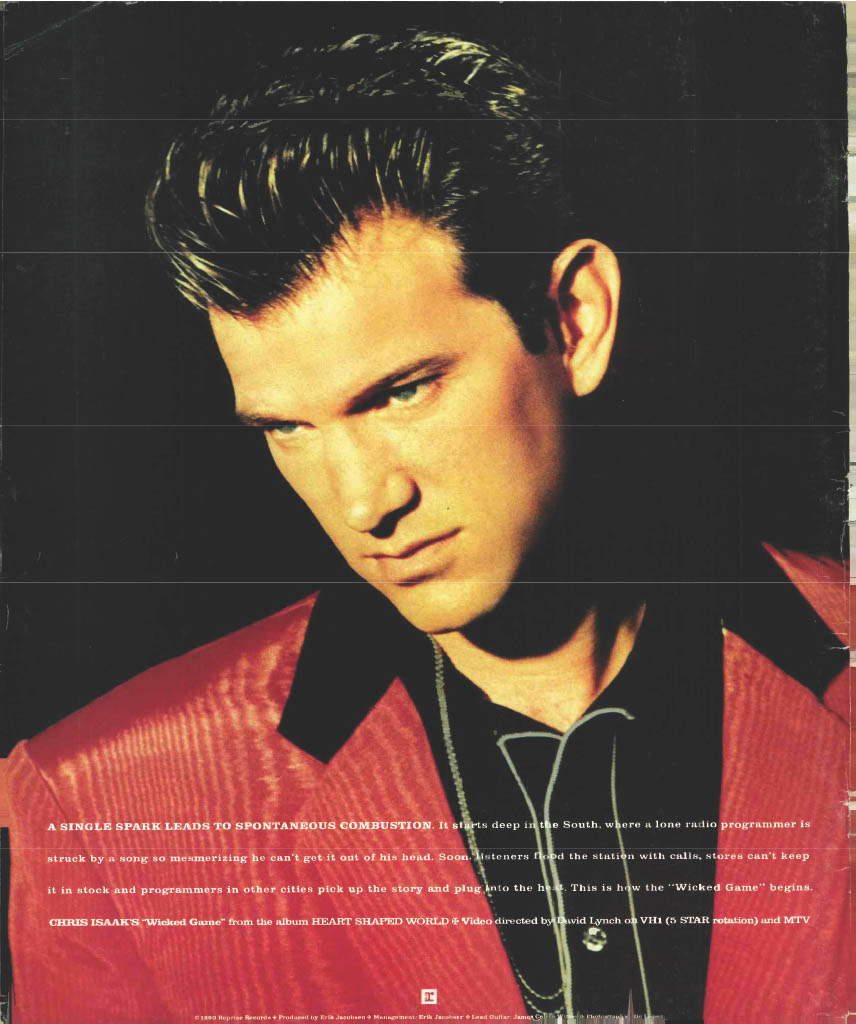
By mid-December, the song started to climb the charts. Isaak appeared on the back cover of Billboard with an insight into the brief history of “Wicked Game,” along with a subtle nod to Chesnut:
“A single spark leads to spontaneous combustion. It starts deep in the South, where a lone radio programmer is struck by a song so mesmerizing he can’t get it out of his head. Soon, listeners flood the station with calls, stores can’t keep it in stock and programmers in other cities pick up the story and plug into the heat. This is how the ‘Wicked Game’ begins.”
With demand building, Warner/Reprise rushed out a CD single.
“David Lynch made a cheap little video in one afternoon,” said Jacobsen. “I begged Mo for money to make a real video. He asked me to come to a meeting with him and plead my case in front of 50 assembled Warner’s functionaries. Not a single person there thought it was a good idea. After the meeting, Mo said, ‘Erik, I’ll give you the money.’ And he gave us a quarter of a million. So we got Herb Ritts and took everybody to Hawaii.”
The video was directed by fashion photographer and director Herb Ritts, who also directed music videos for Janet Jackson, Mariah Carey, and Madonna.
“I remember Herb saying, ‘There’s this girl and she’s not really known, but she’s good. Her name is Helena Christensen,'” recalled Isaak.
“There is only one girl that reminds me of what this song is about,” said Ritts.
The video was shot on the black beaches of Hawaii. The apparent heat between Isaak and Christensen on screen masked a far less glamorous reality.
“People thought we were really lovers,” Isaak recalled. “She was a very beautiful woman. It looks romantic in the video but in real life, we were on a beach, and they were throwing buckets of cold seawater on us to keep us wet. There was a little bit of a wind, she was freezing. Just shivering.”
“Herb asked if I had any notes. I said, ‘Cut me out and put more of her in’,” said Isaak.
“Suddenly we had stations everywhere getting results,” said Gary Briggs, Reprise’s national album promotion manager. “Once we had some radio support, we were able to go to VH-1, who’d always liked Chris, and got them to start playing the video again. This is the way you want to have a hit. This one really came from the streets and slapped us in the face, which is the best way for a record to happen.”
By March 1991, “Wicked Game” broke into the Billboard Hot 100 Top 10, peaking at No. 6, and “Heart Shaped World” became Warner’s best-selling album at the time, surpassing Madonna, Paul Simon, and Jane’s Addiction.
At the 1991 MTV Video Music Awards, the Wild at Heart version directed by David Lynch won Best Video From a Film, while the Herb Ritts–directed video for “Wicked Game” won Best Male Video. The Ritts video was also nominated for Video of the Year and Viewer’s Choice. Rolling Stone later crowned Ritts’ “Wicked Game” as the sexiest music video of all time.
“Patience pays: Chris Isaak’s Heart Shaped World (Reprise) is a label staffer’s dream,” wrote Billboard. “The album previously peaked at No. 149 in August 1989, a month after its release, but, as has been well documented, it was revived recently when WAPW (Power 99) Atlanta took a shot with ‘Wicked Game.’ Through radio and in-store play, the song now reaches an intoxicating demographic mix, including yuppies and rockers, and boosts the album to No. 16 with a bullet. For promotion people, the album proves what can happen when an intelligently crafted song cracks through radio’s tight playlists, while sales execs can be heartened by the knowledge that even forgotten records can be revived.”
The ship that had once sailed just needed the correct sail.
Lyrically: Wicked Game by Chris Isaak
The inspiration for “Wicked Game” came from a late-night phone call and was written in 15 minutes.
“This one I wrote really late at night and it was written in a short time, because I remember that a girl had called me and said, ‘I want to come over and talk to you,’ and ‘talk’ was a euphemism. And she said, ‘I want to come over and talk to you until you’re no longer able to stand up.’ And I said, ‘Okay, you’re coming over.’ And as soon as I hung up I thought, ‘Oh, my God. I know she’s gonna be trouble. She’s always been trouble. She’s a wildcat. And here I am, I’m going to get killed, but I’m doing this,'” said Isaak. “And I wrote ‘Wicked Game.’ It’s like you start thinking about it, and by the time she came over to the house, I had the song written. And I think she was probably upset because I was more excited by the song. I was like, ‘Yes, you’re gorgeous, baby. But listen to this song!'”
“We didn’t do much guitar playin’ after she got there,” said Isaak.
“Wicked Game,” according to Isaak, is “about what happens when you have a strong attraction to people that aren’t necessarily good for you. And I think it hit a nerve because I think a lot of us have a strong attraction to people that aren’t necessarily good for us.”
The song’s sound was not his alone. The guitar that Lynch inserted into Wild at Heart, and the one that stuck with Chesnut in that Atlanta theater, was developed by James Calvin Wilsey, Isaak’s guitarist.
“Chris played me that song and I heard it,” Wilsey recalled. “It was pretty basic, he only had a few lines, and I thought, ‘This is nice, this is right up my alley, I can do something.’ A couple of days later I thought of a riff for the intro and some other parts, and I thought, ‘Good, it’s done.’ It was one of the few times where I felt like that was it. Sure of it. I don’t think Chris liked it at first, he thought it sounded sort of out of tune. So I let it ride for a while. Later on Erik heard it and Chris heard it again, and they thought, ‘Oh wow, what’s that?’ It’s like they were hearing it for the first time.”
“We never imagined ‘Wicked Game’ as a single,” Wilsey said.
“That song had a long life. A real long life,” said engineer Mark Needham. “Chris had played it with the band many times, and we’d recorded a bunch of different versions, with different arrangements.”
The world was on fire, and no one could save me but you
It’s strange what desire will make foolish people do
I never dreamed that I’d meet somebody like you
And I never dreamed that I’d lose somebody like you
The song opens in the middle of the fire. There is no introduction, no setup, no explanation of how he got here. The world was burning and there was only one person who could save him. Desire had already made its decision.
“I never dreamed that I’d meet somebody like you / And I never dreamed that I’d lose somebody like you.” The two lines mirror each other. Meeting and losing arrive together, as if one was always the price of the other. Desire can feel like a fleeting dream.
No, I don’t wanna fall in love
(This world is only gonna break your heart)
No, I don’t wanna fall in love
(This world is only gonna break your heart)
With you
The chorus is where the tension lives. He doesn’t want to fall in love. He is going to anyway. The pendulum between desire and logic swings. The soft whisper in the background, “this world is only gonna break your heart,” isn’t a warning from outside. It’s his own voice, the part that already knows the outcome.
What a wicked game to play to make me feel this way
What a wicked thing to do to let me dream of you
What a wicked thing to say, you never felt this way
What a wicked thing to do to make me dream of you
This is where the song shifts from internal conflict to direct outward expression. The first two verses are about what desire is doing to him. This chorus turns outward and addresses her directly. The desire is one-sided. She deliberately played his emotions. She let him feel this way. She let him dream. “Wicked” is the right word because it implies intent, a quiet manipulation. This heartbreak wasn’t an accident. Even after it has been named, he is still dreaming. The game continues.
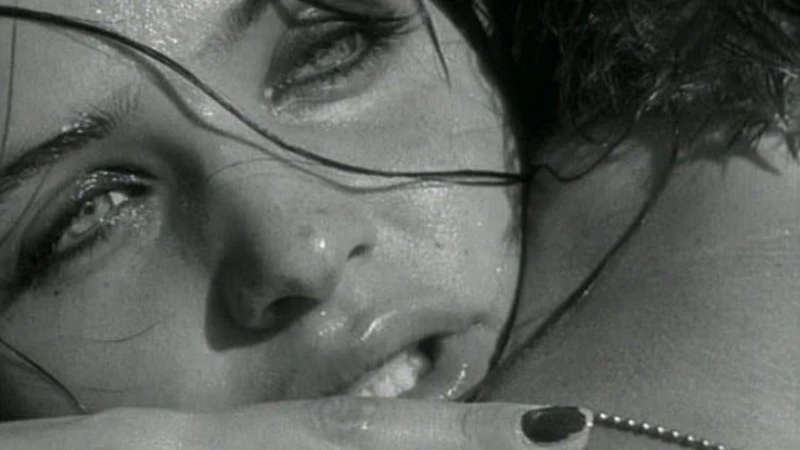
This dynamic translated directly into the video. During an interview with The Dini Petty Show, host Petty realized while watching the music video that Helena Christensen’s character “not once did she look at you, and was sort of like she was bored with you, and you were like in love with her.” Isaak responded, “Yeah, that was the idea. She was distant. She was based on a real thing.”
“I like the fact that I don’t get the girl,” Isaak recalled. “She’s not kissing me, she’s kind of ignoring me through the whole video, and that kind of matches the song, which is, you know, ‘I’m in love with you, but you’re playing me.'”
Christensen saw it the same way. “Everyone was asking me, ‘Why are you looking so annoyed with him?’ And I was like, ‘Well, that was his idea,'” she said.
World was on fire, no one could save me but you
It’s strange what desire will make foolish people do
I’d never dreamed that I’d love somebody like you
And I’d never dreamed that I’d lose somebody like you
The third verse makes one evolved change. Where the first verse said “meet,” this one says “love.” “Meet” describes an encounter. “Love” describes his current experience.
No, I don’t wanna fall in love
(This world is only gonna break your heart)
No, I don’t wanna fall in love
(This world is only gonna break your heart)
With you
(This world is only gonna break your heart)
With you
(This world is only gonna break your heart)
No, I…
(This world is only gonna break your heart)
He is still declaring he doesn’t want to fall in love. The repetition reveals the game is still happening.
Nobody loves no one
The song ends with “Nobody loves no one.” Grammatically it translates to “Everybody loves somebody.” But emotionally it’s love being a wicked game where nobody wins.


What does this song mean to you?
Share your thoughts on this song.