December 1992. New York City had recorded more than two thousand murders a year for two straight years. Crack cocaine had flooded the city’s housing projects since the mid-1980s, fuelling the violence.
Out of those streets, rap music became a way to express and document what was happening. The Bronx, birthplace of the genre, had given the world KRS-One and Grandmaster Flash. Queens had Run-DMC and A Tribe Called Quest. Brooklyn had Big Daddy Kane. Every borough except one. Staten Island, the forgotten borough, the only one unreachable by subway and home to the largest landfill in the world, had nothing on the rap map.
An eight-man crew from Staten Island called Wu-Tang Clan, with no marketing budget and nothing to lose, recorded and pressed 2,000 copies of their own 12-inch vinyl on their own label, Wu-Tang Records. Each member contributed $100 to cover studio time, each dollar made from selling crack on the street.
A handful of them showed up uninvited at a New York radio station and demanded it get played. It did.
Those 2,000 copies were distributed by hand to mom-and-pop record shops, college stations, and DJs from Boston to North Carolina. Demand outpaced supply. They pressed more and sold a total of 10,000 copies.
“RZA had shopped that tape everywhere,” said Ghostface Killah. “All these guys was like, ‘Nah, it’s not gonna work, there’s too many of y’all.'” But one label said okay.
Steve Rifkind had a new label called Loud. On March 2, 1993, Wu-Tang’s producer and de facto leader Robert Fitzgerald Diggs, known on the streets as Prince Rakeem and soon as RZA, arrived at Rifkind’s New York office. “Do you mind if the guys come up?” RZA asked. “I didn’t know if there were three guys, five guys,” Rifkind recalled. “I never did think that there would be nine guys. And they came and they gave me a concert.” Someone ran in the door, said “that’s that shit” and walked out. “I never saw energy like that.” E-Swift, producer and co-founder of Tha Alkaholiks, another Loud Records act, was in the office that day. His verdict: “You got to sign these guys. You’ll own New York in two seconds.”
Rifkind signed the Clan as a whole for $60,000. RZA negotiated something the industry had never agreed to before: every member would retain the right to sign individually to whatever label they chose, while recording collectively as a group. A ninth member would complete the lineup during the album sessions that followed. One team. Nine free agents. RZA also placed a friend, Schott Free, who had been independently promoting the record, inside Loud to oversee operations. As RZA told him: “You one of the only educated dudes in the Clan. We need somebody up in the office, overseeing what these guys are doing with our records.”
The record that started all of this was “Protect Ya Neck.” When Loud reissued it in May 1993, they flipped the B-side to a song that would define a career, give a man his name, and set the terms for everything that followed.
“Method Man” is the song. Method Man is the person. Method Man is a way of life.
Behind the Method
Wu-Tang Clan was formed with the original members including RZA, GZA, Method Man, Raekwon, Ghostface Killah, Inspectah Deck, U-God, and Ol’ Dirty Bastard. Masta Killa joined in 1993. RZA’s pitch to each of them had been direct: “Give me a year of your life, and I’m going to take us to the top, and we’ll never have to sell drugs again.”
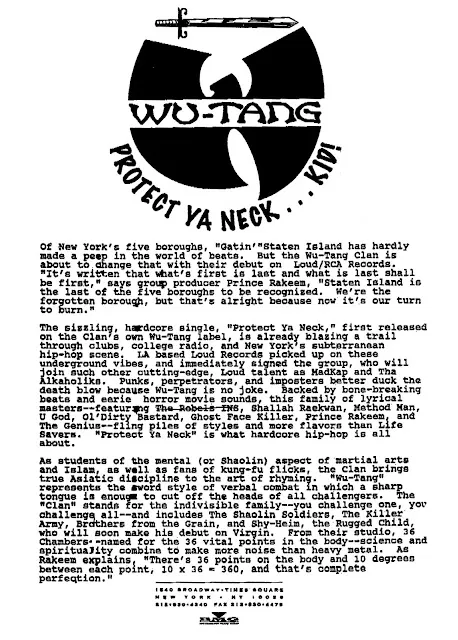
The group called their Staten Island home Shaolin, a reference to the kung-fu films they grew up watching. In the Loud/RCA press release for “Protect Ya Neck,” Prince Rakeem explained the name Wu-Tang as “the sword style of verbal combat in which a sharp tongue is enough to cut off the heads of all challengers.” The Clan, he said, “stands for the indivisible family — you challenge one, you challenge all.”
“My disadvantages are my advantages in this world. Because I’m always underestimated from the door but I’m always ready — so I don’t have to get ready,” said Clifford Smith, the man the world would come to know as Method Man.
It was Cappadonna, a fellow Staten Island rapper who had grown up alongside the future Wu-Tang members, who first taught him how to flow and rhyme. “I was a little wack back then,” Method Man admitted. “The first rhyme I wrote, me and Raekwon wrote, called ‘I’m On A Mission,’ and that was actually just to show Cap so I could get down with their crew the Get Busy Crew. Cap put me down.”
Before Method Man, there was Shakwon, and before that, possibly Papa Smurf. When asked about his earliest rap name, Smith revealed, “I was big on the Smurfs… I had a few though, for sure.”
“Method Man was Shakwon until he made that song — Shakwon the Panty Raider. Then, after he made that song, everybody in the hood called him Method Man,” said RZA. “Meth will get the women and children,” he added, though Method Man himself was not convinced. “He didn’t want to do women and children. He didn’t know that, though. Method Man is a rough, rugged street dude, but all the girls love him.”
RZA was clear on why the name stuck. “Method Man is potentially one of the oldest lyrics on the album… that was already a neighbourhood hit… we all knew that song by heart, we all loved it… It was the concept because meth is weed. He’s the king of smoking weed. So he’s the method man. A year later, he’s Method Man,” he stated. “It was a conscious decision by us as a crew, but the streets did push it.”
The record that moved before anyone was ready
Before the trade press caught on, the record had already forced its way onto radio. In December 1992, RZA, Ol’ Dirty Bastard, Ghostface Killah, and two others showed up uninvited at Columbia University’s WKCR 89.9 FM, evading two security doors to reach DJ Bobbito Garcia. Garcia was handed a white label with no information on it. “They weren’t being nice,” he recalled. He previewed it, then he played it. Listeners called in. It was the world premiere of “Protect Ya Neck.”
In early January 1993, GZA, one of Wu-Tang’s founding MCs and RZA’s cousin, took a copy of the record to Kid Capri, who had a weekly show on WBLS 107.5 FM, one of New York’s most influential commercial radio stations. Getting played there was another level from WKCR. The whole crew gathered at RZA’s sister’s house waiting to hear it. When Kid Capri played it, the room erupted. Raekwon lost his mind. “He jumped to the fuckin’ ceiling,” said Ghostface. “Kid Capri played it. And it was on.” Inspectah Deck recalled: “When it came on the radio, for a minute I felt like a star. I felt like Big Daddy Kane and all the cats that I was listening to coming up. You really felt like you made it.”
By March 1993, The Source, the most influential hip-hop magazine in America, had taken notice. In its Sure Shot Singles column, the magazine spotlighted “Protect Ya Neck” as a record worth watching, describing the crew as “packed with flavor MCs, all bringing a unique style to the cutting edge of underground hip-hop.” It was the first known published press on the group.
While the record spread, RZA sent the “Protect Ya Neck” music video to Ralph McDaniels at Video Music Box, a New York public television show that brought hip-hop videos to audiences without cable. The video had visible time code on screen. McDaniels played it anyway. “I played it on my show before they even had a record deal,” he recalled. “RZA still had time code on the video and I just played it all the time because I just thought it was so much different than everything else that was out there at the time.”
On May 3, 1993, Loud Records reissued “Protect Ya Neck” with “Method Man” flipped to the B-side. Schott Free, who had been promoting the record to radio stations, explained why it worked: “Every four to eight bars or so, you’re presented with a whole different style and sound on how to ride one particular wave. That’s the thrill and the shock of it all.”
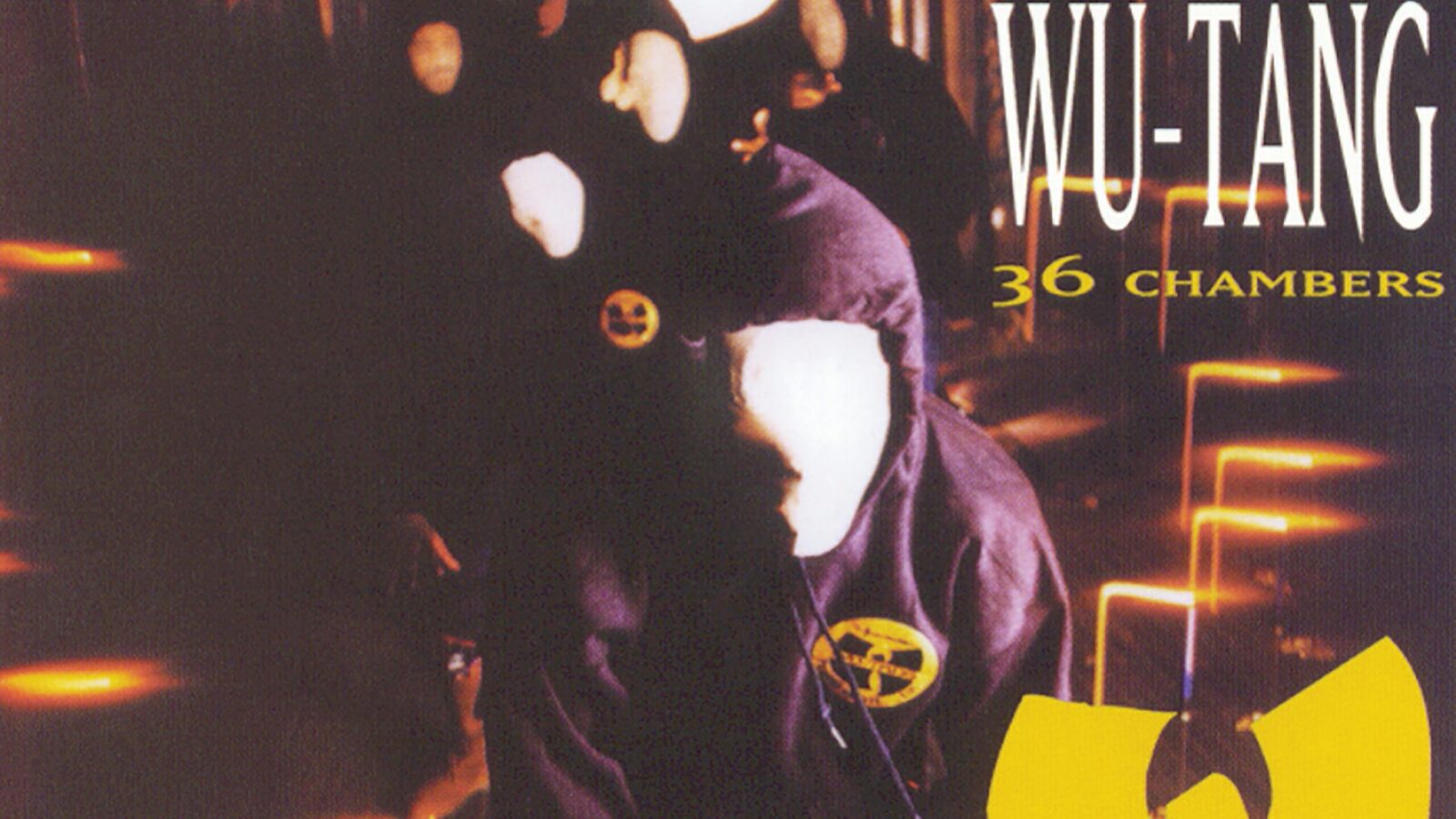
While the reissue was finding a larger audience, RZA had the group in Firehouse Studio in Brooklyn, completing their full debut album Enter the Wu-Tang (36 Chambers).
For the week ending September 17, 1993, industry tip sheet Network 40 flagged “Method Man” in its Breakin’ Out of the Box section. In radio trade language, power calls are the most influential spins, the ones that move records on the charts. The note read: “Power calls from Boston, NYC, Philly and Detroit drive ‘Method Man’ and the Clan from Top 75 to the #8 spot in one week. Even Rifkind was a little surprised.”
By September 25, Billboard reported that “Method Man” had hit the top 10 on pay-to-see cable channel The Box. The album, at that point, was still listed as a February release.
On October 22, Hitmakers, an LA-based tip sheet written for radio programmers, ran two reactions to “Method Man” in the same issue. The first: “Sounded great on the radio. Wu-Tang is going to be big in New England.” The second: “What can I say? This record works. Okay, it grew on me.”
A week later, Network 40 published its Crossover Most Requested chart. Hot 97 DJ Baltazar named “Method Man” the No. 2 most-requested record at the most important hip-hop station in New York, behind only 2Pac’s “Keep Ya Head Up.” This was no longer an underground story.
Billboard reported: “RCA and Loud Records are howling about the potential of the debut album by Wu Tang Clan, the rap unit whose ‘Method Man’ clip ranked as high as No. 4 at pay-to-see cable channel The Box. Originally projected for release next year, the album’s street date has been pushed up to Nov. 9. Wu Tang’s single, ‘Protect Ya Neck’ b/w ‘Method Man,’ has shipped more than 130,000 units; it has been a top five seller in New York City and a top 10 hit in Philadelphia.” Big retail orders had been placed by Musicland Group, Trans World Music Corp., Wherehouse, The Wiz, and Strawberries. Wu-Tang had gone from pressing 2,000 copies by hand to stocking the shelves of every major music retailer in America. RZA had asked for one year. It had taken just that.
Three weeks after the release, Billboard ran a Spotlight review of Enter the Wu-Tang (36 Chambers), a designation reserved for releases with exceptional merit. “In tracks like ‘Protect Ya Neck,’ ‘Method Man,’ and ‘Bring Da Ruckus,'” the review stated, “the rappers throw rugged rhymes against buff beats. Their voices sound like they’re attempting to murder the tracks.”
The album peaked at number 41 on the Billboard 200, earned platinum certification in 1995, and became one of the most influential hip-hop albums of all time.
In the ready position
“When I wrote ‘Method Man,’ I was like 15 or 16 years old, 17 or 18… my mind works crazy. I don’t know where I heard these records before, but they were etched in my head,” said Method Man. The inspiration for the song came from Masta Ace, Bootsy Collins, Michael Jackson, The Beatles, and Hall & Oates.
“I didn’t have an extensive record collection but I always grew up around music so I have an extensive memory of records. Even if I didn’t know the words to the song, I had my own version of the words.”
Method Man said the song came together like this: “RZA and me were in his house one day and he was making beats. That’s when he made the ‘Wu-Tang Clan Ain’t Nuthing ta F’ Wit’ beat and he made the ‘Method Man’ beat. I happened to be there first, so I got to jump on it first. I had wrote this rhyme after I heard the Michael Jackson song ‘Come Together’ — from his 1988 film Moonwalker, which was a cover of The Beatles — it just fit perfect with the whole beat and everything, so we just put that shit down. The beginning was a mixture of Hall & Oates, ‘Method of Modern Love’, and the ‘Man’ part came from ‘Music Man’ by Masta Ace.”
“That was just me making the record in my head,” he said. “I was sampling it in my fucking head and saying it like it would be sampled. I said ‘Move it on your left! Ah!’ I was supposed to say ‘Set it up on your left! Ah!’ But that’s what it sounded like in my memory. The ‘Hey, you! Get off my cloud!’ That’s Bootsy Collins. It just fit because we were talking about getting high.”
“[Getting a solo song] just happened,” said Method Man. “In the same breath, GZA had his solo joint on there too. I don’t know why RZA did ‘Method Man’ first. I guess it was a sign of the times and what people were actually listening to. Leaders of the New School — the Long Island group featuring a young Busta Rhymes — and a few other groups with that frantic style where it was just all over the place were popular at that time. I guess RZA being who he was and being so in tune with what the flavor was, he was like, ‘Yeah. We gonna put this ‘Method Man’ joint on because this is something nobody has ever heard before.'”
“Back in the day, when we were shorty, we didn’t have things like Video Music Box or Video Jukebox. The closest we could get to seeing hip-hop videos was, well, never, really, if you think about it. So, the videos we did see were Top 40 countdowns — a lot of rock and roll,” he added.
When the “Method Man” video aired, Method Man watched it alone inside the house. “I was eating white rice with ketchup on it,” said Method Man. “No food in the house. I think it was Thanksgiving too. I was feeling bad like, ‘Damn, this shit is not popping. This fucking rap shit is weak.'”
Outside, the record was on the radio, in the clubs, on the streets. A borough nobody talked about was becoming the only one anyone could hear.
That was November 1993. The recognition that followed took decades, but it came.
“Method Man,” the song that started in RZA’s basement in Staten Island, went on to be named to The Source‘s 100 Best Singles list and ranked No. 5 by Pitchfork in its Top 200 Tracks of the 1990s.
By 2020, Rolling Stone ranked the album No. 27 on its 500 Greatest Albums of All Time list. In 2022, it was added to the Library of Congress National Recording Registry, the highest cultural preservation honour in the United States. In 2025, Wu-Tang Clan were inducted into the Rock and Roll Hall of Fame.
Lyrically: Method Man by Wu-Tang Clan
The song opens with an intro, a back-and-forth between Method Man and Raekwon where they trade threats while laughing at each other. Method Man revealed where it came from: “It started on the block. We would have movie night and we would get a bunch of dudes together with three dime bags of weed and we’d all smoke it and watch a movie on VHS. After the movie was over, dudes would still be high, so dudes start geeking and snapping on each other. That’s where all that shit came from.”
Method Man then spells out M-E-T-H-O-D before landing on Man. The inspiration came from two sources. Hall & Oates’ “Method of Modern Love” spells out M-O-D-E-R-N L-O-V-E in exactly the same way. The word “Man” came from “Music Man” by Masta Ace. Method Man took both and made them his own name. Before a single verse begins, the song has already told you exactly who you are listening to.
M-E-T-H-O-D Man
M-E-T-H-O-D Man
M-E-T-H-O-D Man
M-E-T-H-O-D Man
Out of the gate, Method Man establishes his presence with “Hey, you, get off my cloud / You don’t know me and you don’t know my style.” The line traces back through Bootsy Collins‘ “Disciples of Funk,” which sampled The Rolling Stones’ “Get Off of My Cloud.” Mick Jagger and Keith Richards wrote the song in 1965 about protecting their space from people who did not belong there. Method Man takes the same idea and makes it a sword. The cloud is his. There is no room for anyone else. He just started and told you exactly where you stand.
“Pat-a-cake, pat-a-cake, hey, the Method Man” and “Don’t eat Skippy, Jif or Peter Pan / Peanut butter ’cause I’m not butter” are playful, but the underlying message is that Method Man is not soft. The lyrics “I snap back like a rubber / Band, I be Sam, Sam-I-Am / And I don’t eat green eggs and ham” use childhood references to say something clear: He will not be moved, softened, or redirected.
“I’m about to blow, light me up / Upside, downside, inside and outside / Hittin’ you from every angle, there’s no doubt I / Am the one and only Method Man.” Every direction is covered. There is no angle from which Method Man cannot reach you and declares he is the one and only. He does not compete. He’s his own category.
The continued references to 1980s pop culture, with Tweety Bird (“I tawt I taw a putty tat”) and Bill Cosby’s Fat Albert (“Hey, hey, hey, like Fat Albert”), pile nostalgia on top of nostalgia. These are the shared experience of an entire generation. Method Man reaches for something already stored in everyone’s memory to make you feel like you already know him.
“I got fat bags of skunk / I got White Owl blunts / And I’m about to go get lifted.” The flow came from hearing Michael Jackson’s cover of The Beatles’ “Come Together.” White Owl is a cigar brand and when the tobacco is removed, the wrap becomes the perfect blunt-rolling tool. Method Man is telling you exactly how his night is about to go.
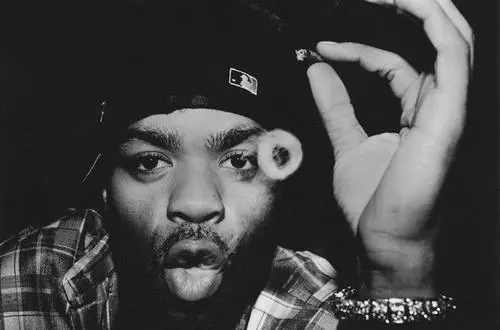
I got myself a Forty And I got myself a shorty And I’m about to go and stick it Yes, I’m about to go and stick it, uh
A forty. A shorty. A plan for the evening. “H-U-F-F, huff, and I puff” nods to the Big Bad Wolf, his presence and authority, but also those White Owl blunts that he’s working on. Method Man is always operating on more than one meaning at the same time.
P-A-N-T-Y, R-A-I-D-E-R, mad raw, I don’t fry
Meaning, no one can burn or toss and turn me
Ooh, I be the super sperm
Method Man pays tribute to his former identity, Shakwon the Panty Raider, the name he carried before the song gave him a new one. “Wrote a song about it / like to hear it? / Here it goes / Question, what exactly is a panty raider?” It is a very important question to ask.
Method Man builds his self-portrait line by line, stacking identities. Each line adds experiences.
Ill behavior, savior or major flavor
All of the above, oh yeah, plus seducer
Also, flam, I’m the man, call me super
Not an average Joe with an average flow
Doin’ average things with average hoes
Yo, I’m super, I’ll make a bitch squirm
For my super sperm (Check it)
Check it, I give it to you raw butt-naked
I smell sess, pass the method
Let’s get lifted as I kick ballistic
The verse pivots, and Humpty Hump arrives. Potentially a respectful hat tip to the character created by Shock G, lead member of hip-hop group Digital Underground and the mind behind “The Humpty Dance.”
“Chim chimmeny chim chim cherie / Freak a flow and flow fancy-free / Now how many licks does it take / For me to hit the Tootsie Roll center of a break.” Method Man crafts the words from Mary Poppins and rolls in a Tootsie Pop reference. The 1968 commercial for the candy came with the tagline of “How many licks does it take to get to the Tootsie Roll center of a Tootsie Pop?” One cultural reference flows into the other.
“Peep and don’t sleep, the crew’s mad deep (Wu-Tang)” is a collective warning. “Mad deep” is not just the size of the group but their influence. “Fadin’ motherfuckers like bleach” is direct. Bleach erases colour and identity. “You’re clear like glass, I could see right through” finishes it. Nothing there at all.
I’m
M-E-T, H-O-D, MAN
M-E-T, H-O-D, MAN
M-E-T, H-O-D, MAN
M-E-T, H-O-D, MAN
Here I am, here I am, the Method Man
Straight from the slums of Shaolin
Wu-Tang Killa B’z on a swarm
[Your soul have just been taken through the 36 chambers of death, kid]
The song ends where it began, with the spelling of the name. Now earned. Method Man spent the entire song establishing who he is, where he is from, and his capabilities. Then he returns to the beginning, with the Killa Bees, Wu-Tang’s extended network, and says it again. Straight from the forgotten borough of Shaolin, you were taken through all 36 chambers.
“Method Man” established Clifford Smith as a standout voice of Wu-Tang Clan. Rifkind, the man who signed them for $60,000, later put it plainly: “Meth’s voice was always different. Meth had to stick out because that was the record.” Raekwon was more direct: “When you think of ‘Protect Ya Neck,’ it was like he was our God.”
The press catches up
The trade press had documented the single’s rise week by week through the autumn of 1993. By February 1994, three months after the album dropped, the editorial press caught up.
The Source published its full album review that month, awarding Enter the Wu-Tang (36 Chambers) four and a half mics. The producer was still credited as Prince Rakeem. The review placed the album in the lineage of Boogie Down Productions’ Criminal Minded, calling it a throwback to the days when rap was filled with honesty, greatness and skill.
In the same month, the Los Angeles hip-hop publication Rap Sheet ran a review in its “Check the Wax” column. It noted that many radio stations were still confused about what Wu-Tang was, even as the record moved, and called the “Protect Ya Neck” backed with “Method Man” 12-inch one of the best records of the previous year.
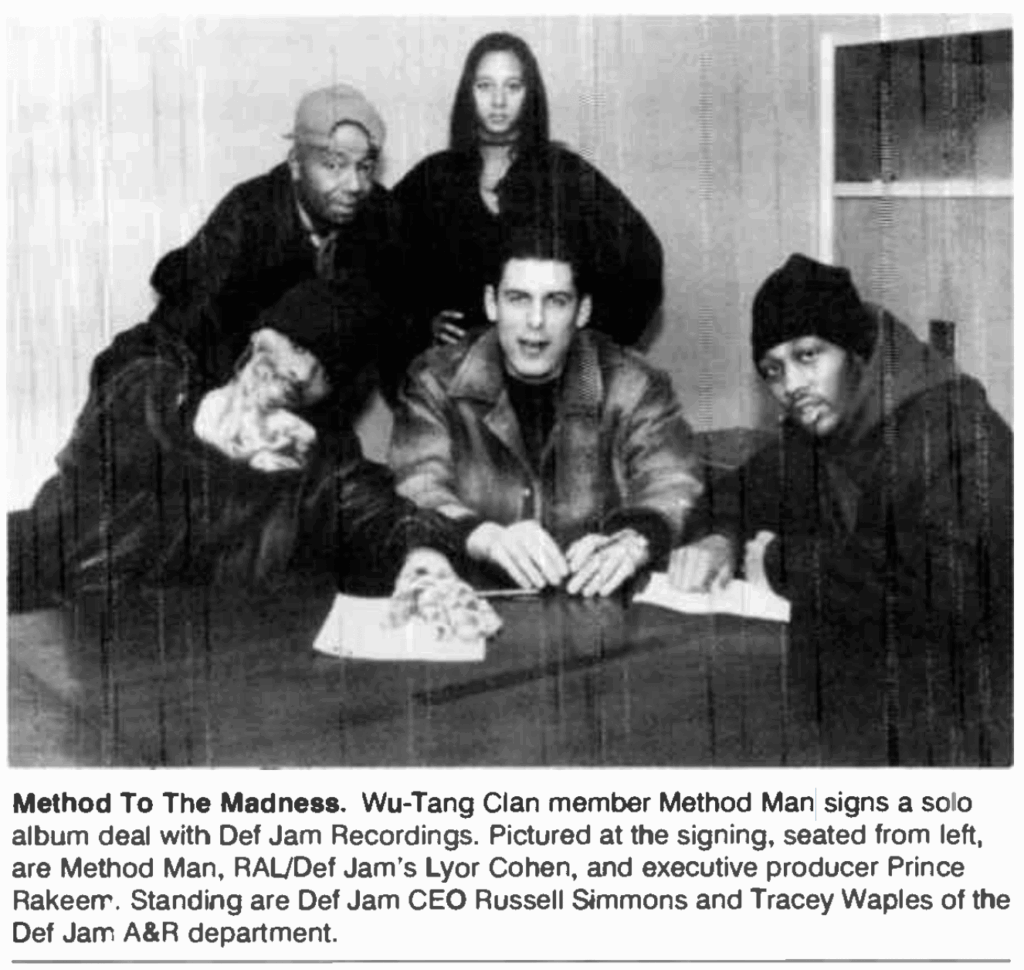
Method Man signed with Def Jam in January 1994. That November, he released his debut solo album Tical, which debuted at No. 4 on the Billboard 200 and went platinum.
In 1996, he won a Grammy Award for Best Rap Performance by a Duo or Group for “I’ll Be There for You/You’re All I Need to Get By” with Mary J. Blige.
The music had opened doors, and he went on to act in films like Belly and How High, and TV series including The Wire, Oz, and Power Book II: Ghost.
From Shakwon to Method Man, from Staten Island to the world, Method Man is ready.


What does this song mean to you?
Share your thoughts on this song.