Washington, D.C., 1970. The house is dark and the street outside is quiet. Marvin Gaye is 31 years old and cannot sleep.
His younger brother Frankie, 28, is home from the war, and Marvin wants to hear everything.
“Nights were the best,” Frankie recalled. “We really became kids again as we stretched out in our beds, telling stories in the dark. Only now, Marvin wanted me to do the talking. He was full of questions, and they all had to do with my experiences in Vietnam. It went on night after night, for over a week.”
Frankie had been sent to Vietnam and had served three years. He came home carrying things that do not leave. He talked about the blood that swam through every memory. He talked about the value of human life, which the war had made unbelievably low. He talked about children eating out of garbage cans, a sight that he would never get past.
“After my brother heard me, and saw my tears, he began to understand,” Frankie said. “He said, ‘Damn, Frankie, what can I do?’ I let him know that he could fight in so many other ways, especially through his music.”
Eighteen months later, Marvin Gaye changed what people expected to hear in popular music.

Marvin Pentz Gay Jr. was born on April 2, 1939, in Washington, D.C., the second of four children. Before the world heard him, he sang in his father’s church.
His father, Marvin Gay Sr., was a Pentecostal preacher with a congregation and a household he ruled with equal severity. The church gave his son a voice. The household gave him reasons to leave.
In 1956, between the Korean and Vietnam Wars, the 17-year-old enlisted in the Air Force to escape the strict parenting and abuse of his cross-dressing, alcoholic father. He had dreamed of becoming an aviator since childhood. “I had tremendous interests in aviation,” he said. “I could tell you what any plane was without even looking at it, by the sound of its engines.”
While relieved to be away from home, he was unmotivated by the menial tasks of military life and became uncooperative. Within eight months, in mid-June 1957, he was back home in Washington, D.C., with a general discharge. His discharge papers documented him as “a constant problem” who “required constant supervision.” His Commander’s report stated, “Airman Gay is uncooperative, lacks even a minor degree of initiative, shows very little interest in his assigned duties, and does nothing to improve his job knowledge… further retention in the service would be a waste of time, effort and money.”
At 18, his dream of flying was grounded.
“I was torn between two desires,” he said. “I wanted to become an aviator, and I wanted to become a great singer.” He turned his focus to singing. “I decided that, come hell or high water, I was going to make it as a pop singer.”
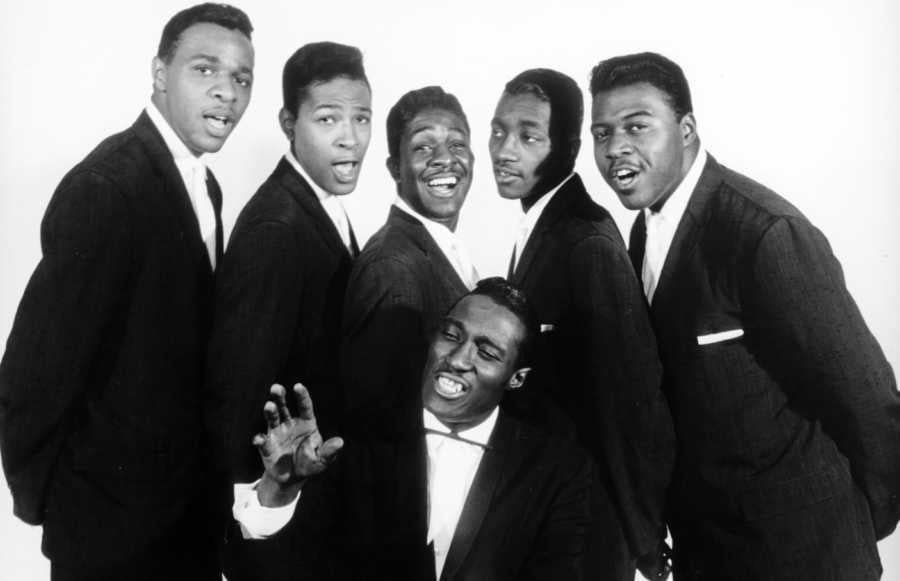
He reunited with friends Reese Palmer, Chester Simmons, and James Nolan and formed The Marquees, a doo-wop group. “We had a little group. We were singing around town, Washington, D.C., and we called ourselves the Marquees. We always patterned ourselves after the Moonglows. Boy, we loved their sound… we really sang, man, like the Moonglows,” said Gay.
The Marquees started singing on street corners, performing at talent shows at the Lincoln Theater, and competing at high school battles of the bands. They eventually caught the attention of Bo Diddley, known as “The Originator” for his role in bridging blues music to rock and roll.
Diddley had moved from Chicago to Washington, D.C., in 1957 and built a recording studio in his basement. He began working with the Marquees and secured a recording session with Okeh Records in New York City. In September 1957, they recorded “Wyatt Earp” and “Hey Little School Girl.” The record was released in November with no promotion and received minimal attention.
The Moonglows, the doo-wop group that The Marquees aimed to emulate, split up in 1957. Founding member Harvey Fuqua, who helped establish early rock and roll, was looking to form a new group and was introduced to The Marquees by Diddley. In 1958, Harvey and the New Moonglows was created with members of The Marquees.
“We were singing around and Harvey popped through there. Harvey, the leader of the Moonglows, he heard us and he thought that we sounded quite a bit like the group, the original group, and they had long since dispersed, and he thought that we would make a nice replacement… so we got together, we went on the road, and we were fairly successful. We had lots of fun, really,” said Gay.
Harvey and the New Moonglows recorded several songs in 1959, including “Mama Loochie” and “Twelve Months of the Year,” but the group disbanded in 1960.
A new start in Detroit, with a new name
In 1960, after the Moonglows disbanded, Fuqua recognized Gay’s potential and proposed they move to Detroit. The city was beginning to emerge as a music hub, buzzing with the R&B sounds coming out of the newly founded Motown Records. For Gay, the move was a chance to pursue his dream of becoming a pop singer and an opportunity to leave his home life behind.
Fuqua had a direct line to the label. He was romantically involved with Gwen Gordy, sister of Motown founder Berry Gordy. Rather than navigating the typical audition channels, Fuqua brought Gay straight to Gordy and pitched him as a talent worth signing. On September 19, 1960, Gay secured a recording contract with Motown’s Tamla subsidiary.
Motown had parties where artists would perform impromptu. At the Christmas party in 1960, Bill “Smokey” Robinson heard Marvin Gay for the first time. “He was singing it to himself. But everybody started to gather around, especially the ladies,” said Robinson, “because he had that voice.”
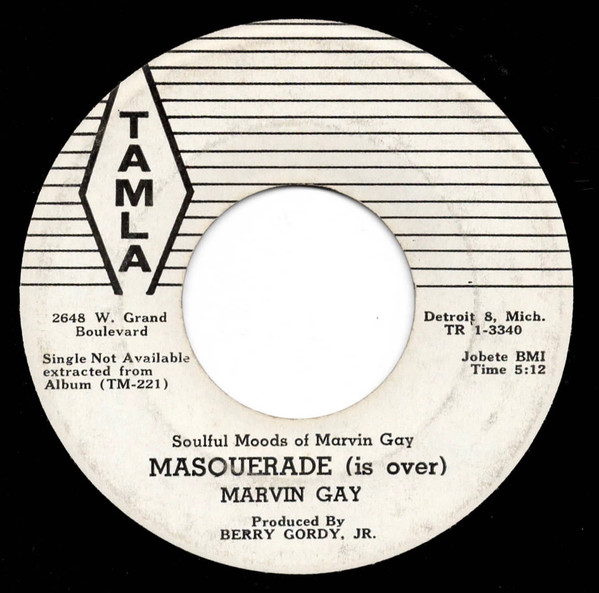
Gay began recording music with Motown in early 1961, focusing initially on jazz and traditional pop rather than the R&B sound the label was becoming known for. A limited-run promotional single featuring “Masquerade (Is Over)” and “Witchcraft” was sent to radio stations and industry insiders to generate interest ahead of his debut album.
At the release of his debut album, Gay added an “e” to his surname to become Marvin Gaye. He wanted distance from his father. The name change also addressed rumours about his sexuality, a subject the surname had made unavoidable.
“I was aware that Sam Cooke had done exactly the same thing,” he said. “If it worked for Sam, why wouldn’t it work for me?”
Gaye’s pop star dream had become a very specific vision. He wanted to be a Motown version of Frank Sinatra. “Every woman in America wanted to go to bed with Frank Sinatra,” he said. “He was the king I longed to be. My greatest dream was to satisfy as many women as Sinatra.” The commercial logic behind that ambition was blunt. “Pop meant selling whites, and R&B or soul meant selling the sisters and brothers back in the neighbourhood,” he said. “Everyone wanted to sell whites ’cause whites got the most money. Our attitude was: give us some.”
On June 8, 1961, Gaye’s debut album, The Soulful Moods of Marvin Gaye, arrived. Neither the album nor its singles charted. By summer 1962, after three more failed attempts, Gaye was considered by some at Motown “the least likely hit maker.” Gordy insisted Gaye abandon jazz and reinvent himself as an R&B artist. He reluctantly agreed. “Motown never really wanted me to be a pop singer,” Gaye later said. “They undercut my efforts and never gave me the promotion or push I needed.”
The pivot worked. With producer Mickey Stevenson, Gaye co-wrote “Stubborn Kind of Fellow,” his fourth single, released July 23, 1962. It peaked at No. 8 on the R&B chart. “Hitch Hike” followed in early 1963, reaching the Top 40. “Pride and Joy” became his first pop Top 10 hit that April. Gordy added duets to the formula, pairing him with Mary Wells, then Kim Weston. When Smokey Robinson handed Gaye “Ain’t That Peculiar” in 1965, it became one of his biggest solo successes. Then “I Heard It Through the Grapevine” became the biggest-selling single in Motown’s history, selling more than seven million copies worldwide.
In 1967, Gaye stepped into the studio with Tammi Terrell and everything changed. The duo released “Ain’t No Mountain High Enough,” a song co-writer Nick Ashford described as capturing the “physical attraction” between them. It reached No. 3 on the R&B chart and No. 19 on the Billboard Hot 100. Their chemistry was undeniable, and Motown knew it.
Tragedy struck when Terrell collapsed into Gaye’s arms during a performance at Hampden-Sydney College in Virginia on October 14, 1967. She was rushed to the hospital and initially diagnosed with exhaustion, but later tests revealed a brain tumour. Despite this news, they continued recording. Their 1968 album You’re All I Need featured “You’re All I Need to Get By” and “Ain’t Nothing Like the Real Thing.”
In 1969, although Terrell was often too ill to stand in the studio, the duo recorded one final album, Easy. On March 16, 1970, she died. She was 24 years old.
Gaye was devastated. Terrell’s death broke something within him and he pulled back from performing live. “My heart was broken…. I could no longer pretend to sing love songs for people,” he said.
He grew a beard. The depression that followed was harder to hide. “I was terribly disillusioned with a lot of things in life and life in general,” said Gaye.
“Black men weren’t supposed to look overtly masculine. I’d spent my entire career looking harmless, and the look no longer fit. I wasn’t harmless. I was pissed at America,” said Gaye. “You might even say I became a recluse. That scared me because for the past ten years, Father had been leading exactly that kind of life.”
The son who had run from his father’s house at 17 was looking in the mirror and seeing a similar man. Depression pulled him under. “Even the laughter of children couldn’t pull me out of it,” he said. “More than anything else, it was probably just walking over to the park and playing ball which saved my ass.”

Months of a showdown
Within weeks of Terrell’s death, Kent State happened.
On May 4, 1970, National Guard troops opened fire on student anti-war protesters at Kent State University in Ohio. The students had been protesting the U.S. invasion of Cambodia, announced by President Nixon four days earlier. Four students were killed, nine were wounded.
“My phone would ring,” Gaye said, “and it’d be Motown wanting me to start working and I’d say, ‘Have you seen the paper today? Have you read about these kids who were killed at Kent State?’ The murders at Kent State made me sick. I couldn’t sleep, couldn’t stop crying. The notion of singing three-minute songs about the moon and June didn’t interest me.”
“I saw what was happening in this country and I wasn’t doing a damn thing about it. I was tired of going out and getting the women to scream. I had to be more than a sex symbol. I had to be an artist,” said Gaye.
Then Frankie came home. Gaye went back to Washington D.C. to be with him.
“The death and destruction I saw in Vietnam sickened me,” Frankie said. “The war seemed useless, wrong and unjust. I relayed all this to Marvin.”
“My blood started to boil,” Gaye said. “I knew I had something, an anger, an energy, an artistic point of view. It was time to stop playing games.”
The song that would carry all of it had already been started by someone else.
In 1969, Renaldo “Obie” Benson of the Four Tops was on tour when he witnessed police violence against protesters at People’s Park in San Francisco. “I started wondering what the fuck was going on?” Benson said. “What is happening here? One question leads to another. Why are they sending kids so far away from their families overseas? Why are they attacking their own children in the streets here?”
With Motown staff writer Al Cleveland, who worked with Smokey Robinson, Benson began shaping a song around those questions. The Four Tops rejected it. “My partners told me it was a protest song,” Benson said. “I said no, man, it’s a love song, about love and understanding. I’m not protesting, I want to know what’s going on. But they never really understood what was happening.”
When the Four Tops toured England, Benson thought he’d stumbled onto a match for the song. “We were doing a TV show, Top Of The Pops or one of those, and I tried to give it to this girl. This famous folksinger, played a guitar. What’s her name? I went into her dressing room, picked up her guitar and played this song. I had some words, but they weren’t the finished lyrics yet. She seemed interested, but somehow we got separated and I never got to finish presenting it to her. What was her name?” The folk singer was Joan Baez.
Cleveland brought the song to Gaye, who reshaped it. Gaye rewrote sections, sharpened the melody, and layered in the reality his brother had given him. Everything Frankie had told him in the dark was now material.
“He added some things that were more ghetto, more natural, which made it seem more like a story than a song,” Benson said. “He made it visual. He absorbed himself to the extent that when you heard the song you could see the people and feel the hurt and pain. We measured him for the suit and he tailored the hell out of it.”
Gaye entered the studio on June 1, 1970, to record what would become “What’s Going On.” He produced it himself, the first time a Motown artist had done so. Gaye wanted nothing that resembled a standard Motown sound. The arranger was David Van DePitte. Ken Sands engineered the session.
Gaye had cut two lead vocals and asked Sands to prepare a tape with each on a separate track. Sands accidentally played both vocals simultaneously on a mono machine. “That double lead voice was a mistake on my part,” Sands admitted. Gaye kept it.
Van DePitte had his doubts going in. “I told Marvin I didn’t think we were gonna get away with it,” he said. Gaye’s response was immediate. “‘I don’t care, man, I’m gonna do what I’m gonna do.’ After that, we both got into a kind of ‘the hell with the company’ mode.”
When the session ended, bassist James Jamerson drove home and told his wife he had just cut a classic.
Berry Gordy called it the worst he had ever heard. “Why do you want to ruin your career? Why do you want to put out a song about the Vietnam War, police brutality and all of these things? You’ve got all these great love songs. You’re the hottest artist, the sex symbol of the sixties and seventies,” Gordy told him.
“From Jump Street, Motown fought What’s Going On,” Gaye said. “They didn’t like it, didn’t understand it, and didn’t trust it. Management said the songs were too long, too formless, and would get lost on a public looking for easy three-minute stories.”
“At that time it was so controversial. I think they wanted to keep the Motown platform not political, more just love themes,” said Nick Ashford.
“Put it out or I’ll never record for you again,” he told the label.
“It should’ve been my moment of artistic triumph, but Berry and the promoters in the Motown marketing meetings ridiculed ‘What’s Going On’,” said Gaye.
Inside Motown, there was one executive who appreciated the new music. Harry Balk had been overseeing much of Motown’s creative department while Gordy spent time in California, and had received the acetate by mistake.
“One day this Marvin Gaye acetate was sent to me by mistake,” Balk said. “I just fell on the floor when I heard it. I loved it, and made a tape of it before sending the acetate on. I listened to it over and over, and fell more in love with it. I started playing it for people who came into my office. Of course, everybody will tell you now how wonderful they thought What’s Going On was, but I played it for the hot producers and got nothing but negative opinions. The only one that was really knocked out with it – the only one – was Stevie Wonder.”
So Gaye waited. He tried out for the Detroit Lions.
He spent months in a standoff with the label. All along, America kept burning. “He knew where he was and who he was so long before the company even allowed him to be,” Motown songwriter Valerie Simpson said. “It’s a treasure that sat on a shelf for a year because we were waiting for them to grow up to where he was musically.”

Barney Ales, Motown’s general manager, stated, “I remember a meeting with Berry Gordy in Los Angeles, and he was complaining about Marvin being up in the mountains, talking to God, not finishing his album. By the start of ’71, we had nothing new, so I got together with our quality control head, Billie Jean Brown, and we decided to release ‘What’s Going On’ as a single. That’s all we had.”
“What’s Going On” was released on January 21, 1971. As the record was about to fade out, Gaye grabbed the fader and pushed it back up for a few seconds. “It wasn’t planned,” said Steve Smith, the engineer on the session. “It was something that just happened. It was Marvin’s mind trip, his way of saying ‘Fuck you’ to the company, and I think more so to Berry Gordy. You think this song you hate is over? Surprise!”
Ales was on a flight to Los Angeles the day the record came out. “Berry went crazy,” Ales said. “He didn’t like the record at all. Luckily, by the time my flight touched down in LA, we already had reorders for 100,000 copies. And this was only the first day, mind you. When he found out we’d sold 100,000 in one day, his attitude changed.”
Record World, reviewing the single the week of February 6, 1971, wrote that the record incorporated elements of jazz vocal and Gaye’s old-fashioned smooth style. Its verdict: “The artist is reborn.”
Lyrically: What’s Going On by Marvin Gaye
The opening of “What’s Going On” puts you right on a busy street, immersed in spontaneous, happy chatter between people. The voices belong to Bobby Rogers of the Miracles, musician and songwriter Elgie Stover, and two of Gaye’s friends, Lem Barney and Mel Farr, who played for the Detroit Lions.
“He says, ‘Lem, you take this part,’ ‘Mel, you take this part,'” Barney recalled. “The next time you listen to it, in the beginning when it says, ‘Hey, brother, what’s happening?! Solid! Right on! Mother, mother…’ We backgrounded him on the whole song, man!”
Gaye wanted you to hear the reality of everyday street life and the sounds of community. Trade publications reached for jazz to describe what they heard, but this was different. It was the crooner Motown had spent a decade suppressing, finally given room to speak.
“For the first time I really felt like I had something to say,” said Gaye.
Mother, mother
There’s too many of you crying
Brother, brother, brother
There’s far too many of you dying
You know we’ve got to find a way
To bring some lovin’ here today, yeah
By the time Gaye entered the studio, more than 40,000 Americans had died in Vietnam, hundreds of thousands more wounded, and a generation was rejecting the war through protests, draft resistance, and demands for peace.
The mothers were crying, and brothers were dying. Gaye suggested that the only way forward was to show love for each other. The song never raised its voice to make the point.
Father, father
We don’t need to escalate
You see, war is not the answer
For only love can conquer hate
You know we’ve got to find a way
To bring some lovin’ here today
When Gaye calls out ‘Father, father,’ he is pleading with those in power, from the President and military leaders to spiritual authorities. The answer he offers is not war. Love is.
Picket lines and picket signs
Don’t punish me with brutality
Talk to me
So you can see
Oh, what’s going on (What’s going on)
What’s going on (What’s going on)
The lyrics “Don’t punish me with brutality / Talk to me / So you can see” came from real places and real people. Benson had watched police attack protesters at People’s Park in San Francisco in 1969. Frankie had described a war where violence had become so routine it lost meaning. Nothing in the song was invented. Every line had a source.
By the time Gaye finished writing in September 1970, the country had given him three more months of evidence. On May 4, National Guard troops fired on student anti-war protesters at Kent State University in Ohio, killing four and wounding nine. Three days later, the Hard Hat Riot broke out when construction workers attacked anti-war demonstrators in New York City, injuring around 100. On August 29, the Los Angeles Sheriff’s Department attacked Chicano anti-war marchers during the Chicano Moratorium, killing three.
“Talk to me / so you can see” is a call for understanding through conversation, while the repeated ‘What’s going on’ is a question asked twice because once was not enough. It asks you to pause. To look up. To notice what is happening.
Mother, mother
Everybody thinks we’re wrong
Oh, but who are they to judge us
Simply ’cause our hair is long
Oh, you know we’ve got to find a way
To bring some understanding here today
Gaye addresses the experience of being judged, for beliefs and for appearance, and turns to the same answer: understanding. The closing verse returns to the conversational tone of the opening, ending where it began, in the street chatter of “Right on, baby, right on.”
Writing in Rolling Stone in August 1971, critic Vince Aletti described the album as a unified statement on the state of the world, its tracks flowing into each other with unusual care. The lyrics, he wrote, carried a mood of “aching dissatisfaction” from beginning to end.
Gaye, for his part, deflected the credit entirely. “I feel it all came from God. He drew me into it,” he told Disc and Music Echo in 1971. “I was only the instrument in the album.”
“What’s Going On”: The Album
“What’s Going On” the single was an opening statement. The album it came from was the full argument.
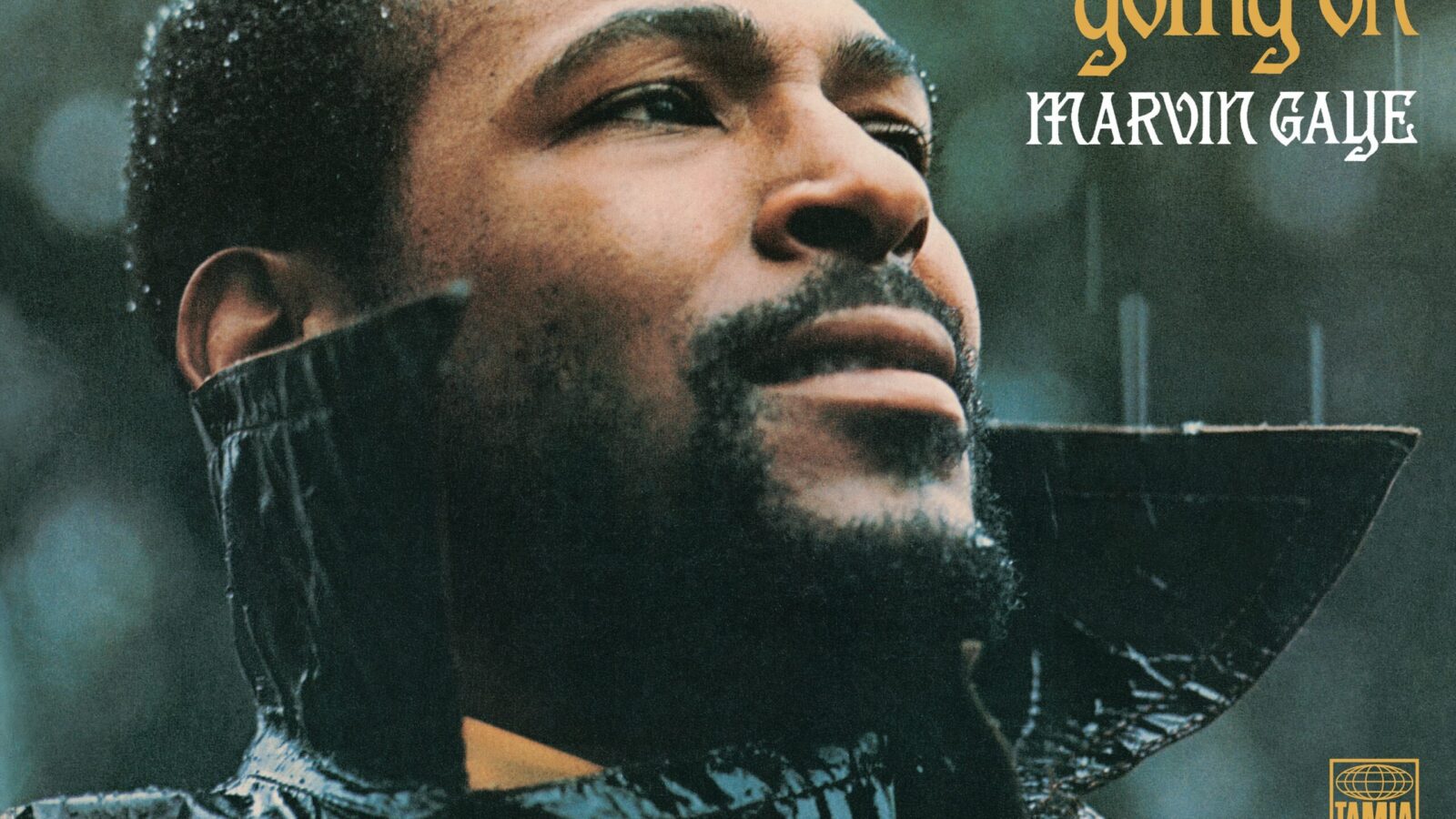
What’s Going On, released in May 1971, was nine tracks, all connected, all produced by Gaye himself. It was the first Motown album to carry printed lyrics. It was the first to credit its studio musicians by name, listing 39 of them. Both were firsts for the label. The back cover showed a bearded, distraught Gaye standing in the rain, wearing a tie he had sworn never to wear. He dedicated the work to his parents, his siblings, his wife, and his friends. Berry Gordy was not mentioned.
Billboard reviewed the album in June 1971 and described it as a cross between Curtis Mayfield and the old Motown spell, singling out “Inner City Blues,” “Right On,” and “Flyin’ High” as standouts. Cash Box called it “sparkling” that shows “Marvin’s belief in the power of love.”
In the United Kingdom, Blues and Soul described the album as being “different from anything we’ve ever known before from Marvin.”
Time magazine ran a two-column review and quoted the Rev. Jesse Jackson: after listening to the record, Jackson told Gaye that he was “as much a minister as any man in any pulpit.”
The album generated three singles in the same year: “What’s Going On,” “Mercy Mercy Me,” and “Inner City Blues.” The single had hit No. 1 on the Cash Box Top 100 in April 1971, sitting above the Temptations, Elvis Presley, and John Lennon. It peaked at No. 2 on the Billboard Hot 100 and No. 1 on the R&B chart.
Billboard named Gaye its No. 1 Top Singles Male Vocalist for 1971, ahead of James Brown, Elvis Presley, Stevie Wonder, John Lennon, and Al Green. The man Motown had once considered the least likely hit maker had closed the year at the top of the entire industry.
Marvin Gaye was inducted into the Rock and Roll Hall of Fame in 1987. “What’s Going On” was later included in the Hall’s “500 Songs that Shaped Rock and Roll,” added to the Library of Congress National Recording Registry in 2003, and ranked on Rolling Stone‘s list of the 500 Greatest Songs of All Time.
“As a child, I had dreams and visions of becoming a great singer. And I always had the same dream, strangely enough. And the dream was that, I still dream this dream occasionally, it seems that I’m singing for hundreds of thousands of people, and they’re beautiful people, and I got standing ovations, and I could see this as a child. And I hope it comes true one day,” said Gaye.
It did.



What does this song mean to you?
Share your thoughts on this song.