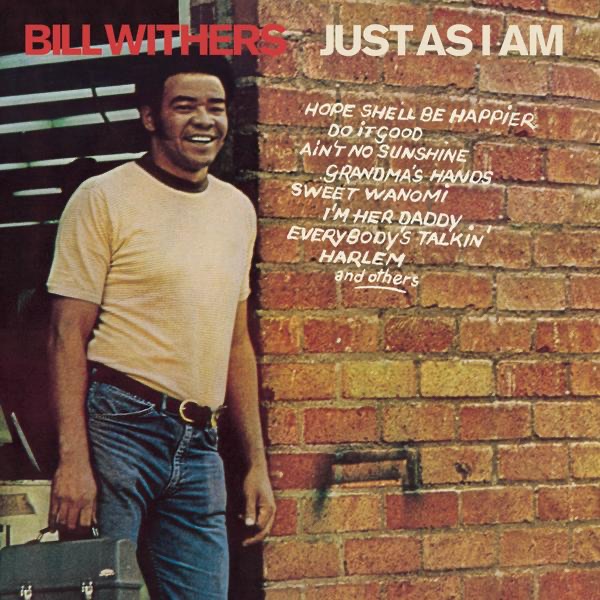
It was early 1971 in Burbank, California. Bill Withers went on his lunch break from Weber Aircraft to meet Norbert Jobst outside, a photographer sent by Maurer Productions to take pictures for an upcoming album from Sussex Records.
At the time, Withers was a 32-year-old mechanic installing the bathroom unit into Boeing 747s, making three dollars an hour. He wore ripped blue jeans, a tucked-in yellow T-shirt, a belt, and black boots. Jobst captured Withers standing against a weathered red brick wall, sitting on wooden steps, holding his grey metal lunchbox, smiling. Just as he is.
“So it was funny because my first album cover picture was actually taken on my lunch break. Cause I didn’t want to take time off, so I said, ‘Send somebody up here.’ You know, they can take my picture. So, I’m standing in the door with my actual lunch box. And so guys are in the back yelling, ‘Hey Hollywood!'” said Withers. “My co-workers were making fun of me… They thought it was a joke.”
On this day, he was shooting the cover photo for his debut studio album Just As I Am.
Withers was not known as a soul singer. Before music, he had worked as a milkman and a mechanical assembler at companies including IBM, Ford, and Douglas Aircraft Corporation. He even took a job babysitting for the daughters of musician and producer Mike Melvoin.
Even after the album’s release in May of 1971, and well into its success and the popularity of “Ain’t No Sunshine,” Withers still didn’t believe it would last. By the time the New York Times profiled him in September 1972, his thinking hadn’t changed.
“Hey, man,” said Withers. “I don’t take much of it seriously, you know? I mean, look, I’m really a factory worker. That’s a real job. This thing I’m doing now, hey, it’s a break, just a break. I don’t expect to be here very long.”
He was incorrect. It was a modest statement from a man who wrote something far more genuine on the liner notes on the inside of that same album.
“It matters not where I came from in relation to the world, as long as the world and I arrive at a common point at a common time. I would like to thank Sussex Records and Booker T. Jones for allowing me to present myself to the world to whoever is kind enough to listen. Just As I Am, Bill Withers.”
Was there sunshine in Slab Fork?
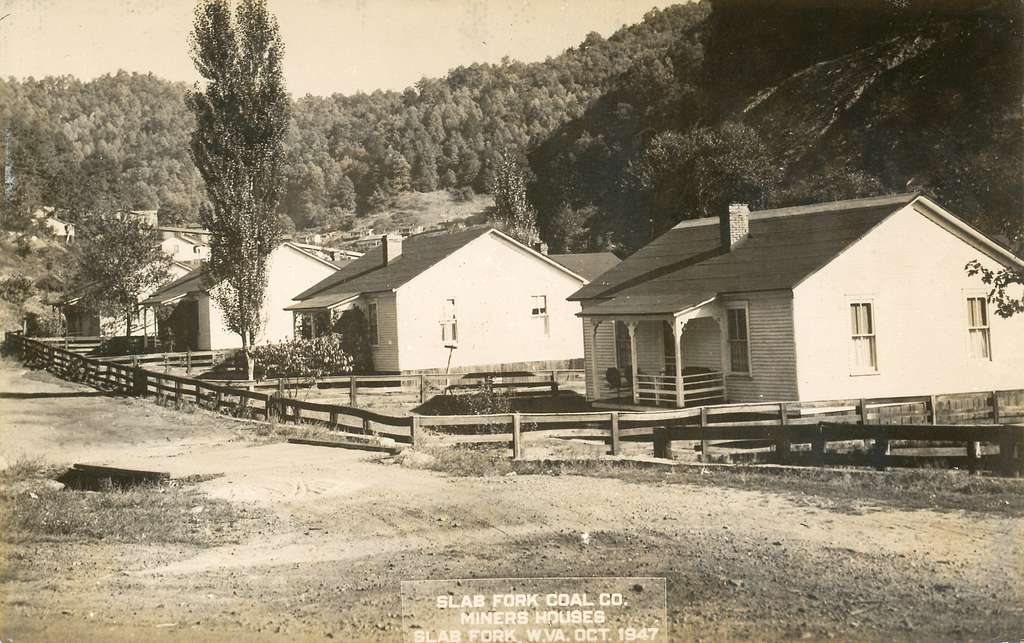
Withers was born on Independence Day, July 4, 1938, in Slab Fork, West Virginia, a small coal-mining community of around 200 residents. One of 13 children, six of whom lived to adulthood, he was three years old when his parents divorced and was raised primarily by his mother’s family in nearby Beckley. His father, a miner, died when Withers was 13.
For money, his mother cleaned houses. “She was a worker, a very independent and energetic woman,” Withers said. “She sang around the house. I think I got my music thing from her.”
As a teenager, Withers developed a love for music growing up on the border of a black and white neighbourhood in West Virginia. “I heard guys playing country music, and in church I heard gospel. There was music everywhere,” he said.
He took a keen interest in country singers such as Hank Williams and Little Jimmy Dickens, alongside gospel and the classic pop of Frank Sinatra and Nat King Cole. “Whatever I could stand to listen to, I listened to,” said Withers. He started singing a cappella. “That’s something we could do without owning any instruments.”
Much of what Withers knew of the world beyond Slab Fork came from the local movie theatre. “My mother didn’t have money for babysitters,” Withers recalled. “So she’d send me to the movies every day. It only cost fifteen cents, and I’d sit there anywhere from eight to sixteen hours. I remember those movies with Gene Kelly and Frank Sinatra. They were always in the Navy, always laughing and seemed to have a good time.”
Withers wanted out of Slab Fork. Right after graduating from high school, at 17, he enlisted in the U.S. Navy, serving as an aircraft mechanic. He was stationed in Guam, Florida, and California, and traveled throughout the Far East.
“The Navy was good to me,” said Withers. “I could eat food in quantities I’d never seen before. I lived real well.”
During his nine years of service, Withers began writing songs and started singing in front of people. His voice lacked confidence, partly due to a stutter. “I couldn’t get out a word. I realized it wasn’t physical. I figured out that my stutter, and this isn’t the case for everyone, was caused by fear of the perception of the listener. I had a much higher opinion of everyone else than I did of myself. I started doing things like imagining everybody naked — all kinds of tricks I used on myself,” said Withers.
Slowly, he learned to carry a tune. “Sing whatever the piano player could play,” he said. “You know, couple of drinks and you start singin’.”
After being discharged in 1965, Withers moved to San Jose, where he became the first Black milkman in Santa Clara County. “It was all about survival,” he said. He eventually took a job at an aircraft parts factory, where his Navy experience as a mechanic made him ridiculously overqualified.
One night in Oakland, Withers visited a club where Lou Rawls was performing. “He was late, and the manager was pacing back and forth,” Withers recalled. “I remember him saying, ‘I’m paying this guy $2,000 a week and he can’t show up on time.’ I was making $3 an hour, looking for friendly women, but nobody found me interesting. Then Rawls walked in, and all these women are talking to him.”
It was the moment something shifted. Withers headed to a pawn shop, bought a cheap guitar, and began teaching himself to play. Between factory shifts, he started writing his own songs. “I figured out that you didn’t need to be a virtuoso to accompany yourself,” he said.
“I thought, ‘Wait a minute, I’m working long hours here and I’m getting about 100 bucks a week,'” Withers said. “That was my first interest. It wasn’t very serious. Then once I got involved in the whole craft, thing took over.”
He eventually moved to Los Angeles in 1967. During his off hours, Withers frequented the Troubadour, a popular rock club on Santa Monica Boulevard in West Hollywood. While the performers arrived in leather jackets, sunglasses, and boots, Withers watched from the crowd in his T-shirt and rumpled jeans. He made contacts there, including guitarist Stephen Stills, who pointed him toward labels worth approaching.
“I saved up some of my own money and recorded myself. I had never written any songs. I didn’t really know how to play anything, and I had never sung before, not really, you know, in the shower or someplace. But I just decided it would be awfully nice to get in the music business. And then I just walked around and knocked on everybody’s door. A lot of times I would go in and somebody would say to me, ‘You’re too old to be just beginning.’ I was like 32 years old at the time. And that made it even more interesting, you know. So then I got very, very disgusted with the whole thing, but I didn’t quit,” said Withers. “Most of the major record companies called me up, but they had a different idea. They didn’t want me to do anything quiet. They had this rhythm and blues syndrome in their mind, with the horns and the three chicks and the golden lamé suit. And I wasn’t really into that. So I thought, I had a job, you know. If they won’t let me do it like I want to do it, I got this good job making these toilets. I don’t need you cats.”
Those doors were the major labels, who all rejected his sound. For two years. “After I made the record that I made with my own money, it took me about two years from that time,” Withers said.
The break came through his demos in the summer of 1970. Ray Jackson, a member of the Watts 103rd Street Band who served as arranger and keyboardist on the recordings, introduced Withers to drummer Forrest Hamilton. Hamilton then brought him to Clarence Avant, the founder of Sussex Records.
“He came to me through a gentleman by the name of Forrest Hamilton,” Avant recalled. “I remember when he walked in here, I think he said he had been to four or five other labels and he said, ‘I guess I get the same answer from you.’ So I said, ‘We have to wait and see.’ But I just kept listening to the record. I said, ‘Wow, this guy’s got it.’ You just had to keep going until you found somebody that would take the time. You have to find the right producer.”
“You just had to listen to his lyrics. I gave him a deal and set him up with Booker T. Jones to produce his album,” Avant recalled.
Avant made the call. “Clarence called me one day,” recalled Booker T. Jones, the leader of Booker T. & the MGs. “‘Booker, there’s this guy over in Inglewood building airplane toilets. I think you really need to hear this guy, or at least listen to his songs. Can I send him over?’ He came out to my ranch wearing big old broken shoes and overalls, because he’s a carpenter. But he walked in with a notebook, thick full of songs. The one he sang for me was ‘Ain’t No Sunshine.’ He started singing that, so I walked into the next room, got on the phone, and started calling numbers. I called Al Jackson: ‘Come out and play drums.’ I called Steve Cropper. He was busy. I called Stephen Stills; he came to the studio. And that’s how it happened. We walked into the studio. Bill walks into the control room. He says, ‘Booker, who’s gonna sing these songs?’ I said, ‘You are, Bill.’ And that was the beginning of his career as a singer. He walked right around, right back out in the studio, walked up to the microphone, and sang the whole record.”
Following his signing with Sussex Records, Withers, while still working as an aircraft mechanic, began recording. The sessions were spread over three recording dates across two studios, Sunset Sound Recorders and Wally Heider’s Studio 3 in Hollywood, with a six-month break between the second and final session. The musicians included drummer Al Jackson and bass player Donald “Duck” Dunn, plus Stephen Stills on guitar. The engineer was Bill Halverson.
“It was Stephen Stills’ studio time that we were using,” Halverson recalled. “I was working with Stephen on his first solo record, and he came to me a couple nights before this and said, ‘I’ve got this guy who needs a night of studio time.’ Stephen was hanging with Rita Coolidge, and Booker was marrying [Rita Coolidge’s sister] Priscilla Coolidge, and somehow Booker asked Stephen for some studio time.”
“When Bill Withers showed up,” Halverson said, “he comes walking in with his guitar and a straight-back chair, like a dining room chair, and asks, ‘Where do I set up?’ I showed him right in the middle of the room, and then he left and he came back in with this platform, a kind of wooden box that didn’t have a bottom. It was about four inches tall, and was maybe 3 foot by 4 foot; it was a fairly large platform, and he set it down in the middle of the room. Then he put his chair on it and got his guitar out, and he’s sitting on top of this box. So I miked him and I miked his guitar, and then I was doing other things—getting sounds together.”
“But then he calls me over and he points down to the box and says, ‘You gotta mike the box.’ Well, the way I was trained, you serve the artist, whatever the artist needs. So I got a couple other mics and I miked the box, the place down near the floor, next to this platform.”
“And now, when you listen to ‘Ain’t No Sunshine,’ you know that all that tapping that goes on ‘I know I know I know’ all through it, actually, that’s him tapping his feet on the box, which is actually more intricate than the guitar on that track. He had evidently rehearsed that in his living room, maybe for years.”
Those sessions produced the album.
Just As I Am was released in May 1971. Withers’ debut single, “Harlem,” was released in June 1971, with “Ain’t No Sunshine” as its B-side. Although “Harlem” was intended as the lead track, radio DJs began favouring “Ain’t No Sunshine.”
“Let me tell you how lucky I was. That was the B-side of the first record,” Withers said. “Now, the one they put on the B-side of your first record, that’s a throwaway. And the disc jockeys, they turned it over, and life has never been the same since.”
Sometime after Norbert Jobst photographed him for the album cover, Withers was laid off from Weber Aircraft. By the time the company tried to hire him back, he had also been invited to appear on The Tonight Show with Johnny Carson.
“It’s funny because I got two requests in one day,” Withers remembered. “I got a letter from my job saying that I was called back for work. And I got a request to do The Johnny Carson Show.”
He chose Carson. On November 3, 1971, Withers made his first appearance on The Tonight Show.
“Everything about him is right,” said Variety.
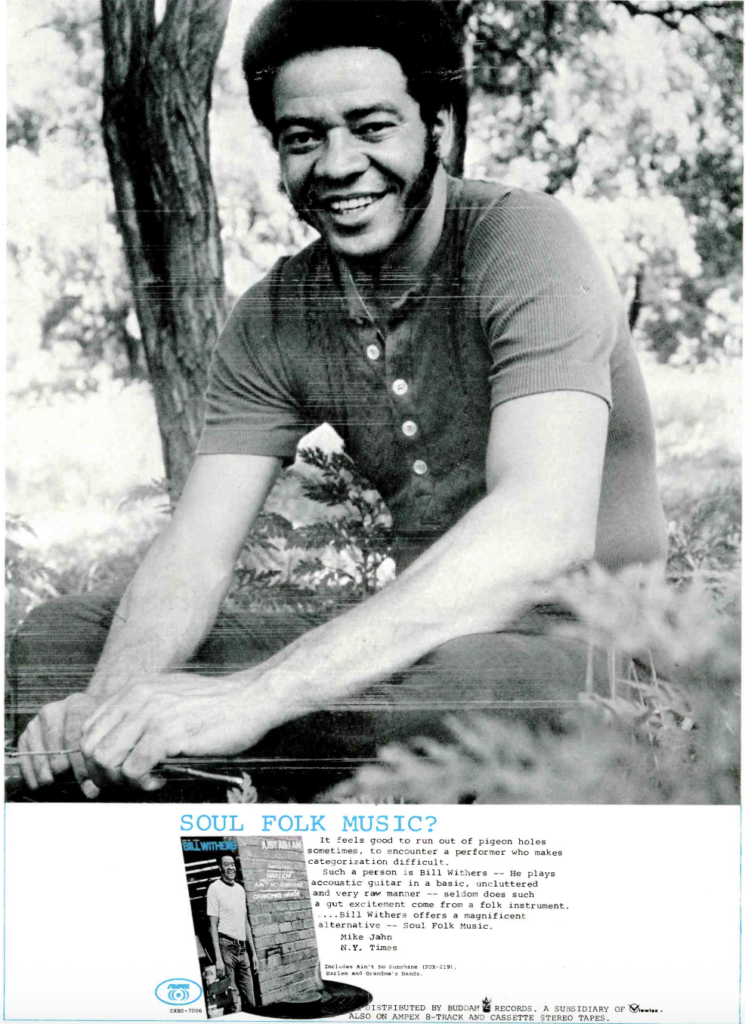
“It feels good to run out of pigeon holes sometimes, to encounter a performer who makes categorization difficult. Such a person is Bill Withers. He plays acoustic guitar in a basic, uncluttered and very raw manner — seldom does such a gut excitement come from a folk instrument… Bill Withers offers a magnificent alternative — Soul Folk Music,” said Mike Jahn in the New York Times.
“He has a very good voice, marked by clean phrasing, a strong delivery, gentleness when it is called for, and a powerful grasp on translating tender situations in life into music. He is an all around talent, marvelously capable of involving an audience in his private world set to music. Withers’ strength lies in the beauty of his voice, melting with romance and the softness of a caress. But he can get downright soulful, digging into the gutsiness of the blues,” wrote Billboard.
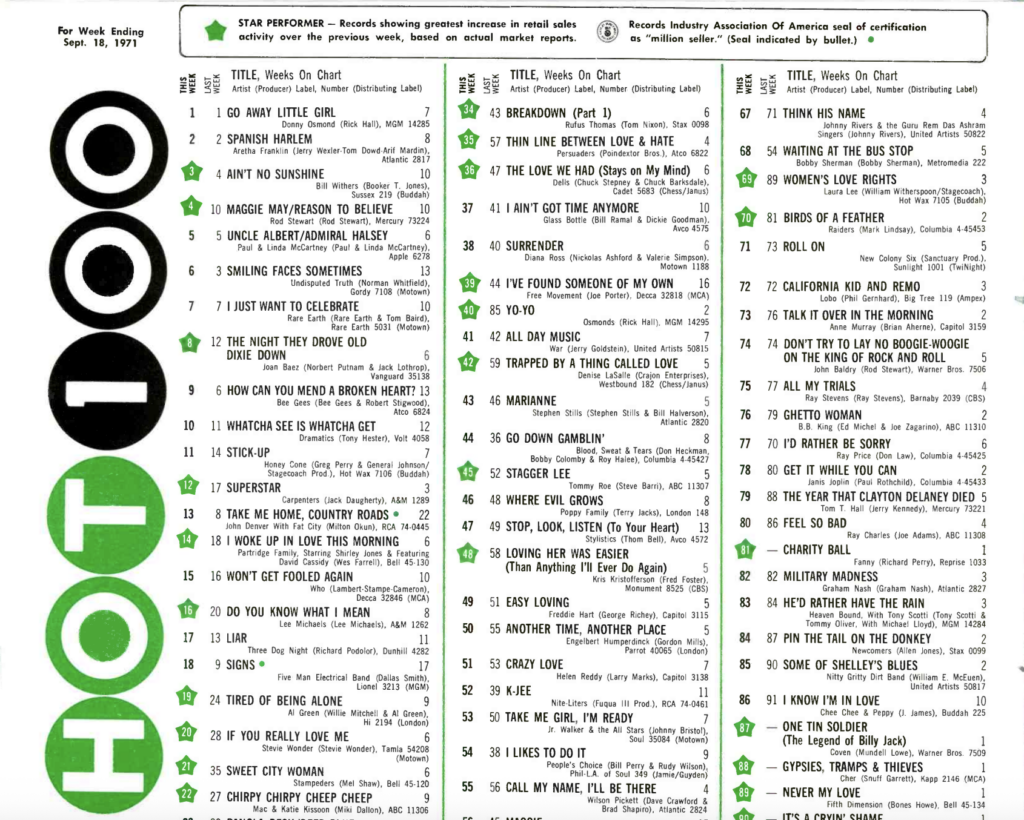
“Ain’t No Sunshine” started to get radio airplay across the world, then climbed the charts and peaked at #3 on the Billboard Hot 100. The song established Withers as a major force in the industry, earning him his first Grammy for Best R&B Song at the 14th Annual Grammy Awards in 1972.
When the song went gold, Sussex Records distribution partner Buddah Records president Neil Bogart gifted Bill Withers with a gold toilet seat.
With his success, Withers stayed just as he was, humble. “I felt like I was glad to be working someplace, you know,” he said. “It was nice and I didn’t have to get up really early in the morning anymore. So all that was kind of nice. And, you know, I stayed quiet.”
“I was able to write songs that people could identify with. I don’t think I’ve done bad for a guy from Slab Fork, West Virginia,” said Withers.
Lyrically: Ain’t No Sunshine
“Ain’t No Sunshine” is two minutes and three seconds of addiction. It was born from a single night watching a 1962 film.
Days of Wine and Roses stars Jack Lemmon and Lee Remick and follows a couple destroyed by alcohol.
“I was watching a movie called Days Of Wine And Roses with Lee Remick and Jack Lemmon. They were both alcoholics who were alternately weak and strong. It’s like going back for seconds on rat poison,” said Withers. “Sometimes you miss things that weren’t particularly good for you. It’s just something that crossed my mind from watching that movie, and probably something else that happened in my life that I’m not aware of.”
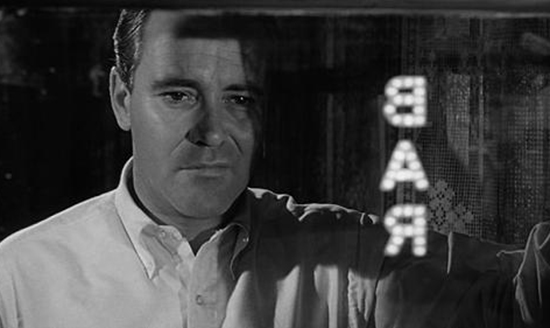
Joe, played by Jack Lemmon, is a San Francisco public-relations executive who drinks to cope with his insecurities and the pressures of his work. Kirsten, played by Lee Remick, doesn’t drink when they meet. He courts her, she falls for him and starts drinking to keep him company. They rush into marriage, have a daughter and over time become unrecognizable by the slow grip of alcohol. When the film reaches its final act, Joe has become sober through Alcoholics Anonymous. Kirsten has not.
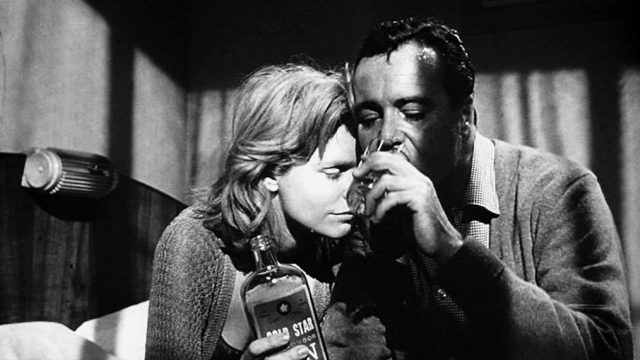
“You’d be surprised how much fun you can have sober, when you get the hang of it,” Joe tells her.
“The world looks so dirty to me when I’m not drinking,” Kirsten replies. “I don’t think I could ever stop drinking completely, not like you. I want things to look prettier than they are. But I know… l know I-I could be all right if you’d help me. I know I could, I’d be all right if we were together… and things were like they used to be and I wasn’t so nervous. I need to be loved. I get so lonely from not being loved.”
“I love you. I’m afraid of you. I’m an alcoholic. I can’t take a drink. And I’m afraid of what we’d do to each other. If you just say that you’d try… Just one day at a time… You and I were a couple of drunks on the sea of booze, and the boat sank. I got ahold of something that kept me from going under. And I’m not gonna let go of it. Not for you, not for anyone. If you want to grab on, grab on. But there’s just room for you and me, no threesome.”
She asks him to help her. He tells her she has to choose sobriety herself. She leaves. Whether she returns is left unanswered.
Their young daughter wakes and asks when mommy is coming home. Joe answers the only way he can. “Honey, mommy’s sick. She has to get well before she can come home.”
“Is she going to get well?”
“I did, didn’t I? Go to sleep.”
“Okay. Good night, daddy.”
“Good night, honey.”
It was this moment that Bill Withers carried out of the cinema and into a song.
Ain’t no sunshine when she’s gone
It’s not warm when she’s away
Ain’t no sunshine when she’s gone
And she’s always gone too long
Anytime she goes awayWonder this time where she’s gone
Wonder if she’s gone to stay
Ain’t no sunshine when she’s gone
And this house just ain’t no home
Anytime she goes away
The opening verse doesn’t say he loves her, but it’s implied. She is the light, the warmth, the home. Without her, there is none of that. He doesn’t know where she’s gone and doesn’t know if she’s coming back.
Withers immediately answers the whole verse in one sentence: “Sometimes you miss things that weren’t particularly good for you.” Addiction has a way of making that true.
“Every woman that I have had ever had anything to do with in my life before then thinks that song is about them and they’re probably all right,” said Withers.
And I know, I know, I know, I know
I know, I know, I know, I know, I know
I know, I know, I know, I know, I know
I know, I know, I know, I know, I know
I know, I know, I know, I know, I know
I know, I knowHey, I ought to leave young thing alone
But ain’t no sunshine when she’s gone, whoa-whoa
When “Ain’t No Sunshine” was just a demo, the song was incomplete and missing a third verse. The repeated “I know” was a temporary filler until he finished writing the lyrics. This never happened. When Withers stepped into the studio to record the song, Booker T. Jones said, “No, leave it like that.”
“I was going to write something there, but there was a general consensus in the studio. It was an interesting thing because I’ve got all these guys that were already established, and I was working in the factory at the time. Graham Nash was sitting right in front of me, just offering his support. Stephen Stills was playing and there was Booker T. and Al Jackson and Donald Dunn – all of the MGs except Steve Cropper. They were all these people with all this experience and all these reputations, and I was this factory worker in here just sort of puttering around. So when their general feeling was, ‘leave it like that,’ I left it like that,” said Withers.
The two words, repeated 26 times, became the bridge that connects self-awareness without self-control. He knows what he “ought to” do. But “ought to” is not “will do.”
Ain’t no sunshine when she’s gone
Only darkness every day
Ain’t no sunshine when she’s gone
And this house just ain’t no home
Anytime she goes awayAnytime she goes away
Anytime she goes away
Anytime she goes away
The final lyrics offer no resolution. Only darkness. The word “anytime” is the anchor within the habit. Not once, not this time, but every time. She comes and goes and always hits the same way. The darkness is just as dark. The house is just as empty. The substance doesn’t lose its power over you. It keeps its grip regardless of how many times the cycle is repeated. That’s the pendulum of addiction.





What does this song mean to you?
Share your thoughts on this song.