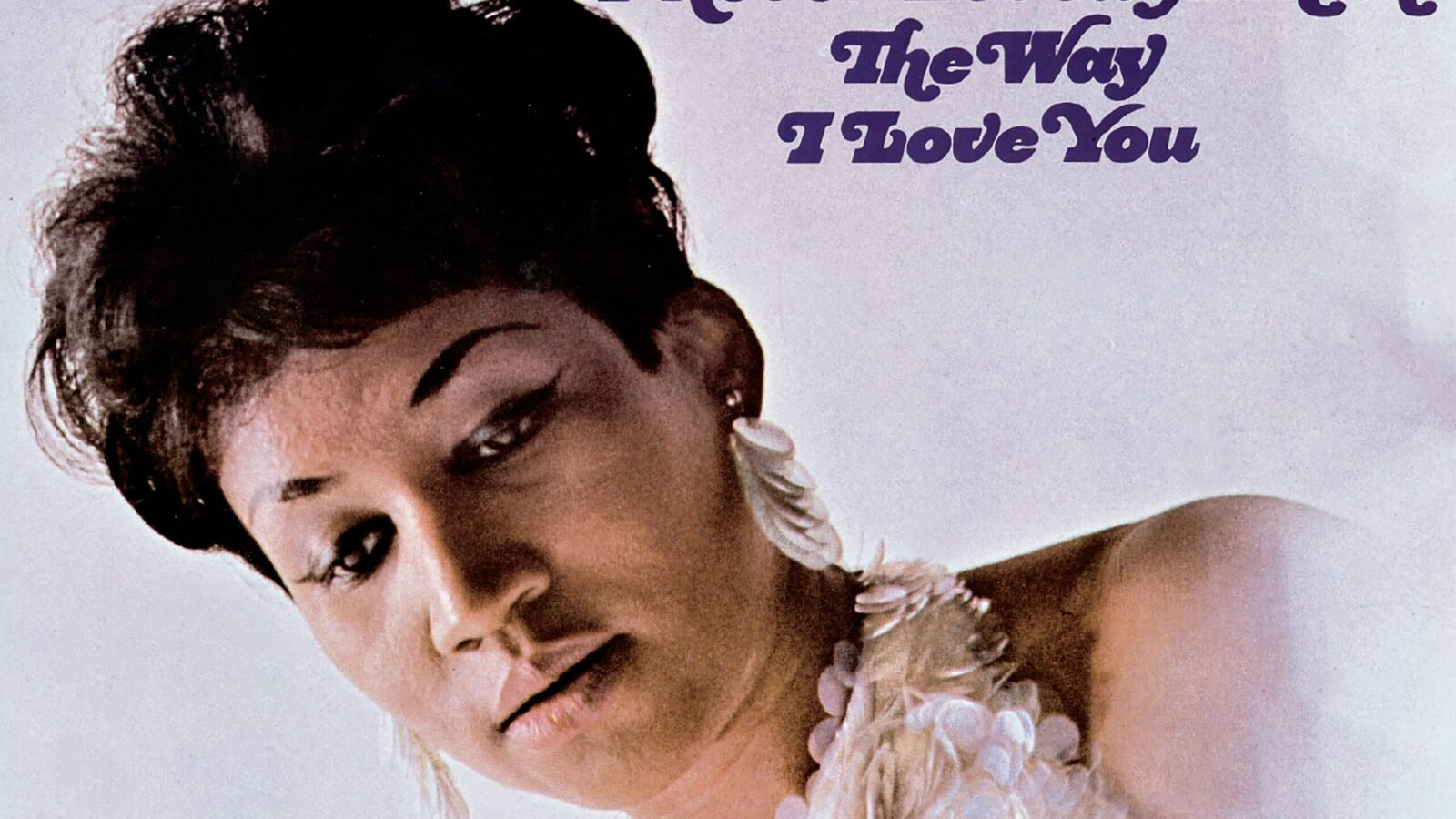
Late 1965. Detroit. Aretha Franklin has moved out of her father’s home and into her own apartment. She is cleaning and the radio fills the space.
Then she hears a song about a man demanding respect.
It’s Otis Redding. The song is his.
For now.
Franklin stops. Listens and feels the music. “I loved it. I loved it! I felt I could do something different with it.” She sits down at the piano by the window and watches the cars drift past. She starts to play.
It takes her a year and a half to make it her own.
On February 14, 1967, Valentine’s Day, Franklin walks into Atlantic Records’ studio in New York and sits down at the piano. The arrangement is already in her head. In the room: producer Jerry Wexler, engineer Tom Dowd, arranger Arif Mardin, saxophonist King Curtis, the Muscle Shoals rhythm section, and her sisters Carolyn and Erma.
Nobody in that room knows what they are about to make. A man demanded respect. A woman is about to command it.
In mid-1965, Otis Redding was in the studio talking to drummer Al Jackson, complaining about his wife Zelma and how she treated him when he came home from the road. Jackson cut him off. “You’re on the road all the time,” he said. “All you can look for is a little respect when you come home.” The remark stopped Redding and put those words straight into a song.
This song is called “Respect.”
By the time Redding released the song on August 15, 1965, Aretha Franklin had eight albums to her name. Her voice had been shaped by singing gospel in her father’s church long before it ever entered a recording studio. She was known as an artist but had minimal commercial success. She performed in supper clubs and small jazz venues, primarily touring cities like Detroit, Baltimore, Washington, D.C., Chicago, Cleveland, Boston, and Philadelphia.
By 1966, Franklin’s Columbia contract was ending, and the relationship was falling apart. The label had lost $90,000 on her music and offered a deal, but she refused. She had been steered toward pop and jazz, a direction she described as “more kind of easy listening.” “Rock-a-Bye Your Baby with a Dixie Melody” reached number 37 on the Billboard Hot 100 in 1961. It would be her only real hit there.
Ted White, Franklin’s husband and manager, was direct about what had gone wrong. “The big reason was we were tied to a five-year contract with Columbia Records and their A&R was in a flux. They simply didn’t know what to do with Aretha,” White said. “And since we didn’t have much to say about it in the contract, we just had to sit on our hands, so to speak, and wait until the contract expired.”
The frustrated Franklin added Redding’s “Respect” to her club performances.
“I remember she sang ‘Respect,'” recalled Louise Bishop, a gospel music radio personality at Philadelphia’s WDAS Radio during the 1960s. “And I just could not believe that anybody could sing that song better than Otis Redding.”
In late 1966, Bishop went to see Franklin at the Cadillac Club in Philadelphia. At the time, Franklin’s contract with Columbia had expired. The club seated roughly two hundred and fifty people. Bishop stated, “Her singing was so close to church singing that I was just in love with her. The last night she was there, I said, ‘Aretha, what are you going to do with yourself? You don’t have a contract anymore!’ She said, ‘I’m going to record myself. I’m just as good a singer as Barbra Streisand, and I’ve not had the push behind me that she has. I can sing anything she can sing — and better.’ So I said, ‘Aretha, you’re much too big a singer to record yourself. You’re an artist! I know somebody. Why don’t you let me introduce you?'”
Bishop was thinking of Jerry Wexler from Atlantic Records. “I used to call Jerry Mr. Atlantic,” Bishop stated. “I absolutely thought he was the greatest soul producer there was. I knew that Jerry’s talent was exactly what Aretha needed, so making the marriage, performing the ceremony between Jerry and Aretha, was a natural.”
Once Franklin agreed, Bishop called Wexler. “Jerry,” she said, “it’s Louise Bishop. Aretha’s ready for you.” Wexler had been waiting more than a year to hear those words. “Aretha, Jerry,” Bishop told them both. “Jerry, Aretha.”
On November 21, 1966, in New York City, Aretha Franklin signed with Atlantic Records, where she was encouraged to “drop the Judy Garland Cabaret Act.” Franklin was direct about what she wanted. “I want hits,” she told Wexler at their first meeting. “My idea was to make good tracks, use the best players, put Aretha back on piano, and let the lady wail,” said Wexler.
Wexler sent Franklin to FAME Studios in Muscle Shoals, Alabama, on January 24, 1967. FAME founder Rick Hall stated, “At around ten o’clock that morning, Aretha walked into the studio, then casually walked over to the baby-grand piano that sat in a corner of the studio in front of the large control room glass window, and sat down to do what she came to FAME to do — to cut a hit record.”
The session included some of the best musicians Muscle Shoals had to offer: Roger Hawkins on drums, Tommy Cogbill on bass, Jimmy Johnson on rhythm guitar, Chips Moman on lead guitar, Charlie Chalmers and Ed Logan on saxophones, Ken Laxton on trumpet, David Hood on trombone, and Spooner Oldham on electric piano.
Franklin recorded “I Never Loved a Man (The Way I Love You)” and began recording “Do Right Woman, Do Right Man.” The plan was to record for a full week. It lasted one day. The session was cut short when the trumpet player Ken Laxton got too comfortable with Franklin, addressing her as “Retha baby.” White took offence. The two men had been drinking together and the goodwill soured fast. White demanded the player be fired. Hall fired him. The argument escalated. Hall went to the hotel to smooth things over, against Wexler’s advice. White met him at the door on the fourth floor. The confrontation turned physical. Hall told White “he’d better get out of town.” They left town early the next morning.
With recording on pause, Wexler devised a plan to fly the Muscle Shoals Rhythm Section to New York and complete the album at Atlantic Studios, without White present.
“He didn’t have to ask us twice,” said guitarist Jimmy Johnson. “We actually would drive to Memphis and catch our first jet flight to LaGuardia. Was a big deal.”
Back in New York, Franklin completed “Do Right Woman, Do Right Man” on February 8, 1967. Wexler released it two days later as the B-side to “I Never Loved a Man (The Way I Love You),” which shot to number one on the R&B chart and number nine on the Billboard Hot 100. The momentum for Franklin had started.
On February 14, 1967, Franklin was in New York to record the rest of the album, including “Respect,” the song that she had been working on for a year and a half.
In the studio that day: Wexler producing, Tom Dowd engineering, Arif Mardin arranging, King Curtis on saxophone, the Muscle Shoals rhythm section, and Franklin’s sisters — Carolyn, who led Franklin’s vocal group and co-wrote songs for her, and Erma, a recording artist in her own right.
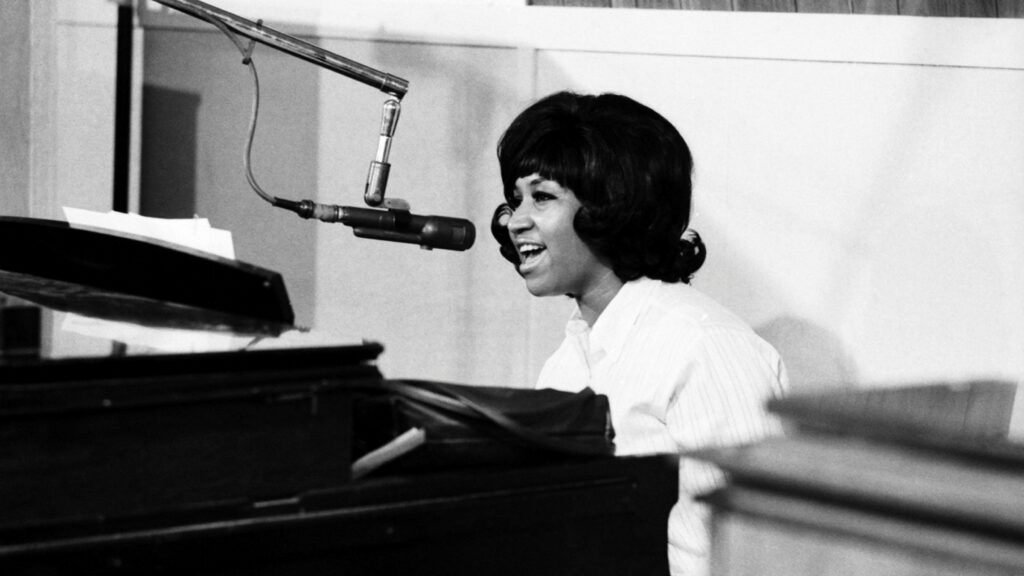
Franklin sat down at the grand piano. “She was a player like you can’t imagine,” Johnson said.
“Aretha had worked out the pattern for the songs on her Fender Rhodes at home,” Wexler explained. “She and her sisters worked out the background parts. The plan was to have her come into the studio, show that bad Muscle Shoals rhythm section her outline, and let them jam around her.”
Lyrically: Respect by Aretha Franklin
“Aretha wrote most of her material or selected the songs herself, working out the arrangements at home and using her piano to provide the texture. In this case, she just had the idea that she wanted to embellish Otis Redding’s song. When she walked into the studio, it was already worked out in her head,” said Wexler.
“I could see more potential in ‘Respect,'” Franklin said. “In fact, I can say I knew that would be a hit song.”
There would be no Aretha Franklin “Respect” without Otis Redding’s “Respect.”
Franklin transformed “Respect” from a man’s perspective into a song for everyone, everywhere. “It [reflected] the need of a nation, the need of the average man and woman in the street, the businessman, the mother, the fireman, the teacher — everyone wanted respect,” she said. “It was also one of the battle cries of the civil rights movement. The song took on monumental significance.”
What you want, baby, I got it
What you need, do you know I got it?
All I’m askin’ is for a little respect when you get home
(Just a little bit) hey, baby
(Just a little bit) when you get home
(Just a little bit) mister
(Just a little bit)
The shift in conversation is quick. In Redding’s version, he sings in the second verse, “All I’m asking / Is for a little respect when I come home.” Franklin takes the same line but transforms it by changing one crucial word, singing conversationally, “All I’m askin’ / Is for a little respect when you come home (just a little bit).”
I ain’t gon’ do you wrong while you’re gone
Ain’t gon’ do you wrong ’cause I don’t wanna
All I’m askin’ is for a little respect when you come home
(Just a little bit) baby
(Just a little bit) when you get home
(Just a little bit) yeah
(Just a little bit)
“The call for respect went from a request to a demand,” Wexler wrote. “And then, given the civil rights and feminist fervor that was building in the 1960s, respect — especially as Aretha articulated it with such force — took on new meaning. ‘Respect’ started off as a soul song and wound up a kind of national anthem.”
I’m about to give you all of my money
And all I’m askin’ in return, honey
Is to give me my propers when you get home
(Just a, just a, just a, just a) yeah, baby
(Just a, just a, just a, just a) when you get home
(Just a little bit) yeah
(Just a little bit)
“I’m about to give you all of my money” reveals that Franklin is financially independent, not dependent on another. It is a direct reversal of Redding’s original.
“Propers” was Detroit street slang, a cliche of the neighbourhood, meaning the recognition and respect you had earned. “I do say propers,” Franklin said. “I got it from the Detroit street. It was common street slang in the 1960s.”
Ooh, your kisses, sweeter than honey
And guess what? So is my money
All I want you to do for me, is give it to me when you get home
(Re, re, re, re) yeah, baby
(Re, re, re, re) whip it to me
(Respect, just a little bit) when you get home, now
(Just a little bit)
Her money is her own. She is not waiting on anyone. Franklin sings “Re, re, re, re,” which is her own family nickname. “Whip it to me” is not a request. She is telling, not asking.
R-E-S-P-E-C-T
Find out what it means to me
R-E-S-P-E-C-T
Take care, TCB
Oh (sock it to me, sock it to me
Sock it to me, sock it to me)
A little respect (sock it to me, sock it to me
Sock it to me, sock it to me)
With the now famous “R-E-S-P-E-C-T” hook, Franklin and her sister Carolyn spelled out the word and made their message impossible to miss. Franklin showed the Muscle Shoals rhythm section exactly how to play it. When the moment arrived, the entire band stopped playing. Only the vocals remained.
“I fell off my chair when I heard that!” said Tom Dowd.
Dowd had been in the room for the original Redding recording too. “I know that song,” he told Franklin when she started singing it. “I made it with Otis Redding like three years ago.” What he heard next was something different entirely. “She and Carolyn were the ones who conceived of it coming from the woman’s point of view instead of the man’s point of view. And when it came to the middle, Carolyn said, ‘Take care, TCB.’ Aretha jumped on it, and that was how we did ‘Respect.'”
Following this was “take care, TCB,” which Franklin stated means “taking care of business.”
The “sock it to me” line was created by Franklin and Carolyn. “It was a cliche of the day. And some of the girls were saying that to the fellows — like, sock it to me in this way or sock it to me that way. It’s not sexual. It was non-sexual, just a cliche line… It’s like if you gave me a high five,” said Franklin.
Carolyn remembered the lyrics arrived the same way. “I had heard the expression on the streets and thought it might work in a call-and-response with ‘Respect,'” she said. “Obviously, Otis wrote the song from a man’s point of view, but when Erma and Aretha and I worked it over, we had to rearrange the perspective. We saw it as something earthier, a woman having no problem discussing her needs. It turned out that it was interpreted in many different ways — having to do with sexual or racial politics. Far as I’m concerned, all those interpretations are correct because everyone needs respect on every level.”
Within a year, “sock it to me” had migrated to Rowan and Martin’s Laugh-In as a television catch-phrase and was appearing on bumper stickers.
The final verse. Franklin warns that she’ll leave. “Whoa, babe / A little respect / I get tired / Keep on tryin’ / You’re runnin’ out of foolin’ / And I ain’t lyin’ / ‘spect / When you come home / Or you might walk in / And find out I’m gone / I got to have / A little respect.”
“I have been in many studios in my life,” Mardin said, “but there was never a day like that. It was like a festival. Everything worked just right.”
Before the single was released, Wexler played Redding the tape in his office. “He broke out into this wide smile,” Wexler recalled, “and said, ‘The girl has taken that song from me. Ain’t no longer my song. From now on, it belongs to her.’ And then he asked me to play it again, and then a third time. The smile never left his face.”
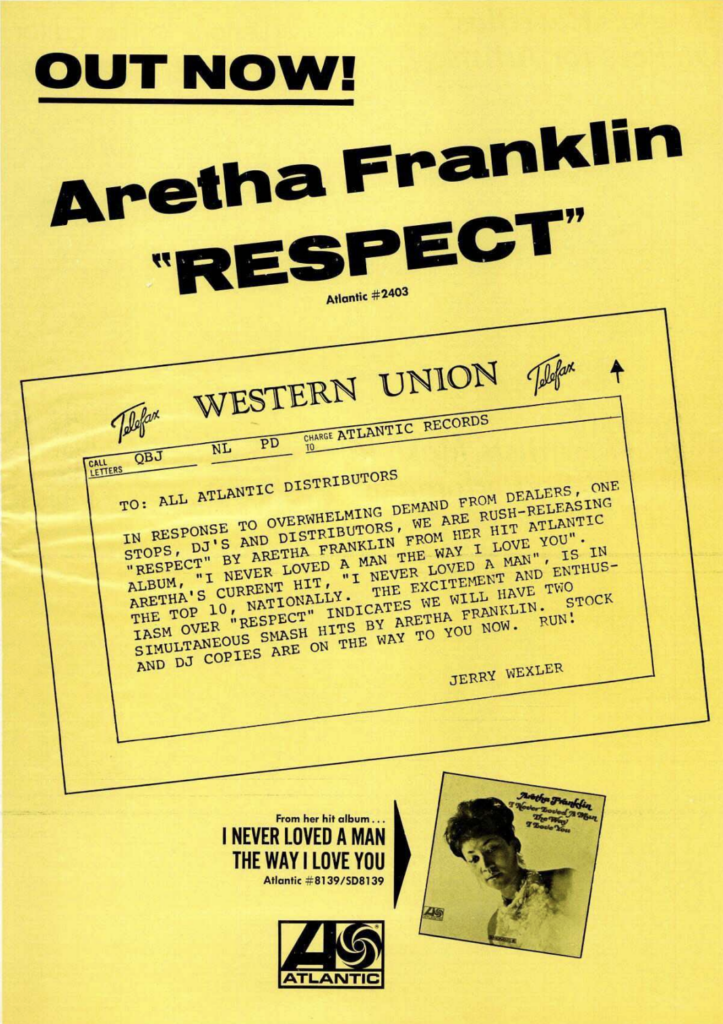
Aretha Franklin’s “Respect” was released as a single on April 29, 1967. All three major trades reviewed it the same week. Cash Box called it “oft-requested” and “frantic,” a direct reflection of the appetite her live performances had already built. Billboard called it “driving.” Record World named it Smash of the Month, stating it “the most dynamic thing to happen to the business since Ray Charles at his peak.” Across the Atlantic, Melody Maker praised the record but concluded it was “not” right “for England.” Within weeks, the world would prove them wrong.
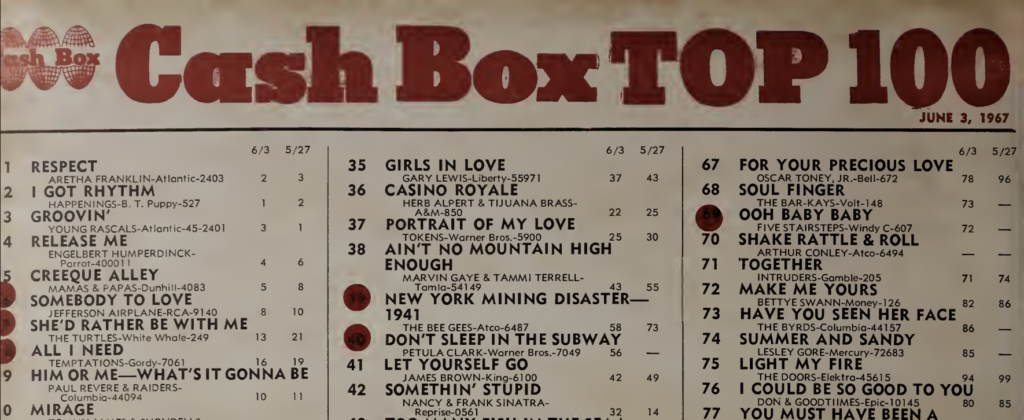
“Respect” reached No. 1 on the Billboard Hot 100 and Cash Box on June 3, 1967, where it remained for two weeks. “Respect” also held the top spot on the Billboard R&B chart for eight weeks.
While “Respect” was dominating the charts and the hearts of listeners, in May of 1967, WVON radio personality Pervis Spann introduced Franklin at Chicago’s Regal Theater as “the Queen of Soul” and placed a crown on her head.
“That happened when I was at the Regal Theater in Chicago, which was very much like The Apollo in New York. One of the local DJs there, a guy named Pervis Spann, he walked on stage one evening with a crown, and I went, ‘Whoooa! What is this?'” said Franklin. “Who wouldn’t want to be called ‘Queen’!”
In 1968, “Respect” won two Grammy Awards: Best Rhythm & Blues Recording and Best Rhythm & Blues Solo Vocal Performance, Female. The honours kept coming. In 2002, it was inducted into the National Recording Registry in its first class. Franklin would go on to become the first woman inducted into the Rock & Roll Hall of Fame and top Rolling Stone‘s list of the Greatest Singers of All Time.
On June 17, 1967, during a performance at the Monterey Pop Festival, Redding told the audience, “This is a song that a girl took away from me, a good friend of mine. This girl she just took this song, but I’m still going to do it anyway.” He performed a variation that blended his version with Franklin’s.
On December 9, 1967, in what would be Redding’s final performance before his death the next day, he sang “Respect” with Franklin’s signature hook of “R-E-S-P-E-C-T / Take care, TCB.” The next day, December 10, his plane went down over Wisconsin. He was 26.
“Respect” by Franklin became everyone’s song.




What does this song mean to you?
Share your thoughts on this song.