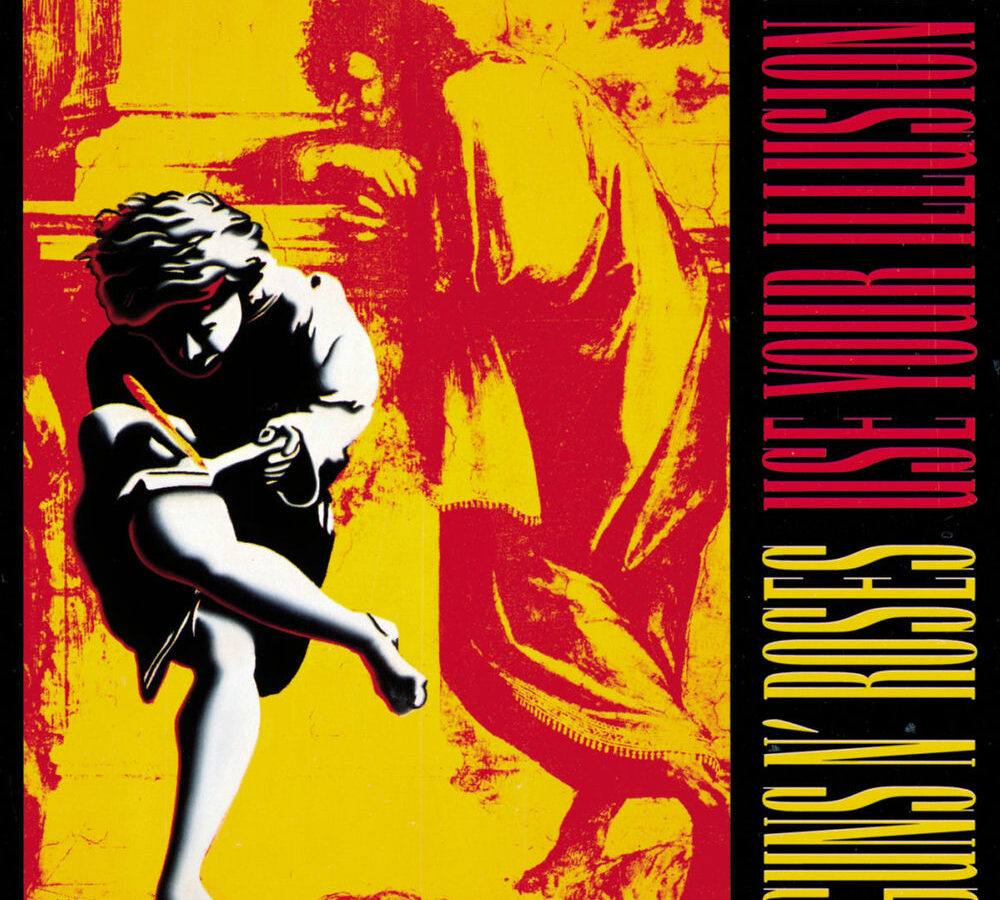
“On Tuesday, September 17, 1991, one of the most anticipated album releases in the annals of popular music will take place with the premiere of Use Your Illusion I and Use Your Illusion II from Guns N’ Roses. The occasion also marks the first time a major contemporary recording act will release two separate albums simultaneously,” stated a Geffen Records press release. “So anxious are fans that approximately 1,000 record stores around the country plan to open their doors at one minute past midnight to accommodate the Guns N’ Roses phenomenon. Radio stations nationwide are also slated to broadcast live from many of those stores at midnight and the entire day of the 17th.”
“From the beginning, when they were roaming the mean streets of Hollywood and playing nasty little clubs, Guns N’ Roses never planned to be as on-the-edge explosive, as nakedly honest, and as passionately uncompromising a rock ‘n’ roll band as there has ever been. They just were. For Axl Rose, Slash, Izzy Stradlin’, Duff McKagan, Matt Sorum and Dizzy Reed, anarchy and integrity aren’t options, they’re personality characteristics,” declared the press release.
The frenzy surrounding the launch was unlike anything the industry had seen in years. Four years after Appetite for Destruction and three years after G N’ R Lies, most retailers had secured “their largest pre-release orders ever.” Geffen Records planned to ship each album double platinum in the United States alone. “If they take off, as we believe they will,” said Geffen president Ed Rosenblatt, “in the next few months we’ll have albums of Thriller proportions.”
The midnight openings were not Geffen’s idea. “Retail outlets approached us with the idea,” explained Eddie Gilreath, Geffen’s head of sales. “Based on the enthusiasm the stores were hearing from their customers, they’re going through the expense of re-opening at 12:01 Tuesday morning instead of waiting until regular store hours. Frankly, I’ve never seen anything like this in the 25 years I’ve been in this business. Retail is expecting an explosive day.”
“The excitement in the marketplace for these albums is astonishing,” said Geffen’s marketing executive Robert Smith. “Business is always great when you’re offering something great.”
This was not just a big-city story. On September 17, at DJ’s Record Shop in Superior, Wisconsin, a city of approximately 27,000, fans lined up outside in the middle of the night, with the store letting in only five people at a time. Owner Darrell “DJ” Johnson had watched the demand build for over a year.
“As of last week they had pre-booked over 3 million through the distributors,” said Johnson. “If it’s three million and they sell it over the counter — it’s already triple platinum. It would be interesting to see if it’s Volume I or Volume II, or if they’ll share the split, being the first split album at number one. We sold out CDs before the cassettes — they told us buy more cassettes, you’ll sell more cassettes than CDs, but the CDs went first.”
One album was never going to be enough. “Izzy has brought in eight songs – at least,” said frontman Axl Rose. “Slash has brought in a whole album. I’ve brought in an album. Duff knows everybody’s material backwards. So we’ve got, like, 35 songs we like, and we want to put them all out, and we’re determined to do that.”
The two albums, Use Your Illusion I and Use Your Illusion II, delivered 30 songs that “run the gamut of emotion.” Rolling Stone was more blunt about Use Your Illusion I specifically, noting the album is “a sixteen-song tour de spleen so physically assaultive, verbally incendiary and at times downright screwy that it’s hard to believe there’s a sister disc out there just like it.”
“You Could Be Mine,” the lead single from Use Your Illusion II, was featured in the soundtrack for the movie Terminator 2: Judgment Day and sold 1.5 million singles within its first 30 days, leaving fans “temporarily sated.” Billboard praised its “thunderous rhythm section” and “breakneck guitar work and Axl Rose’s signature vocal style.” From Use Your Illusion I, three singles followed: “Don’t Cry” on September 3, “Live and Let Die” on December 9, and “November Rain” on February 18, 1992.
Billboard called Use Your Illusion I “remarkable in nearly every way,” singling out the “expansive ballad ‘November Rain'” among the album’s best tracks. Of the combined release, the verdict was unambiguous: “A brilliant vindication of America’s top hard rock band.”
Rolling Stone was less convinced, calling “November Rain” “overlong at almost nine minutes and overrich with electro-orchestration,” while conceding it has “a cool, ‘Layla’-like coda with sublime high-wire guitar by Slash.”
What those reviewers could not have known at the time was just how long that nine minutes had been in the making.
“November Rain,” Axl Rose’s magnum opus, even predated their defining debut, Appetite for Destruction, and its self-released 1986 EP Live ?!*@ Like a Suicide. Rose began writing it long before Guns N’ Roses formed in March 1985.
While resting his head, the song came to him. “I actually had a dream of the piano in the song,” Rose recalled. “I woke up and went, ‘wow, I’m gonna go try and start playing that.’ I went in and started playing it and realized I was onto something. I felt the emotions it was bringing out of me and started actually writing the words to it as I started the playing of it.”
Tracii Guns, co-founder of the rock band L.A. Guns, in which Rose was the lead singer before Guns N’ Roses existed, recalled, “When we were doing that EP for L.A. Guns, in like ’83? He was playing ‘November Rain’ – and it was called ‘November Rain’ – you know, on piano. Way back then, it was the only thing he knew how to play, but it was his. He’d go, ‘Someday this song is gonna be really cool.’ And I’d go, ‘It’s cool now.’ ‘But it’s not done’, you know, he used to say. And, like, anytime we’d be at a hotel or anywhere, there’d be a piano; he’d just kinda play that music. And I’d go, ‘When are you gonna finish that already?’ And he’d go, ‘I don’t know what to do with it.'”
Rose was patient with “November Rain,” telling Rolling Stone, “If it’s not recorded right, I’ll quit the business.”
By August 1989, the song was taking shape. “The most important songs at this point are the ones with piano, the ballads,” he told Rolling Stone, “because we haven’t really explored that side of the band yet. The beautiful music is what really makes me feel like an artist.” Asked about upcoming material, he confirmed the song was still very much alive: “There’s a song called ‘November Rain’… Last night I wrote a whole new intro. It just appeared out of nowhere.”
The band had been demoing the song with guitar and solo piano for years, with one version running 18 minutes. During the sessions for Appetite for Destruction, a 10-minute piano demo was recorded but Rose stated, “That one’s for the second album.”
“When I wanted to do the album, it was coming down between that and ‘Sweet Child,’ and I knew ‘November Rain’ wasn’t done,” said Rose. “I didn’t really want anybody to help me write it; and, at the same time, I knew that it was gonna take a lot of work to do what I wanted to do, and I really didn’t feel capable and that the people around me were capable of understanding what I was trying to do, and that there was enough time to do it. So we decided to save it.”
The Use Your Illusion recording sessions ran from January 13, 1990 to August 3, 1991, but the song did not fully come into its own until Rose shaped it in the studio. “For eight hours I just sat there and played strings to ‘November Rain’ over and over and over,” Rose recalled, “and picked every single string sound to create my own 130-piece orchestra.” Rose was very particular in what he wanted. “We went through, like, three thousand sounds. We had to sit there and go, ‘Wait, is that one sound more real than that one?'”
For bassist Duff McKagan, the song required a completely different approach. “It’s a real subtle song and you can’t attack it like we attack most of our songs,” said McKagan. “There’s certain parts of the song that you do attack. I approached it differently than I would the other songs.”
Rose had long cited the influence of many artists, including Queen, Jeff Lynn of Electric Light Orchestra, and Elton John. Of Queen, he noted that A Night at the Opera “was the first album I ever bought.”
“I’ve always looked at things in a versatile sense because of Queen, ELO, Elton John, especially early Elton John,” he told Rolling Stone. “It’s important to show people all forms of music, basically try to give people a broader point of view.” But of all his influences, one stood above the rest. “For myself as well as others, no one has been there more for inspiration than Elton John,” said Rose. “When I first heard ‘Bennie and the Jets,’ I knew I had to be a performer.”
For “November Rain” specifically, it was Tommy Lee of Mötley Crüe who provided the initial spark. “It was the first time I saw ‘Home Sweet Home,’ and watching the part of doing the piano, it made me realize that I could take what I did know about piano and focus it into something simple, but very serious,” said Rose. “I saw that video, then shut off the TV and started on ‘November Rain.'”
That influence was felt directly in the studio. “We listened to Elton John for inspiration for the drum fills and overall tone,” said drummer Matt Sorum. “I vividly remember sitting with Axl listening to ‘Don’t Let the Sun Go Down on Me’ and Axl pointing out the style of the tom fills.”
“I was writing these ballads that I feel have really rich tapestries and stuff, and making sure each note, in effect, is right,” said Rose. “Cos whether I’m using a lot of instrumentation and stuff or not, I’ll still write with minimalism. But it has to be right; it has to be the right note and it has to be held the right way, and it has to have the right effect.”
The music Rose had been carrying since 1983 was finally ready. He just needed to complete the lyrics.
Lyrically: November Rain
The inspiration came from an unexpected place.
“‘November Rain’ came about on a night where Axl called me, when he was still living with his girlfriend who later on became his wife Erin Everly, at about 4:00 in the morning and said, ‘Dude, you have to come over here,'” recalled Del James, Guns N’ Roses longtime friend and authorized biographer. “It was frightening to be around them. There was so much insanity that was brought upon by their love and their insecurities that inspired me to write this short story called ‘Without You.’ This is before Appetite for Destruction was released.”
“Essentially, the short story is about a rock star, who was inspired by Axl, who writes a song called ‘Without You’ about the woman who he loves but he can’t really have,” said James. “Although this character, whose name is Mane in the short story, has the rock ‘n’ roll world by the balls, the woman who he loves he can’t have. So his crown jewel, his song that everybody loves and respects, is also his damnation. The world might perceive a superstar having everything, all the luxuries; but it’s simple things like love and relationships that at times are the hardest to keep.”
Rose confirmed the personal connection. “He started writing this story kind of based off my relationship and used that kind of for inspiration,” said Rose. “A relationship of a singer and a woman, and a huge rock band.”
“‘November Rain’ is a song about not wanting to be in a state of having to deal with unrequited love,” said Rose. “I wrote the song basically about who I am and how I feel and the breakup of my marriage with Erin and how I didn’t want it to die. It also applied to a lot of other situations or friendships or family things where you knew it had to end.”
After several years of dating, Rose and Erin Everly, daughter of Don Everly of the 1950s rock ‘n’ roll duo the Everly Brothers, married on April 28, 1990, at Cupid’s Wedding Chapel in Las Vegas. But the marriage ended after approximately 10 months.
When I look into your eyes
I can see a love restrained
But darlin’ when I hold you
Don’t you know I feel the same?
The song opens with a search for truth, an understanding of the love that was once unleashed, is now love held back. This awareness is not only acknowledged, but mutual. Holding her, he recognizes the same restraint within himself. They are stuck in the space between feeling the love and showing the love. That gap is at the heart of everything that follows.
Nothin’ lasts forever
And we both know hearts can change
And it’s hard to hold a candle
In the cold November rain
“Nothin’ lasts forever” is not a cry of sadness but an acceptance of the volatility that love brings. The image of holding a candle in the cold November rain is relatable as sometimes it’s a struggle to keep love alive when everything around it works against it. The flame is still there. But barely.
“I know what the problem was,” Rose told Rolling Stone. “I had an extremely volatile relationship with Erin. And I was projecting strong negative feelings about myself onto other people. I was attracted to people with similar dysfunctional traits, people that I was going to end up not really getting along with. And it wasn’t good for me or them; it just made me despise being with anyone or meeting anyone or having good thoughts linked to someone.”
We’ve been through this such a long long time
Just tryin’ to kill the pain, ooh yeah
Love is always coming,
love is always going
No one’s really sure who’s lettin’ go today
Walking away
The lyrics describe the exhaustion of a long-standing, worn down relationship. “Trying to kill the pain” suggests the unresolved hurt is no longer occasional but constant, something to be managed rather than resolved. Love “always coming” and “always going” captures the exhausting push and pull of a relationship that cannot find balance. And “who’s letting go today” speaks to the paralysis both feel as neither wants to be the one to walk away.
If we could take the time to lay it on the line
I could rest my head just knowin’ that you were mine
All mine
So if you want to love me
then darlin’ don’t refrain
Or I’ll just end up walkin’ in the cold November rain
The lyric “take the time to lay it on the line” is a call for honesty without hesitation. The desire that the love be returned is clear and complete: “I could rest my head just knowin’ that you were mine… all mine.” Then comes the plea: “If you want to love me, then darlin’ don’t refrain” is as direct as the song gets. To hold back is to repeat the same uncertainty. Walking in the cold November rain.
Do you need some time on your own?
Do you need some time all alone?
Ooh, everybody needs some time on their own
Ooh, don’t you know you need some time all alone
These lyrics reflect the need for personal space within a relationship. They acknowledge that even in love, sometimes distance is necessary, not to retreat, just time alone to process emotions. The repetition emphasizes that this is universal, not a sign of failure. Taking a step back does not mean the love has ended, but can mean respecting each other enough to come home whole.
I know it’s hard to keep an open heart
When even friends seem out to harm you
But if you could heal a broken heart
Wouldn’t time be out to charm you?
Oh, oh, oh
What follows is perhaps the song’s most honest pivot, a turn from questioning the other person’s need for space to something more vulnerable. “It’s hard to keep an open heart, when even friends seem out to harm you” speaks to the pain that comes from being hurt by those closest to you. Yet the lyrics suggest time heals, and there is quiet optimism in the word “charm.” Healing is not just possible, it’s something worth looking forward to. “If you could heal a broken heart, wouldn’t time be out to charm you?” It is a quiet case for patience.
Sometimes I need some time on my own
Sometimes I need some time all alone
Ooh, everybody needs some time on their own
Ooh, don’t you know you need some time all alone
The shift from “do you need” to “I need” is the whole point, moving from questioning the other person to acknowledging his own need for space.
And when your fears subside
And shadows still remain, oh yeah
I know that you can love me when there’s no one left to blame
Even after fear fades, shadows linger. Doubt does not leave cleanly. But the more striking lyrics come in the second line. The relationship has been caught in a cycle of fault-finding, and only when there is no one left to blame can love be fully returned.
So never mind the darkness,
we still can find a way
‘Cause nothin’ lasts forever,
even cold November rain
“Never mind the darkness, we still can find a way” are lyrics that build hope and strength in the relationship, together. The repeated phrase “nothin’ lasts forever, even cold November rain” reframes the song’s central message: The cold and the rain are not permanent. Uncomfortable moments pass.
Don’t ya think that you need somebody?
Don’t ya think that you need someone?
Everybody needs somebody
You’re not the only one
You’re not the only one
The final lyrics are universal. After everything, the restrained love, the cold rain, the blame, the fears, the broken heart, everybody needs somebody.
The Music Video
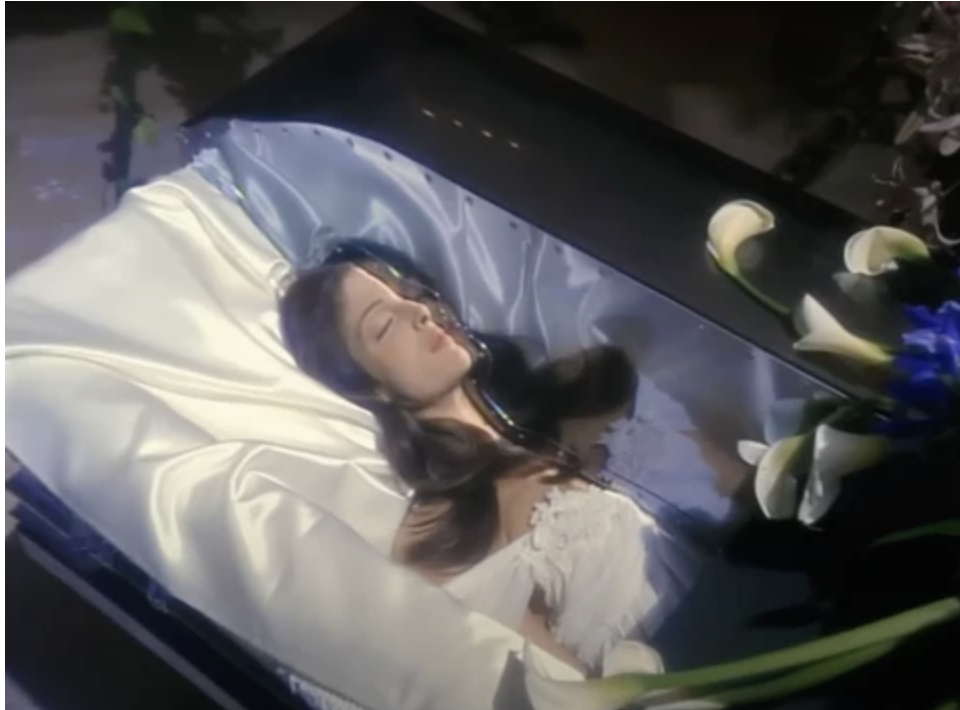
“November Rain” runs 8 minutes and 57 seconds. The music video, directed by Andy Morahan, matched the song’s intensity. At the time of its release it was one of the most expensive videos ever made, costing $1.5 million, and it became MTV’s most requested video. Rose had a clear vision for how the Del James story would translate to screen. “One of the things about the story is that it was about this band that gets huge,” Rose recalled. “And all of a sudden it dawned on me, why don’t we just use our band.”
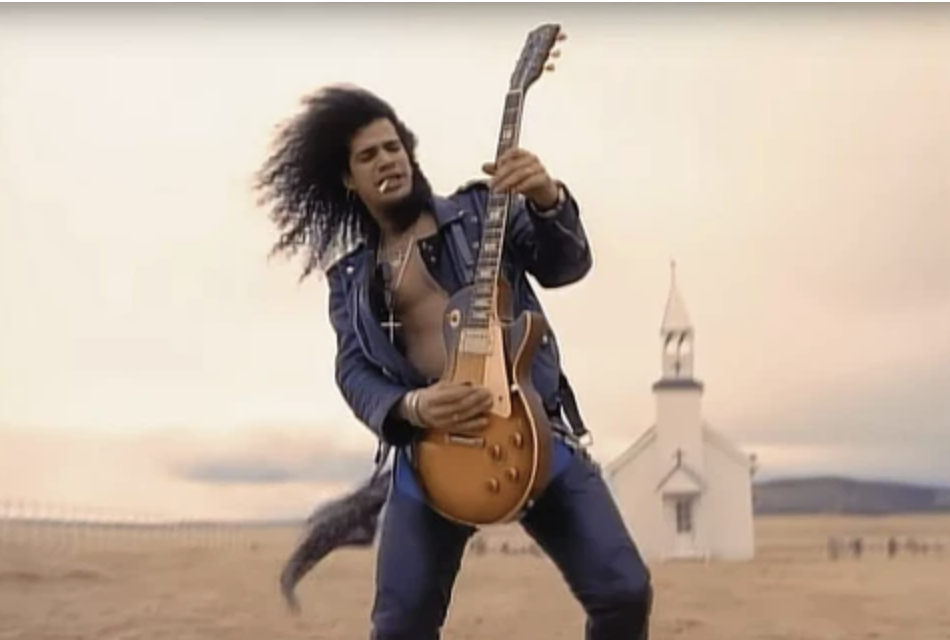
At the end of the video, which featured supermodel Stephanie Seymour, the credits read “Based on the short story ‘Without You’ by Del James,” anchoring the visuals to the story of a rock star who loses the woman he loves. Slash’s guitar solo, performed outside a church, has become one of the most recognizable moments in rock history. It arrives at the moment the song needs it most, feeling less like an add-on and more like its own emotional statement.
“Before the Illusions came out, there was talk of actually developing ‘Without You’ into a full-length feature movie,” said James. “Due to logistics, that hasn’t been able to be a reality. So what has happened is that there’s, like, kind of a condensed version of the story in the visuals. ‘Don’t Cry’ segues into ‘November Rain,’ which hopefully, if there’s time, will be ‘Estranged’ – you know, the third part of it, and it’ll all kind of make sense and we’ll tell this pretty heavy tale.”
Lay it on the line
Use Your Illusion I and Use Your Illusion II debuted at No. 2 and No. 1 on the Billboard 200 simultaneously, a first in chart history. Use Your Illusion I earned a Grammy nomination for Best Hard Rock Performance. And “November Rain” reached No. 3 on the Billboard Hot 100, at the time the longest song ever to crack the top 10. Together the two albums have sold nearly 40 million copies worldwide, each certified 7x Platinum by the RIAA.
On September 9, 1992, the video for “November Rain” won Best Cinematography at the MTV Video Music Awards. That same night, Guns N’ Roses closed the show with a respectable 9-minute live performance of the song, with Elton John on piano.
“Elton John has always been one of my biggest influences, and if it wasn’t for Elton John, this song wouldn’t necessarily probably exist for Guns N’ Roses. And then John Connelly of MTV came up with the idea of having him play it with us in the MTV Awards. So that was a great honor, to have him play the song,” said Rose. “I’ve never been that nervous but I felt that much under pressure and I was also blown away. You know, that’s Elton John sitting across playing the song, and he’s just into it, just doing it, whatever. And he kept teasing me and laughing, and I was, like, trying to keep concentrating cuz that was the longest version of ‘November Rain,’ just mentally, to play ever. I was like, ‘When this song is gonna end so I can relax?’ That was pretty extreme, but that was kind of like taking the song to its highest peak for me.”


What does this song mean to you?
Share your thoughts on this song.