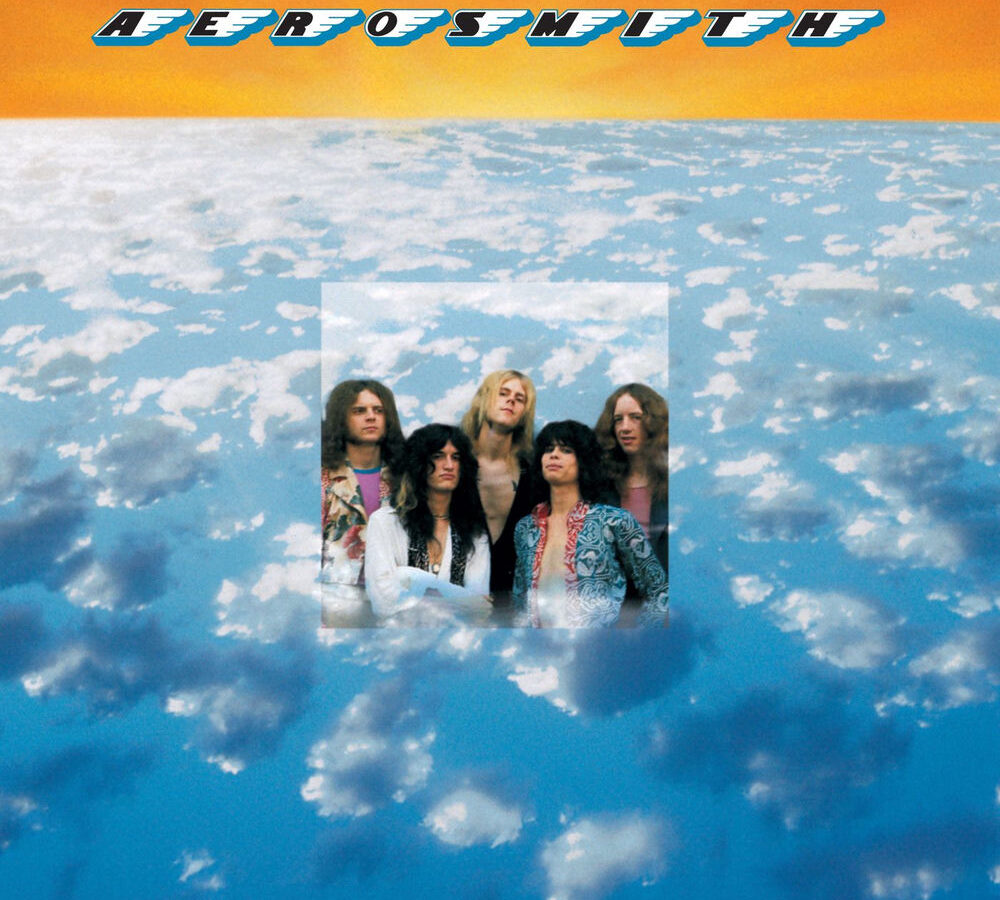
He was lying under a Steinway grand piano, looking up, when the dust fell in his eyes.
“I remember crawling up underneath the piano and running my fingers on top of the soundboards and feeling around. It was a little dusty, and as I was looking up, dust spilled down and hit me in the eyes — dust from a hundred years ago… ancient piano dust. It fell in my eyes and I thought, ‘Wow! Beethoven dust — the very stuff he breathed,'” recalled Steven Tyler, who was maybe seven years old at the time. He didn’t know it yet, but a song had already started forming inside him like a dream.
Before he was Steven Tyler, he was Steven Tallarico, and the Tallarico home was not a quiet one. His father, Victor Tallarico, had studied music at Columbia University, attended the Juilliard School in New York City, performed at Carnegie Hall with the Vic Tallarico Orchestra, and later became a music teacher. Every key on the family’s full-blown Steinway had its own life to him. His mother, Susan Ray Blancha, was a secretary, painter, maker of a legendary blueberry pie, and a highly competitive Scrabble player.
The Tallarico family moved a few times, including living in Manhattan at 124th Street and Broadway, blocks away from the Apollo Theater. In 1951, Victor started teaching at Cardinal Spellman High School and the family moved to 5610 Netherland Avenue in the Bronx, New York. In 1957, the Tallaricos moved to 100 Pembrook Drive in Yonkers.
Regardless of the address, Tyler’s home base was under the piano. “And that’s where I grew up, under the piano, listening and living in between the notes of Chopin, Bach, Beethoven, Debussy. That’s where I got that ‘Dream On’ chordage. Dad went to Juilliard and ended up playing at Carnegie Hall. When I asked him, ‘How do you get to Carnegie Hall?’ he said, like an Italian Groucho, ‘Practice, my son, practice.’ The piano was his mistress. Every key on that piano had its own personal and emotional resonance for him. He didn’t play by rote. God, every note was like a first kiss, and he read music like it was written for him,” said Tyler.
Tyler learned to play the piano but eventually turned his attention to drums, inspired mainly by listening to records of Sandy Nelson. He was also influenced by watching Elvis and witnessing the British Invasion unfold with The Beatles, The Rolling Stones, and The Yardbirds. He spent his summers playing waltzes and show tunes in his father’s band.
While attending Roosevelt High School, Tyler recalled, “In ’65, ’64, I was a drummer in a band, a school drummer. Then I bought a set of drums ’cause I wasn’t being looked at, got made fun of, because I was being called Lippo, Lippawania, and got beat up after school. I thought, ‘if we got a little band together and play at lunch that would be really cool.’ We were called The Maniacs. So we played at lunch and I went ‘holy shit, Marsha Resnick is talking to me now… and I feel cool… Jill Ellsworth… and she looked at me and no-one did before.'”
The Maniacs was short‑lived, but Tyler continued by playing drums and contributing as lead vocalist in a band that began as The Strangers, then became The Strangeurs and later Chain Reaction, a name meant to capture a continuous flow of high energy.
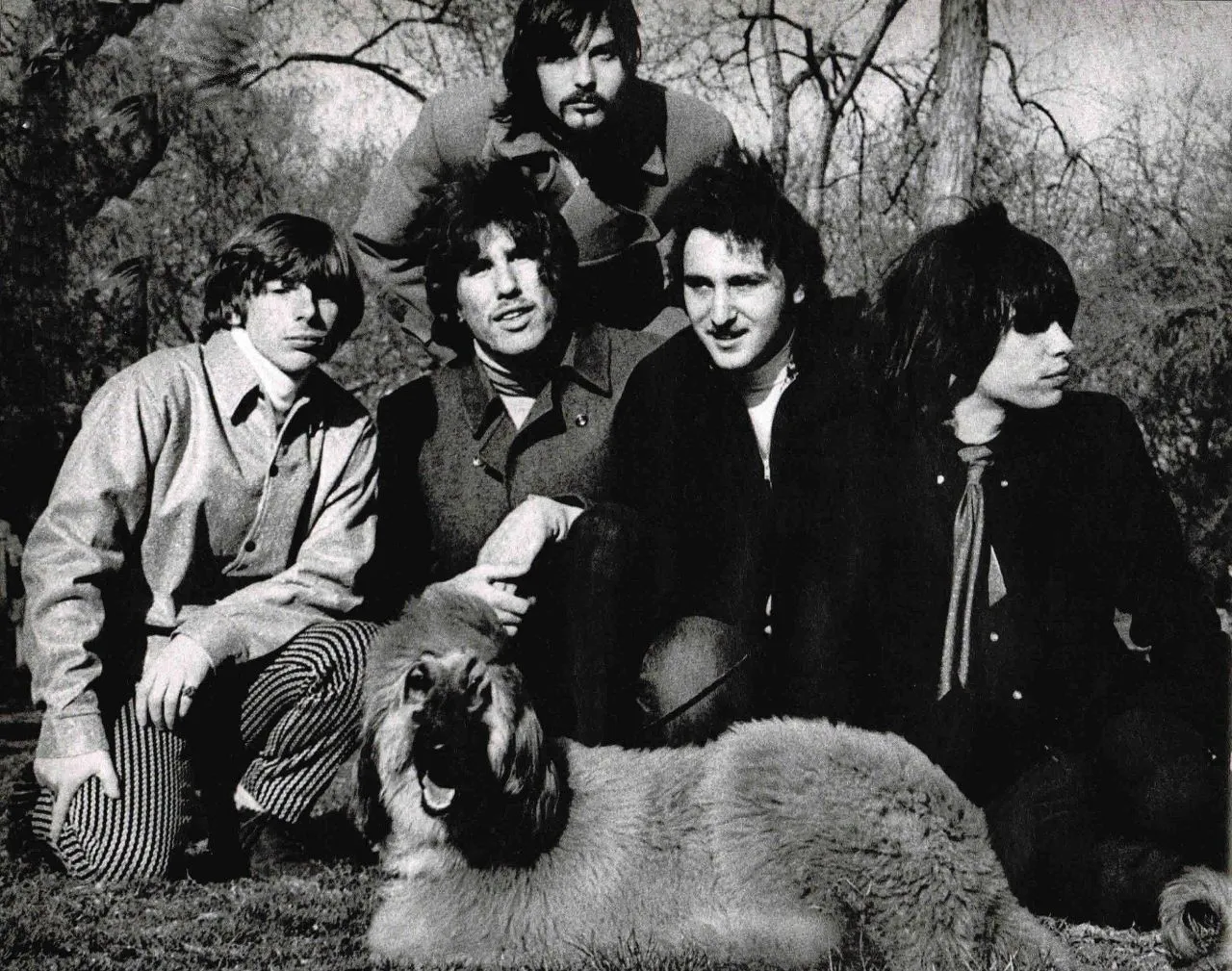
A Stranger Chain Reaction
On March 26, 1966, when Tyler was 18, The Strangers opened for The Byrds at the Westchester County Center in White Plains, New York.
“Our first gig (as The Strangers) was in front of 5,000 at Westchester County Center in White Plains, New York opening for the Byrds. Steve finally had his opportunity to be truly ‘up front,'” said drummer Barry Shapiro. “Shortly after I became a member of the group, we were told we had to change our name as there was already a group called The Strangers. (I think it was Terry and the Strangers). We even tried to change the spelling of the name to get around it (Thee Stranguers). That didn’t work and we came up with the name Chain Reaction.”
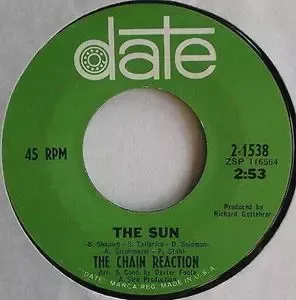
Chain Reaction gained attention and secured a recording contract with Date Records, a subsidiary of Columbia Records. The band played their own shows, including a Homecoming dance on October 15, 1966, before opening for the Yardbirds on October 22, 1966.
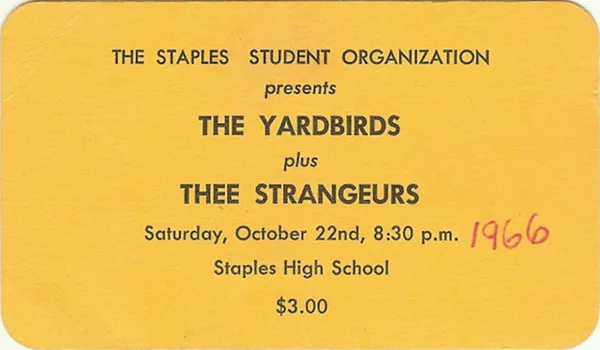
“We got to know the Yardbirds because they played at Staples High School in Westport, Connecticut, in 1966. We had a friend, Henry Smith, who had been our manager for a while, and he had gone to school there. He called me and said, ‘Steven, the Yardbirds are playing here, and you can open up.’ It was the lineup with Jeff Beck and Jimmy Page, who was playing bass on that tour. We waited all day for them to arrive. I grabbed their amps, they grabbed ours. We carried each other’s gear in, because back then, that’s what you did. Hence began the rumor that I was a roadie for the Yardbirds,” said Tyler.
Chain Reaction released its first songs, ‘The Sun’ and ‘When I Needed You,’ on December 1, 1966.
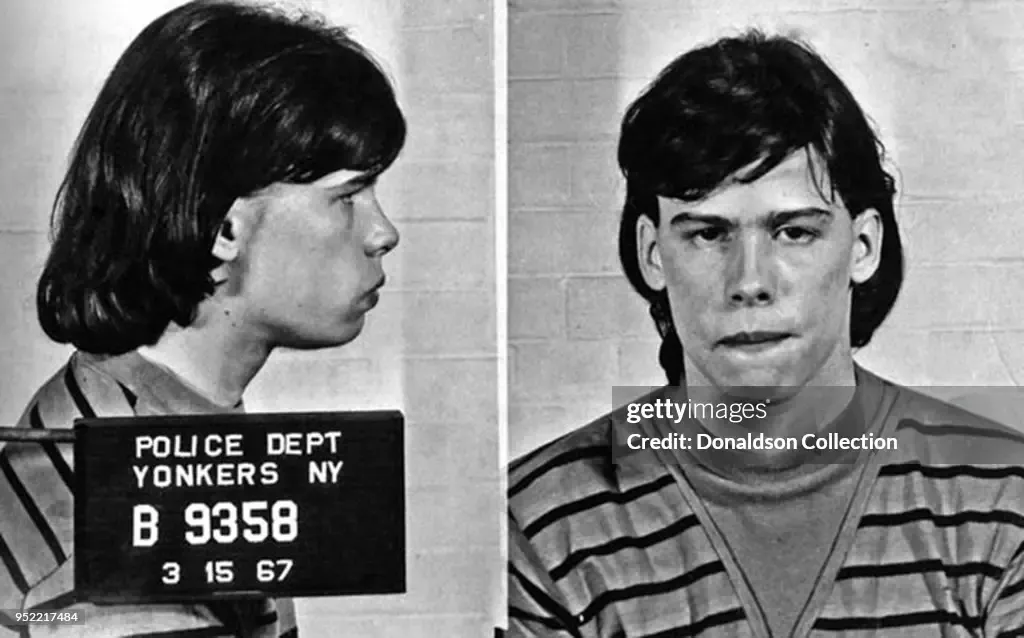
Tyler started using LSD and smoking marijuana during the mid-1960s and was subsequently thrown out of Roosevelt High School in 1967. On Wednesday, March 15, 1967, Tyler was one of ten students arrested on charges of marijuana possession.
Tyler enrolled in and eventually graduated from the Jose Quintano School for Young Professionals, a private high school in Manhattan for students pursuing careers in entertainment and the arts.
“But the drugs—it was just a way of life. If you didn’t take LSD in high school, you weren’t cool. So we took acid and walked up to the top of Mount Sunapee. Tasted the wind when it blew,” said Tyler.
Chain Reaction continued to open for bigger bands, such as the Beach Boys at the Westchester County Center on April 25, 1967, as well as The Buckinghams and Satan’s Helpers. While these performances helped establish the band’s local reputation in the New York music scene, they did not achieve significant commercial success.
“I remember being at the end of my rope… I was drumming, and I jumped over the drum set and really got into a fistfight with the guitar player. Things just weren’t happening. I split, packed my suitcase, and headed up to New Hampshire,” said Tyler.
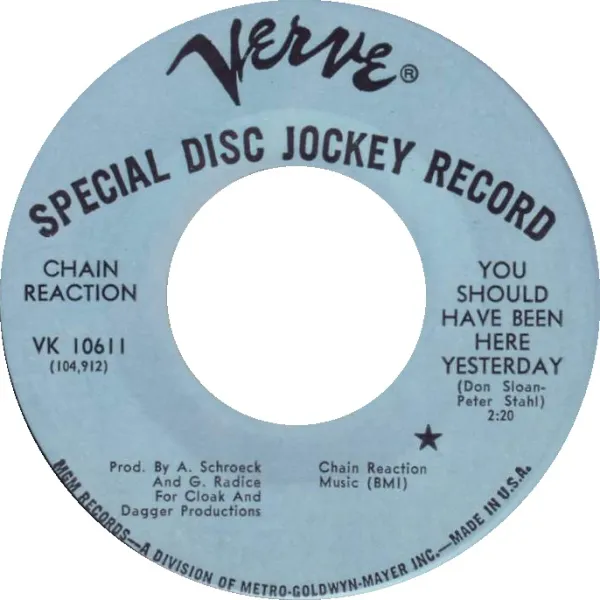
Two additional songs, “You Should Have Been Here Yesterday” and “Ever Lovin’ Man,” were recorded and later released by Verve Records in 1968.
This marked the end of Chain Reaction and a new beginning for Tyler.
Cleaning the mess at Trow-Rico
During Tyler’s upbringing, the family ventured every summer to a place called ‘Trow-Rico’ in Sunapee, New Hampshire. It was named that by combining Trow Hill, a local landmark, with Tallarico. Tyler said, “The cottages sat on 360 acres of woods and fields. It was my grandfather Giovanni Tallarico’s dream when he immigrated from Italy in 1921 with his four brothers.”
In the summer of 1966, in Sunapee, Tyler (still going by his birth name) and the other members of Chain Reaction ate at a restaurant on the harbor that later became known as The Anchorage. They were loud and left the table in a complete mess.
The person who cleaned up was 15-year-old Joe Perry, who worked at the restaurant.
“My band is eating at a place called the Anchorage, down at Sunapee Harbor… I’m sitting there eating some french fries and I realize that these are the best french fries I’ve ever had in my life. Back in the kitchen, this kid that made the french fries is flipping cheeseburgers. He has long hair over his eyes and thick black horn-rim glasses… It was Joe Perry. It later turned out he was mad because we always threw food when we ate at the Anchorage and he always had to clean up after us,” said Tyler.
“In the summers, I needed money like every kid. I hated mowing lawns, so I got a job operating the big Hobart steam dishwasher at the Anchorage, an ice cream parlor in Sunapee Harbor,” said Perry. “I remember looking out the screened window one day and thinking, Oh, that’s Steven Tallarico. I had seen his band play at The Barn and he had that song ‘The Sun’ on our jukebox. I never talked to him or anything like that, but I knew who he was. Everybody in Sunapee did, with his Mod clothes from Greenwich Village and all that shit. Steven would come in with his bands and they’d act like they figured rock stars are supposed to, throwing food, real loud and obnoxious, wearing Carnaby Street outfits, the whole trip in this little town that looked up to them as the local rock stars. Then they’d leave and I had to go out to the booth and clean up after them.”
Perry, who was born in Lawrence, Massachusetts, on September 10, 1950, became interested in music and started playing guitar at around 10 years old. He was largely self-taught, and honed his skills by listening to records from The Yardbirds, Jeff Beck, and Jimi Hendrix. “I took one lesson from a guy, and then a week later when I was driving to school, I saw a hearse in front of his house. He had died — so, that was the last lesson I took… I just took it as an omen,” said Perry.
“They were kind of loud and obnoxious and kind of big fish in a small pond, so to speak,” stated Perry. “They’re not rock stars yet, but they’re playing the part.”
Woodstock
Mid-August 1969, Tyler went to Woodstock, stating, “I went early and left three days later… So I’m tripping on acid and these helicopters are coming by with 500 pounds of hot dogs and they are dropping them in a field… then another giant pile of pots and pans to cook the hot dogs. I mean it was a disaster area. I grab the pots and pans and I started [drumming], then some other guy walks over and starts going, another guy comes over. By the time I was done, an hour later, there was 50 people banging on every pot there was there. That was a moment. Then when I got up from tripping my ass off, I walk down a path and walking towards me was one guy. It was Joey Kramer… who I knew from high school, but that I met there.”
After Woodstock ended on August 18, and with his bands broken up, Tyler was mowing the lawn at Trow-Rico when Perry drove by and invited him to see his band play at the Barn Nightclub, where they were the house band on Saturday nights.
Perry was in a band called the Jam Band, with high school friend Tom Hamilton on bass and David ‘Pudge’ Scott, who worked at The Anchorage as a dishwasher, on drums.
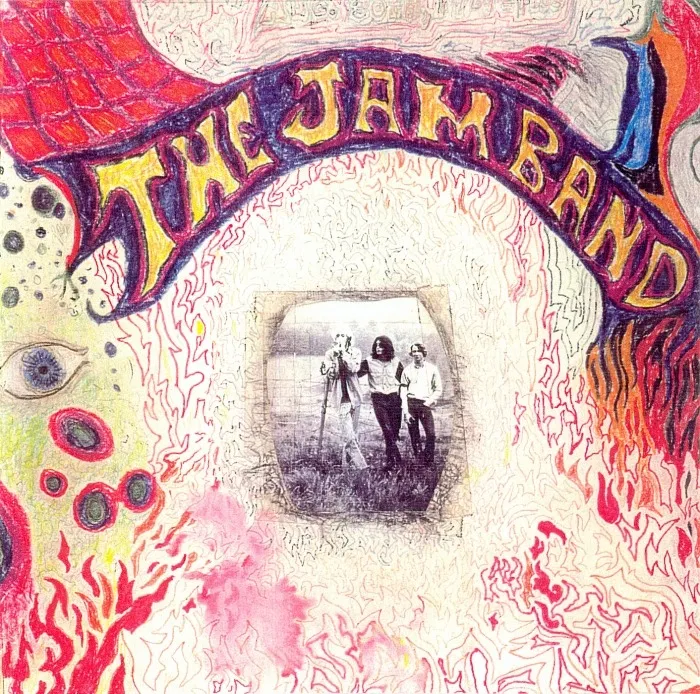
“So Joe, Tom and I were in bands for at least four to five summers in Sunapee; in the winter, we would go back to school,” said Scott. “We played as the house band at the Barn Nightclub in Sunapee… We played there one night when Steven showed up to see us. We played a rendition of Fleetwood Mac’s ‘Rattlesnake Shake.’ He came up to me after the gig and said, ‘You play the meanest backbeat I have ever heard,’ and ‘you guys are so bad, you are good.'”
That Saturday night, possibly August 23, Tyler was in the audience and witnessed the Jam Band playing. “I wasn’t expecting much… I’m listening carefully, and I’m thinking, That’s it. They suck. They couldn’t sing, they couldn’t tune their instruments, they were sloppy, and they just sucked. But… they were great,” said Tyler. “They had a groove that was better than any sex I’d ever had up to that point… I actually experienced what I can only describe as an epiphany during a song called ‘Rattlesnake Shake.’ There was just something about the way Joe played it, this whole fuckin’ train feeling. The energy was just so intense. I looked and it was like Joe Perry was the electric guitar. I thought, If I can put that energy together with something that my father gave me, that classical influence, we might have something.”
This is “when I got formally introduced to Steven,” recalled Perry.
Tyler continued playing local gigs with various musicians and writing songs. The Jam Band also kept performing, but eventually, Perry said to Hamilton, “I think we should move to Boston, rent an apartment, and start a band. I think we should just go for it.”
Perry and Hamilton moved to Boston and rented a two-bedroom apartment at 1325 Commonwealth Avenue in September 1970.
When Rod Stewart and Ronnie Wood left the Jeff Beck Group, Beck was re-forming his band and looking for a new lead singer. Tyler heard this news and asked Perry and Hamilton to be his backup band to record and send a demo tape. “He’d heard that the Jeff Beck Group were looking for a new singer,” said Perry.
They eventually came together to record a version of “I’m Down” by The Beatles. The session was a success, and Tyler and Perry continued jamming for hours afterward, solidifying their friendship. The demo tape never made it to Beck.
“I think that’s when he saw something,” said Tyler, who didn’t need much convincing. “I don’t really want to play drums. I want to be up front.” Perry replied, “Great. You be out front and we got this guy Joey Kramer and he’s talking about playing drums.”
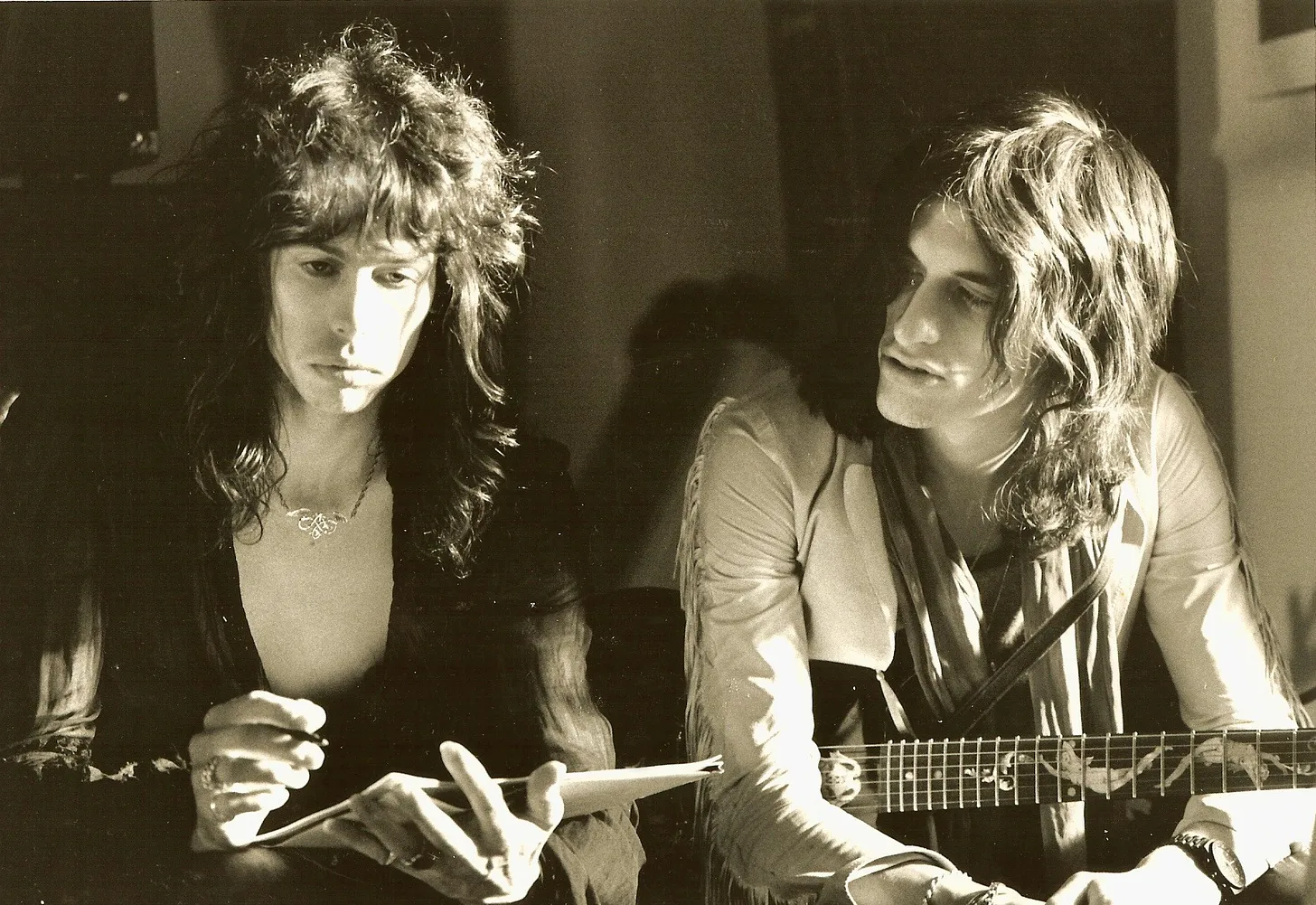
Tyler moved to Boston in October 1970. The band comprised Tyler on lead vocals, Perry on lead guitar, Hamilton on bass, Kramer on drums, and Ray Tabano on rhythm guitar.
“It was like we were the students and Steven was the teacher. He taught us order and discipline and we taught him energy and raw power,” said Perry. “What I knew how to do was get up there and rock. What Steven knew was songwriting, craft, pacing a song, a set, a whole show.”
Kramer, who knew Tyler from their days in Yonkers, had moved to Boston to study at the Berklee College of Music and joined the band after hearing Perry and Hamilton play. Tabano was a childhood friend of Tyler from Yonkers and a fellow member of The Strangers.
During their early days in Boston, they struggled financially and took various odd jobs to make ends meet. Tyler worked in a bagel shop, Perry worked as a janitor and swept floors at a synagogue, and Hamilton was an orderly at a nursing home. Kramer didn’t work, and Tabano sold leather goods. The band also played low-paying gigs at venues like frat parties and high school dances. Much of their earnings went toward rent, food, and getting high while watching reruns of the Three Stooges.
“I’m the only one of us that really had a job,” said Tabano. “Joe Perry had a job a couple of times. He would work at a place for a week and then say, ‘I can’t do this.’ I don’t think Joey Kramer was working at the time. Steven definitely wasn’t working. Tom wasn’t working… We were scrounging money all the time. We’d do a gig here and there during the time.”
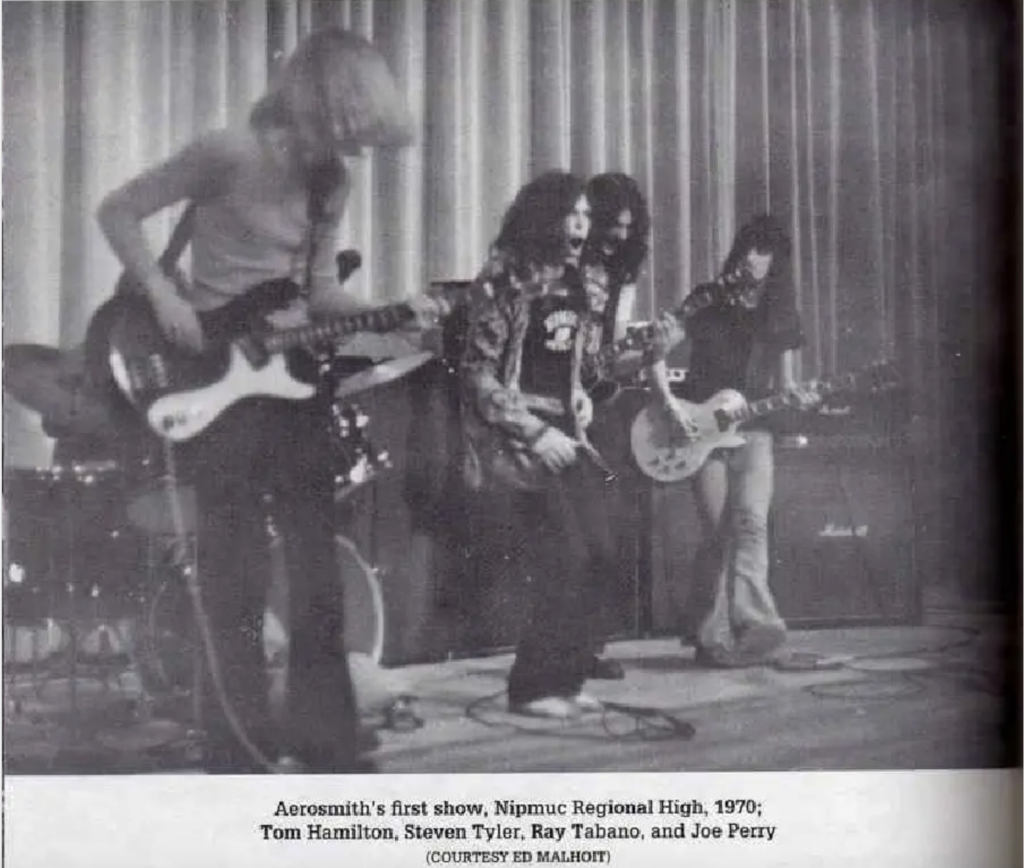
The unnamed band, referred to only as “Joe’s new band” or “Steven’s new band,” played their first show on November 6, 1970, at Nipmuc Regional High School in Mendon, Massachusetts, for $50. They got the gig because Joe Perry’s mother, who worked at a nearby school, knew Carl Olson, a history teacher at Nipmuc, and helped organize it. Tickets were about a dollar.
This first show included 11 songs: “Route 66,” “Rattlesnake Shake,” “Happenings Ten Years Time Ago,” “Movin’ Out,” “Somebody,” “Think About It,” “Walkin’ the Dog,” “Live with Me,” “Great Balls of Fire,” “Good Times Bad Times” and “Train Kept A Rollin’.”
“They didn’t play many songs but it was loud,” said Olson. “And the kids loved it, though the adults were a little taken back… They performed in the gym to a crowd of about 125 people, which was a good crowd for dances back then. The kids had a good time.”
Kramer is credited with creating the band’s name, which was inspired by a Harry Nilsson album.
“I was listening to an album at the time, by Harry Nilsson, called Aerial Ballet. We were listening to this record and I started really getting off on the lyrics. We started kicking around this word ‘aerial,’ and ‘aerial’ eventually came into ‘aero’ – I don’t know how that happened,” Kramer recalled. “And it was like Aeromind, Aerostar, Aero-this, Aero-that; and somebody said ‘smith’—Aerosmith? Wow! And from then on it was all over my high school psychology books and my math books. The question was always, ‘What’s Aerosmith?’ And I would tell people, ‘When I leave high school I’m going to go have a rock ‘n’ roll band, and that’s what it’s going to be called. And we’re going to be big and famous, and that’s the scoop.’ And they were all like, ‘Oh, that’s very nice, Joey.'”
Tabano’s time with the band proved short‑lived. His lack of practice became an issue, and by 1971 he was replaced by Brad Whitford.
“If he had continued to grow with the rest of the band he may still have been in the band. But he was kind of all over the place. He’d be late for rehearsals. Not only were we learning and getting better on our own as individuals, we were learning to find a sound and starting to develop a real musical backbone by putting our own touches on the cover songs that we were doing. That led to us finding our sound,” said Perry.
Tabano stayed on with Aerosmith as a member of the crew and is credited with creating the now-iconic winged “A” logo.
“We played at every high school in Massachusetts and New Hampshire. We’d play anywhere fifty people would show up to hear us,” said bassist Hamilton.
In 1972, after years of playing clubs throughout Massachusetts and New York, Steven Tallarico adopted the stage name Steven Tyler.
“In the early spring of 1972, Frank said he was looking for a partner in New York to help us with the record companies. We made a demo tape of one of our rehearsals and played three different dates at Max’s Kansas City in Manhattan over the next six months. That’s where we met David Krebs and Steve Leber for the first time,” said Perry.
Aerosmith entered a management partnership with Frank Connally, David Krebs, and Steve Leber.
“I played Aerosmith’s tape for two people: Jerry Greenberg, president of Atlantic Records, and Clive Davis, president of Columbia Records,” said Leber. “Then we arranged for Aerosmith to play at Max’s and invited them down. Jerry Greenberg brought Ahmet Ertegun, the founder and chairman of Atlantic. We knew that either Columbia or Atlantic would sign the band. We thought it would be Atlantic because they were the rock ‘n’ roll company, with the Stones, Zeppelin, and all their bands. Clive Davis had built Columbia more on music he liked — Paul Simon, Barbra Streisand — but he had also signed Janis Joplin and wanted to get more into rock ‘n’ roll.”
“So we’re at Max’s Kansas City, everyone drugged out of their minds, and we’re having a few drinks, and Aerosmith comes on, this young band, loud, strong, tough, Steven Tyler at twenty-four, phenomenal! They played a forty-minute set and were terrific,” recalled Leber.
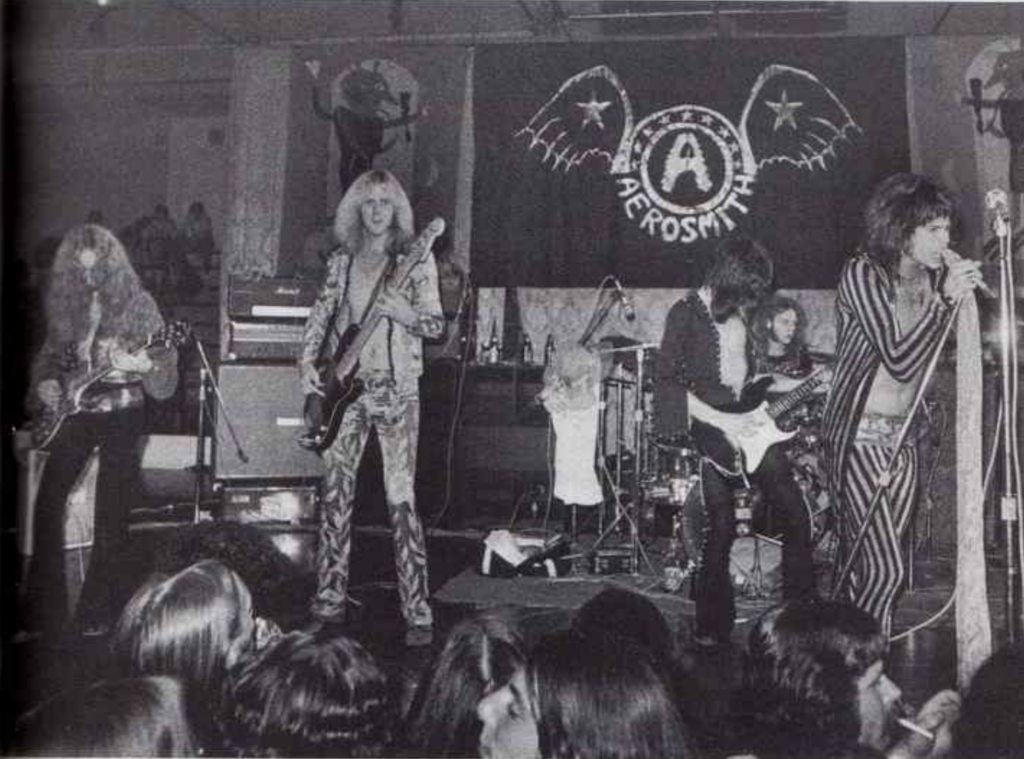
Ertegun passed on the band, mainly because Atlantic was already the distributor for Led Zeppelin and The Rolling Stones, and Tyler resembled Mick Jagger. However, Davis was impressed. “After the show Clive Davis put his arm around me, gave me a little squeeze, and said, ‘Steven, you want to know something? You’re gonna be a big star,'” recalled Tyler.
On August 5, 1972, Aerosmith signed a recording contract with Columbia Records, receiving an advance of $125,000 and a deal that called for two albums a year.
In the months that followed, the band returned to Boston, finalized their management setup, and recorded their debut album over two weeks at Intermedia Studios in October 1972.
Aerosmith released their self-titled debut album on January 5, 1973. It received little attention, though “Mama Kin” gained some airplay on radio.
The album had disappointing sales. Columbia had signed Bruce Springsteen that same year, and his debut album, “Greetings from Asbury Park, N.J.,” was released the same day. Columbia put greater promotional effort behind Springsteen’s release.
“If the release of a record is the birth of a band, ours was a stillbirth. We kept running to the newsstand to pick up Rolling Stone and read a review. But Rolling Stone never ran one. It’s one thing to have your debut criticized; it’s even worse to have your debut ignored. We were pissed,” said Perry. “There was no fanfare, no parades, no critical accolades. There was nothing at all: no press, no radio, no airplay, no reviews, no interviews, no party. Instead the album got completely ignored and there was a lot of anger and flipping out. We saw review copies of our album in the deejay bins at the record store. We’d go out on the road and couldn’t even find our record in some markets.”
The band continued to tour, and Billboard reviewed a show in Cincinnati in early March, stating, “Throughout the entire evening, from the time they came on stage, was there rarely a person sitting. Tyler’s stage charisma was such, it literally brought the audience away from their tables and ‘up to the stage boogie’ time with their group. In all, Aerosmith is distinctively very good.”
The first single from the band, “Dream On,” was released on June 27, 1973, and reached number 59 on the Billboard Hot 100.
Despite the slow start, Aerosmith hit the road and toured relentlessly through 1973 and 1974, and built up a loyal following that was dubbed the “Blue Army,” which represented their blue collar roots and jean jackets.
“We called the kids who came to see us the Blue Army,” said Perry. “We drove up to the gig and the line went around the building, long-haired teenage boys wearing blue denim jackets and jeans. An army of blue jeans. Our people.”
Their second album, Get Your Wings, released in March 1974, built on that momentum and solidified their reputation as a band to experience live. A year later, Toys in the Attic changed everything. Released in April 1975, “Sweet Emotion” and “Walk This Way” carried Aerosmith to mainstream audiences, well beyond the clubs they had spent years conquering.
After “You See Me Crying” underperformed, “Dream On” began receiving sudden radio play across the country in November 1975. Sensing the song could have a second life, David Krebs persuaded Columbia to re-release it. He was right.
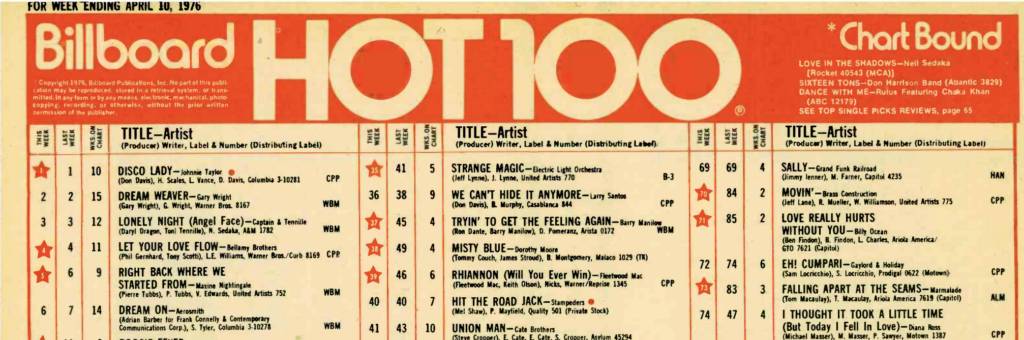
“Dream On” was re-released on December 27, 1975, and peaked at number 6 on April 10, 1976, truly living out the lyrics of the song.
Lyrically – Dream On
“Dream On” was recorded and mixed as part of Aerosmith’s debut album at Intermedia Studios in Boston over two weeks in October 1972, but the song was living inside Steven Tyler years before.
“The music for ‘Dream On’ was originally written on a Steinway upright piano in the living room of Trow-Rico Lodge in Sunapee, maybe four years before Aerosmith even started,” recalled Tyler. “When I was seventeen or eighteen, I used to come home and crash there, Napoleon Blownapart on some trashy New England weed. I’d have a pipe, go in there, and play the piano. One day I realized I’d been playing too much in the key of C, so I went to F. When you’re a kid, F is the greatest. That’s where it started. It was just this little thing I was playing, and I never dreamed it would end up as a real song or anything.”
“I had been working on ‘Dream On’ for a long time already, but the first sheet music is dated May 26, 1971,” said Tyler.
From 1970 to 1972, the band shared an apartment at 1325 Commonwealth Avenue, now nicknamed the “Aerosmith Apartment,” and it was here where bassist Tom Hamilton was frequently woken up by Tyler working the song out on the piano, which happened to be in Hamilton’s room. “Mine was the only room with a piano in it,” said Hamilton. “I remember waking up and hearing Steven playing this song over and over again. It probably pissed me off then, but now I’m sure glad he kept playing.”
“Frank Connally was always saying, ‘We gotta get the guys out of the house and away from their girlfriends and put ’em all together in a hotel or rent a house for ’em, and they’ll be creative’,” recalled Tyler. “So he booked us into the Sheraton Manchester north of Boston, where we lived and worked that fall. Then he put us into a couple of suites at the Hilton near the airport, and then there was a house in Boxboro, Mass., where we did a lot of rehearsing… The songs for the first album were worked out in all these places.”
“The first verse was written in Sunapee, and the second verse later at the Logan Hilton. The song was first brought to the band at a house in Boxboro,” said Tyler. “There were only six songs ready for the record and four more were needed. There was a piano in the basement where the melody was played for the rest of the group. Right away, Joe Perry started playing the right-hand parts on his guitar, while Tom Hamilton played the left-hand parts on bass. It was a significant moment getting the band to play the song, as there had been some resistance to the style initially. Later, while working on the bass line with Tom, the realization that the song was finally coming together brought a great sense of emotional relief.”
Every time that I look in the mirror
All these lines on my face getting clearer
The past is gone
Oh, it went by like dusk to dawn
Isn’t that the way?
Everybody’s got their dues in life to pay, oh, oh, oh
I know nobody knows
Where it comes and where it goes
I know it’s everybody’s sin
You got to lose to know how to win
The song began to take shape when Tyler was 17 or 18, around 1965 to 1966, before Aerosmith existed. Tyler had minimal recognition and a hunger to be somebody. By the time he reached the studio, he had lived through failed bands, years of struggle, and an unrelenting desire for success.
The opening lyrics present images of self-reflection and the passing of time. The past is already gone and life keeps moving whether you are ready or not. The line “you got to lose to know how to win” acknowledges that failure is not the opposite of success but the price of it.
“This song sums up the shit you put up with when you’re in a new band. Only one in fifty people who write about you pick on the music. Most of the critics panned our first album, and said we were ripping off the Stones,” said Tyler.
“Dream On” reads like the rock version of Oh, The Places You’ll Go! by Dr. Seuss. Nobody fully understands where life comes from or where it leads, and the phrase “everybody’s sin” makes that uncertainty something we all carry.
Half my life’s in books’ written pages
Live and learn from fools and from sages
You know it’s true
All the things come back to you
With the mention of “half my life’s in books’ written pages,” life’s lessons come from many different places, including reading and studying others’ experiences. Lessons arrive not just from books but from unexpected places, whether from the mistakes of fools or the wisdom of sages. The line “all the things come back to you” suggests that life has a way of repeating the lessons we need to learn.
Sing with me, sing for the year
Sing for the laughter and sing for the tear
Sing it with me, if it’s just for today
Maybe tomorrow, the good Lord will take you away
Pursuing your dreams brings a roller coaster of emotions, laughter and tears, and singing serves as the bridge for how we carry these emotions. The invitation to sing “with” rather than alone underscores a shared experience, while “just for today” suggests that living in the present moment should be our focus, as we don’t know what tomorrow will bring. The final line adds a spiritual element, reminding us that life is truly unpredictable.
Dream on, dream on / Dream on, dream until them dreams come true.
The chorus is so powerful that it is repeated like a mantra. These are words to live by and live at the heart of the song’s message about persistence and belief. The lyric “dream until your dreams come true” reminds us that success is something you return to every day until it becomes real.
Tyler stated that Dream On is “about the hunger to be somebody: Dream until your dreams come true.”
“Sure, we’re the sum of our experiences. If you listen to that song I wrote in 1969, ‘Dream On,’ you might get a different view. I may not have been quite sure of what I was doing, but I was on to something,” said Tyler.
In 2018, “Dream On” was inducted into the Grammy Hall of Fame, certified 4× Platinum by the RIAA, and ranked No. 172 on Rolling Stone’s 500 Greatest Songs of All Time. The song was sampled by Eminem in 2002’s “Sing for the Moment” and has appeared in numerous films including Wayne’s World 2, Armageddon, and Rock of Ages. “Dream On” remains a staple at Aerosmith’s live shows.
“People ask me all the time what ‘Dream On’ is all about. It’s simple. It’s about dreaming until your dreams come true. It’s about the hunger and desire and ambition to be somebody that Aerosmith felt in those days,” said Tyler. “You can hear it in the grooves because it’s there. It was ‘Make it, don’t break it’ for real.”


What does this song mean to you?
Share your thoughts on this song.