Berkeley, California. Winter 1988.
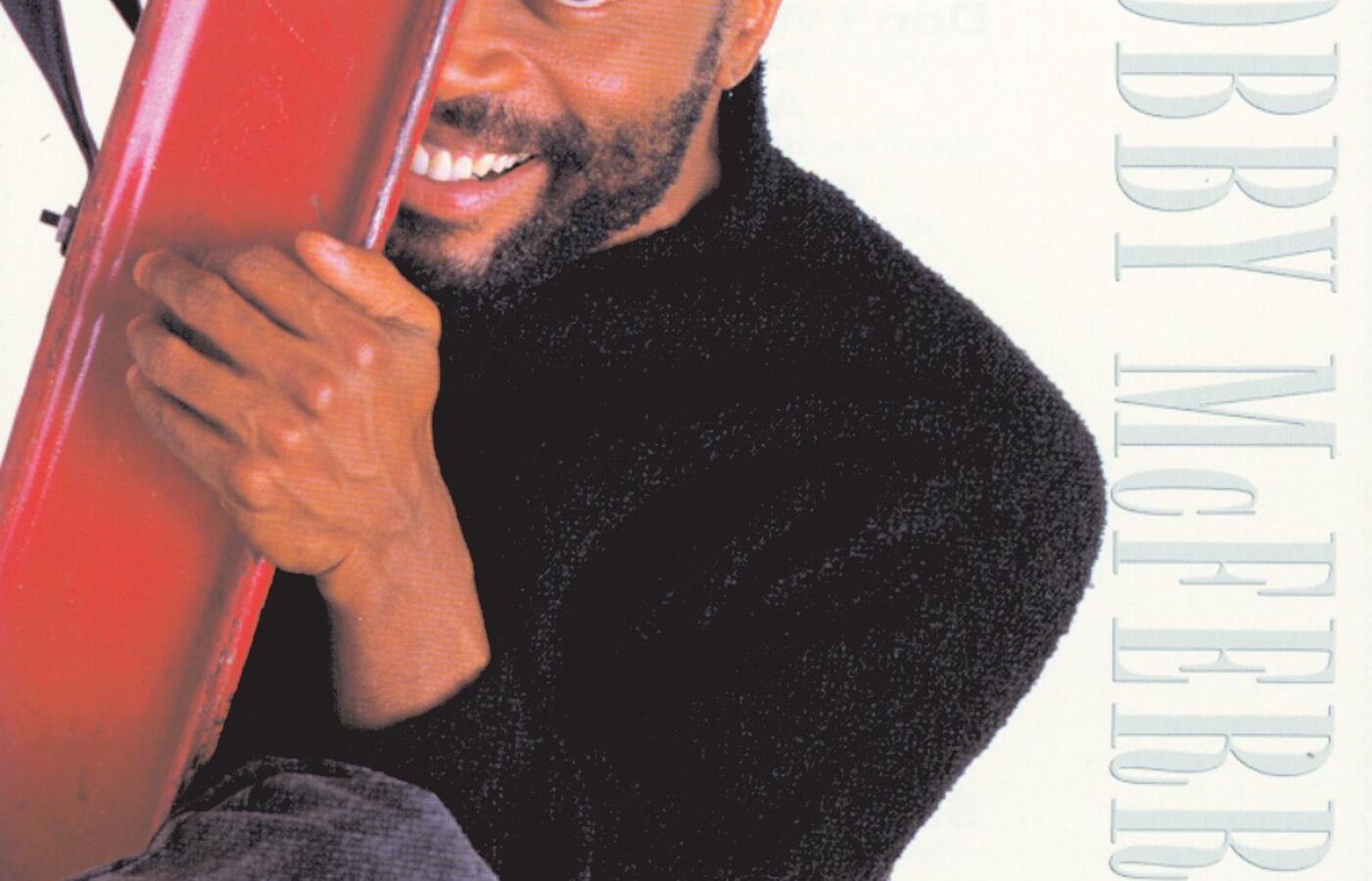
Bobby McFerrin is not supposed to be a pop star. He is a jazz singer from San Francisco who built his career entirely on performing alone, without instruments, without a band, without anything except what his body can produce.
Three albums in, he has earned critical praise and a loyal audience. The sales have never followed and his label is running out of patience. His manager, Linda Goldstein, has been with him since 1979 and believes in him anyway.
Goldstein steps out of the car. McFerrin is beside her. The engineer, Chris Tergesen, pulls up behind them. They are heading into Fantasy Studios to begin recording McFerrin’s final album under his Elektra Records contract.
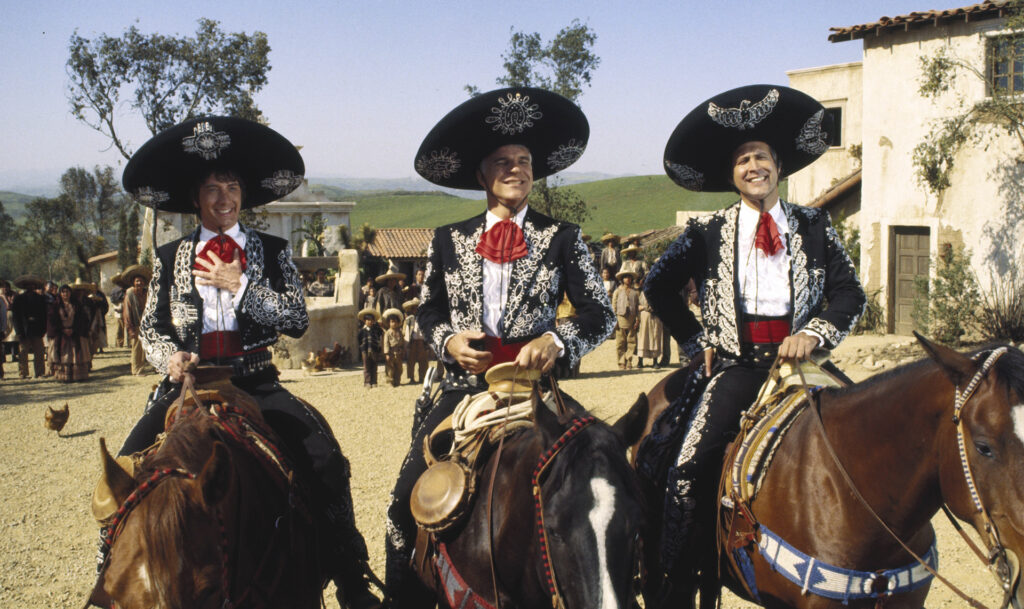
Nobody is talking about that. They are talking about The Three Amigos. McFerrin had recently seen the Chevy Chase, Steve Martin, and Martin Short comedy and cannot let it go. The accents. The ridiculous, clumsy, fake Spanish accents. By the time the three of them cross the parking lot, they are doing their own versions. Badly. Happily.
Then Goldstein sees the doors. One reads: Stu. The other reads: Dios. “Stu. Dios. Hola, Stu,” said Goldstein. They all burst out laughing.
McFerrin sits down at the piano and starts playing. In a Spanish accent, in the character of a man named Juan, he opens his mouth.
“Don’t worry,” he sings. “Be happy.”
Bobby McFerrin did not arrive at that piano by accident.
Both of McFerrin’s parents were voice teachers. Students moved through their Los Angeles home all day long. His father, Robert McFerrin Sr., helped break the colour bar at the Metropolitan Opera, singing a major role in Aida in 1955. His mother, Sara Copper McFerrin, was an accomplished soprano soloist who taught voice at Fullerton College in Southern California and served as the soprano soloist at St. John’s Episcopal Church.
Music began before McFerrin could speak.
“The whole time that I was carrying Bobby, I was at the piano all the time,” Sara McFerrin said. “He was getting an input of music constantly on a daily basis. And so when he was born, as I say, he came out singing.”
Bobby and his sister Brenda would stand in their cribs facing each other across the wall and sing to each other before either of them had words to sing with. “She had her crib song, I had mine,” McFerrin said. “And we would sing them to each other.”
At five, he began learning piano. At ten, he took up the clarinet and fell in love with it immediately, earning first chair in his school orchestra within weeks.
“The clarinet was my first heartbreak in my life,” McFerrin said. “I had to have braces. And the orthodontist said that I could not play clarinet and wear braces, and my heart was broken.”
He returned to piano.
“My father had the good fortune of being taught how to sing the spirituals by Hall Johnson,” McFerrin said.
McFerrin sang in the children’s choir and served as an altar boy. He grew up hearing Bach, Handel, and experimental modern works from the pews every Sunday. At home, the music never stopped.
“There was singing, singing, singing going on all the time,” McFerrin said.
His father “was a humble man” and a demanding teacher, stopping students mid-phrase, drilling breath and diction, refusing to let praise substitute for precision. “God’s given me this gift,” the elder McFerrin would say. “He’s entrusted me with a talent, and it’s my job to take care of it.”
“Those words have stuck with me,” McFerrin said. “I feel like I’ve been entrusted with a talent. It’s my job to take care of it.”
He considered a monastic order at 16. He considered the priesthood at 24. Neither held.
He had spent seven years playing piano bars up and down the West Coast, sitting in with rock and funk bands, directing regional choirs, playing organ in churches, and composing for dance troupes.
“Music had always been a part of my life,” he said. “Singing at 27 just took over.”
On July 11, 1977, something within McFerrin shifted.
“One day, I just knew I wasn’t a pianist,” McFerrin said. “I just all of a sudden knew that I was not a pianist and that I was a singer.”
The inspiration for his solo a cappella approach came from an unlikely place: pianist Keith Jarrett. Watching Jarrett walk onstage alone and improvise without accompaniment gave McFerrin an idea. He would do the same thing with his voice.
“I was fascinated with the whole solo concept of singing,” McFerrin said. “On stage by myself. A cappella.”
Now based in San Francisco, he took singing gigs wherever he could find them and went to every jam session he could find. In 1980, jazz vocalist Jon Hendricks invited him to sit in with his band.
“I was in New York, walking down 7th Avenue past Sweet Basil, and there was John Hendricks with his family. And this guy, Bobby McFerrin, was singing the Lambert, Henderson and Ross material. John introduced him to do a solo number, and Bobby sang completely a cappella,” Goldstein said. “Bobby sang really all the parts, tracing the bass lines in this incredibly funky way, tracing all the harmony of the chords, and he did it with his single voice. I have never heard anything like it in my entire life.”

His singing caught the ear of Bill Cosby, who arranged for McFerrin to perform at the 1980 Playboy Jazz Festival at the Hollywood Bowl.
“I was able to borrow a recording studio in Los Angeles, and we were able to go and play the songs that Bobby had rehearsed for the Hollywood Bowl in the studio, and those became the demo tape that I was able to shop in order to get Bobby a recording contract,” Goldstein said.
Then, in 1981, he took the stage at the Kool Jazz Festival in New York. Bruce Lundvall, president of Elektra Records, was watching. He signed McFerrin.
His first album, the self-titled Bobby McFerrin, was released in 1982. It did not top any charts. It did not generate any hits. But it won him enough fans and critical attention to keep going. Time Magazine wrote, “calling Bobby McFerrin a singer is like calling the Grand Canyon a hole.”
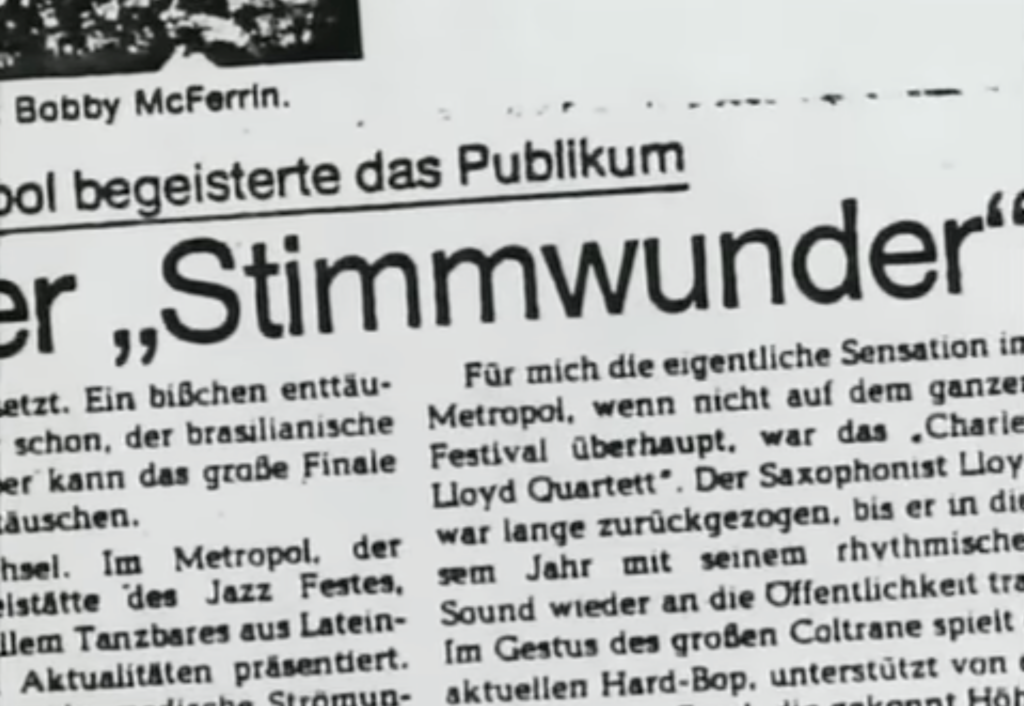
His second album, The Voice, recorded live during a solo tour of Germany in 1984, was something else entirely. No instruments. No overdubs. Just McFerrin alone on stage, building entire songs from a single voice. German critics called him Stimmwunder, which translates to Wondervoice. His label had wanted a pop record. He had given them a glimpse into the future.
When he scheduled his first solo European tour, promoters who could not imagine him holding an audience without backup musicians cancelled half the dates. When he proved them wrong, bookings poured in.
Spontaneous Inventions followed in 1986, featuring surprise guests including Robin Williams and Wayne Shorter. It became his best-selling album to that point, selling around 200,000 units.
Vocalist Mel Torme was paying attention. “If there is such a thing as a jazz singer, I think maybe Bobby is the purest of the pure,” Torme said. “Perhaps he is at the forefront of a whole new generation of young singers who are not going to bother much with lyrics or popular songs or, if they do, are going to simulate instruments. It’s a new dimension.”
McFerrin himself was less interested in definitions. “I wish I knew how to define what I do, but at the same time I’m glad I can’t really define it yet,” he said. “A definition would be a barrier, and I don’t want to build a wall around me.”
By the time McFerrin walked into the studio in the fall of 1987, he was hardly unknown. He had won the Down Beat magazine readers’ poll for best male singer four years running and had taken home the Grammy for Best Male Jazz Vocalist three consecutive years. Nobody, however, saw him for a pop star.
For Simple Pleasures, Elektra wanted something more commercial. They offered him a big-name producer and a larger budget. He turned them down.
“I felt that if I wanted people to really know who I was as an artist, I should do this first,” he said.
When McFerrin brought Lundvall the concept for an all-vocal album, Lundvall pushed back. McFerrin held firm.
“God wants me to make this record,” he said.
Lundvall paused. “Who am I to stand in the way of God?”
By the fall of 1987, Simple Pleasures was underway at the Power Station in New York City. The album was McFerrin’s vision realized: nothing but his own voice, layered and multi-tracked, no instruments.
Shortly before the sessions began, McFerrin had recorded the theme for The Cosby Show at Power Station with engineer Chris Tergesen using the same overdubbing method.
The song list for Simple Pleasures had been settled. “It was never on the list to record ‘Don’t Worry Be Happy,'” Goldstein said. “The list had Eric Clapton’s ‘Sunshine of Your Love’ and Buddy Miles’ ‘Them Changes.’ And that was enough.”
Before any of that, there was a poster. In the early 1980s, McFerrin was walking through Manhattan when he spotted it on a wall. It bore the image of Indian spiritual master Meher Baba, who had taken a vow of silence years earlier and communicated with his followers through an alphabet board. He had never spoken the words aloud himself. The phrase had already been circulating in counterculture circles for decades, appearing on bumper stickers and posters. The poster said: Don’t Worry, Be Happy.
“I wanted to remember it,” McFerrin said. “I wanted to remember it all. So I wrote a song about it to remind me what to say. Don’t worry. Be happy.”
The phrase stayed with him for years.
In the winter of 1988, the sessions moved to Fantasy Studios in Berkeley, California. It was there that “Don’t Worry Be Happy” was recorded.
Then came the parking lot, the doors, and the character of Juan.
“We had just seen the movie The Three Amigos and we were all doing the bad Spanish accents from that film,” Goldstein said. “We were just cracking each other up, making all sorts of stupid jokes, like, ‘It takes Juan to know Juan.’ We arrived at Fantasy and the entrance to one door said ‘STU’ and the other ‘DIOS,’ and we thought that was hilarious, so we kept going with Spanish accents. Bobby went to the piano in the midst of all this and started playing this tune, and I said, ‘Why don’t you sit down and write some lyrics to that?’ And Bobby wouldn’t stop doing this character, which is funny because to this day people think it’s Bob Marley or some Jamaican guy. But it’s not. That’s how bad his Spanish accent is.”
McFerrin agreed that the sound was never quite Jamaican.
“I hate to go so far as to say it`s Jamaican,” he said. “It was heavily influenced by Juan`s Mexican Restaurant, which was just around the corner from the studio.”
Goldstein rolled tape. McFerrin started with a rhythm bass part, slapping his chest as he sang to create percussive sounds. He doubled it, added harmonies, developed the melody, and saved the lead vocal for last. Eight tracks in total.
“I know I didn’t have ‘Don’t Worry Be Happy,'” McFerrin said. “That was scribbled in the studio at the last moment. And literally, just the lyrics and everything in the studio. Boom, boom, boom, boom, wrote them down, and then OK, and then it was written within an hour, I think it was all done. Boom. Who would have thought? Who would have thought?”
Elektra was not impressed. The label considered cancelling the album’s release entirely. There was resistance from another direction too.
“I had people saying, don’t put it on the record,” Goldstein said. “They won’t take Bobby seriously as a jazz artist. I have to frequently defend ‘Don’t Worry Be Happy’ because sometimes, especially in the jazz world, people are dismissive about it.”
After some back and forth, they agreed to put it out.
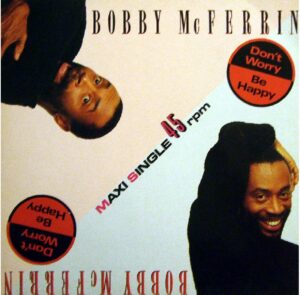
Simple Pleasures was released on March 23, 1988. By the time EMI-Manhattan prepared to release “Don’t Worry Be Happy” as the album’s first single, the record had already sold 250,000 units on the strength of McFerrin’s live following and a Levi’s television commercial.
The single had been planned to coincide with the release of Cocktail, the Tom Cruise film set in Jamaica, on July 29, 1988. Radio moved faster. Stations were already playing the song as an album track, and EMI VP of promotion Jack Satter pushed the release date up by three weeks.
“I think 250,000 records reflects a very strong audience base that Bobby had already developed through his live performing and through some TV appearances, particularly things like his Levi’s commercial,” Goldstein said.
The first station to break the song was KFMB-FM “B100” in San Diego. Music director Gene Knight called it “the ‘Morning Zoo’ anthem.” The phones lit up immediately.
“Every so often a song comes along that touches off a catch phrase,” said Billboard’s chart analyst Paul Grein. “Usually it works the other way around, where a song will capitalize on a catch phrase. This song is unprecedented.”
The song crossed every format boundary, airing on jazz, Top 40, and country stations simultaneously.
“Everybody’s talking about this record,” Knight said. McFerrin had never expected any of it.
“I always felt that what I was doing couldn’t be pigeonholed by any particular kind of music,” he said. “I never really felt that I was specifically a jazz singer. I came from that tradition and it’s real easy to understand why people see me [as a jazz artist] because that’s where I got the most exposure, but I never really intended on staying there.”
“Don’t Worry Be Happy” debuted on the Billboard Hot 100 on July 30, 1988. On September 24, it reached number one, displacing “Sweet Child o’ Mine” by Guns N’ Roses. A New York Times report noted that “the summerlong hegemony of heavy metal has relaxed a little.”
The song was the first a cappella recording to reach number one on the Billboard Hot 100. It held the position for two weeks and spent 26 weeks on the chart in total.
The chart story went further. Simple Pleasures and the Cocktail soundtrack were simultaneously in the top 10 on the Billboard Top Pop Albums chart, with the song appearing on both. Billboard noted it was the first number one single to appear on two top-10 albums since Barbra Streisand and Donna Summer’s “No More Tears (Enough Is Enough)” in 1979.
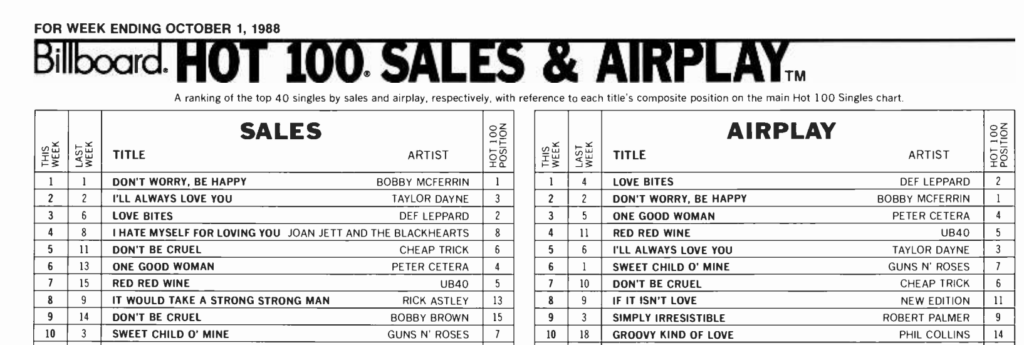
The song also reached number 11 on the Billboard Hot Black Singles chart, number seven on Adult Contemporary, number two in the United Kingdom, and number one in Canada.
A music video followed, starring McFerrin alongside comedians Robin Williams and Bill Irwin.
“Bobby just made people feel good with that simple melody and the wonderful lyrics,” Goldstein said. “We just had a great time doing this weird video.”
Lundvall offered the simplest explanation for why the song spread the way it did.
“If you’re going to work and commuting for an hour and going home and drive time and hot weather and all that kind of stuff, and you hear something like that on the radio, all of a sudden, instead of just moping and being angry and honking your horn, you’re singing along with it,” Lundvall said. “And that’s really, I think, what happened.”
McFerrin chose not to tour. Against every piece of conventional music industry advice, he went home.
“The tune was riding the charts and against conventional music wisdom, instead of touring like crazy, I stayed home,” he said. “I stayed home while the song worked. I wanted to stay. I wanted to be home with my family. I could have really gone nuts at that period if I had just gone out there and toured the song. I could have really gone crazy.”
Goldstein watched the machine run without him.
“‘Don’t Worry Be Happy’ brought this avalanche of attention that was almost unattractive,” she said. “It was overwhelming.”
McFerrin disappeared so completely from public view that rumours began to circulate. People assumed he had committed suicide. The man behind the most cheerful song in the country was nowhere to be found, by choice, at home in San Francisco with his family, while the song kept climbing.
At the 31st Annual Grammy Awards on February 22, 1989, “Don’t Worry Be Happy” won Song of the Year, Record of the Year, Best Male Pop Vocal Performance, and Best Jazz Vocal Performance. Simple Pleasures was nominated for Album of the Year alongside Faith by George Michael, …Nothing Like the Sun by Sting, Roll With It by Steve Winwood, and Tracy Chapman by Tracy Chapman. It did not win.
The producers of the ceremony wanted McFerrin to open the show with “Don’t Worry Be Happy.” He declined. The song was a studio project built on multi-tracked vocals. It was not designed to be performed live, and he was not willing to pretend otherwise.
The producers pushed back. McFerrin held firm. He suggested they open with their second song instead. In the end, he agreed to perform a cappella, improvising a comedy routine alongside Billy Crystal. Then he collected four Grammys.
“I wanna thank my father and my mother who taught me how to listen to music, how to have an inner ear here all over my body. My feet listening, my knees be listening, my back be listening,” McFerrin said in his acceptance speech for the Song of the Year.
Lyrically: Don’t Worry Be Happy by Bobby McFerrin
McFerrin had been carrying the phrase for years before it became a song.
“When I was working on Simple Pleasures, ‘Don’t Worry Be Happy’ was a song that was sort of like in the back of my mind,” he said. “It was something I wrote about four years ago. And I was working on another song and I got stuck. I couldn’t figure out what I was gonna do with this song. So I went to the piano and I started playing.”
“I didn’t have a song. I didn’t have the lyrics or anything,” he said. “So I dismissed everybody. And I went in some room someplace and I remember writing down all these lyrics. And then I went, OK, let’s try this.”
“I wanted everybody to take a hold of themselves when things aren’t going so well. Everybody’s got that trouble,” McFerrin said.
Here’s a little song I wrote
You might want to sing it note for note
Don’t worry, be happy
In every life we have some trouble
When you worry you make it double
Don’t worry, be happy
Don’t worry, be happy now
The song opens not with a statement but with an invitation. Not a message, not a manifesto. A little song. “In every life we have some trouble / When you worry you make it double.” These two lines are the philosophical core of the song in ten words. McFerrin does not promise the trouble goes away. He sings that worry is a choice and does not solve the trouble. It multiplies it.
“Don’t worry, be happy now.” Not eventually. Not when things improve. Now.
“The purpose of my singing is not so much to dazzle as to uplift, and to remind the listeners that there is joy and beauty in the most ordinary of events, dailyness in life,” McFerrin said.
Ain’t got no place to lay your head
Somebody came and took your bed
The landlord say your rent is late
He may have to litigate
Don’t worry, be happy
(Look at me I’m happy)
The first verse establishes the philosophy. The second verse tests it. McFerrin gets specific. No place to sleep. Someone took your bed. The landlord is threatening legal action. These are everyday things that happen to people everywhere. McFerrin is not ignoring them but deciding to face them head on and not to worry and sing anyway.
“Look at me I’m happy.” McFerrin steps out of the narrator role and offers himself as evidence. Not telling you to be happy. Showing you.
Ain’t got no cash, ain’t got no style
Ain’t got no gal to make you smile
But don’t worry, be happy
‘Cause when you worry your face will frown
And that will bring everybody down
So don’t worry, be happy
Don’t worry, be happy now
The verse expands the trouble. No money. No style. No one beside you. The losses are real but McFerrin moves past them to make a subtle point of not dwelling in worry.
The song shifts from external to internal. The first two verses describe things happening to you. This verse is what you do to yourself. “When you worry your face will frown / And that will bring everybody down.”
Worry is no longer a personal problem. It is contagious and spreads.
Now there, is this song I wrote
I hope you learned it note for note
Like good little children
Don’t worry, be happy
Listen to what I say
In your life expect some trouble
When you worry you make it double
Don’t worry, be happy, be happy now
The song circles back to where it started and asks “I hope you learned it note for note / Like good little children.” He is asking the listener if they were paying attention.
Then he is direct by stating, “Listen to what I say.” “In your life expect some trouble.” Not if, but expect it.
The final line of the verse repeats: “be happy now,” a reminder of how to live.
(Put a smile on your face, don’t bring everybody down like this)
(Don’t worry)
(It will soon pass, whatever it is)
Don’t worry, be happy
I’m not worried, I’m happy
The song closes to something almost conversational. “Put a smile on your face, don’t bring everybody down like this.” “It will soon pass, whatever it is.” Whatever your troubles are, he is not minimizing it. He is reminding you that it’s temporary and will pass.
“I’m not worried, I’m happy.” The song ends in the first person. Not a command. Not a refrain. A statement of fact from the man who wrote it, sang all eight tracks of it alone in a studio in one hour, and never quite expected any of this to happen.
McFerrin called the Meher Baba phrase “a pretty neat philosophy in four words.”




What does this song mean to you?
Share your thoughts on this song.