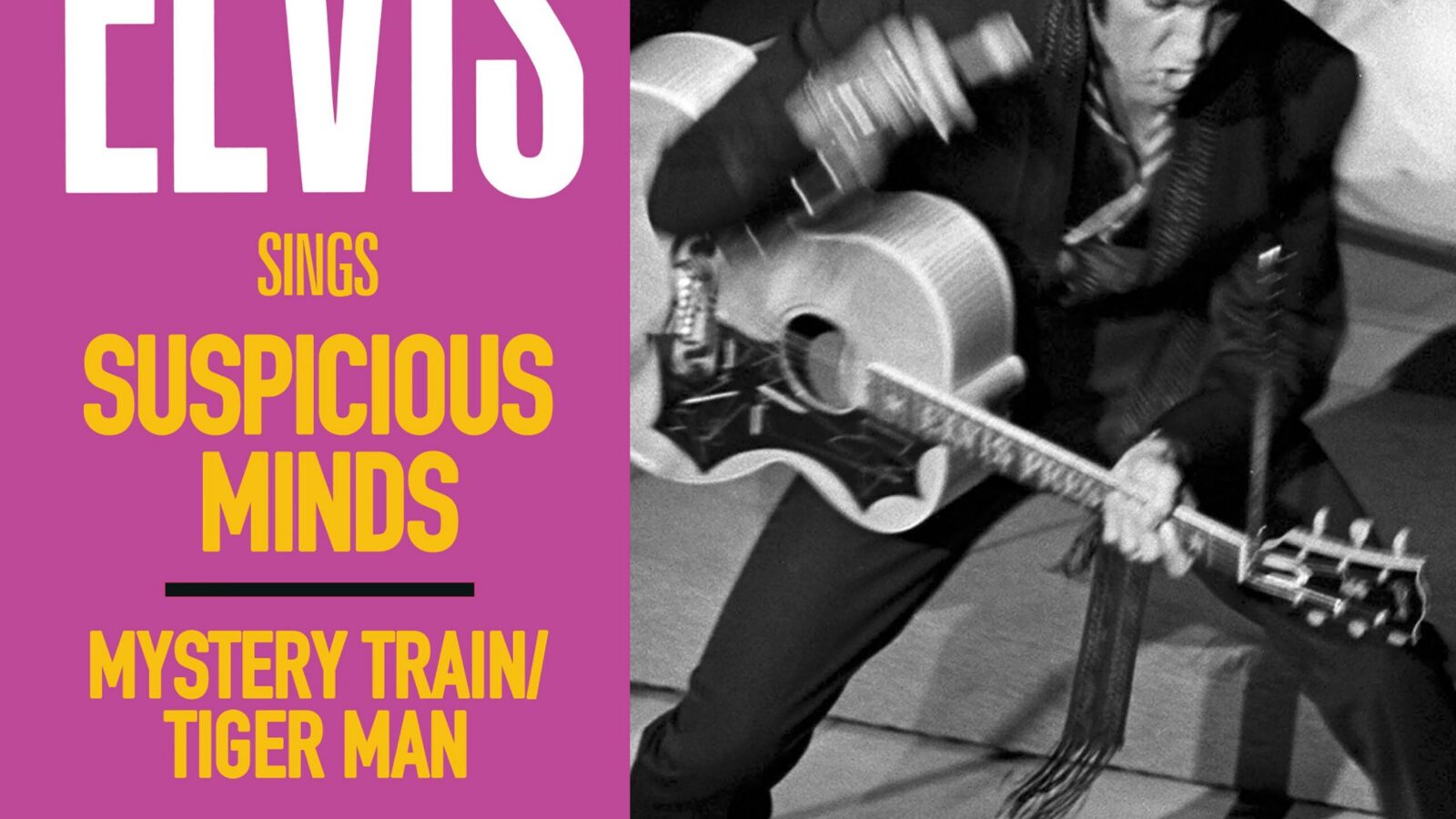
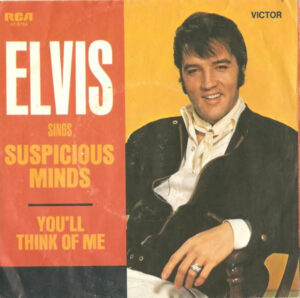
Memphis, Tennessee. January 13, 1969. The King has returned.
Elvis Presley walked into American Sound Studio through the back door that evening for the first time in his life. He arrived nursing a cold. The building at 827 Thomas Street was rat-infested, guarded by dogs, with a man on the flat roof watching the car park. Elvis looked around and announced: “What a funky funky studio!”
Ten days later, in the same room, he would record the final number-one hit of his life.
Elvis had not recorded in Memphis since 1955, the city that gave birth to his reign and helped reshape American music and culture. But the throne had not been taken from him. It had been gradually surrendered.
Elvis had spent most of the 1960s in Hollywood. His manager, Colonel Tom Parker, had steered him there after his Army discharge in 1960. When asked in March of that year whether music had changed while he was away, Elvis said, “Possibly yes… I haven’t been here long enough to even know… If it has changed, well, I would be foolish not to try to change with it… but as of now I have no reason to change anything.”
The films kept coming, twenty-seven of them through the 1960s alone, each packaged with a generic soundtrack. Elvis did not change. The times did. The Beatles and the Rolling Stones captured America. Soul music rewired the airwaves. Bob Dylan was rewriting what a song could say. A new generation had grown up never knowing an Elvis who mattered. His last number-one hit had been “Good Luck Charm” in 1962, seven years earlier. To them, Elvis was irrelevant.
Then came December 3, 1968. NBC aired the television special Elvis, now known as the ’68 Comeback Special. Director Steve Binder, the man who outmaneuvered the Colonel every step of the way to make the program, convinced Elvis to ditch the tuxedo and play his music, stripped of the facade of Hollywood. The Colonel wanted scripted skits. Binder wanted Elvis in a room with a guitar. In the end, a compromise.
In black leather, Elvis took the stage. Drummer D.J. Fontana recalled that Elvis “was hardly ever nervous, but he was then.” It did not show. He sat with his band in an intimate setting before a small studio audience, opening solo with his guitar before the rest joined in. No production gloss. No choreography. It looked like a rehearsal. It was the unrehearsed Elvis the world remembered. That night, 42 percent of the total television audience tuned in, making it NBC’s highest-rated special of 1968. Elvis was back in the living room.
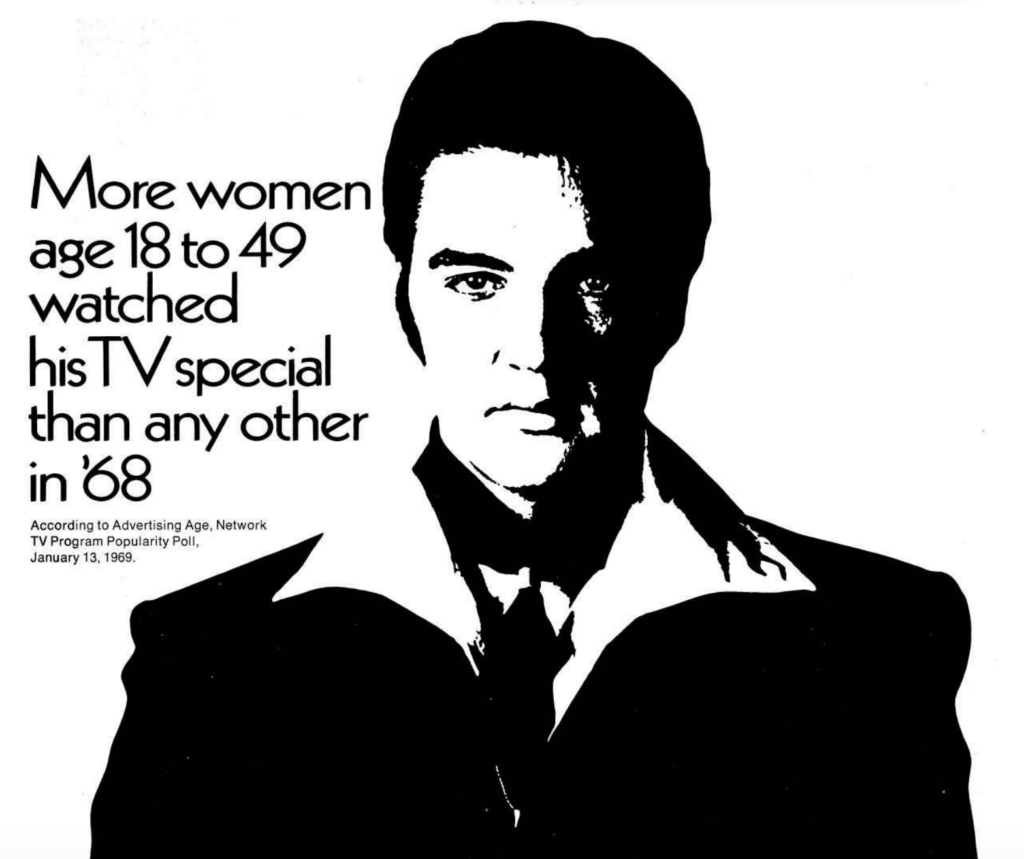
But the cameras had captured something deeper. For years the Colonel had steered Elvis with a heavy hand toward safe, profitable work that had nothing to say. The Comeback Special reminded the public Elvis was alive. It reminded Elvis of his purpose. Binder said, “Elvis rediscovered himself.”
After watching the finished special, just the two of them, Elvis made a private decision. “He told me that he never again wanted to record a song that he didn’t believe in or a movie where he didn’t like the script,” said Binder.
The decision needed a destination.
It came a few weeks later at Graceland, Elvis’s home in Memphis, in early January 1969. His close friend Marty Lacker was sitting in the den while Elvis and his RCA producer Felton Jarvis discussed an upcoming Nashville recording session.
Lacker had been spending time at American Sound Studio and had seen what producer Chips Moman and The Memphis Boys, his house band, could do. Neil Diamond’s “Sweet Caroline,” Dusty Springfield’s “Son of a Preacher Man,” The Box Tops’ “The Letter,” and B.J. Thomas’s “Hooked on a Feeling” were all recorded there.
What set American Sound apart was how they worked. Most studios at the time recorded the singer and the band separately. At American Sound, everyone performed together in the same room at the same time. It had the same relaxed, living-room energy that had made the Comeback Special feel so alive. It was also how Elvis had first recorded at Sun Records in 1955.
“I saw a huge difference in the way they were cutting at American and the way that Elvis had been recording for the last ten years prior to that,” said Lacker.
Lacker sat against the wall shaking his head. Elvis noticed. “What the hell’s wrong with you?” he asked. Lacker told him he wished Elvis would try working with Chips. Elvis gave his usual answer: “Well, maybe someday.”
Then dinner was announced. Everyone got up. Lacker stayed seated. Elvis knew exactly what it meant. He had never once turned down a meal. Thirty seconds after the room emptied, Felton came back out. Elvis wanted him in the dining room. Lacker braced for more talk about Nashville. Instead, Felton delivered the news: “He wants to cut in Memphis.”
“I was out of that chair like a bolt of lightning,” Lacker recalled.
That night, Lacker called Moman from the hallway phone and arranged the sessions. Elvis was going back to Memphis to record.
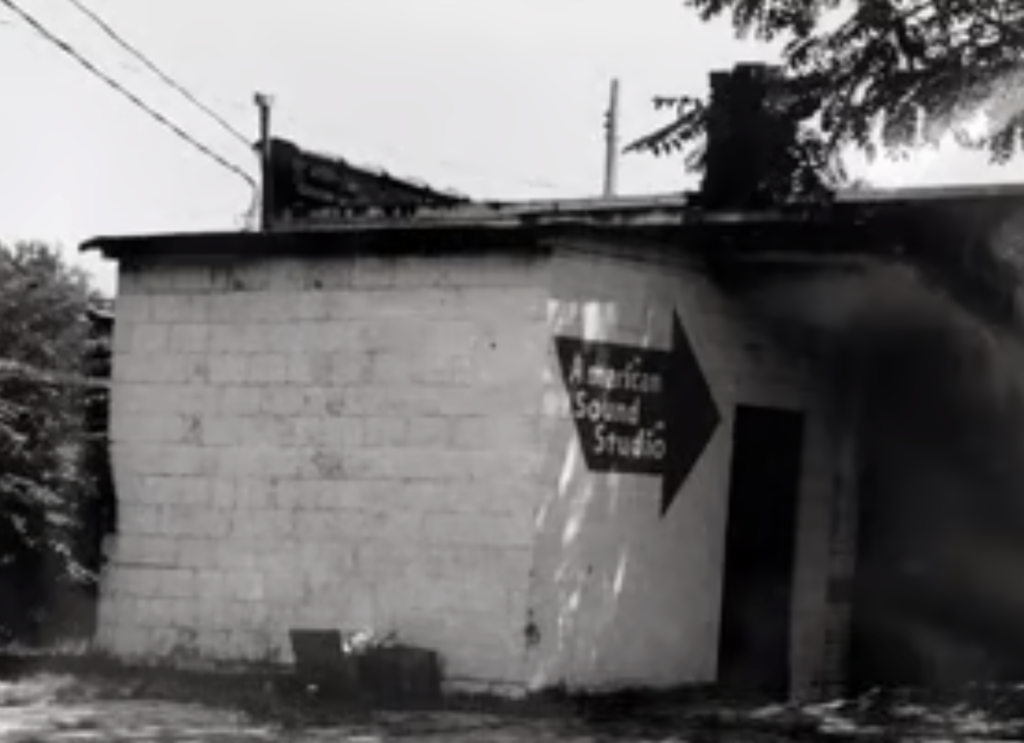
Someday arrived
On the evening of Monday, January 13, 1969, guitarist Reggie Young recalled thinking it was no big deal. Then Elvis walked through the door at American Sound Studio.
“We were all kind of taken aback,” Young said. “I was amazed at my own reaction. I thought, ‘Man, that’s Elvis!’ He had that charisma about him, and I think we all kind of backed up a step and went, ‘Whoa!'”
The sessions had begun.
Over the first several nights, Elvis recorded songs that felt nothing like his soundtrack work of the previous decade. “Long Black Limousine.” “Gentle on My Mind.” “Inherit the Wind.” Songs he believed in. Chips Moman pushed him in ways the Nashville sessions rarely had.
Then his voice gave out. Elvis went home with laryngitis and the sessions paused for several days.
When he came back, the Colonel’s office had sent down a package of demos through Hill and Range, the publishing company that had controlled Elvis’s song selection for a decade. Freddy Bienstock, Hill and Range’s song screener for Elvis, filtered every demo the company could claim a share of, a practice that earned its own name: the Elvis Tax.
Elvis played one of the demos and turned to guitarist Reggie Young. Young recalled what happened next: “He turned to me, I don’t know why, and said ‘Do you like that song?’ I said, ‘No, not really.’ Bobby Wood was standing next to him. Elvis asked him too. ‘No, that’s awful,’ Bobby said.”
Chips was not interested. Neither was anyone else in the room.
Elvis said, “Man, what am I gonna do? I don’t have any good songs to cut. I don’t know why I don’t get any good songs.”
Lacker had watched enough. He told Elvis directly what the problem was. Every good songwriter would want Elvis to record their song. But the pipeline ran through the Colonel’s office and Hill and Range, and the moment a song arrived, Bienstock or the Colonel would move to take a piece of it. Writers with real material had stopped sending it. “The only songs that you hear are what they send you,” Lacker told him.
Elvis sat back and said, “This is the way it is. From now on I wanna hear every damn new song that I can. If I like it I’m gonna cut it whether we get a piece of it or not.”
The ’68 Comeback Special was where Elvis made a promise. Memphis was where he kept it.
Chips had an answer. “I’ve got this song that I think would be great for you,” he told Elvis. “I put it out on Mark James who wrote it and it didn’t do too well but to me it’s a hit song.”
The man behind the song
Born Francis Rodney Zambon on November 29, 1940, in Houston, Texas, he came from a musical family. He could play violin before he could read and served as a concertmaster in junior high school. By the time he was a teenager, his group The Naturals had a regional hit in Texas with an instrumental called “Jive Note.”
After his early musical success, he was drafted into the United States Army and served during the Vietnam War. On his return, he signed to a Memphis music publishing company run by Chips Moman and Zambon adopted the professional name Mark James. He wrote “The Eyes of a New York Woman” and “Hooked on a Feeling” for B.J. Thomas, which revived Thomas’s career. Thomas said that James had a gift for “telling stories in a concise way. They get to the point. They’re relatable. They’re familiar.”
“In early 1968, Chips Moman asked me to come to Memphis to write songs for his music publishing company. I was living in Houston at the time and had written three hits that reached No. 1 in the South. Chips’s American Sound Studio was just starting to get hot. So I relocated,” said James.
“Late one night, fooling around on my Fender guitar and using my Hammond organ pedals for a bass line, I came up with a catchy melody. I was married to my first wife then but still had feelings for my childhood sweetheart, who was married back in Houston. My wife suspected I had those feelings, so it was a confusing time for me. I felt as though all three of us were all caught in this trap that we couldn’t walk out of,” said James.
“When Chips heard it, he said, ‘Man, I want to cut that on you,’ and he was real excited,” said James.
That was July 1968. The song had a name: “Suspicious Minds.”
“At my recording session, Chips produced, I sang the lead vocal and the studio band backed me,” said James. “After the tape was mixed, Chips and I flew to Scepter in New York, where my manager had contacts.”
The reception was overwhelming. “They said, ‘Smash!’ Chips and I went up there and we had a big party, a big promotional thing, 25 promotional people were there. They all said ‘smash, smash, smash’ and they even gave Chips a Rolls-Royce for producing that,” said James.
Then nothing. “They loved the song and put it out, but the label didn’t have the dollars to promote new talent, so the song didn’t chart.”
“Later that year, Don Crews, Chips’s partner, told me Elvis had booked American Sound to record what would become his ‘From Elvis in Memphis’ album. Don kept asking if I had any songs that would be a good fit,” said James.
“I kept working on it, trying to come up with that one song, and I can feel it sometimes. I know when a song is in the air, I know when something’s there, and I try to grab it or capture it,” said James. “Don Crews was the publisher, and every time I’d go back to American Studios he’d say, ‘Well, you capture that for Elvis yet? You know he’s coming in in a week and a half.’ And I said, ‘No, not yet, not yet.'”
“It got down to two days before Elvis was due to come in, and I said, ‘I cannot come up with it!’ So Don [Crews] says, ‘What about your old catalogue? What about Suspicious Minds?’ I turned around in the chair and it’s like I was seeing a golden number one, and I knew that was the song I’d been looking for!” said James.
“I knew there was a song in the air. I kept trying to write it,” James said. “I had no idea that I had already written it.”
“When Elvis came in, he [Crews] played it for him and Elvis said, ‘Let’s hear that again.’ I wasn’t there. I stayed away. And sure enough, he got it several times, liked it so much Chips made a tape for him. He took it home.”
“He wanted to hear the song over and over again, and learned it on the spot,” Moman said. “We finally got around to recording ‘Suspicious Minds’ after midnight [early on Jan. 23]… He used the same arrangement on Mark’s single and most of the same American Sound studio musicians.”
James was not in the studio that night. “I thought: ‘I cannot be here when he records my song or I’m gonna jeopardize it,'” James said. “It was the same room, same producer, same engineer and same musicians that played on my record. I didn’t have to be there, so I stayed away. The downside is everyone got a picture with him but me.”
“The musicians had no trouble kicking into gear… Elvis spent some time working over the lyrics, and then, after three or four takes, nobody could think of any way the track might be improved. Chips played it back over the loudspeakers, and the studio just went nuts. It was a great song, given an awesome performance by Elvis; it was one of those magical moments when everything had gone right,” said George Klein, Elvis’s best friend and a member of the Memphis Mafia.
“Suspicious Minds” was recorded between 4 a.m. and 7 a.m. on January 23, 1969, over the course of eight takes. At the end of the seventh, Moman asked Elvis, “Y’all got one more in you?” Elvis replied, “Yeah.” Take eight was the master.
Glen Spreen, the horn and strings arranger, remembered one thing above all else. Elvis had stretched the closing section far beyond anything in James’s original recording, repeating the final lines again and again. “We laughed at it,” Spreen said. “We just went, ‘God, how can they do this?’ as it kept going and going and going.”
When Moman played the finished take back through the studio speakers, Elvis turned to him. “We have some hits, don’t we, Chips?” he said. Moman’s reply: “Maybe some of your biggest.”
The song nearly never came out
During the sessions, Hill and Range’s Freddy Bienstock and the Colonel’s representative Tom Diskin cornered Moman and demanded half his publishing rights on “Suspicious Minds.” The Elvis Tax. “I blew up and told them to get out of the studio,” Moman said.
Marty Lacker followed Diskin into the studio and positioned himself behind him. When Diskin told Elvis that Moman would not give up a piece of the song, Elvis looked over Diskin’s shoulder and saw Lacker standing there. Lacker shook his head. Elvis turned back to Diskin and said, “Why don’t you let me and Chips and Felton handle the session?”
Diskin walked out, called the Colonel from the lobby phone, and flew back to California. The Colonel’s response to Elvis’s decision was six words: “Let him fall on his ass.”
Harry Jenkins, vice president of RCA, was also there and settled it. “This boy is right and we’re going to finish the session just the way he wants to,” he told the room. Moman kept his publishing. The session was saved.
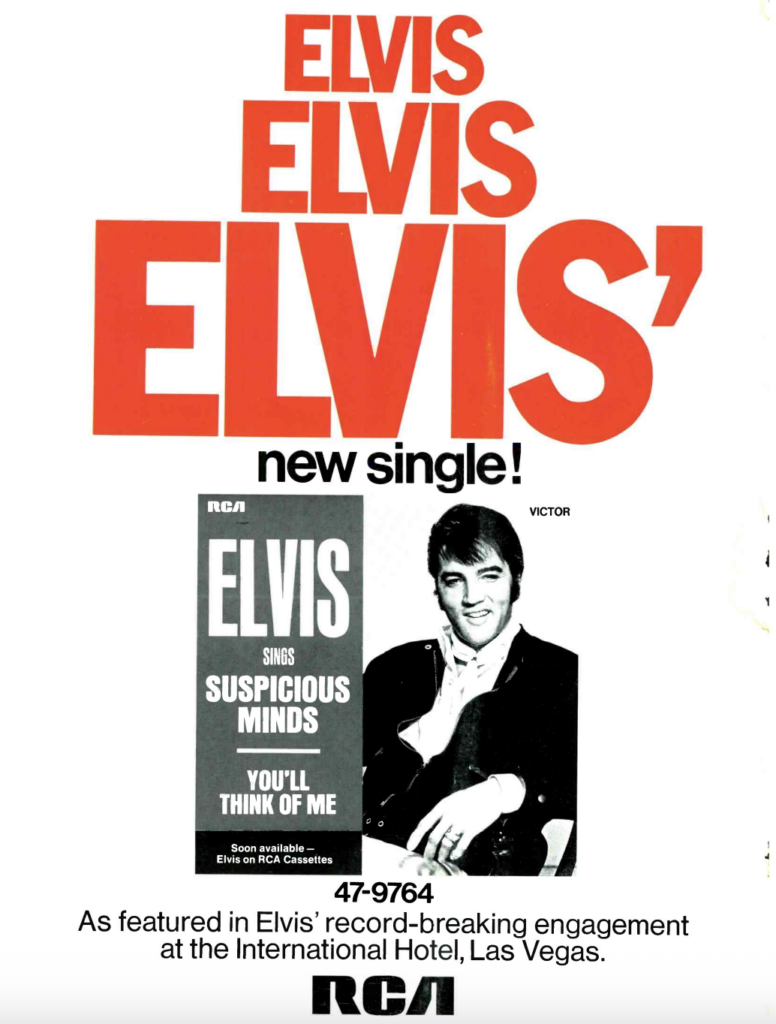
In the February 1, 1969 issue of Billboard, coverage of the early sessions noted that Elvis and a contingent of RCA technicians had quietly arrived in Memphis to record at American Sound. In the only in-studio interview Elvis granted since signing with RCA, he said, “This is where it all started for me. It feels good to be back in Memphis recording.” He noted the sessions were his first not tied to a motion picture. “This is especially refreshing.”
When James heard the track for the first time, his first reaction was that it sounded too slow. Then the embellished version came through the speakers. “They tried to make it greater and they did,” James said, “provided Elvis would sing it and get a great performance, and he did, and provided RCA knew what it was and they started pounding it and promoting it, and they did. It was number one in 27 countries and Elvis was on top again.”
“Suspicious Minds” was not included on From Elvis in Memphis, the album that emerged from the sessions. It was held back and released as a standalone single. Billboard reviewed the album in June 1969, stating, “Elvis returns to Memphis, where he began his sensational career, and the return is really an event. He’s never sounded better.”
On July 31, 1969, Elvis began a fifty-seven show engagement at the International Hotel in Las Vegas, marking his return to the concert stage for the first time since 1961. He made “Suspicious Minds” the highlight of every show before it had even been released, stretching it to seven minutes, fading the band to near silence before everything came rushing back. Before one show, he introduced it from the stage and laughed: “A new record that I made recently, ladies and gentlemen, that should be out in a few weeks or so… plug, plug, plug.”
Billboard reported in its review of the show that “there was one exception, however, which really rocked the 2,000-seat showroom. That song was his forthcoming single, ‘Suspicious Minds,’ which told of two people caught in a trap of distrust.”
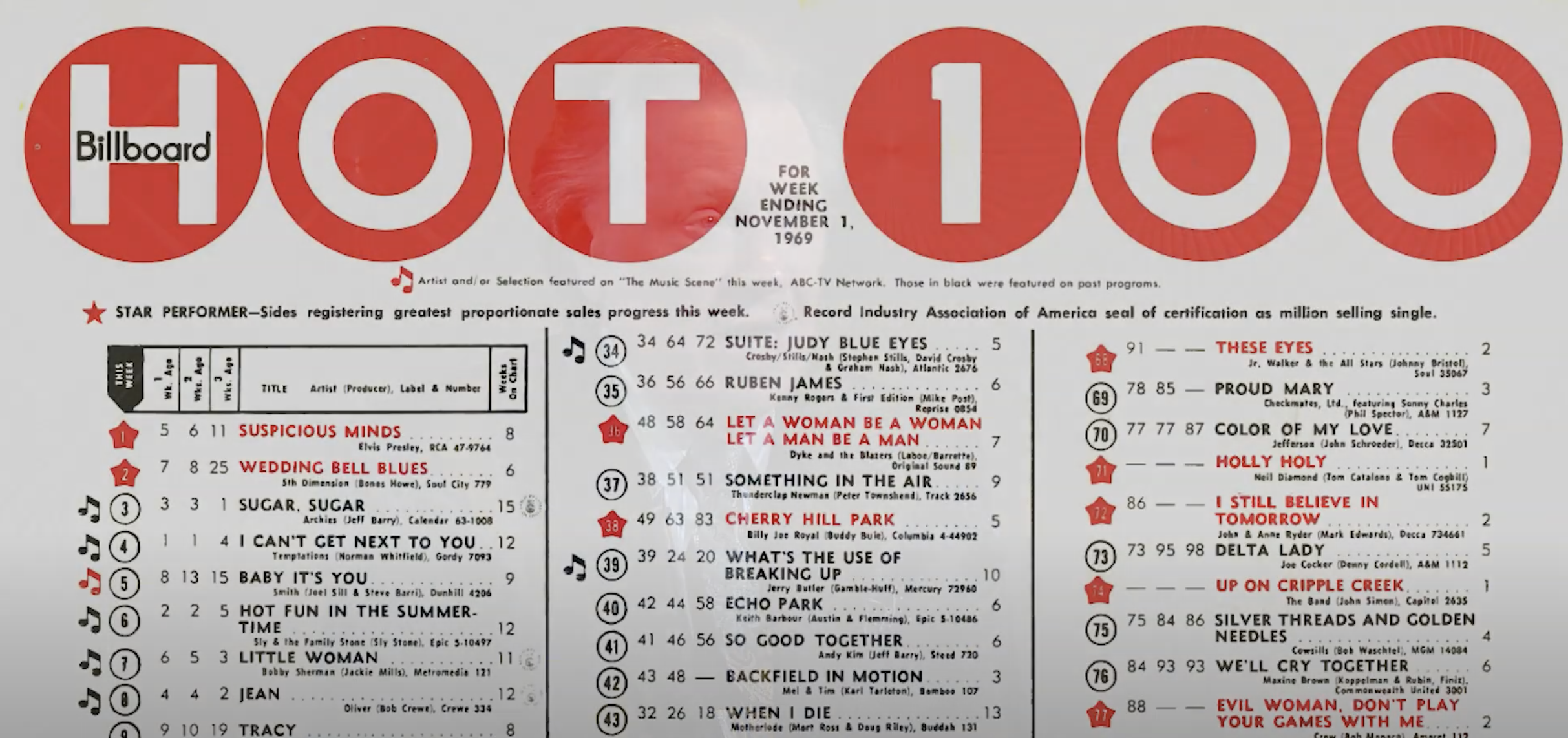
“Suspicious Minds” was released on August 26, 1969, and reached number one on the Billboard Hot 100 on November 1, 1969, ending a seven-year drought. Elvis’s 18th and final number-one hit in the United States, it also topped the charts in Australia, Austria, Canada, New Zealand, South Africa, and Sweden. In the United Kingdom it peaked at number two.
In 1999, James was named one of BMI‘s Songwriters of the Century alongside John Lennon, Paul McCartney, Paul Simon, Elton John, Ben E. King, Dolly Parton, and others. That same year, “Suspicious Minds” was inducted into the Grammy Hall of Fame. James was inducted into the Songwriters Hall of Fame in 2014 and the Nashville Songwriters Hall of Fame in 2015.
The song is placed at number 70 on Rolling Stone‘s list of the 500 Greatest Songs of All Time.
“The bottom line is, ‘Suspicious Minds’ wasn’t meant for me. It was meant for Elvis,” James said.
Lyrically: Suspicious Minds by Elvis Presley
Mark James wrote “Suspicious Minds” in Memphis in 1968, but the heart of the song was in Houston.
It was 1968. James was 27 years old, married to Shirley Yates, and the couple had a daughter together. He had moved from Houston to Memphis to focus on his music, writing songs for producer Chips Moman at American Sound Studio. His childhood sweetheart, Karen Taylor, a girl he had first met when he was thirteen, was still living in Houston and was also married. James never stopped having feelings for her. His wife knew it. Three people. One trap.
The music arrived in Memphis. “The title came to me one night. I was playing organ bass pedals at an apartment I was living in, getting kind of a riff thing, feeling the groove of it,” James recalled.
“It’s like being in a place where your heart didn’t belong,” James said. “I was working off this title and that suspicion that happens when somebody you used to know comes by.”
“That song was a sledgehammer,” he said.
We’re caught in a trap, I can’t walk out
Because I love you too much, baby
Why can’t you see what you’re doin’ to me
When you don’t believe a word I say?
The words came from the trap he was already living in. “My wife suspected I had those feelings, so it was a confusing time for me. I felt as though all three of us were all caught in this trap that we couldn’t walk out of,” said James.
“A lot of the substance of the song came from how I was feeling,” said James.
Both people are caught in the same trap. Nobody is placing or accepting blame yet. Then it shifts. The man who just admitted he cannot walk out is asking why she cannot see what her distrust is doing to him. He knows the trap. He stays anyway. Then turns it on her with “When you don’t believe a word I say?”
We can’t go on together
With suspicious minds (With suspicious minds)
And we can’t build our dreams
On suspicious minds
The chorus is a declaration. Suspicion is a cautious distrust of someone or something. It does not announce itself. It filters everything through doubt until nothing feels certain.
“We can’t go on together / With suspicious minds.” Together is the word that carries the weight. You cannot build something with someone you do not fully trust. Everything built on suspicion is unstable. “And we can’t build our dreams / On suspicious minds.” There was a future being imagined. Distrust gets in the way of everything that has not happened yet.
So if an old friend I know stops by to say hello
Would I still see suspicion in your eyes?
Here we go again, asking where I’ve been
You can’t see the tears are real, I’m cryin’ (Yes, I’m cryin’)
This verse moves from the abstract to the specific. An old friend stops by for a conversation. And already the eyes are watching, potentially judging the conversation. “Here we go again.” Not anger but exhaustion at being questioned again. This has happened before and will happen again.
“You can’t see the tears are real, I’m cryin’.” Suspicion has reached the point where even genuine emotion cannot be trusted.
In James’s life the old friend was not hypothetical. The lyric is not invented but rather the daily reality of someone living with suspicion.
We can’t go on together
With suspicious minds (With suspicious minds)
And we can’t build our dreams
On suspicious minds
The chorus returns. The declaration has not changed. Neither has the problem. The repetition in the song mirrors the repetition in the relationship.
Oh, let our love survive
I’ll dry the tears from your eyes
Let’s don’t let a good thing die
When, honey, you know I’ve never lied to you
Mm, yeah, yeah
The tone shifts. Every line before this has named the problem. The trap. The distrust. The exhausting cycle of suspicion repeating itself. This asks for something different. A plea to “let our love survive.”
“I’ll dry the tears from your eyes.” After all the exhaustion and accusation, he is still reaching toward her and offering comfort.
“Let’s don’t let a good thing die / When, honey, you know I’ve never lied to you.” The ask is simple. Do not let this end. His honesty is all he has left.
We’re caught in a trap, I can’t walk out
Because I love you too much, baby
Why can’t you see what you’re doin’ to me
When you don’t believe a word I say?
Well, don’t you know I’m caught in a trap? I can’t walk out
Because I love you too much, baby
Well, don’t you know I’m caught in a trap? I can’t walk out
Because I love you too much, baby
Well, don’t you know I’m caught in a trap? I can’t walk out
Because I love you too much, baby
Well, don’t you know I’m caught in a trap? I can’t walk out
Because I love you too much, baby
Well, don’t you know I’m caught in a trap? I can’t walk out
Because I love you too much, baby
Well, don’t you know I’m caught in a trap? I can’t walk out
Because I love you too much, baby
The verse returns but the question has changed. “We’re caught in a trap” becomes “Well, don’t you know I’m caught in a trap?” The song does not end. It repeats. It fades. The trap is still there.
James and Shirley Yates eventually divorced. James married his childhood sweetheart Karen Taylor in 1971 and stayed together for 53 years.
James wrote the words. Elvis made them universal.



What does this song mean to you?
Share your thoughts on this song.