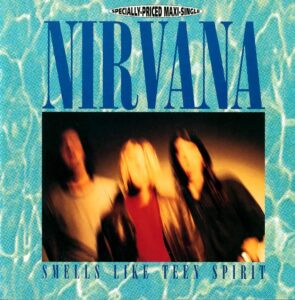
Tuesday, September 10, 1991. Nirvana’s “Smells Like Teen Spirit” altered culture and became one of the songs to define a generation. Yet Kurt Cobain came to despise it and eventually refused to perform it live.
In 1991, teenagers lived in a world ruled by rock and pop stars. Guns N’ Roses and Madonna dominated the airwaves, while A Tribe Called Quest and Public Enemy were pushing hip-hop forward. MTV was the gateway to new music, and life revolved around malls, arcades, and landline phone calls. Saved by the Bell, Beverly Hills, 90210, and Saturday Night Live defined TV culture, while the Nintendo-Sega console wars were making gaming mainstream.
Then “Smells Like Teen Spirit” unhinged the world.
Nirvana formed in 1987 in Aberdeen, Washington, with Kurt Cobain as lead vocalist, guitarist, and primary songwriter, and Krist Novoselic, a childhood friend of Cobain’s, on bass. The band cycled through drummers until Dave Grohl joined on September 25, 1990. This is when Nirvana truly found itself.
Sixteen days later, on October 11, the trio played their first show together at Olympia’s Northshore Surf Club. Ticket price: $5.
A review by Ian Dickson in The Cooper Point, the student newspaper of The Evergreen State College in Olympia, captured what happened that night: 500 “screaming teenage punk rockers” witnessed “Nirvanamania!”
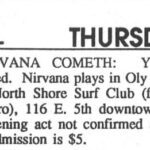
“Nirvana had serious problems. The sound kept cutting out in the middle of their first few songs, the drums broke, Kurdt’s voice was off. None of that mattered… They could have played the introduction to ‘Free Bird’ for 2 hours and kids would still be stumbling around dazed, saying ‘oh my gawd, they were so great.’ It’s true. Dave, from D.C.’s now defunct Scream, is a great drummer. He hits hard with a smile on his face,” said Dickson.
Dickson’s spelling wasn’t a typo. Cobain intentionally misspelled his name as “Kurdt Kobain.” He explained why.
“I think I want it to be anonymous. At first, I was really thinking about changing my name for the Nevermind record, but then I just decided to spell it the right way. I just wanted it to be confusing. I wish I would have done the same thing that Black Francis did when the Pixies did — he’s changed his name so many times that nobody really knows who he is. I wish nobody ever knew what my real name was so I could someday be a normal citizen again. I have no real reason. I just didn’t bother spelling it correctly. I didn’t care. I wanted people to spell it differently all the time,” said Cobain.
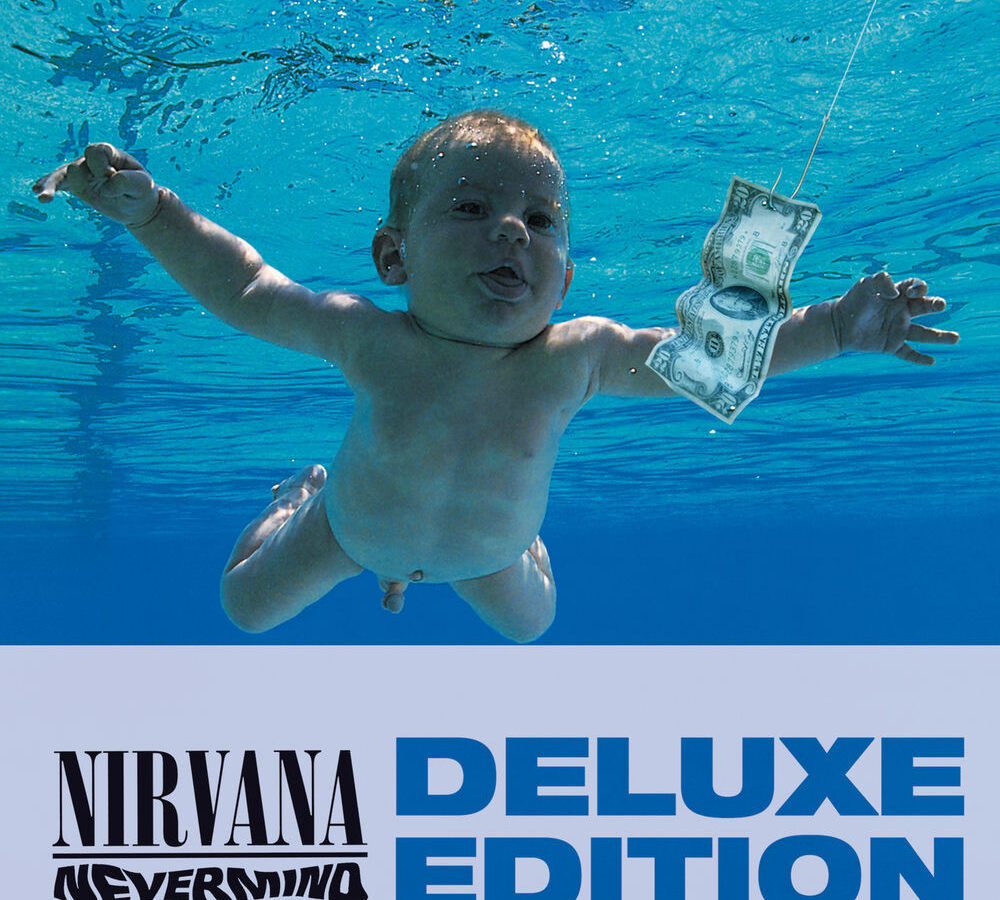
A year later, on September 10, 1991, Nirvana released “Smells Like Teen Spirit.” Two weeks later came Nevermind, the album that would reshape popular music.
What happened in those months made “Smells Like Teen Spirit” become “Smells Like Teen Spirit.”
The Birth of a Generational Anthem
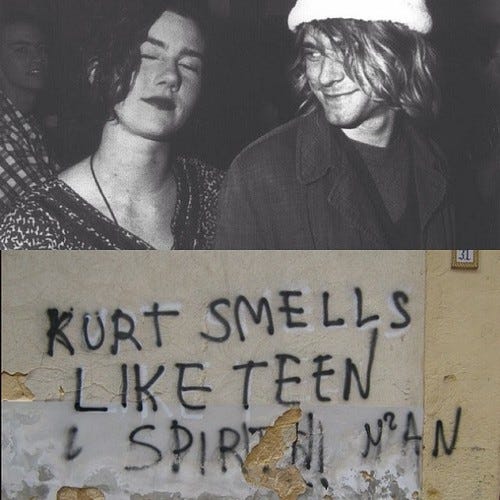
The inspiration for “Smells Like Teen Spirit” started with Kathleen Hanna, frontwoman of the punk band Bikini Kill. Hanna and Cobain were hanging out one day in August 1990.
“In August of 1990, I found myself laying on my stomach in the woods with a pair of binoculars, a bottle of Canadian Club, and my friend Kurt Cobain… I lived in Olympia, Washington, and walked down the hill, went to the bar, got some more Canadian Club, then went to my apartment. We got those 40-ouncers, got a little more drunk. And apparently, I insulted just about everybody in my whole entire town, and I threw up on someone’s legs. It was one of those nights that, like, later on, every time anyone ever mentions it, you don’t want to think about it,” said Hanna.
“Ended up at Kurt’s apartment, I smashed up a bunch of shit, and took out a Sharpie marker. I wrote a bunch of shit all over his bedroom wall, and it was a rental, so it was really kind of lame that I did that. And then I passed out with the marker in my hand, and I woke up, and I had one of those hangovers… So I wasn’t too happy when, six months later, Kurt called me up and said, ‘Hey, do you remember that night?… Well, there’s this thing that you wrote on my wall, and it was actually kind of cool. I want to use it as a lyric in one of my songs,'” recalled Hanna. “‘As long as I can get out of that conversation and not think about it anymore, I’m totally cool. So you can use whatever you want.’ Then I hung up, and I was like, ‘How the fuck is he gonna use Kurt Smells Like Teen Spirit as a lyric?'”
The Pixies, a Boston alternative rock band known for their quiet-loud dynamics, were a defining influence on Cobain.
“We’d been practicing for about three months. We were waiting to sign to DGC, and Dave and I were living in Olympia, and Krist was living in Tacoma. We were driving up to Tacoma every night for practice, trying to write songs. I was trying to write the ultimate pop song. I was basically trying to rip off the Pixies. I have to admit it,” said Cobain. “When I heard the Pixies for the first time, I connected with that band so heavily I should have been in that band, or at least in a Pixies cover band. We used their sense of dynamics, being soft and quiet and then loud and hard. ‘Teen Spirit’ was such a clichéd riff. It was so close to a riff by the rock band Boston or ‘Louie, Louie.’ When I came up with the guitar part, Krist looked at me and said, ‘That is so ridiculous.’ I made the band play it for an hour and a half.”
Cobain started writing lyrics for “Smells Like Teen Spirit” in February 1991, but the idea had been bouncing around in his mind since that drunken night in August 1990.
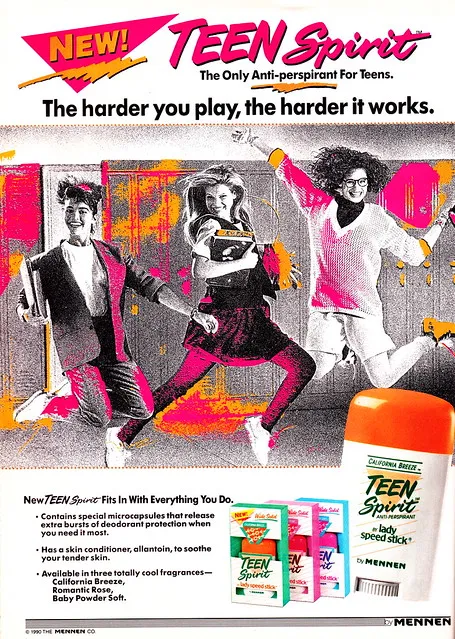
“Smells Like Teen Spirit” was a reference to Tobi Vail, the drummer of Bikini Kill and Cobain’s girlfriend at the time. Vail used Teen Spirit deodorant, and Hanna was joking that Vail had left her scent on him. They dated from July until early November 1990.
Cobain misinterpreted the phrase, thinking it referenced a conversation he and Hanna had about teen revolution. Similar to the plot in Over the Edge, a 1979 film about suburban teenagers rebelling against an indifferent adult world, which Cobain said, “That movie had such an effect on me.”
“I took that as a compliment. I thought that was a reaction to the conversation we were having, but it really meant that I smelled like the deodorant. I didn’t know that the deodorant spray existed until months after the single came out,” said Cobain.
By April 1991, Nirvana had outgrown Sub Pop Records. The Seattle independent label had released their debut album Bleach in 1989 for just $606.17. But Sub Pop’s limited distribution meant fans couldn’t find Nirvana’s records in stores, and this frustrated Cobain.
“The fact that people couldn’t find our record in stores really bothered us,” Cobain said.
The band needed gas money to get to Los Angeles to record their next album with a major label. So they booked a last-minute show.
The first time Nirvana performed “Smells Like Teen Spirit” live was on Wednesday, April 17, 1991, at the OK Hotel in Seattle. The show also featured Fitz of Depression and Bikini Kill.
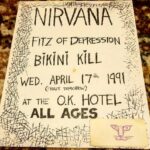
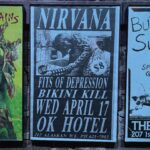
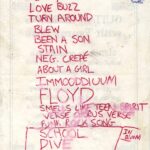
“This song is called ‘Smells Like Teen Spirit,'” Cobain announced to the crowd.
“That show at the OK Hotel was legendary,” Seattle-area musician Kurt Bloch stated. “There were a few genre-defining shows, and that was certainly one of them. I remember standing next to [Sub Pop A&R representative] Nils Bernstein and then ‘Hey, here’s a new song, blah blah blah.’ They started playing ‘Teen Spirit’ and Nils and I looked at each other like, ‘Holy fuck! This song is unbelievable.'”
“They started playing the new song, and people erupted,” says Jennie Boddy, a publicist for Sub Pop Records who was at the show. “We were being slimed on by shirtless guys, just moshing… My friend Susan started hyperventilating; she thought it was so good. ‘I can’t—gasp—believe what they just played!’ It was just instantaneous; it was crazy.”
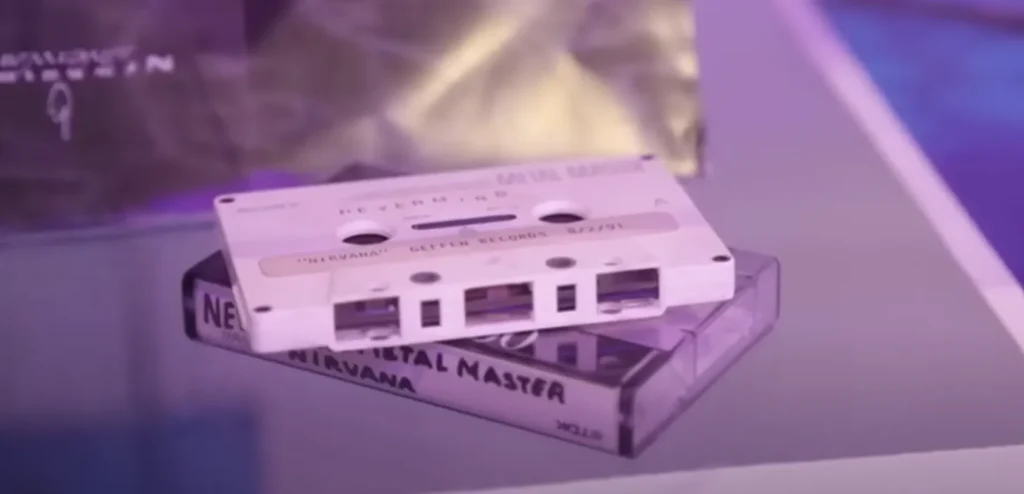
Thirteen days after the OK Hotel show, on April 30, 1991, Nirvana signed with DGC Records in Los Angeles, receiving a $287,000 advance. Between May 2 and 28, they recorded Nevermind with producer Butch Vig at Sound City Studios in Van Nuys, California.
By early June, Cobain had settled on the album title, Nevermind. Collapsing two words into one, it reflected his current attitude and referenced a key phrase in the lyrics from “Smells Like Teen Spirit.”
By early June, Cobain had settled on the album title, Nevermind. This was deliberately misspelled and reflected his current attitude. It also referenced a key phrase in the lyrics from “Smells Like Teen Spirit.”
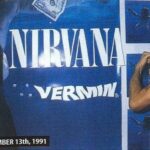
“It’s nicer [being on DGC] because we have the freedom to spend a bit more money. We can take our time now, and we’re guaranteed to get our album in any store, which is the main gripe we had about [being] independent,” said Cobain.
The Song
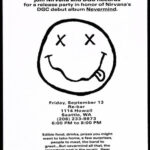
“Smells Like Teen Spirit” was released as the lead single on September 10, 1991. Three days later, the band held an album release party at Seattle’s Re-bar.
It didn’t go well.
Re-Bar’s owner Steve Wells kicked out Cobain, Novoselic, and Grohl from their own party because they snuck in hard liquor, got drunk, and started a food fight.
“Suddenly, Kurt, Krist, and maybe Dave started a food fight. I guess I freaked about the whole situation, rounded them up, including Bruce [Pavitt], and with the help of the doormen, got them out of the door just in time for them all to barf on the curb,” recalled Wells.
Three days after that, there was a packed in-store listening party at Beehive Records in Seattle where Nirvana performed to promote the album.
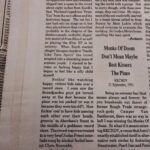
“When Kurdt started slingin’ the open chords to ‘Smells Like Teen Spirit’ the crowd erupted into a slamming mass of ecstatic youth. I started to become so fucking happy that I began to feel like a silly child myself,” wrote a reviewer named Adam in a magazine called Hype. “Nothin’ like watching happy, violent kids take over a record store. I even saw the Soundgarden guys get turned away at the door because the place was too packed.”
“Kurdt Kobain scares me. The guy never smiled, despite the fact that every other person in the building was orgasming. I think I would probably be pretty happy if I had Seattle by the nose-ring, like Nirvana does. But then again, maybe I’d be worried too if my next task was conquering the world with a guitar. Not to worry though, with these new songs, they can’t lose. My enjoyment of the set was briefly marred by a bomb threat called in from Boston by Matt Lukin which forced everyone to evacuate the building. So I rode a Metro home, smelling like teen spirit,” said Adam from Hype.
Nevermind was officially released on Monday, September 24, 1991. Other albums that dropped that day included Soundgarden’s Badmotorfinger, the Seattle band who shared Nirvana’s grunge roots, Red Hot Chili Peppers’ Blood Sugar Sex Magik, and A Tribe Called Quest’s The Low End Theory.
That night, Nirvana played at Boston’s Axis club to a sold-out crowd. DGC Records had shipped just 46,251 copies of Nevermind to the US and 35,000 to the UK, expecting modest sales. The record sold out immediately.
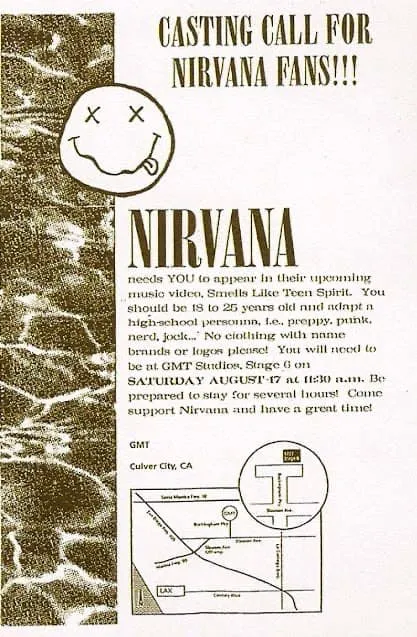
The “Smells Like Teen Spirit” music video, resembling a high school rally with actual Nirvana fans as extras, debuted on MTV’s 120 Minutes, the network’s late-night alternative music show, on September 29, 1991, bringing both alternative rock and grunge to the mainstream.
MTV senior vice-president of music and talent Abbey Konowich said the channel added the video immediately. “It virtually exploded.” The clip landed in the Buzz Bin, MTV’s heavy-rotation category for new artists.
“I expected our core audience to buy our record within the first couple of weeks, and then the sales would decline after that,” said Cobain. “But after I realized that we were on MTV in heavy rotation, I suspected we would sell a lot more.”
The industry was slower to catch on. On October 19, 1991, Billboard reviewed Nevermind, calling Nirvana a “Northwestern rock act” delivering a “hard-rocking sludgeorama on major-label debut.”
By mid-November, just six weeks after release, Nevermind had sold in excess of 600,000 copies and sat at No. 9 on the Billboard 200 without a single top 40 hit. DGC director of alternative music Mark Kates noted it was on “virtually all alternative and college stations.” DGC’s head of promotion Bill Bennett called it the first record he could remember appearing on modern rock, hard rock, and album rock stations simultaneously, pulling strong responses at every one.
Co-manager John Silva summed it up simply. “There was an audience thing, and then the job of the record company was to be true to that thing,” he said. “The watchword for all of this has been, ‘Get out of the way.'”
Nevermind had entered the Billboard 200 at No. 144. On Saturday, January 11, 1992, just 123 days after “Smells Like Teen Spirit” was released, it hit No. 1. It dethroned Michael Jackson’s Dangerous, which the King of Pop had held at the top spot for four weeks with “Black or White.”
That same night, Nirvana appeared as the musical guest on Saturday Night Live. They played “Smells Like Teen Spirit” and “Territorial Pissings.” At the end of their set, Cobain rammed the neck of his guitar into the speakers while Novoselic gently dropped his bass and joined Grohl in tossing his drum kit around.
When the show ended, host Rob Morrow, known for his role in Northern Exposure, thanked the cast, crew, Nirvana (Grohl was smoking), and everyone watching.
Novoselic seized the opportunity, kissing, making out with, and hugging Grohl before doing the same with Cobain. Grohl and Cobain then hugged, and Grohl twirled Cobain. Novoselic and Grohl mingled, while Cobain stood just outside the group with his hands in the front pockets of his jeans, until Kevin Nealon shook his hand, followed by a double handshake from Chris Farley.
Nevermind went on to sell over 30 million copies worldwide and spend more than 700 weeks on the Billboard 200. “Smells Like Teen Spirit” was inducted into the Grammy Hall of Fame and, in a 2015 study by Goldsmiths, University of London, declared the most iconic song of all time. “Imagine” by John Lennon is next.
Thus, backed by culture and science, Cobain’s desire to create the “ultimate pop song” was achieved.
Lyrically: Smells Like Teen Spirit
Kurt Cobain wrote “Smells Like Teen Spirit” in fragments. Just “pieces of poetry and just garbage,” as he put it. He scribbled lyrics five minutes before singing them. Yet somehow, these throwaway lines became the defining statement of a generation.
What Cobain captured is the feeling of teenage alienation. His refusal to make sense became the most honest thing about the song.
Load up on guns, bring your friends
It’s fun to lose and to pretend
“It’s a typical teenage aggression song. It has revolutionary themes, but I don’t really mean it in a militant [light],” stated Cobain in an October 1991 interview with Pulse! “The generation’s apathy is getting out of hand. [I’m] pleading to the kids, ‘Wake up!'”
The opening sounds like a call to arms. Teenagers in 1991 weren’t looking for a battle cry. They were looking for someone to name and to carry the exhaustion of pretending everything mattered.
She’s over-bored and self assured
Oh no, I know a dirty word
“Over-bored and self-assured” captures the particular teenage condition of being bored with everything while remaining absolutely certain of yourself. And also describing any restless, confident person who has lost interest in their surroundings.
The dirty word is never named. That’s the point. Perhaps this is part of the “garbage” Cobain was referring to.
Hello, hello, hello, how low
Hello, hello, hello, how low
Hello, hello, hello, how low
Hello, hello, hello
The repeated “hello” is an attempt to connect with anyone listening. “How low” expresses a sense of emptiness.
“I’m disgusted by my own and my generation’s apathy. I’m disgusted at what we allow to go on, by how spineless, lethargic and guilty we are of not standing up against racism, sexism and all those other ‘isms’ that the counterculture has been whining about for years while they sit and enforce those same attitudes every night on their televisions and in the magazines,” said Cobain.
The “hello” isn’t answered because no one’s really listening.
With the lights out, it’s less dangerous
Here we are now, entertain us
I feel stupid and contagious
Here we are now, entertain us
A mulatto, an albino, a mosquito, my libido
Yeah, hey, yay
The chorus is where Cobain’s “garbage” reveals its brilliance.
“With the lights out, it’s less dangerous.” Cobain never explained what ‘it’ is directly, but the lyrics work because they capture an unconventional feeling: sometimes ignorance really is bliss. When you can’t see the mess, you don’t have to deal with it. Whatever ‘it’ is you’re dealing with.
“Here we are now, entertain us” became part of the anthem, but Cobain stated it was just an awkward ice breaker he used at parties. “Something I used to say every time I used to walk into a party to break the ice. A lot of times, when you’re standing around with people in a room, it’s really boring and uncomfortable. So it was ‘Well, here we are, entertain us. You invited us here,'” said Cobain.
“I feel stupid and contagious” is self-loathing that spreads. “Kurt really despised the mainstream. That’s what ‘Smells Like Teen Spirit’ was all about: The mass mentality of conformity,” said Novoselic.
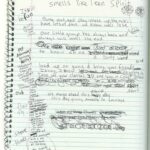
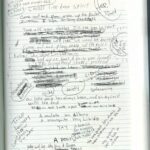
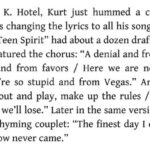
Then comes the line that grabs your curiosity. Three syllables each, ending in “o” sounds, creating a hypnotic flow: “A mulatto, an albino, a mosquito, my libido.”
“I was just using pieces of poetry and just garbage — you know, just stuff that just would spew out of me at the time,” said Cobain. “A lot of times when I write lyrics, it’s just at the last second because I’m really lazy. And then I find myself having to come up with explanations for it.”
“Just seeing Kurt write the lyrics to a song five minutes before he first sings them, you just kind of find it a little bit hard to believe that the song has a lot to say about something,” said Grohl. “You need syllables to fill up this space or you need something that rhymes.”
The “garbage” works. A mulatto, an albino, a mosquito—all outsiders, all things that don’t fit neatly into categories. These random words don’t belong together but somehow purposefully do, which is what the song is about.
I’m worse at what I do best
And for this gift I feel blessed
Our little group has always been
And always will until the end
“I’m worse at what I do best” is Cobain at his most contradictory. He built his identity on not fitting in. Now he can’t even do that right. Yet somehow, he is still grateful for it.
“Our little group has always been / And always will until the end” reads like a promise of loyalty, but there’s resignation in it too. They’re committed to staying true to themselves, even if it ends badly.
“Kris, Dave, and I haven’t changed at all. I mean, believe it or not, we get along just as well as we ever did… We’re just the same passive-aggressive people as we used to be, you know. We never fight, and when we’re pissed off at each other, we just hold it under our breath and have respect for one another in that way. You know, it’s just… it’s easier to—it’s easier to work that way, you know, ‘cuz we have a mission,” said Cobain.
And I forget just why I taste
Oh yeah, I guess it makes me smile
I found it hard, it’s hard to find
Oh well, whatever, never mind
“I forget just why I taste” is a disconnection. The sensation is there, but the meaning behind it is gone. “Oh yeah, I guess it makes me smile” is the shrug that follows. “I found it hard, it’s hard to find” brings the realization that things are tough and challenging, but “Oh well, whatever, never mind” became the album title for a reason. Not defiance, not acceptance, just indifference. These lyrics don’t resolve. They trail off.
With the lights out, it’s less dangerous
Here we are now, entertain us
I feel stupid and contagious
Here we are now, entertain us
A mulatto, an albino, a mosquito, my libido
A denial, a denial, a denial, a denial, a denial
A denial, a denial, a denial, a denial
The song ends by repeating “a denial” nine times. It’s unknown what’s being denied. Perhaps it’s reality, responsibility, revolution, hope. All of the above.
“We still feel as if we’re teenagers because we don’t follow the guidelines of what’s expected of us to be adults… It also has kind of a teen revolutionary theme,” said Cobain. “The entire song is made up of contradictory ideas. It’s just making fun of the thought of having a revolution. But it’s a nice thought.”
“Smells Like Teen Spirit” is a revolutionary anthem that mocks revolution. A call to action that celebrates apathy. A protest song that protests nothing in particular. Oh well, whatever, never mind.
Producer Butch Vig understood what Cobain couldn’t quite articulate, stating, “Even though we’re not really sure exactly what Kurt is singing about, there’s something in there that you understand—a sense of frustration and alienation. And to me, ‘Smells Like Teen Spirit’ reminds a little bit of how Bob Dylan’s songs affected people in the ’60s. In a way, I think, that was a song that affected a generation of kids in the ’90s. They could relate to it.”
Dylan’s generation had a clear declaration with “The Times They Are a-Changin’.” Cobain’s generation got “a denial, a denial, a denial.” And somehow, that was exactly what they needed to hear.
“I never wanted to sing,” Cobain stated. “I just wanted to play rhythm guitar — hide in the back and just play. But during those high-school years when I was playing guitar in my bedroom, I at least had the intuition that I had to write my own songs.”
“I wanted to have the adoration of John Lennon, but have the anonymity of Ringo Starr, you know. I didn’t want to be a front-man. I just wanted to be back there but, you know, be a rock ‘n roll star at the same time,” said Cobain.


What does this song mean to you?
Share your thoughts on this song.