Imagine being born in a time when you are called “lord.”
Ella Marija Lani Yelich-O’Connor sang this fantasy to life. Known by her stage name, Lorde, which is a reference to nobility, as she was inspired by her interest in royalty and aristocracy.
“When I was trying to come up with a stage name, I thought ‘Lord’ was super rad, but really masculine — ever since I was a little kid, I have been really into royals and aristocracy,” said Lorde. “So to make Lord more feminine, I just put an ‘e’ on the end! Some people think it’s religious, but it’s not.”
“Ever since I was a kid, I’ve been reading up on royal families of all kinds,” she says. “I’ve just found it super fascinating—the crazy, opulent lifestyle, and some of them were so young and shouldn’t have been ruling countries at all. There was something so tragic and awesome about all of it.”
“Obviously I’ve had this fascination with aristocracy my whole life. Like, the kings and queens of 500 years ago… they’re like rock stars. If there was a TMZ 500 years ago, it would be about like Henry VIII and Marie Antoinette and all those people,” said Lorde. “I’m really interested in the Ivy Leagues, the final clubs, all the really old-money families, the concept of old money.”
Lorde was born on November 7, 1996, in New Zealand. Her mother, Sonja Yelich, a notable poet, encouraged her to read books. Her father, Vic O’Connor, is responsible for her interest in music. Yelich and O’Connor eventually married and have four children: Jerry, Ella, India, and Angelo. That’s the bloodline.
“We had a big backyard and a sandpit and a lot of animals and books and paints. It was good,” said Lorde.
“I guess my mum influenced my lyrical style by always buying me books. She’d give me a mixture of kid and adult books too, there weren’t really any books I wasn’t allowed to read. I remember reading Feed by M.T. Anderson when I was six, and her giving me Salinger and Carver at a young age, and Janet Frame really young too,” said Lorde.
“My dad’s a really good singer, and same with my sisters and little brother. I got Led Zeppelin, I got Stairway to Heaven, and Elton John—everything he sang, the classics. It kind of sculpted my music taste for the present day,” stated Lorde. “I shut my eyes and hear his voice in the dark, singing the old songs over and over, ending each one with ohhh-yeah, because he’s a first-verse-and-chorus kind of guy.”
She attended Belmont Intermediate School in New Zealand and in 2009 was in a 7-piece band called “Extreme” with other students from the school (Isaac, Connor, Gavin, Tom, Sophie, Midland, and Ella). They competed in the Intermediate Schools Battle of the Bands Finals that year, performing “Man on the Silver Mountain” by Rainbow and “Edie (Ciao Baby)” by The Cult. Extreme came in third place.
Connor’s brother Louis McDonald also attended Belmont and was in a folk-pop band called Five Mile Town. “Belmont Intermediate has a school band, and my brother Connor was in a band with her. I also had a band, and we needed a singer, so we invited Ella around and it worked,” said McDonald.
The two gained attention and won the annual Belmont Idol in 2009 with a cover of “Warwick Avenue” by Duffy. “I just decided to do it like the weekend before, and I won the talent show,” stated Lorde.
On August 13th, the duo appeared on the radio on Jim Mora’s Afternoons show on Radio New Zealand and sang covers of Pixie Lott’s “Mama Do (Uh Oh, Uh Oh)” and Kings of Leon’s “Use Somebody.”
The duo also performed at a local cafe called the Leigh Sawmill Cafe.
The performance was recorded, and McDonald’s father Ian submitted a tape to Universal Music Group (UMG)’s A&R, Scott Maclachlan.
“I’m here, I thought. I wonder if it’s just me imagining that she’s good or whether she actually is as good as I think she is. So I thought, look, I’m—you know—I’m going to send, you know, a squeezed-down MP3 of her singing to Scott Maclachlan at Universal Music and see what happens. And, he came back with a lovely email. He came back and said—it was just a one-liner—saying, ‘I think she’s intriguing. Can you bring her in?'”
“I discovered music in a pretty slow relaxed way. I don’t read music or you know really play anything very well I just always say it was just something that was quite a personal thing for me really,” said Lorde.
“I tend to start with lyrics – sometimes the seed of a song will just be a word that I thought was rad, one that summed up a particular idea I’d been trying to pin down,” said Lorde. “I guess I’m first and foremost a writer; lyrics and melody are always the first things I process. Some people construct music and then put a lyrical idea to that, but my music is shaped by what I’m trying to say, which feels like a more cohesive way of working to me. I don’t play any instrument well enough to write on, so I just use my voice.”
Yelich-O’Connor signed a development deal in 2009 and created the character and stage name of “Lorde.”
“Right from the off, lyrically, her words were incredible,” Maclachlan recalled. “The arrangements required work, but when you’re dealing with a 13- or 14-year-old, you’re not really in a massive hurry…I just let her get on with it, and she just kept on improving.”
In 2011, UMG hired a vocal coach, Frances Dickinson, to work with Lorde twice a week for a year to develop her sound.
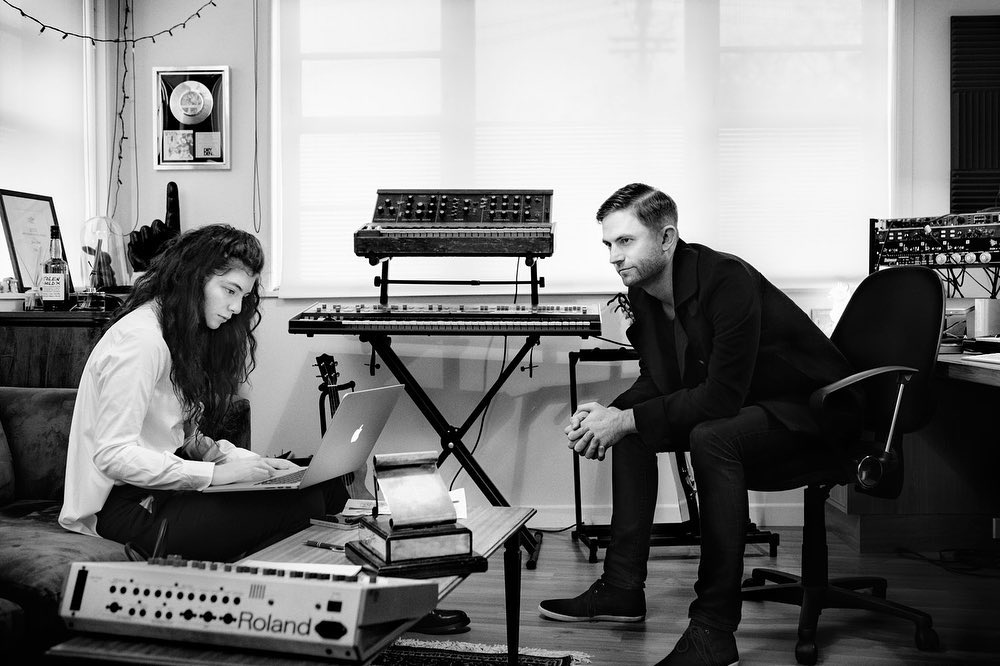
By December 2012, Lorde was paired with songwriter, producer, and former Goodnight Nurse lead singer Joel Little.
“I’ve been writing music since I was about 12 or 13, just mucking around with people and doing vocal coaching and stuff. Then I started working with Joel Little, and we just started making stuff. It just happened,” Lorde said. “I started writing songs when I was 13 or 14 because I’ve always been a huge reader. My mum’s a poet and we’ve always had so many books, and that’s always been a big thing for me, arguably more so than music.”
“When I met her she’d just turned 15, and I just remember her coming in, and us both probably feeling a bit odd. It’s quite a weird situation when you sit down with someone you’ve never met before to try to write a song,” said Little. “So the first few times, we didn’t write a whole lot, we’d just hang out and listen to music, maybe start coming up with an idea.”
“We just hit it off,” said Little “We started working on trying to figure out what she wanted to do, just playing with different ideas and different styles. There was never any pressure for it to really be anything in particular, it was just write some songs and see what happens. And Universal gave us a lot of freedom there, to just make what we liked. They weren’t in a hurry.”

Within three weeks, the pair co-wrote, recorded and produced five songs at Little’s Golden Age Studios in Morningside, Auckland.
“It was actually her lyrics that got me first. She brought in the lyrics and I thought ‘These are ridiculous, how can you be thinking of things like this?’ And then when I heard her sing, I was just like ‘yussss!’. I knew it was gonna work,” said Little.
On November 22, 2012, Lorde published The Love Club EP through SoundCloud as a free download and quickly rose to power, with “Royals” leading the charge. On March 8, 2013, UMG decided to commercially release “Royals” as a single, where it reached number 2 on the New Zealand and Australian charts.
Lorde said, “The first weekend we put it out, I went on SoundCloud and saw all these people I didn’t know were listening to it, and I think I realized this is bigger than just me and my friends… [The first time I heard it on the radio], I was in my parents’ living room. My sister had called the radio station to request it, and I felt very proud but very shy.”
Lorde wanted some anonymity before her reign.
“It was basically all me, that stuff. I’ve always been frustrated with that misalignment, because with a pop star you know everything about them all the time… Here’s what my legs look like, here’s what my body looks like, this is what my face looks like. Whereas you get someone like Burial– you don’t know what he looks like, but it’s awesome his music can be such a big thing but it’s only the music… and it frustrates me that those two can’t mesh at all. It was more like ‘I don’t really want to do a photo shoot yet’, and then everyone made a big deal of it.”
“I feel like mystery is more interesting,” Lorde said. “People respond to something that intrigues them instead of something that gives them all the information — particularly in pop, which is like the genre for knowing way too much about everyone and everything.”
A few days after The Love Club EP started to spread throughout New Zealand, Victoria Tsigonis of Weapon of Choice, an artist management and marketing firm, heard the song Royals and sent the SoundCloud link to her friend Natalia Romiszewski, of the consulting company Sound Language, who was having a “hating life and bitching about it” kind of day.
“Listen to this. It will make you feel better,’ said Tsigonis to Romiszewski. “I heard it and I was like, ‘Holy fuck,'” recalled Romiszewski. She sent the song to New York-based Lava Records head Jason Flom. “As a music supervisor, it’s my job to know stuff before anyone else, and that’s his job as well,” said Romiszewski.
“I have the email framed in my office from her from November 27th, 2012. The subject line is ‘Hot S**t,'” recalled Flom. “I get a dozen of these a day from people, ‘Hey listen to my thing it’s the biggest thing in the world,’ right? She was a music supervisor and she sent me a SoundCloud link. It says, ‘Unsigned New Zealand Female, Listen!’ And she put a little disclaimer on it that says, ‘Not sure if it’s for you, but wanted to pass along.’ I was just sitting, minding my business at home going through my inbox, I opened that up and listened to it and went, ‘What in the world is this?'”
“I took one listen and was immediately obsessed,” said Flom.
“So I found her address on Facebook, I emailed Lorde and she wrote me back and pretty soon I’m on the phone with her parents and I said to her [mother], ‘I think your daughter is gonna win Grammys’ and we did the deal,” recalled Flom. “I got there just in time. I think she had 200 Soundcloud plays at the time.”
Maclachlan received a message from Lorde, stating, “I got an email from this guy in America called Jason Flom. Does this mean anything to you?'” recalled Maclachlan. “There was a tsunami of American A&R after that, but Jason was the first, and Jason was the most outwardly passionate about this.”
Shortly after signing the deal, Flom travelled to New Zealand to visit Lorde.
“When I was in NZ I got an email from Sean Parker [Napster founder and later president of Facebook] who I have a long history with,” recalled Flom. “He said, ‘Hey I just came across this girl Lorde and I think you guys should check her out,’ and I wrote him back and said she’s sitting right next to me at a café in Auckland right now. It was a great moment.”
“I sent an email very shortly after signing [Lorde] to all the key people at iTunes, and I said, ‘This really takes me back to when I signed Tori Amos,” stated Flom. “I feel like Lorde will have the same impact. I worked with Tori from the very beginning, and I can say with some authority that Lorde has the same level of intensity and genius.”
Starting March 30, just weeks after signing her U.S. deal, “Royals” spent three weeks at the top of New Zealand’s digital songs chart.
“I saw her do her first show she ever did singing her own material at a club with about seventy people in Auckland, New Zealand,” stated Flom. “That was one of my favorite moments because she was so poised and so great already. She was fifteen and I said, “Oh my God, where’s this going?” It went exactly where you would hope it would go.”
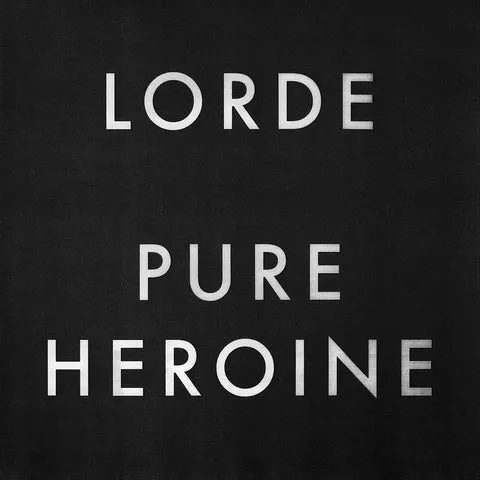
“I remember when she called me up and told me that the title of the album was going to be Pure Heroine and I almost fell down. That title is batshit fucking crazy. I mean it’s so good right, and the black cover – It’s perfect,” stated Flom. “It’s like some Ziggy Stardust type of perfection… Heroine with an e and Lorde has an e on the end. Get the fuck outta here! What depths of your soul did that spring from, cos this is amazing.”
“I don’t use the word lightly… but I’d say she’s a legitimate genius,” said Flom.
Back in the States, Flom was methodically building buzz. On April 26, Buzzfeed ran an article titled “Listen to This Teen Singer From New Zealand Right Now,” stating, “Her voice is incredible — something like a cross between Adele and Ellie Goulding, but with a roughed-up smart kid swagger that’s completely foreign to both of them. And she writes her own songs.” Additional coverage followed in Rolling Stone, which declared Lorde “is the sort of teen you forget is a teen. In conversation, she comes off not simply self-possessed but downright wise.”
Spin noted that “Lorde keeps living up to the hype,” while The Guardian named her the “One to Watch.” Billboard hailed Lorde as “the new queen of alternative” and featured her on the cover.

Flom’s approach was deliberate. “It’s one of those six-format records, but we’re really trying to take our time. We really want to take a very deliberate approach to this—there’s absolutely no rush.”
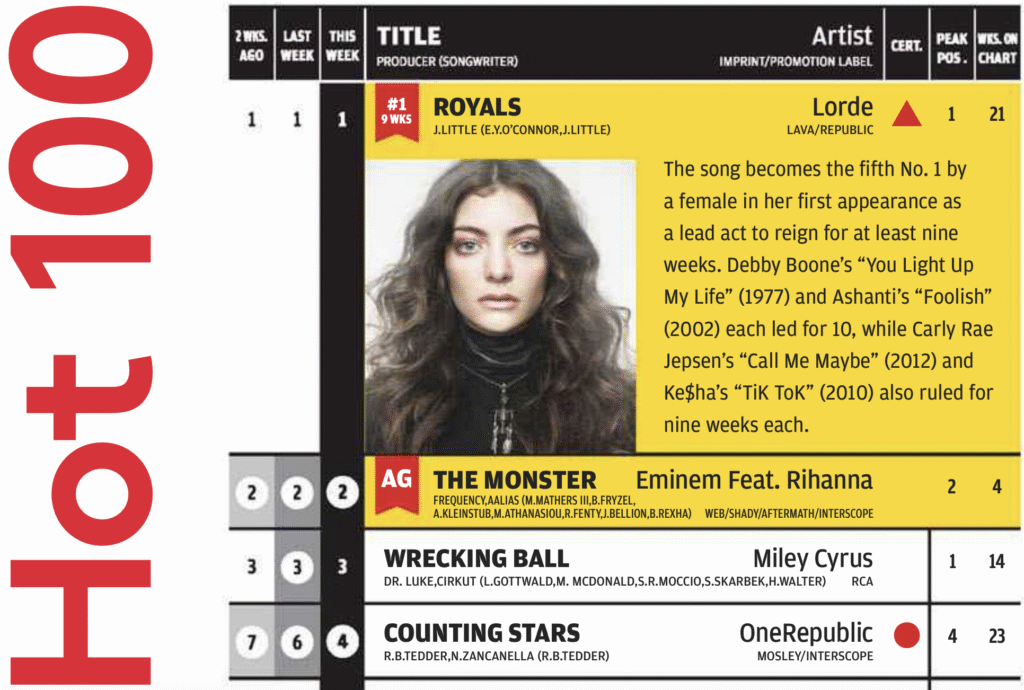
By May 13, 2013, a music video for Royals was produced, then released as a single in the United States on June 3, 2013. By August 2013, it had sold 60,000 copies and Royals continued marching and eventually ruled the US Billboard Hot 100 for nine weeks. The achievement was historic: “Lorde becomes the first lead solo female to crown Billboard’s Nielsen BDS-based Alternative chart in more than 17 years,” reported Billboard. “No female soloist, in fact, had led the list as a lead artist in Lorde’s lifetime until this week.”
Lorde released her debut album, Pure Heroine, featuring 10 songs on September 27, 2013.
The influence of Kanye West and George Brett
Lorde wrote the lyrics for “Royals” in “like half an hour” at her home and found inspiration from the lavish lifestyles of Kanye West and Jay-Z, especially their collaboration on Watch the Throne, and also Drake and Nicki Minaj.
“When I wrote Royals, I was listening to a lot of rap, but also a lot of Lana Del Rey, because she’s obviously really hip-hop influenced, but all those references to expensive alcohol, beautiful clothes and beautiful cars – I was thinking, ‘This is so opulent, but it’s also bullshit,'” said Lorde. “I can get absorbed in Kanye’s world, but a part of me is always like, ‘This is kind of bullshit’—all the crazy extravagances he’s talking about.”
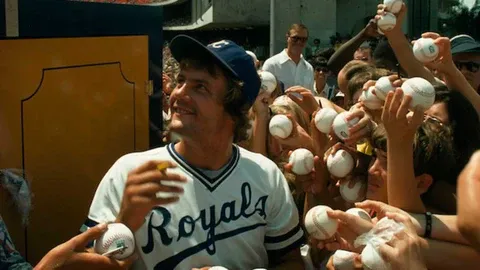
Another inspiration point for Royals arrived after seeing a picture of George Brett from the Kansas City Royals. Brett, wearing his Royals jersey, was surrounded by fans seeking an autographed baseball. “That is so cool. That word is so beautiful and how can I incorporate that into something,” Lorde said in an interview.
Lyrically: Royals
“Hearing about the Murcielago Kanye owns is a nice way of switching off reality and pretending you own a Murci. Which is fine! It’s just really irrelevant to us, and that was the point I was trying to make with Royals. A lot of adults forget that people my age are actually tastemakers, but because we don’t have any money to buy pretty things, or an ID to get in anywhere cool, we’re kind of moored…it’s a frustrating place to be sometimes, so hopefully having someone batting for the team who gets played on the radio and stuff is nice for people,” said Lorde.
“I’m not thinking when I’m writing, but with my lyrics everything is personal. Everything has happened to me and all those things help to build up this kind of fabric that people can hopefully relate to,” said Lorde. “You’ve got to be honest for it to lock with me, it’s got to have real things – a night I’ve had or an experience you look back on and go, ‘I’m glad I put this somewhere.'”
I’ve never seen a diamond in the flesh
I cut my teeth on wedding rings in the movies
And I’m not proud of my address
In a torn-up town, no postcode envy
The opening lyrics of “Royals” immediately establish a distance from luxury and describe a lifestyle of humble beginnings, revealing “I’ve never seen a diamond in the flesh / I cut my teeth on wedding rings in the movies.” The song continues to express dissatisfaction with the current living situation: “And I’m not proud of my address / In a torn-up town, no postcode envy.”
Lorde grew up in the suburbs of Auckland, New Zealand, specifically in the North Shore area. Her childhood was spent in Devonport and Bayswater. “New Zealand is really quiet and pretty tame compared to the parts of America that I’ve seen. Pretty much my whole life I’ve been in the same suburb, surrounded by the ocean and everyone like swims and goes fishing,” she recalled.
But every song’s like gold teeth, Grey Goose, trippin’ in the bathroom
Bloodstains, ball gowns, trashin’ the hotel room
We don’t care, we’re driving Cadillacs in our dreams
But everybody’s like Cristal, Maybach, diamonds on your timepiece
Jet planes, islands, tigers on a gold leash
We don’t care, we aren’t caught up in your love affair
“We’re driving Cadillacs in our dreams, ‘was something I had written in a diary when I was like 12 years old. I found the diary and thought, ‘that’s kinda cool,'” said Lorde.
Lorde wrote Royals at the age of 16, noting “I definitely wrote Royals with a lightness in mind, and there is definitely a humorous tone to it. I wasn’t trying to be aggressive and anti-consumerist. I was definitely poking fun at a lot of things that people take to be normal. I listened to a lot of hip-hop and started to realize that to be cool in hip-hop, you have to have this sort of car, drink this sort of vodka, have this sort of watch, and I was like, ‘I literally have never seen one of those watches in my entire life.'”
And we’ll never be royals (royals)
It don’t run in our blood
That kind of lux just ain’t for us
We crave a different kind of buzz
Let me be your ruler (ruler)
You can call me Queen Bee
And baby I’ll rule, I’ll rule, I’ll rule, I’ll rule
Let me live that fantasy
Lorde blends reality with aspirations of hierarchy. “And we’ll never be royals… That kind of lux just ain’t for us.” These lines capture the disconnect between how most people live and the luxury lifestyle pictured by pop culture. It’s not accessible, “It don’t run in our blood.” What’s needed is a “different kind of buzz” – something beyond materialism.
“Let me be your ruler… you can call me Queen Bee.” These lyrics bring dreams of ruling them all. “Let me live that fantasy” is a declaration of wanting this dream to be real.
My friends and I, we’ve cracked the code
We count our dollars on the train to the party
And everyone who knows us knows that we’re fine with this
We didn’t come from money
No limousines, no stacks of cash. Just trains and pooled dollars counted on the way to the party. What matters is the connection, not the cash.
Ooh ooh oh
We’re bigger than we ever dreamed
And I’m in love with being queen
Ooh ooh oh
Life is great without a care
We aren’t caught up in your love affair
“We’re bigger than we ever dreamed.” They’ve exceeded expectations, gone farther than imagined. Yet the fantasy persists. “I’m in love with being queen.” The desire for power and status remains.
The closing lines offer a philosophy: life is great when you let it unfold without stress. “We aren’t caught up in your love affair” distances from the opulent obsession. The buzz isn’t in acquiring things; it’s in letting them go.
In a video of Royals, posted May 13th, 2013, Lorde wrote in the description, “lately i’ve been waking up at 4 or 5 a.m., turning things over in my head. so much to think about, so much to break down and process and decide. i’m only at the beginning, but it has always been important to me that everything feels cool, feels right. this song means a hell of a lot to me, and to others, and i guess what i tried to do is make something you could understand. a lot of people think teenagers live in this world like ‘skins’ every weekend or whatever, but truth is, half the time we aren’t doing anything cooler than playing with lighters, or waiting at some shitty stop. that’s why this had to be real. and i’m at that particular train station every week. those boys are my friends. callum’s wearing a sweater that used to belong to me. so it all feels right, and i can sleep. thanks for being with me all the way so far — so much to come, such great heights. i’m just getting started. enjoy xx”
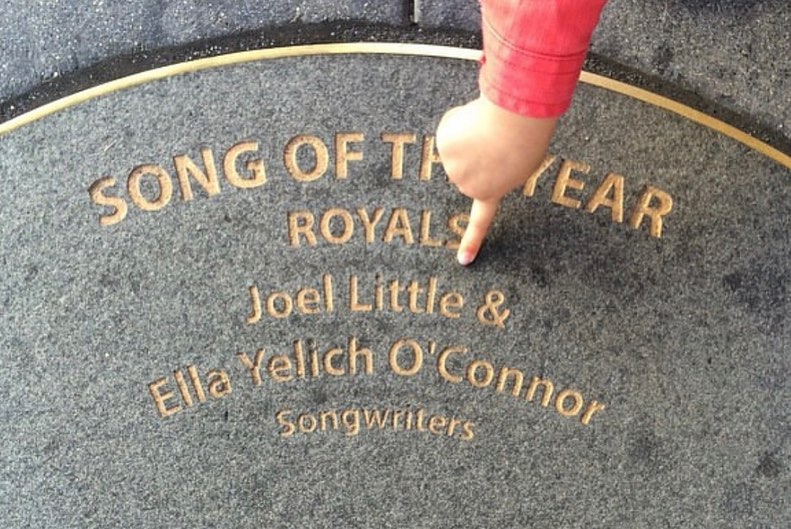
Royals won two Grammy Awards—Song of the Year and Best Pop Solo Performance—in 2014. The song also earned a Billboard Music Award for Top Rock Song, an MTV Video Music Award for Best Rock Video, and multiple honours at the New Zealand Music Awards and APRA Music Awards.
“I’ll be forever grateful for this life, thanks as always to the incomparable @lorde for everything, and to everyone that has listened to the album over the years and made it as much a part of their lives as it is ours,” said Little in celebrating its 10th anniversary. “10 years ago today Pure Heroine came out and changed my life forever. It’s hard to put in to words how much I loved making this album with @lorde and how much that time and these songs will always mean to me.”
“Every situation I’m in, I’m thinking about lyrics,” says Lorde. “I’ll be at a party and enjoying it, but at the same time looking around and thinking about the translation, and how I’ll write about it. You can never shut that off as a writer.”
Lorde recalled, “As a young teen, I went to a lot of David Lynch films, I read a lot of strange books, I loved to go to the museum all day. I was that kid. I liked to hang out with people older than me, I didn’t really know what I wanted to do—writing and singing was just a hobby. But sometime in the last 18 months, working on The Love Club with Universal, I was just like, “This is what I want to do.” Now I’m travelling to New York because of it! I’ve watched so many movies [about New York], but I’ve never really travelled, I’ve never even been on a plane, so I’m very excited.”
From a teenager fascinated by aristocracy, Lorde had ascended to her throne, living the fantasy.