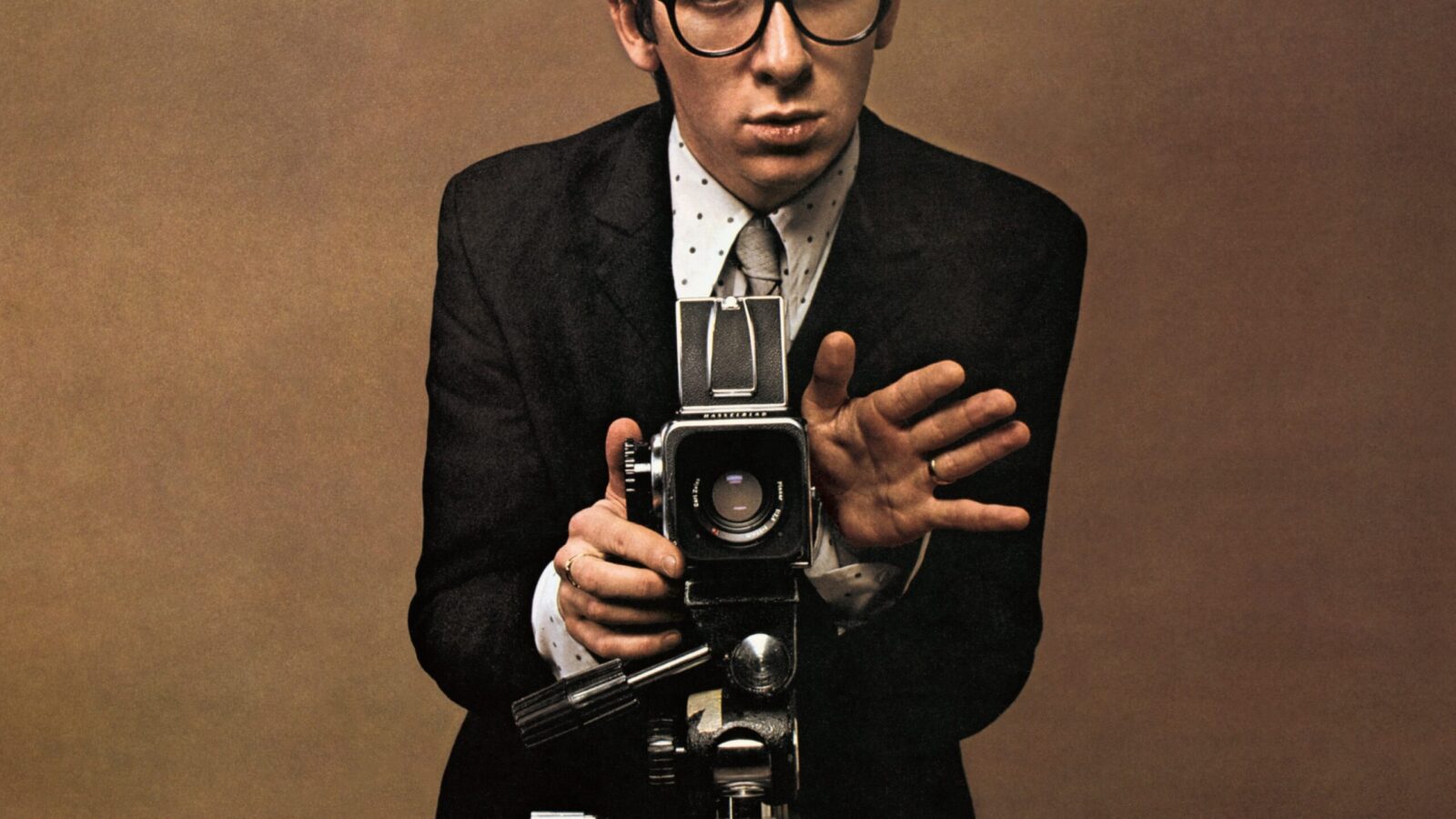
Fourteen seconds.
That’s how long Elvis Costello played “Less Than Zero” on Saturday Night Live before he stopped, waved his hand, and cut off The Attractions mid-song. It was December 17, 1977. Columbia Records had insisted he play this song from his debut album about British fascist Oswald Mosley.
Costello had other ideas.
“I’m sorry, ladies and gentlemen,” he said into the microphone, “there’s no reason to do this song here.”
Producer Lorne Michaels stood in the control room, reportedly furious and giving Costello the middle finger. The audience looked confused. The Attractions waited for direction. Then Costello counted off a different song entirely. The opening chords of “Radio Radio,” an unreleased song about the influence of the media and the state of rock radio, transmitted into the living rooms of millions of Americans.
The defiance was visible. This was Costello’s second and final performance of the night. Earlier, he’d played “Watching the Detectives,” his fourth single overall and his first hit that was charting in the U.K. He’d followed the script then. Now, for his closing number, he’d abandoned it entirely.
His debut studio album My Aim Is True was released by Stiff Records on July 22, 1977, in the U.K. Columbia Records, signed by A&R exec Gregg Geller, picked it up for U.S. distribution. Costello was about a month into his first American tour when he appeared on SNL, playing to around 500 people each night in small clubs for $4 per ticket. Being the musical guest on Saturday Night Live was pivotal.
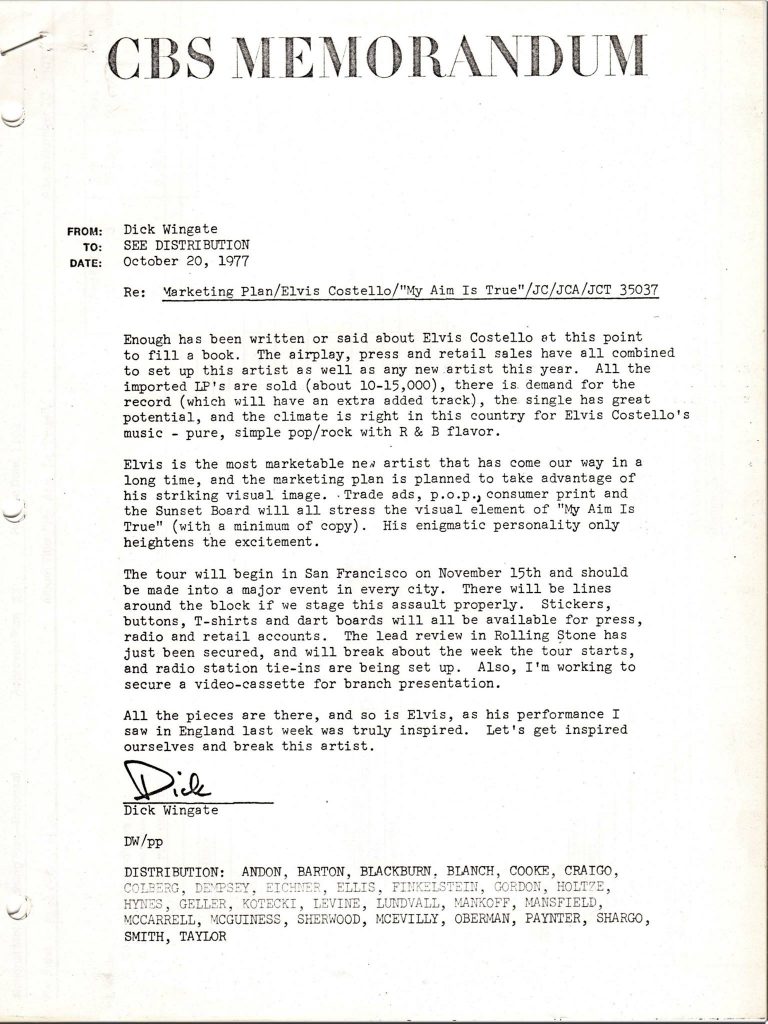
Dick Wingate, a product manager at Columbia, was executing the plan to introduce Elvis Costello and his album to American audiences. “Elvis Costello is the most marketable new artist that has come our way in a long time,” said Wingate. “His enigmatic personality only heightens the excitement.”
Costello wasn’t SNL’s first choice, or second choice. Two days before the show, on December 15, the Sex Pistols were denied entry visas to the United States due to their criminal histories. Michaels scrambled for a replacement and approached the Ramones, who famously refused the invitation: “We don’t substitute for nobody.” Costello got the call as a last-minute backup.
But there were other complications. Months before his SNL appearance, on August 16, 1977, Elvis Presley died.
“One unexpectedly low-key aspect of the whole ‘Elvis explosion’ was the attitude of the normally exuberant Stiff Records’ new wave organization. It was decided to keep a low profile on the company’s new hit artist, Elvis Costello. It was felt that any action could be misunderstood by the media as a Presley cash-in, but reports that Costello would now change his ‘assumed’ first name were strongly denied,” wrote Billboard.
How did this relatively unknown British musician with the stage name “Elvis Costello” make it to Saturday Night Live? The answer begins in a house filled with music.
Music Was All Around
Declan Patrick MacManus was born on August 25, 1954, in Paddington, West London, the only child of Ross MacManus and Lillian Alda Ablett. Music was everywhere in his house.
Ross and Lillian both worked at a local record shop called Bennett’s and eventually married in 1952. Ross, the son of an orphaned trumpet player, formed a band called Ross MacManus & The New Era Music from 1950 until 1955. In March 1955, 27-year-old Ross joined the Joe Loss Orchestra as one of three vocalists and a trumpet player. The band was one of Britain’s most successful dance orchestras and had a residency at the Hammersmith Palais, performed and recreated songs on the BBC, and was a favourite at Buckingham Palace and Windsor Castle events involving the British Royal Family.
“The house was filled with both the music my parents listened to for pleasure and the working tools of my dad’s job as a dance band singer — demonstration records and sheet music he used to learn whatever the new releases were that week,” said Costello.
“Musicians, as they often did in those days, gravitated to the place where unusual music could be found,” recalled Costello. “I came along a little later, and my dad had to make what I imagine was a slightly painful decision: to move away from the music he loved — which wasn’t very rewarding financially — toward something he discovered he had a real talent for, which was entertaining people by singing popular songs of the day.”
“This was my father’s place of employment. His office. His factory,” said Costello of seeing his father play at the age of seven at Hammersmith Palais in 1961. “There was nobody else up in the balcony except the women who checked coats and another who sold refreshments at the kiosk. I think my Dad charged one of them with checking on me from time to time, to make sure I hadn’t wandered off. She needn’t have worried. My eyes were fixed on the bandstand.”
“I think both my parents allowed me to hear music on my own terms. It didn’t seem unusual for music to be playing all the time. My mother and father actually met across the counter of a record shop. My mother sold records from the age of thirteen, so she was the girl in town who knew about jazz,” said Costello.
Lillian was an authority on available records, what was new, and what sounds musicians were wanting to hear. By 1961, Lillian changed from various record shop work, including Selfridge’s record department, to venue operations, running bebop and jazz club nights such as “Bop City” with Ross. This exposed Declan beyond his father’s orchestra work to see how it all worked. Three years into the venture, in 1964, Declan’s parents separated, and he began living in two households.
“My mother sold records and therefore she had to know all about the record catalog because she didn’t have a computer to refer to,” said Costello. “She had to look it up in a book and memorize things, and she was very knowledgeable about music.”
The summer before he turned 14, in 1968, Declan worked a weekend job in a grocery store, saved up his money, and took his pay to Potter’s music shop in Liverpool where he bought his first guitar, a mock-Martin acoustic. “I proudly carried the guitar back over the Thames, wondering if anyone passing by mistook me for a musician,” said Costello.
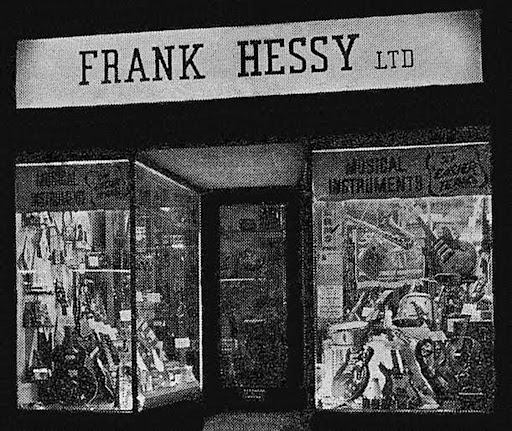
In early 1970, Lillian and Declan relocated to the Liverpool area, first to West Derby and later to Birkenhead, where she worked in the office of a biscuit factory, and part-time as a late-night chemist to make ends meet. Still keen on the guitar, Declan once again saved money and decided to rent-to-own an electric guitar from Frank Hessy’s Music Store, which was located on Whitechapel Street in Liverpool’s city center. This was a hotspot for local musicians to hang out, and where all four Beatles purchased instruments, including John Lennon‘s first guitar.
“I was absolutely determined that I was going to buy this small Rickenbacker that would vanish and then reappear on the wall of the shop with strange regularity. Behind the strings there was always a card that read FORMERLY OWNED BY GEORGE HARRISON,” recalled Costello. “After proving that I really did have the money for the initial deposit, I finally got to take the guitar down and try it out. It was a terrible guitar. I quickly found out the reason why it kept disappearing and rematerializing. Anyone who bought it sold it straight back to the shop, as the damn thing was nearly unplayable.”
“So I settled for a white Japanese-made Vox Les Paul copy… It was also a pretty dreadful guitar, but it was in my price range and I thought holding such a flashy-looking instrument might somehow transform me,” recalled Costello. “Pretty soon I decided that playing the electric guitar was passé after I read something in a magazine about people in Laurel Canyon playing something called ‘wooden music.'”
It was also during this time, post-Woodstock, that the psychedelic era gave way to folk-rock, with artists like Neil Young, The Band, and Van Morrison gaining popularity among those who wanted something more grounded. Declan discovered this scene was gaining momentum across Liverpool’s pubs and clubs and wanted to be part of it.
On New Year’s Eve 1971, at a house party in Liverpool, 16-year-old Declan met Allan Mayes, an 18-year-old singer-songwriter with a love for folk-rock. While a celebration was happening downstairs, the two sat in a bedroom playing their guitars.
The next day, Mayes invited Declan to join his band Rusty, which at that time included bassist Alan Brown and vocalist Dave Jago. Declan became the fourth member. However, the initial lineup proved to be unstable as Brown departed for university and Jago’s role scaled back as the band’s direction shifted. Within a month, Rusty had evolved into an acoustic duo of Declan and Allan, who shared vocal duties while playing guitars.
This stripped-down configuration was a turning point in Declan’s musical life. He had never performed in front of an audience before joining Rusty, and he found himself stepping onstage night after night across Liverpool’s pubs and folk clubs.
“Our repertoire did include a few of our own compositions ‐ lyrics written in various shades of purple ‐ but they were often put in the shade by the songs of Neil Young, Van Morrison and two Bob Dylan tunes; one made famous by The Byrds and the other co‐written by Rick Danko of The Band. We played tunes by Randy Newman, John Martyn and the psychedelic band, Help Yourself,” said Costello. “It was all part of learning your trade as we were certainly only earning enough money to put petrol in Allan’s Ford Anglia.”
By the summer of 1972, Rusty was playing up to five or six nights a week. To support himself, Declan took a job as a computer operator, which meant scheduling Rusty’s gigs around his shift work. This lasted until early 1973, when he made the decision to leave Liverpool, stating he was “looking for something” and decided to “take to this long and crooked road.” He asked Allan to come along, but he had a steady job and chose to stay. Declan believed he might “travel lighter and further alone,” and the duo that helped define his first band experience came to an end.
Becoming Elvis Costello
By 1974, Declan had settled in London and was ready to go back on stage. He formed a pub rock band where he served as vocalist and rhythm guitarist. After some debate with fellow bandmates on names such as “The Mothertruckers” and “The Bizario Brothers,” it was decided that ‘Flip City’ was the band name, a nod to Cheech Marin’s off-hand remark on Joni Mitchell’s song “Twisted,” where Cheech says, “Man, the chick is twisted, crazy… Flip city!”
The band played small pub rock clubs including the Red Cow and the Lord Nelson, occasionally sharing bills with established acts like Dr. Feelgood. Flip City gained enough attention to perform at the E1 Festival in Stepney on July 21, 1974.
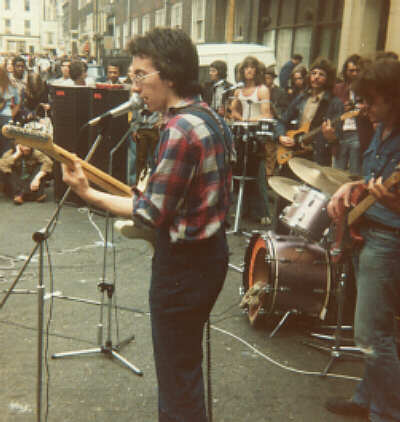
Despite their potential, the band never released an album and disbanded by late 1975 as Declan prioritized supporting his young family. He had married Mary Burgoyne in November 1974, and their son Matthew was born early the following year. By late 1975, Declan was working as a computer operator at the Elizabeth Arden cosmetics factory in North Acton while continuing to write and demo songs. He spent his lunch breaks and time between shifts writing, sometimes recording demos on a tape machine, and shopping these around to publishers and record labels. The rejections piled up until mid-August 1976, when he submitted a six-track demo to a new independent label called Stiff Records.
Stiff Records was known for signing punk rock and new wave acts such as Nick Lowe, the Damned, Wreckless Eric, Ian Dury, and Devo, as well as their catchy marketing slogans and promo campaigns.
Stiff’s co-founders Jake Riviera and Dave Robinson saw potential and offered him a songwriting and recording deal. As a marketing strategy, Riviera suggested a new stage name. Declan was already using the name D.P. Costello, which was something his dad used as a moniker while recording under the name Day Costello.
“It was so weird, because I immediately put it on and thought, ‘God, this is fuckin’ good’,” said Riviera. “But at the same time I was hesitating because after all it was [his] first tape and I wanted to get a better perspective.”
“Given my unpromising appearance, Dave and Jake probably saw me more as an in-house songwriter for other artists than an actual recording star, but a modest recording session was planned by way of an experiment,” recalled Costello.
“I just felt, well, my family name McManus is hard to say on the telephone; it didn’t look very attractive written down. It sort of suggested a guy in a cable knit sweater singing wailing songs, you know, and so I wanted something a little groovier, so I had adopted that part. And in addition, my father had made records in the 60s under assumed names because he had to make money on the side from his contracted gig as a dance band singer. He’d made records under the names Frank Bacon and the Baconeers and Hal Prince and The Layabouts. It seemed like a noble showbiz tradition like Duke Ellington,” said Costello.
As for the name “Elvis,” Costello stated that it was chosen because “we wanted to give it an aura of excellence.”
“I mean when when he died like a couple of weeks into our career there was this moment of panic in the office like can we go through with this cuz this is like a global,” said Costello.
“I said to him, don’t use my name; people will just think I’m helping you along, you know, because you’re doing it all on your own, so he decided to use my grandmother’s name, who was Elizabeth Costello,” said Ross MacManus. As for the Elvis name, “That was just a bit of cheek on the part of his management, you know, because he doesn’t sound anything like Elvis. There’s no way he portrays Elvis.”
After signing with Stiff in August 1976, Costello held a successful test session in mid-September at Pathway Studios. By the end of the year, he travelled to Headley Grange in East Hampshire, where Clover were living, to spend several days rehearsing and working out arrangements for his songs, then recording them the next day at Pathway.
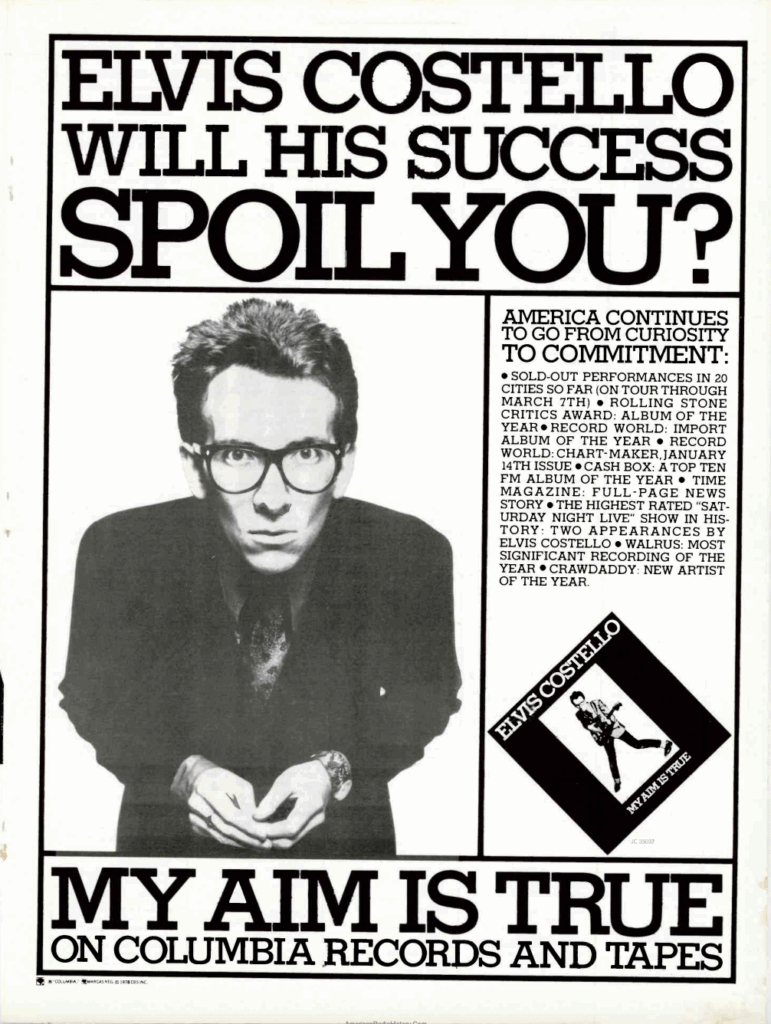
Costello still held his full-time office job as a computer operator, so the sessions were spaced over several weeks to accommodate his work schedule and Stiff’s tight finances. My Aim Is True was recorded and mixed in six four-hour sessions for a total cost of about £1,000, with the final production mix completed by Stiff’s own Nick Lowe in late January 1977.
By February 1977, Riviera and Robinson, who were now Costello’s managers, had given him his new stage name, Elvis Costello. His first single, “Less Than Zero,” was released at the end of March 1977, followed by “Alison” in May 1977, and “Red Shoes” in July 1977. The trifecta of songs all failed to chart, but Costello made a leap of faith and decided to quit his job at Elizabeth Arden in early July to fully commit to his music career.
When “Watching the Detectives” was released on October 14, 1977, it quickly gained attention and reached number 15 on the UK singles chart, becoming Costello’s first hit. That same month, Jake Riviera left Stiff Records, taking with him Nick Lowe and Elvis Costello to the newly launched label Radar Records, which had been founded by Andrew Lauder, Martin Davis, Tim Read, and Riviera.
His first ever interview was on ‘Good Afternoon’ with Mavis Nicholson on September 27, 1977, who described him by seeing his posters “was Woody Allen in a new film about a rock singer.” Costello stated, “I just take it as it comes. I don’t think about how big it’s gonna be. I don’t have any aspirations in that sense. It doesn’t really bother me that people are building it up in one way or another. If I see that it’s getting too out of hand or they’re not being realistic, then I can say things that I see certain things clearly. And I tend not to think about what might happen. I only think about what is actually happening and what I’m actually doing.”
“I’m more interested in being a person than a celebrity. And that’s why I tend to kind of talk about being a person more than kind of, I’m not interested in being a star, you know, I’m not interested in being a cardboard cutout,” said Costello. “it’s just a question of I keep expressing different opinions as the mood takes me. If I want to say something really that cuts across everything I’ve said before, because that’s what I feel that day, then I’ll do it. I won’t necessarily adhere to what everybody else thinks is my image.”
With his first hit single climbing the charts and a new label behind him, Costello formed a permanent backing band called The Attractions with Steve Nieve on keyboards, Bruce Thomas on bass, and Pete Thomas on drums. Bruce Thomas chose the name, wanting something with the same marketing appeal as Motown’s The Temptations.
Columbia Records picked up My Aim Is True for U.S. distribution in late October 1977, and Costello began his first American tour in November, playing small clubs to audiences across the country.
Just days before his Saturday Night Live appearance, Costello played two shows at the Bottom Line in New York on December 13 and 14. “Hate to say we told you so, but Elvis Costello’s Bottom Line concert on Wednesday night confirmed our prediction of last April, that he is one of the most unique and compelling young performers of the year,” wrote Record World. “After a rough but ultimately convincing set on Tuesday before a full house comprised in most part of CBS executives and field personnel, Elvis put on a show that matched anything we’ve seen this year. Criticisms have been levelled at him for relying so heavily on new, unrecorded and unfamiliar material, but after several exposures to songs like ‘Lipstick Vogue,’ ‘Lip Service,’ ‘You Belong To Me,’ ‘The Beat’ and ‘Radio, Radio’ (a song that may not surface until his third album), Elvis has proven to us that he is a vital, new talent with a bright future. We told you so.”
Columbia was already trying to control when – or if – “Radio Radio” would be released. Three days later, Costello took the stage of Saturday Night Live and made that decision for them. He performed “Watching the Detectives,” then 14 seconds into “Less Than Zero,” he stopped. Columbia and NBC had both forbidden “Radio Radio.” Costello played it anyway.
“I just wanted them to remember us. I didn’t really have anything against the show,” said Costello. “I was more pissed off at being told what to play by the record company than I was NBC, truthfully. I can’t remember whether I said what I was going to do, but I think I just said, ‘Watch me.'”
“I was copying Jimi Hendrix. Hendrix had done the same thing on [BBC’s] the Lulu Show, when he went into an unscheduled number. I remember seeing it and going, ‘What the hell’s going on?’,” said Costello.
Rumours circulated that Lorne Michaels “banned” Costello and The Attractions from appearing on the show, which is folklore. “I’ll read it sometimes in the Post, ‘So and so’s banned for life,'” Michaels stated. “We’ve never banned anyone. We’re way too crass and opportunistic.”
Demand for Elvis Costello increased with radio play, reviews, album sales, sold-out shows across North America, and chatter from his appearance on “the highest rated Saturday Night Live’ show in history.” Reviewers were amplifying Costello as the “most significant recording artist of the year,” and “the new artist of the year.”
“The last date of Elvis Costello’s recent tour was in Asbury Park, New Jersey, where one observer met people who had flown in from Los Angeles…people who had driven from Boston…people who were following Elvis Costello around the country. We’ve never seen this much passionate excitement for a new artist with a month-old album. Let this be a warning to you,” declared a Columbia Records ad celebrating the success in Billboard and Record World.
“Radio Radio” didn’t hurt him. It made his name known.
Lyrically: Radio Radio by Elvis Costello and The Attractions
Elvis Costello and The Attractions recorded what would become This Year’s Model at Eden Studios in London in about eleven days, completing in early January 1978. The album was released on March 17, 1978, in the UK through Radar Records, followed by a U.S. release in May.
“This is a strong followup to last year’s ‘My Aim Is True’ debut LP from this British new wave cult figure. All songs here possess a sparkling, dynamic quality whether it’s a driving rocker or slower tempo material. Costello interprets his own wry lyrics with a raw-edged vocal style and producer Lowe cushions with fine production touches such as riveting keyboard breaks. Above all else there is a tangible energy level that pervades throughout. Best cuts: ‘No Action,’ ‘Pump It Up,’ ‘You Belong To Me,’ ‘Hand On Hand,’ ‘Lip Service,’ ‘Radio, Radio’,” wrote Billboard.
The band released the single “(I Don’t Want to Go to) Chelsea” in March, followed by “Pump It Up” in June. The U.S. version of the album had a different tracklist as Columbia removed “(I Don’t Want to Go to) Chelsea” and “Night Rally” because they felt these songs didn’t suit an American audience, replacing them with “Radio Radio.” The song was later released as a single in the UK in October and reached 29 on the UK singles chart, but “Radio Radio” was never released as a US single.
“Radio Radio” was originally written during Costello’s time with Flip City in 1974, when it was titled “Radio Soul,” a song that depicted the act of tuning into the radio as an escape, an uplifting and emotional experience. Costello described “Radio Soul” as a “shameless imitation” of songs from Bruce Springsteen’s 1973 album The Wild, the Innocent & the E Street Shuffle.
“I was sitting at home [in England] in ’75, in the thrall of Bruce Springsteen,” Costello recalled. “He sort of made it feel like a big dream in America where a radio was playing and it was always the perfect song. And even though there’s sadness in the song, I wanted to believe that somewhere it was like that and it wasn’t like it was in the suburbs, where you couldn’t hear any music you liked half the time. So that was a wishful song.”
His perspective shifted as he became part of the music business. “Then, of course, you get into the business of making records and you realize what it’s really about is some guy going off with a big sack of money to give it to somebody with some hookers and cocaine so that they play your record enough times that people get batted to death with it and that makes it a hit,” he said.
I was tuning in the shine on the late night dial
Doing anything my radio advised
With every one of those late night stations
Playing songs bringing tears to my eyes
I was seriously thinking about hiding the receiver
When the switch broke ’cause it’s old
They’re saying things that I can hardly believe
They really think we’re getting out of control
Given the original inspiration and progression from “Radio Soul” to “Radio Radio,” Costello describes in the opening lyrics how the radio is both a source of comfort and manipulation.
“Tuning in the shine on the late night dial” and “Playing songs bringing tears to my eyes” show radio’s emotional power, but the phrase “doing anything my radio advised” reveals how listeners passively absorb and simply follow what is being broadcasted. Costello is critiquing how radio stations prioritize profit over artistry. The song then shifts its focus to the system itself. “Seriously thinking about hiding the receiver / When the switch broke ’cause it’s old” suggests the listener wants to disconnect but can’t. The “old” system is literally breaking down, becoming obsolete and unreliable.
The line “They really think we’re getting out of control” captures the establishment’s fear of independent thought. When Costello recorded “Radio Radio” for This Year’s Model in late 1977 and early 1978, this was actively happening in the UK as the BBC had put a ban on the Sex Pistols’ “God Save the Queen.” The song had strong views of the monarchy, calling it out of touch, with lines like “no future in England’s dreaming,” and comparing the UK to “a fascist regime” while saying the Queen was “not a human being.”
The single was released on May 27, 1977, to coincide with Queen Elizabeth II’s Silver Jubilee celebrations, and the BBC issued a ban on May 31 forbidding airplay on radio and TV, while retailers like Woolworths and W.H. Smith refused to stock the single. By the time Costello was recording This Year’s Model, the Sex Pistols ban had become one of the most heavily censored songs in British history.
“If pop music is going to be used to destroy our established institutions, then it ought to be destroyed first,” said Labour MP Marcus Lipton.
Radio is a sound salvation
Radio is cleaning up the nation
They say you better listen to the voice of reason
But they don’t give you any choice
‘Cause they think that it’s treason
So you had better do as you are told
You better listen to the radio
The chorus is filled with irony and digs deeper into the media control, suggesting that the medium of the radio can take you away and it’s also a force that has control over the airwaves to “clean up the nation.”
“They say you better listen to the voice of reason” are those enforcing the rules “But they don’t give you any choice” as it has already been made for you. “‘Cause they think that it’s treason” when you start to question what information you’re being fed… “So you had better do as you are told.” The repetition of “you better” brings an implicit threat.
I wanna bite the hand that feeds me
I wanna bite that hand so badly
I want to make them wish they’d never seen me
When Costello stopped “Less Than Zero” after fourteen seconds on Saturday Night Live and played “Radio Radio” instead, he refused to “do as he was told” and literally bit the hand that fed him, that being Columbia Records, NBC, and the complete music business.
Some of my friends sit around every evening
And they worry about the times ahead
But everybody else is overwhelmed by indifference
And the promise of an early bed
You either shut up or get cut up, they don’t wanna hear about it
It’s only inches on the reel-to-reel
And the radio is in the hands of such a lot of fools
Tryin’ to anesthetize the way that you feel
This verse shows a divide between those who care about the future and those who lack interest and just want “an early bed.” “Some of my friends…worry about the times ahead” while “everybody else is overwhelmed by indifference.” Most people are too exhausted to care, choosing comfort over resistance. Which is how the system is designed.
“You either shut up or get cut up” makes the threat clear: speak out and you’re off the airwaves. Broadcasters curated culture and decided what the public could hear, and artists either complied or disappeared from the airwaves.
The Sex Pistols ban wasn’t a one-off incident. Throughout the 1970s, the BBC’s heavy hand controlled what could be played on British radio. The Kinks’ ‘Lola’ was banned in 1970 not for its transgender themes but because it mentioned Coca-Cola. The Who’s ‘My Generation’ had been pulled for stuttered vocals that might have offended those who stutter. Donna Summer’s ‘Love to Love You Baby’ was banned for three months over sexual content. The Beatles’ ‘Lucy in the Sky with Diamonds’ was kept off air for its suspected drug references to LSD.
“It’s only inches on the reel-to-reel” captures the industry’s cold calculation. In the 1970s, music was recorded on reel-to-reel tape, measured in inches. The dismissive “only” reveals how the industry saw the artist and the art produced. Not as human expression, but as inches of tape and the money it could generate.
“And the radio is in the hands of such a lot of fools” needs no interpretation as it’s really a subdued version of what the Sex Pistols stated. But the lyrics “Tryin’ to anesthetize the way that you feel” suggests the message being shared on the radio, or any media, is actively working to keep people passive and prevent them from feeling anything that might lead to questioning the system before one could get “out of control.”
Wonderful radio
Marvelous radio
Wonderful radio
Radio, radio
The chorus repeats, however, these lyrics that end “Wonderful radio / Marvelous radio / Wonderful radio” could be a hope as to what once possible with radio can be possible again with radio. Something that will bring soul to the radio.
“Radio Radio” is one of Elvis Costello’s most memorable songs. In 1999, Costello returned to Saturday Night Live for the show’s 25th anniversary special, bursting in on the Beastie Boys during their performance of “Sabotage” and once again stopping the show, declaring, “I’m sorry, ladies and gentlemen, there’s no reason to do this song here,” before performing “Radio Radio.” The 1977 act of defiance had become a celebration of resistance.
“Oh, you might as well just admit now that radio has nothing to do with music anymore — it’s in the advertising business. There’s a real skill to programming in an intelligent way, but nobody does that anymore. It’s all done by computer, by committee. Radio is absolutely the enemy of music. They are my sworn and mortal enemy, and I will have nothing to do with them,” stated Costello.


What does this song mean to you?
Share your thoughts on this song.