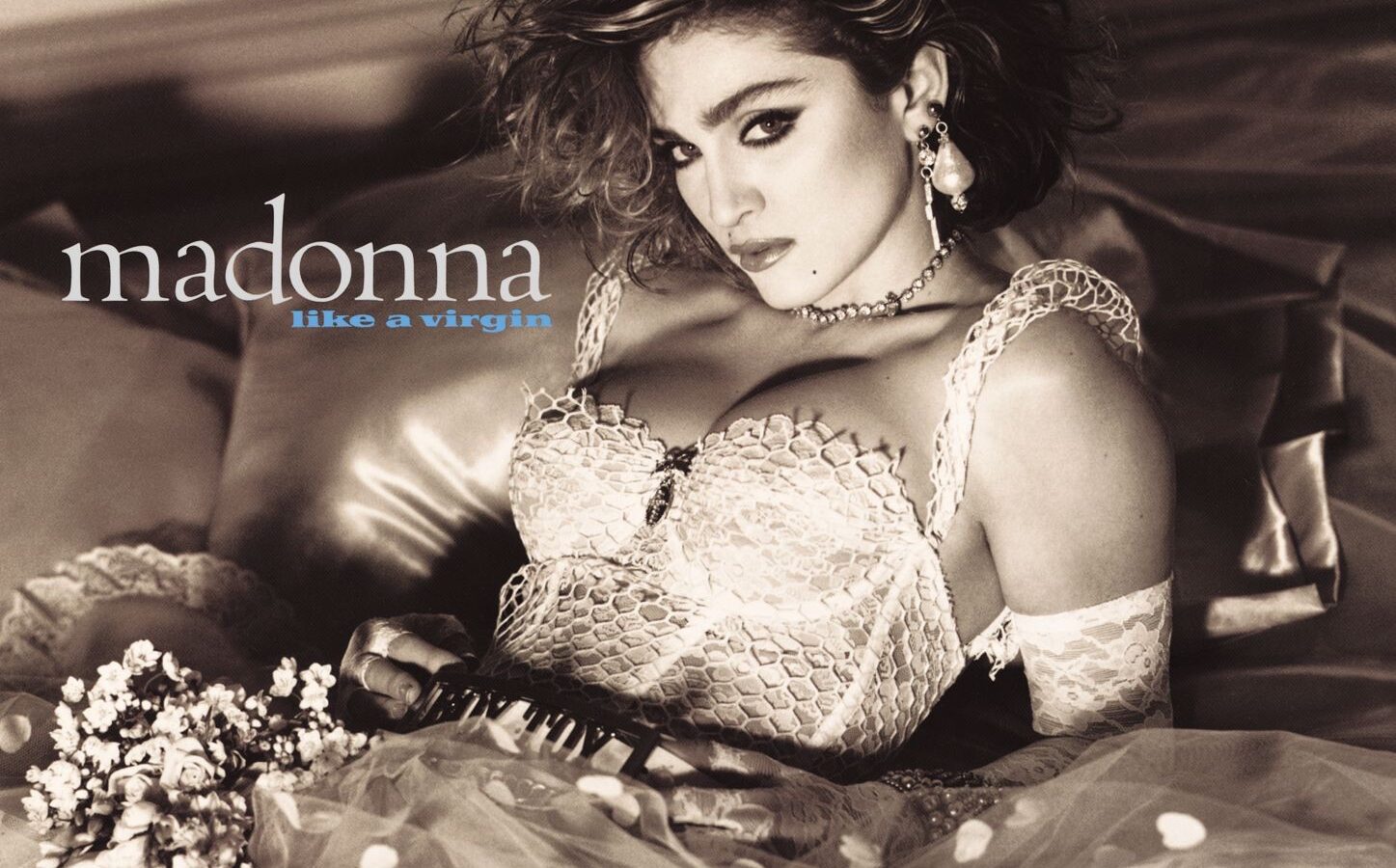
Radio City Music Hall. New York City. September 14, 1984.
The house lights drop for MTV’s inaugural Video Music Awards. The network has spent months fighting to fill this stage, going so far as to threaten pulling ZZ Top’s videos from rotation just to secure a performance. David Bowie, Tina Turner, Prince, Billy Idol, Cyndi Lauper, George Michael, and Michael Jackson’s pet chimpanzee Bubbles are in the audience.
Hosts Bette Midler and Dan Aykroyd, dressed in full silver space outfits, take the stage to open the show. When they step aside, a 17-foot wedding cake stands at centre stage. Standing at its peak, dressed in a white wedding gown with a fitted bustier, lace gloves, and a belt buckle that reads “Boy Toy,” is a 26-year-old from Detroit who has one album to her name. She begins to sing.
Madonna starts to descend the tiers. Then her white stiletto slips off. She dives to the floor and rolls toward the shoe. As she reaches for it, her dress rides up. She keeps singing.
When she walks off stage, her manager Freddy DeMann is waiting.
“He looked at me and he said, ‘Do you know what you just did?’ And I said, ‘Yeah, I sang a song and I lost my shoe on stage.’ And he’s like, ‘No, your butt was showing for the entire song. Your career is over.'”
The opposite happened. Madonna immediately captured attention. Something she always wanted. A moment only made possible thirteen months earlier, inside a pickup truck.
The wilderness
Billy Steinberg had been trying to make it as a performer. He had fronted a band called Billy Thermal, named after the small Coachella Valley town where his father’s vineyard was based. The band signed a record deal in 1979 but never released an album.
Steinberg decided to focus on songwriting. In 1980, Linda Ronstadt recorded his “How Do I Make You,” taking it to the top ten on the Billboard Hot 100. By 1981, he had begun writing with Tom Kelly, a session vocalist who had co-written Pat Benatar’s “Fire and Ice.”
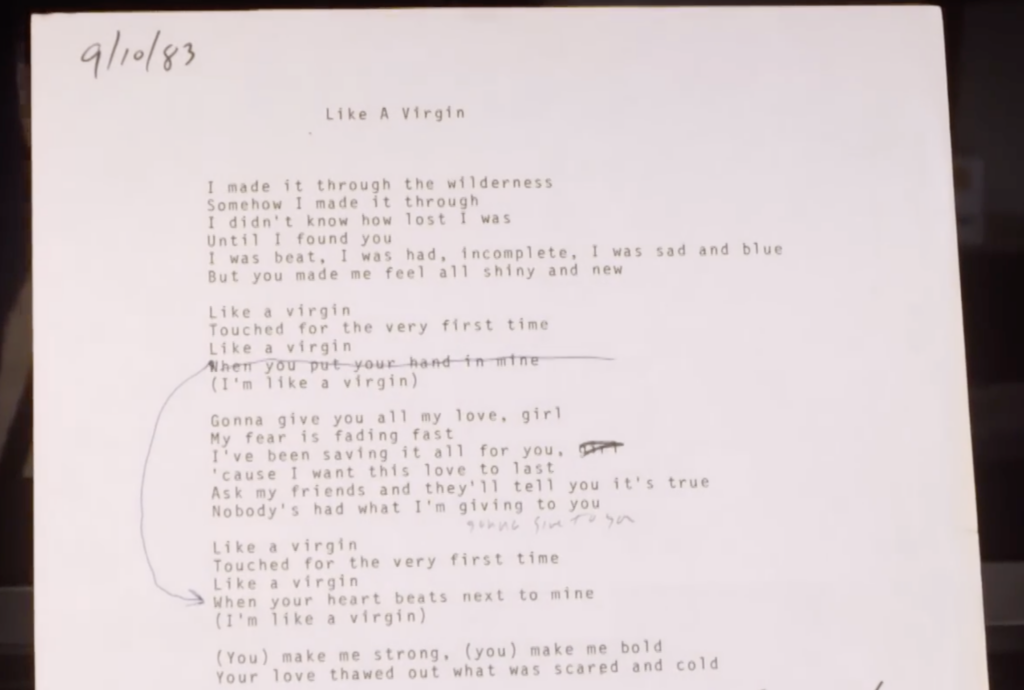
Steinberg was working in his father’s vineyards when, on September 10, 1983, a song came to him.
“I had been in a relationship that was rather difficult, and I extricated myself from that relationship and I met somebody new, and I felt sort of reborn, if you will,” said Steinberg. “And so I wrote, ‘I made it through the wilderness, somehow I made it through, I didn’t know how lost I was until I found you. I was beat, incomplete, I’d been had, I was sad and blue, but you made me feel shiny and new, like a virgin.’ So it was really just telling the story of what I had been through and where it was in my life.”
Steinberg showed the lyrics to Kelly. “I especially related to the lyric at the time, since I was going through a tough divorce. Initially, I tried to compose a ballad or midtempo song to accompany the lyric, but it wasn’t working. Out of frustration, I started to clown around, performing the song in an uptempo, Smokey Robinson-style, with falsetto vocals. Lo and behold, it worked,” said Kelly.
“We tried to place ‘Like A Virgin,’ but everyone looked at us like we were nuts,” said Steinberg. “Some people even asked us to change the title. I knew that compared to most mainstream pop lyrics, the title and theme might seem a bit jolting and risque. But I liked the idea of writing a lyric concept which hadn’t quite been done before.”
“Everybody liked the song that heard it but nobody wanted to touch it until we played it for Michael Ostin,” said Kelly. Ostin was then an A&R executive at Warner Bros. Records.
“We were nervous about playing ‘Virgin’ for Ostin,” said Kelly. “When he heard it, he flipped over the song. He said it would be great for his artist Madonna to record. Madonna at that time wasn’t a major artist yet, it was before Borderline and Lucky Star became hits, but it was clear that she would be a perfect artist to sing this song.”
The first evolution
“My father was very strict, very Catholic, very conservative. I mean, I literally couldn’t leave the house without my skirts being a certain length, half an inch off my knee. I had to go and change. I guess I just had to rebel against all that,” said Madonna.
“It’s extremely rare that a religious Italian woman would name a child after her. My mother wanted to be a singer. So it was like I have a mission, to live up to this name,” Madonna said.
Raised in the Detroit suburbs, a 19-year-old Madonna relocated to New York City in 1978 with $35 to her name to pursue her dance career. When Broadway didn’t materialize fast enough, she expanded her ambitions.
“I’d gone to a trillion auditions on Broadway for musical theatre, because I finally figured out that being just a dancer was not going to get me anywhere. I started auditioning for musicals and I could combine singing and dancing,” said Madonna. “So I finally went to this audition and I danced every dance routine, then they asked me to sing all these songs, then they made me come back, then they made me dance with this guy, then they made me sing another song, and it went on for hours and hours and hours. That night this French guy called me he was one of the producers of the show and he said ‘well you didn’t get the job’ and I said ‘well what are you calling me for then’ he said ‘well we want we want to make you a star. We think you are really special. So they took me to Paris.'”
In Paris, Madonna was placed with Aquarius Records, given an apartment, a car, and a driver. It was more than she had ever had. It was also not what she wanted.
“They gave me all this money and they put me in a really posh apartment and I had a car and a driver and I freaked out because I went from having nothing to having everything,” said Madonna. “I was there for six months and I realized at that time that I did want to be a singer but I didn’t want to be made into a singer. I didn’t want to be part of a factory. I wanted to go back to New York and learn how to write music and play an instrument myself without all these rich people behind me pulling my strings like a marionette. I wanted to earn it. I wanted to make a difference in the world. I wanted to be somebody, and I wanted to be a rebel. So I was a rebel, and I wanted to somehow make that translate into my music.”
The second evolution
Madonna returned to New York determined to build something on her own terms. She taught herself drums, guitar, and keyboards, writing lyrics and singing, eventually joining two bands: The Breakfast Club and Emmy and the Emmys. Neither band lasted.
With Stephen Bray, a former boyfriend and musician she had known since Michigan, she recorded a four-track demo that included a song called “Everybody.”
One Saturday night in the spring of 1982, Madonna brought her cassette to Danceteria, a New York nightclub. The resident DJ was Mark Kamins, one of the city’s most connected figures in dance music, who also held an A&R position at Island Records. “She was one of my regulars on the dance floor but she had this spark, a certain energy, that transcended everybody else,” Kamins recalled. “She brought me a demo of ‘Everybody’ and I played it.” He played her music, became her producer, and the two began dating.
“I was always going to a club called Danceteria. I would bring my cassette tapes to the DJs and drive them all crazy. I was relentless. They would see me and run because I just wanted them to play my cassette. I finally got this guy Mark to play my cassette. It was a song called ‘Everybody.’ I swear to God, I had to promise everything to him to get it played, and when he played it, everybody got up and started dancing to it, and it blew my mind. I mean, seriously, like that was everything to me,” said Madonna.
The next day, Kamins played the demo for Chris Blackwell, founder of Island Records. Blackwell passed. “I couldn’t work out what on earth I could do for her,” he stated.
“He didn’t like Madonna and he said, ‘I’m not gonna sign my A&R guy’s girlfriend,'” Kamins recalled.
Another Saturday night, Kamins played “Everybody” at Danceteria. “The club was packed,” Madonna recalled. “An A&R man from Sire Records was there, Michael Rosenblatt.”
Rosenblatt saw Madonna walk up to the DJ booth and speak with Kamins. “She looked amazing,” said Rosenblatt. He went up and introduced himself to Madonna and invited her to his office. “I said why don’t you come by Monday afternoon and play me your tape,” Rosenblatt recalled. “She said great, I’ll be there.” He asked her to bring ID as he didn’t believe her name was really Madonna.
That Monday, Madonna arrived at Rosenblatt’s office with her passport. Madonna Louise Ciccone. Rosenblatt heard the demo and that evening went to the hospital to play it for Seymour Stein, President of Sire Records, who was recovering from heart surgery. “I said I’m going to play Seymour this tape tonight in the hospital,” Rosenblatt said.
“I’m sure I was going nuts in that little room, but I immediately felt an excitement. I liked the hook, I liked Madonna’s voice, I liked the feel, and I liked the name Madonna. I liked it all and played it again,” said Stein. “I never overanalyze or suck the life out of whatever I instinctively enjoy. I reached over and called up Mark. ‘Can I meet you and Madonna?'”
“By the time Madonna walked in with Mark Kamins that evening, I had been fully briefed and tidied up by a team of ladies. Not that she really cared about my predicament. She’d come to get a record deal before some old record guy croaked, along with his check-signing hand,” stated Stein.
“When I met him he was laying in a hospital bed wearing his boxer shorts and a wife beater. He had a cannula up his nose and a saline drip in his arm. He was grinning like the Cheshire Cat,” Madonna recalled. “I was carrying my giant boombox ready to play my cassette for him immediately. He smiled and laughed when he saw me and asked me if I was related to the Virgin Mary. I knew we would hit it off.”
“She wasn’t even interested in hearing me explain how much I liked her demo. ‘The thing to do now,’ she said, ‘is sign me to a record deal.’ She then opened her arms and laughed. ‘Take me, I’m yours!’,” said Stein. “Peering into the back of my head with those Madonna eyes, she said, ‘And now, you give me the money.'”
Stein signed Madonna on the spot. “The deal we agreed to was modest: Madonna would get an advance of $15,000 per single, for a total of three singles, with an option for an album. On top of that, there was an additional publishing deal by which she’d get a $2,500 advance for every song she wrote. It was more of a test run than a full deal, but that’s all she needed, and under the circumstances, that’s about all I could offer,” said Stein.
“It was only one song, ‘Everybody,’ but there was just a drive, a determination — she was going places,” said Stein.
It was her first record deal. She was 24 years old.
“This moment changed the course of my life forever,” Madonna said. “Not only did Seymour hear me but he saw me and my potential. Words cannot describe how I felt at this moment after years of grinding and being broke and getting every door slammed in my face.”
“Everybody” was released as Madonna’s debut single on October 6, 1982, with no photo of her on the cover. It peaked at number three on the US Dance Club Songs chart and number seven on the Bubbling Under Hot 100. At the time, Billboard described her as bringing to mind “a female version of Michael Jackson.”
“A lot of people thought that I was a Black artist before they saw my videos because a lot of my music is more R&B oriented,” said Madonna. “Burning Up” and “Holiday” followed.
Early in 1983, before the album was released, Madonna was already performing live in New York clubs. Billboard caught her at the Red Parrot in January, noting that the one-woman act, accompanied by three backup dancers, was “more interesting visually than musically.”
Her first album, Madonna, was released on July 27, 1983. Billboard credited her with “the pipes and presence to make them a bit special.” Cash Box was less generous, calling her “certainly legitimate but beyond doubt a disco act” and noting “a grand irony” in Sire, known as a punk label, releasing such an artist. By the summer of 1984 the same publication was describing her as “this amazingly successful new face.”
As her singles climbed the charts, Madonna turned her attention to management. “I thought, who’s the most successful person in the music industry and who’s his manager? I want him,” Madonna said. The answer was Michael Jackson. His manager was Freddy DeMann.
“I took the meeting because of my friendship with Seymour,” said DeMann. “In walks this dynamic blonde — I can’t even describe in words how she sucked all the oxygen out of the room and completely controlled my office space. She wore these big hoop earrings, a zillion bracelets, all her clothes were held together by safety pins. She was so unique and so powerful. It was an amazing attraction in every which way. Then she left with the guy who brought her, Michael Rosenblatt. We had a lovely meeting but we were flirting. We didn’t really talk business. Michael Rosenblatt said ‘She loves you and refuses to meet anyone else.’ I said, ‘You’re kidding. We didn’t even talk business. Bring her back.’ So she says, ‘Are you going to sign me?’ I said, ‘Well, I’d like to get to know you for a minute and I’d like to see you work. Are you going to work somewhere soon?’ ‘Yeah, I’m going to be at Dancetaria in two weeks. Would you come in and see me?’ ‘Yeah, I will. Until then I’ll act as your manager.'”
“In America, Warners don’t know how to push me, whether to push me as a disco artist or as new wave because of the way I look,” Madonna told NME. “I’d rather just start another category.”
The music videos for “Borderline” and “Lucky Star” were in heavy rotation on MTV, then only a two-year-old music channel. “Kids today worship the television,” Madonna said, and she intended to give them something to watch.
“People started writing about me and photographing me and analyzing me and criticizing me and scrutinizing me, and all those things,” said Madonna. “I started to think about my place in the world and think about people’s point of view about me, and I started thinking about pushing boundaries, pushing the envelope. I started reading what people wrote about me, and one thing that really irritated me was that people didn’t seem to put the idea of being sexual and being intelligent together. And I had set out to defy that those two could exist together. So that was my next goal.”
“I want to conquer the world,” she said.
“You just have to be patient,” she told NME. “I’m not.”
The third evolution
By the time her debut album reached the top ten in the spring of 1984, Madonna was already thinking about what came next.
“I change from day to day,” said Madonna. “Sometimes people think that if you’re a girl, you’re going to be a pushover and they can get away with more. They can kind of pull the wool over your eyes. You’re not going to be as strong as a man and like getting what you want, demanding what you asked for. But I just surprise them when they see that they’re wrong. And on the other hand, the advantages are the charms, you know, that people always fall for.”
After her debut album, Madonna wanted creative control over her second album and asked to produce the record herself. Sire Records declined this request but offered her the choice of working with any producer she wanted.
“I now know what I want on my next record,” she said.
She chose Nile Rodgers, who co-founded Chic and had scored six number one dance hits as a producer, bringing the world disco classics including “Le Freak,” “Good Times,” and “I Want Your Love.” By the early 1980s, Rodgers was producing albums for David Bowie, Diana Ross, and Sister Sledge.
“I chose to work with Nile Rodgers because I think that he’s a genius, and I wanted to work with a genius on my record,” said Madonna. “He understands my musicality. He’s a trained musician and I’m not really. He can just read my mind.”
“He’s a very passionate man,” Madonna said. “He lives life to the hilt. When you deal with people who are that way you get good stuff and bad stuff, but it was really great working with him.”
“I was always excited by her because here was this brand-new person who exuded an aura of superstardom,” said Rodgers. “In a very matter-of-fact kind of tone, she said, ‘Nile, if you don’t like all these songs, I can’t work with you.’ And I said, ‘Well, Madonna, I don’t like all the songs, but let me tell you this, by the time I get finished with them, I’m gonna love them.'”
When Warner Bros. A&R executive Michael Ostin, whose label Sire had signed Madonna, played demos of both “Like A Virgin” and “Material Girl” for Madonna and Rodgers, Rodgers favoured “Material Girl” and did not believe strongly in the “Like A Virgin” hook. Rodgers said, “Only Madonna believed in that song to the depth that she believed in it. I was going for Material Girl, I’m a club guy. I don’t come from a world where the lyric is more important than the groove, I don’t get that and she stuck to her guns, she was steadfast and unwavering and every argument I could throw at her, every argument the record company could throw at her… she knew.”
In April 1984, the cover of Time magazine declared the sexual revolution “is over,” citing growing evidence that “the national obsession with sex is subsiding.” That same month, Madonna walked into Power Station Studios in New York.
The nine-track Like a Virgin album took approximately two months to record, from early April through May 1984. “We finished the album, but Madonna was still the focus,” Rodgers recalled. “She was ready to go, like, ‘Come on, come on, let’s put this out,’ and then ‘Borderline’ hit out of the clear blue sky. We didn’t expect that.” The album would remain shelved until November.
“I’d love to be a memorable figure in the history of entertainment in some sexual, comic-tragic way,” Madonna said. “I’d like to leave the impression that Marilyn Monroe did.”
In the meantime, Madonna was invited to perform at her friend and artist Keith Haring’s Party of Life birthday celebration at the Paradise Garage nightclub on May 16, 1984. Haring had heard some of the album just days before.
“In the spring of 1984, it’s time for my birthday, and I stage what I call my Party of Life event,” Haring recalled. “I ask Madonna if she could sing at the party, and she agrees. As a matter of fact, she had been to my studio just days earlier to play me some cuts from her new album, ‘Like a Virgin,’ which at that time hadn’t come out yet. I immediately liked ‘Dress You Up’ and ‘Like a Virgin,’ and we decide she’ll sing these two songs at the party. While we’re hearing these songs, I do a painting on Madonna’s leather jacket, which she wears to the party. Madonna decides that she wants to sing these two songs on a brass bed covered with frilly material and strewn with white roses.”
In attendance were Andy Warhol, Diana Ross, Nile Rodgers, Jeff Beck, Jean-Michel Basquiat, and others. Warhol noted that “Madonna didn’t start until so late.”
“The stage darkened and then when it lit up again there was a big brass bed in the middle of the stage with Madonna. She did ‘Like a Virgin’ and she was wearing her boy toy belt and she, you know, was wearing a bustier,” said video artist Courtney Harmel.
This was the first live performance of “Like a Virgin.”
Preparing for the release of the album, Madonna appeared on MTV with Mark Goodman. During the interview, she was asked about her leather jacket with “boy toy” written on it. “Well, it’s my tag name. It’s what I write up on walls,” Madonna said. “What does it mean?” Goodman asked. “What do you think it means?” Madonna said. “It also has a kind of humorous meaning to it.”
It was the answer of someone already controlling the conversation. Madonna was becoming a story.
That summer, with a budget of $150,000, Madonna went to Venice, Italy to shoot the video for “Like A Virgin.” Directed by Mary Lambert, who had directed “Borderline,” the shoot became a full production. “For Like a Virgin I said ‘Let’s do it in Venice!’ The idea of Madonna singing in a gondola was the most outrageous thing I could think of,” said Lambert. “And Madonna dug it, because she has the whole thing with the Catholic Church and her Italian heritage. It turned into a huge party.”
The shoot also featured a real lion. “The lion-tamer said it wouldn’t bite me — or, at least, it hadn’t bitten anyone yet,” Madonna said. When the lion pressed its head against her unexpectedly, she lifted her veil and stared it down. “Then he opened his mouth and let out this huge roar. I got so frightened that my heart fell in my shoe.”
After filming, Madonna returned to New York to prepare for the MTV VMAs, scheduled for September 14, 1984 at Radio City Music Hall. The show was MTV’s first awards ceremony, and the network struggled to book major artists.
“We’re getting closer to the show, we’re building sets, and Madonna had no idea what she wanted to do,” recalled MTV EVP of programming Les Garland. “She called me the next day and says, ‘I’ve got it. I want to sing ‘Like A Virgin’ to a Bengal tiger.’… And I go, ‘You mean like a baby one?’ ‘No, no, full grown.’… I go, ‘You want a white, full grown Bengal tiger onstage at Radio City Music Hall? If it gets loose and kills [then Sony head] Walter Yetnikoff, I’ve got a [expletive] problem.'” He told her to find another idea, and she did. “So we had a 17-foot cake built.”
Backstage, Maripol said Madonna had “stage fright” because the hall would be packed with artists and industry types. She believed it was “either break or make.”
Maripol said, “The idea of that performance came from a kind of a vision I had. We used the exact dress she is wearing on the album cover… It was incredible because nobody expected it to be so raunchy.”
With Bette Midler and Dan Aykroyd hosting, Madonna, dressed in a white wedding gown with a fitted bustier, lace gloves, and her “Boy Toy” belt buckle, opened the show with “Like a Virgin” in front of Michael Jackson, David Bowie, Tina Turner, Prince, Billy Idol, Cyndi Lauper, George Michael, Quincy Jones, and millions of people watching live on TV.
“I was standing on top of a wedding cake, as one does,” Madonna recalled. “And I walked down these steps, which were the tiers of a wedding cake, and I lost… my white stiletto. I thought, ‘Oh my God, how am I going to get that? It’s over there and I’m on TV.'”
She made a choice in the space of a second.
“So I thought, ‘Well, I’ll pretend I meant to do this,’ and I dove onto the floor. And I rolled around, and I reached for the shoe, and as I reached for the shoe, the dress went up, and then the underpants were showing. And I didn’t mean to.”
What began as a stumble became the most talked-about moment in the show’s history. Everything Madonna displayed, from lifting her veil, to loosening her hair, to rolling across the stage, brought mixed reactions from the audience, from stunned silence to scattered applause.
Annie Lennox called Madonna’s performance “very, very whorish… It was like she was fucking the music industry.” Cyndi Lauper stated, “I loved that. It was performance art.”
“[Manager] Freddy [DeMann] did say to me afterward in the dressing room, he was white with anger, he was so upset, he said, ‘That’s it, you’ve ruined your career’… I didn’t even know that my butt was showing. I couldn’t compute everything that had happened. And since I didn’t really have a career yet, I didn’t feel that I had lost anything,” said Madonna.
Madonna’s publicist Liz Rosenberg stated, “People came up to me and told me her career was over before it started.”
Jean Paul Gaultier, the French fashion designer, was in the audience that night. He was surrounded by “mostly businesspeople, who were horrified,” he recalled. “That is when I realized that she couldn’t care less what others thought of her,” Gaultier said, “and I also saw how powerful she was.”
“I knew, that day, that she had made it,” said Maripol. “Every journalist was rushing, running, going, ‘Oh my God, who is this girl with the white outfit rolling and crawling on the floor, with crosses in her ears, and her name is Madonna?'”
Nick Rhodes, keyboardist of Duran Duran, said, “She came onstage in a wedding dress and rolled around on the floor. Afterwards, everyone knew she was going to be a big star. There was a confidence about her, an energy and a charisma, that really came across.”
Watching the performance on TV from a recording studio, Nile Rodgers turned to Mick Jagger. “I wish I could bottle what she’s got and give you a drink of that shit,” Rodgers said.
“I think we all know she had a few drinks, because she had to get up the nerve to crawl around like she did,” said Les Garland, EVP at MTV. “She stole the show.”
Madonna was nominated that night for Best New Artist for “Borderline.” She lost to the Eurythmics, nominated for “Sweet Dreams (Are Made of This).”
“That three minutes in 1984 was the point when Madonna became a superstar,” MTV’s Jocelyn Vena said.
Lyrically: “Like A Virgin” by Madonna
“She just copied our demo. Her record was produced by Nile Rodgers, and our demo sounds identical to the Nile Rodgers/Madonna record. They used it as a blueprint,” said Billy Steinberg. “Well, I had a good feeling about it, you know. I realized at the time that the title was provocative, and you never know if maybe radio stations would balk at playing a song with that title. I don’t know, but I did have a strong feeling that we had something special and that she was the perfect artist to release this song.”
“Recording artists, they want to take what the writer has and make it theirs. And if they do that successfully, they feel like it’s them. They really want the writers to recede and be out of the picture,” said Steinberg.
I made it through the wilderness
Somehow I made it through
Didn’t know how lost I was
Until I found you
The song’s subject is not sex. It is hurt and what comes after it.
Steinberg wrote the first verse from the perspective of someone exiting a relationship and becoming whole through new love. “The wilderness” is not a place but a state of being lost inside your own life. “Didn’t know how lost I was until I found you” can only be understood looking back.
I was beat, incomplete
I’ve been had, I was sad and blue
But you made me feel
Yeah, you made me feel
Shiny and new
“I was beat, incomplete, I’ve been had, I was sad and blue” is a rapid succession of five descriptors, each easily relatable. Then the release: “you made me feel shiny and new.” The contrast is the point.
Oh, like a virgin
Touched for the very first time
Like a virgin
When your heart beats next to mine
The chorus is the rebirth. To feel again.
Gonna give you all my love, boy
My fear is fading fast
Been saving it all for you
‘Cause only love can last
“The song came first. It was actually written from a male point of view. It was about going through a divorce. You know, ‘I made it through the wilderness, somehow I made it through, I didn’t know how lost I was until I found you.’ It was like, you know, new love,” said Tom Kelly.
Since the song was written from a male perspective, Madonna changed the original lyric from “Gonna give you all my love, girl” to “Gonna give you all my love, boy.” That single word change makes the song about female desire. A woman is telling a man she has reserved her love for him. The belt buckle she wore at the VMAs read “Boy Toy.” Most assumed it referred to her. The copyright on her own official tour program reads “Boy Toy, Inc.” Her production company. She was never the toy. She owned the name.
“My fear is fading fast / Been saving it all for you.” What has been saved is not the body but the capacity to trust again.
You’re so fine, and you’re mine
Make me strong, yeah, you make me bold
Oh, your love thawed out
Yeah, your love thawed out
What was scared and cold
“Every song on my new album really is like a different part of my personality. You know, like ‘Like a Virgin,’ it’s kind of innocent sexuality,” said Madonna.
“When I did the song, to me, I was singing about how something made me feel a certain way, brand-new and fresh, and everyone else interpreted it as ‘I don’t want to be a virgin anymore,'” said Madonna. “That’s not what I sang at all.”
“Like a Virgin” singles you out. The word “virgin” attracts attention, but the “a” speaks to the individual. Steinberg wrote it. Kelly put music to it. Rodgers produced it. But it was Madonna who understood its impact. When she walked down the tiered wedding cake on stage at Radio City Music Hall, she proved it.
“Like A Virgin” was the lead single from Madonna’s second album, Like a Virgin, released on October 31, 1984. The album followed on November 12, 1984. The video went into heavy rotation on MTV. A bride in a gondola. A lion. A wedding dress on the floor of a palazzo. It became her first number-one hit on the Billboard Hot 100, claiming the top spot in December 1984 and holding it for six weeks. The album sold 80,000 copies per day at its peak. Europe followed. By September 1985, the press was tracking what they called “Madonna Mania.”
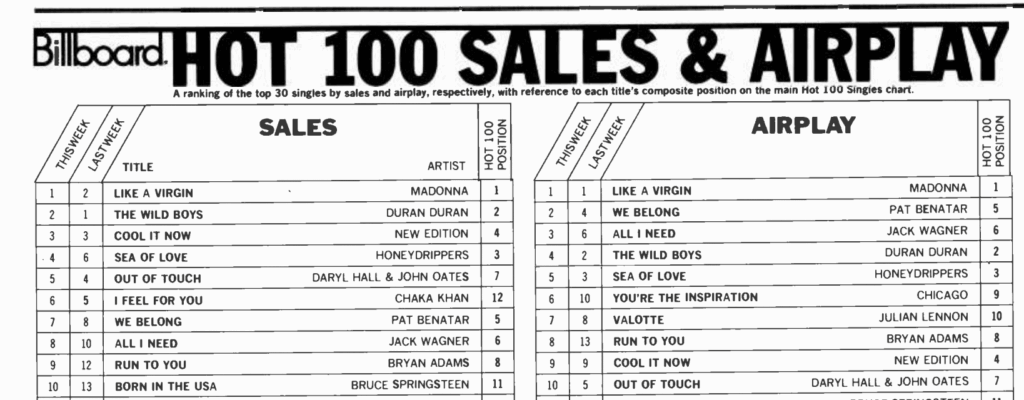
As the song hit number one, Steinberg made a prediction. “Songs like ‘Holiday’ and ‘Like A Virgin’ are the ‘Baby Love’s’ of 15 years from now,” he said. He singled out Rodgers’ work in the studio. “I loved the drum track,” he said. Cash Box agreed, noting “the distinctive production and drum sound of Nile Rodgers.”
Billboard called it “the quintessential multi-format hit of this year-end,” praising Madonna’s “flawlessly phrased, witty performance” in Rodgers’ “sparkling clean setting,” and noting the album brought “considerable muscle to the equation, thanks to producer Nile Rodgers’ sleek but sinewy rhythm arrangements, burnished to surgical sharpness by crisp digital sonics.”
Cash Box called “Like A Virgin” “one of her most appealing crossover tracks,” while noting the album “elaborates on the singer’s sex kitten image.”
“I don’t think that I’m using sex to sell myself. I think that I’m a very sexual person, and that comes through in my performing. It’s the way I am. It’s the way I’ve always been,” said Madonna.
In 2023, the album was inducted into the Library of Congress’ National Recording Registry, recognized as “culturally, historically or aesthetically significant” to the nation’s recorded sound heritage.
“It’s not overnight success,” Madonna said. “I’ve been working my ass off for seven years and it’s been a long haul. I always acted like a star long before I was one.”


What does this song mean to you?
Share your thoughts on this song.