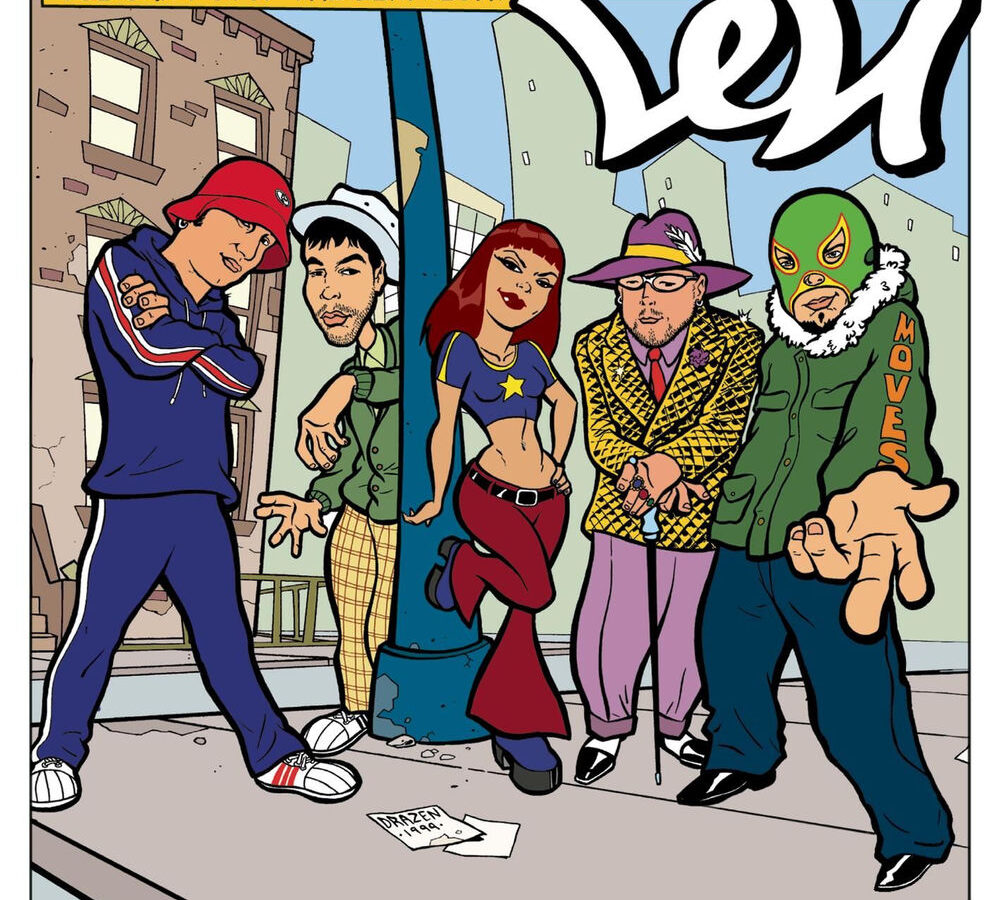
It’s 3:00am on a summer night in 1998, in a field north of Toronto. A three-day rave is still going strong, and Marc Costanzo, the songwriter behind Len, a Toronto band two albums into its career, is sitting about 1,000 feet from the stage, looking at the stars and watching everybody dance.
He starts writing. Part of it goes on his leg, in black marker. A lot of it goes on a napkin. He has no idea he’s writing “Steal My Sunshine.”
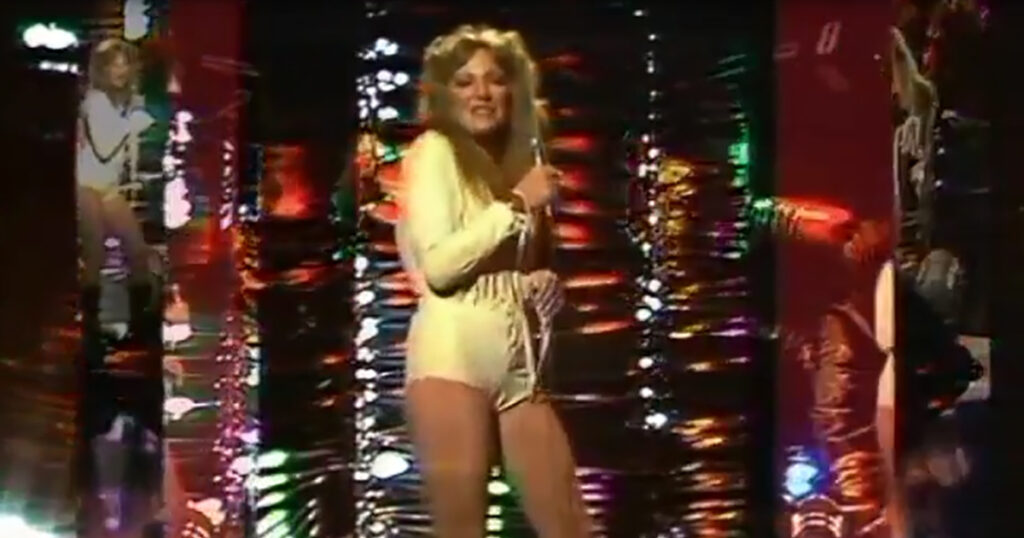
Later that morning, he’s left the field for an after-party. Brendan Canning, the future Broken Social Scene co-founder, is spinning old-school disco and soul. He drops a 1976 record called “More, More, More” by the Andrea True Connection. Costanzo jumps up and loops it right away on his sampler.
Over the next couple of days, he records the song at home, at 4:00am, on old eight-track gear. Deryck Whibley of Sum 41 is in the room when Costanzo records his vocals. Then the tape goes under his bed for months, unwound and gathering dust.
Nobody plans to release it.
Until a friend at Columbia Records, Jason Jordan, hears it and makes sure it gets into the right hands.
Less than a year later, Los Angeles radio station KROQ is calling it the song of the summer. MTV has the video in “Buzzworthy” rotation. And a band that never wanted to be famous hears itself about five times on one cab ride down Sunset Boulevard.
That summer belonged to “Livin’ la Vida Loca,” “Genie in a Bottle,” “No Scrubs,” and “Scar Tissue.” It belonged to the disaster of Woodstock ’99 and the uncertainty of Y2K. And right in the middle of it, Len stole a little sunshine.
Under the Bed
“It’s just a song about what happened that night of the party,” Costanzo said.
Len started in 1991 as Marc Costanzo’s punk band, named after a high school friend, Lenny. A year later, Marc’s older sister, Sharon, joined on vocals.
“We would smash our instruments after five minutes onstage, because we didn’t know how to play,” he said.
Marc was already a hip-hop fan. In the early ’90s, he moved to Halifax, where he fell in with Hip Club Groove, a local hip-hop group whose members included D-Rock and DJ Moves. Around 1995, he came back to Toronto and brought them with him. The two groups settled into a house together and started adding beats to Len’s punk.
Over time, Len grew to six people. Marc sang, played guitar, and produced under the name Mumble C, and performed as the Burger Pimp. Sharon sang and played bass. The boys in the band called her Big Sha, though she said she’d never call herself that. D-Rock and Planet Pea rapped, DJ Moves worked the turntables, and Drunkness Monster rounded out the lineup.
By the late ’90s, the crew had filled a three-storey house Len rented on Roxton Road in Toronto. Ryan Somers, a hip-hop writer in that circle, remembered it as a nonstop scene of freestyling, music, and parties. He said they also loaded copies of an upstart Montreal magazine called Vice into their van and dropped them at record stores and skate shops across the city.
With that many people around, Marc drew a line. Len was “us six,” he said, the members who went on the road, with a crew of about 30 more behind them. But at its core, it was mostly Marc recording at home, in a studio he called Four Ways after his own label, Four Ways to Rock, and calling Sharon in to sing.
That’s how “Steal My Sunshine” happened.
“Marc just dragged me out of bed and into the studio one morning and said, ‘Do you want to sing on this?'” Sharon Costanzo recalled. “Later, he told me he was going for that Human League vibe and had always wanted a song like that, but I had no idea that’s what it was about. And as soon as we recorded the song, it was done for me. We both liked it, but then I never thought about it again.”
She remembered the session as a rush. “He said I had to sing it while he’s still in the vibe,” she said. “I sang it and went to bed. Three days later he threw it under his bed.”
The song Marc had in mind was “Don’t You Want Me,” a back-and-forth between a man and a woman. Under it ran the loop from the “More, More, More” record Canning had played at the after-party, which is why its writer, Gregg Diamond, shares the credit on “Steal My Sunshine.”
Canning isn’t sure how much credit he deserves for the sample. “Marc credits me but to be honest I was doing a bit of drugs back then,” he said. “Certain memories aren’t quite as clear.”
What he does remember is his voice. The label wanted something at the top of the track, so Canning’s freestyle spoken word opens one version of the song. He was paid $2,500 for it, and he spent the money on pedals so he and Kevin Drew could record Feel Good Lost, the debut album from their new band, Broken Social Scene.
Costanzo never thought of the result as special.
“We have a lot of songs like ‘Sunshine,'” Costanzo said. “I’m not saying that they’re all hits or are going to be hits, but we have 30 songs like that lying around, and that was one we just picked out of a bunch. And it was recorded on eight-track! That’s a really low-quality format to have a Top 40 single on.”
“It’s a good song, and I like it, but it’s just a song,” he said.
D-Rock saw it differently. “His confidence wasn’t up to bringing it out of the bedroom till this record,” he said.
Sharon heard something bigger in the album around it.
“This album is a happy album and it feels good,” she said. “In the ’90s, we went through a lot of angst music, very dark introspective whining… It had its merits, but I think people are sort of ready to party.”
Go
Once Jason Jordan heard it, the tape came out from under the bed, where it had been sitting among dirty underwear, ants, and empty Coke cans. It had to be sent to a specialist to be repaired.
“It was all stretched out and warped,” Sharon said. “But those are all the original vocals on there.”
Costanzo said it was then mixed straight off the original gear in a matter of hours. The mix was done by John King, one half of the Dust Brothers, the production team behind the Beastie Boys’ Paul’s Boutique and Beck’s Odelay.
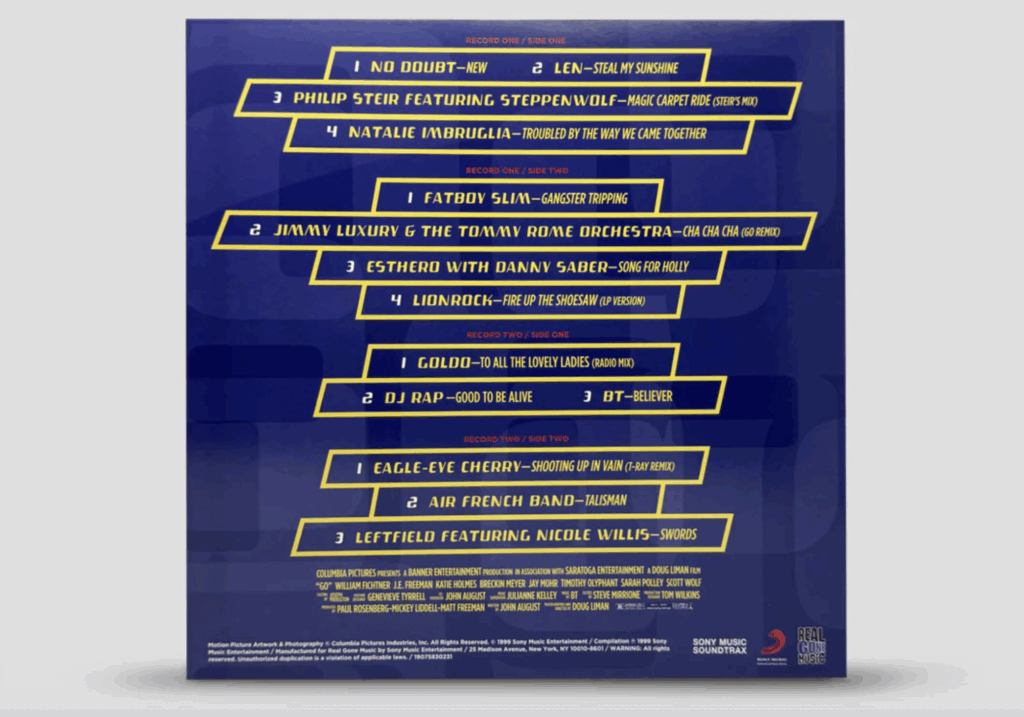
The song landed on the soundtrack to Go, a 1999 crime comedy from Swingers director Doug Liman, starring Sarah Polley, Katie Holmes, Jay Mohr, Timothy Olyphant, and Melissa McCarthy in her film debut.
The soundtrack came out on March 30, 1999, ten days before Go opened in theatres. It was the first official release of “Steal My Sunshine,” nearly three months before the single. No Doubt’s “New” was the lead track. Fatboy Slim’s “Gangster Trippin'” and Natalie Imbruglia’s “Troubled by the Way We Came Together” were on it too. The attention went to track 2, “Steal My Sunshine.”
“Everyone was gung-ho about the new No Doubt, but Len is what really grabbed me,” Aaron Axelson, music director of San Francisco’s Live 105 (KITS), told Billboard. “Not only is it fresh and connected with a hip movie; the song is a great balancer in a sea of Kid Rock and Korn.”
Radio stations from Seattle to San Diego were playing it in March. The response came so fast that the label moved the album up. You Can’t Stop the Bum Rush was due in mid-June. It came out May 25, 1999. The title is a nod to Public Enemy’s 1987 debut, Yo! Bum Rush the Show.
“Steal My Sunshine” followed as the lead single on June 22.
Billboard flagged it as “New & Noteworthy” in its singles reviews and wrote, “It’s hard to imagine that no one has thought of using the instrumental hook of Andrea True Connection’s ’70s hit ‘More, More, More’ to beef up a new concoction. Here, however, the quintet Len does so to grand effect. Somewhere between pop and modern rock, this all-about-summer track, featuring a back-and-forth male-to-female vocal, is uplifting, clever, and instantly appealing. Its melody line, verse construction, and memorable hook make for what should be an absolute breakthrough for this hip, talented act. Modern rock would do well to embrace this track, while top 40 would be missing one great party not to join in the fun.”
Details magazine put it more simply, calling the single “a pop lollipop with a chewy hip-hop center.”
“It’s a perfect summer song,” Kim Monroe, music director of Seattle modern rock station KNDD, said.
“[Len has] a super-catchy single right now that sounds a little different because of the trade-off between the male and female vocals. Another reason why the band is hot right now is because they’re young, they’ve got a good image, and they look like they’re cool,” Dave Seamons, rock buyer for Tower Records in downtown New York, said.
By late July, the single was No. 12 on Modern Rock Tracks, and You Can’t Stop the Bum Rush had climbed to No. 5 on Billboard‘s Heatseekers chart for developing acts, then outgrew it. The album peaked at No. 46 on the Billboard 200 on September 4, 1999, and spent 27 weeks on the chart. That same month, it went gold in the U.S.
Song of the Summer
When KROQ called it, everyone listened.
“Probably the most influential station in the world. So when they said that, every station picked it up,” Costanzo said.
“Len has achieved the rare feat of being selected by both MTV and VH1 as a new act to watch. At the same time that the ‘Steal My Sunshine’ video is in ‘Buzzworthy’ rotation on MTV, Len is one of VH1’s ‘Inside Track’ acts,” Billboard reported.
None of it made sense to the guy who wrote it.
“This was a song that wasn’t supposed to be cool at all. This was almost a joke. Not a joke, but almost like… ‘Ha, disco beat! Ha, raspy voice! Ha, girls singing about being all in space! Aha, let’s see if we can combine those things together! It’s never gonna work!’ You know? And then suddenly you’re like, ‘What the fuck just happened, I’m on fucking MTV,'” Costanzo said.
The video came together that spring. One of Len’s demands when it signed was the right to direct its own videos, and the label gave Costanzo $150,000. He called his friend Brad Walsh to co-direct. About 20 friends and band members flew to Daytona Beach, Florida, over spring break, with more footage shot later at Venice Beach, California.
“In the beginning of the video we’re on the plane, and we’re going to Daytona, because there were movies in the ’80s that were all about Daytona. And we were like, ‘Let’s go to Daytona! Let’s do that ’80s movie shit!’ We had no permits. We just took permits from other film sets. The guys were like, ‘Let’s plan the next five days.’ And I was like, ‘Let’s not,'” Costanzo said. “We had to shoot at one, because we were too drunk after five and too hungover before one. So we’d wake up, and I’d be like, ‘Let’s get some fucking Harleys!’ But they wouldn’t rent us fucking Harleys, so we ended up with scooters, which I hated at first, but then we were like, ‘Let’s destroy these things.’ We destroyed like four or five of them.”
“What you’re seeing was our vacation on tape,” Sharon said. “There were no label people. Nothing. No one. Just us.”
The party had a budget. Costanzo said the group bought about $5,000 of liquor for two nights, and loading it all broke the hotel elevator.
Look closely at one of the scooters. There’s a Vice sticker on the front, from the same upstart magazine the crew used to deliver around Toronto.
The scooters even became a marketing plan. “Len has also entered into co-promotion with the Motorrad North America scooter company, whose scooters are featured prominently in the ‘Steal My Sunshine’ video. The promotion includes giveaways of the same model of scooter seen in the video, with the contest being held in 15 markets,” Billboard reported.
At home, the video swept the 1999 MuchMusic Video Awards, winning Best Video, Best Pop Video, and Favourite Canadian Video.
Not every critic was charmed. Reviewing the single for NME, Stevie Chick ran through Canada’s gifts to the world, from Neil Young to John Candy, before landing on the latest one. “Then, in 1999, Canada gave us Len. Eh, what’s that aboot?” he wrote.
Sharon was there for one reason.
“The only reason I do this is my brother’s standing beside me,” she said. “I don’t do hip-hop, but I love it, especially the kind of rap they do, really up, party tracks. I mean, anything I can shake my [booty] to, I’m down with.”
Turning the Bus Around
Jeff Ayeroff, co-president of the Work Group, the Sony label that signed Len, had bet on the band early. “Len is a self-contained unit that does everything and does it well, much like the Talking Heads,” he said that summer. “That kind of act is usually the most rewarding to work with, but they’re also a big risk. We had faith, and it turns out they’re brilliant.”
Soon after, Ayeroff and fellow co-president Jordan Harris, the two executives who had signed the band, left the company.
“It sucks, but it’s manageable,” Costanzo said.
The label stayed confident. “If people think Len is a one-hit wonder, they should think again,” Work Group VP Barbara Bausman told Billboard.
Costanzo was less sure.
“If we turn out to be a one-hit wonder, that doesn’t mean we’ll think any less of our music. We’ll still be making beats and records years from now. Even if the record company drops us, we’ll still be making music,” Costanzo said.
D-Rock was blunter. “If this all ends at the end of the summer, it will be like 1999 was a good year. We’re not naive individuals,” he told the Vancouver Sun. “It’s one in a million that can get a hit, let alone a career.”
Len was due in the United States that July for a 20-city tour. A show in Sacramento was set for July 19, the band was booked in Washington, D.C., on July 27, and an appearance on Late Show With David Letterman was scheduled for August 6.
Drunkness Monster was thrilled. On MuchMusic, he called Len “the first Canadian band with no talent whatsoever to actually make it to Letterman.”
None of it happened on schedule.
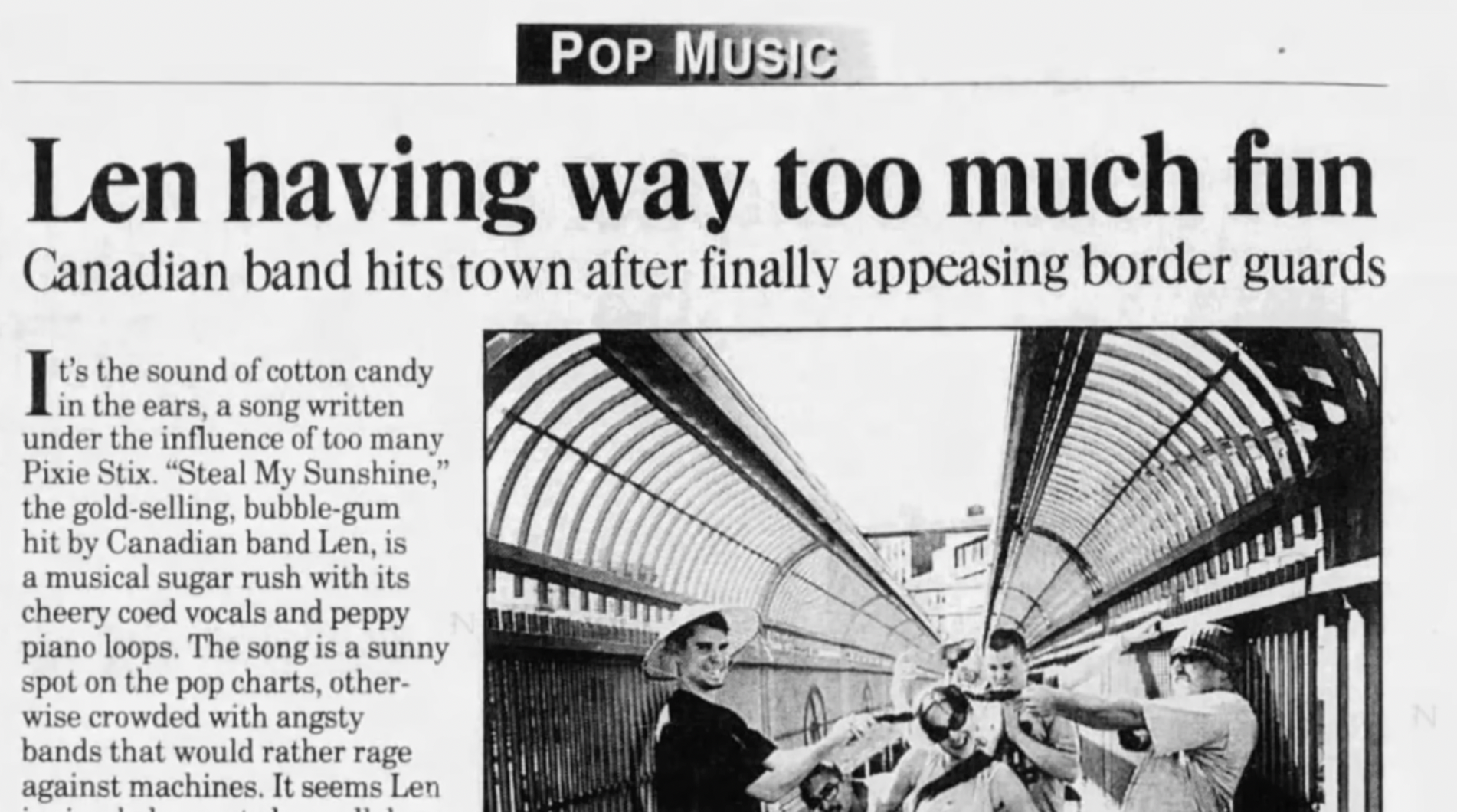
In July, Len’s tour bus was stopped at the border, and the band didn’t exactly help its case.
“We were acting crazy,” Costanzo said. “The border patrol people came in the bus, but we didn’t care. We were jumping around, and then Drunkness Monster ran out with a 40-ounce (beer) in his hand. He started running toward the border yelling, ‘I’m gonna make it!’ and they were chasing after him.”
Len was denied entry into the United States. The tour was postponed, and so was the Letterman appearance. When the band made it to Sacramento that October for a makeup show, the Sacramento Bee‘s headline summed it up: “Len having way too much fun.”
Fame didn’t sit well either. Costanzo said, “When people used to come up to me in the street, I thought they were trying to fight me! But they just wanted to tell me how much they loved my song.”
By then, Costanzo was already planning the next record: two months in a house in the mountains of Nova Scotia, under the name the Len Crew. “We’re just going to get drunk every night for two months and make a record,” he said.
The follow-up single, “Feelin’ Alright,” featured Poison’s C.C. DeVille on lead guitar. It failed to chart.
At the 2000 Juno Awards, “Steal My Sunshine” was nominated for Best Single, alongside Matthew Good’s “Hello Time Bomb,” Prozzäk’s “Sucks to Be You,” and the Tea Party’s “Heaven Coming Down.” It lost to the Tragically Hip’s “Bobcaygeon.”
The tour kept going into 2000. In the spring, after cancelling a show in Phoenix, they turned the bus around.
“It wasn’t a hard decision. We just realized that everything we were, we’re not anymore,” Costanzo said.
“Here’s the deal: when you have that kind of a quick single blowing up, you sell a million records in what, six months? When it goes that fast off one single, and you have no other singles… we knew there was no other single. We were surprised there was even one single,” Costanzo said. “So we were looking at this whole bigger picture of what’s gonna happen next, and we knew it’s over in terms of generating more money from the rest of the album. So we just kind of backed out in terms of being public figures. We had 200 shows planned, and after 80 shows, we turned the tour bus around and went home. I went back to my house in BC and just hung out with my friends. We were just like, ‘We need to go home, I’m sick of this shit.’ Our manager and the record label said, ‘You can’t do this.’ And we’re like, ‘Well, we just did it.'”
Sharon moved to Los Angeles.
Getting out of the Sony deal wasn’t simple. The Work Group had been folded into Epic, and Marc, Sharon, and their manager, Graeme Lowe, wanted off the label. Freeing a band from its deal right after a hit that big took Len’s lawyer, Jonathan Simkin, two years. “Try getting a band off a label in those circumstances,” Simkin said.
Len signed with DreamWorks, which Costanzo said paid the band about $750,000 after he danced around the label’s office promising more hits. He didn’t have any.
Costanzo has never pretended otherwise. “We were just partying, we weren’t connecting to the outside world at all,” he said.
DreamWorks fell apart before the album was delivered.
Not My Song Anymore
“Steal My Sunshine” entered the Billboard Hot 100 on August 14, 1999. The summer anthem didn’t peak until November 13, when it reached No. 9, and it stayed on the chart for 25 weeks. It was Len’s first and only entry on the Hot 100. In Canada, it reached No. 3. In the U.S., it made Len a one-hit wonder.
It never really went away. In February 2000, after its run on the current charts, “Steal My Sunshine” hit No. 1 on Billboard‘s Mainstream Top 40 Recurrents chart, which tracks older hits still in heavy rotation on pop radio. It held the top spot for two weeks and stayed on the chart for 24 weeks.
Then Hollywood found it again. The song turned up in Zack and Miri Make a Porno in 2008. In a 2011 episode of Parks and Recreation, Leslie Knope plays it on repeat while panicking about following up her biggest success.
In 2012, Len quietly returned with “It’s My Neighbourhood,” a tribute to Toronto with a video filmed in Chinatown, Kensington Market, and Little Italy, plus helicopter footage of the CN Tower borrowed from Tourism Toronto. Costanzo said they didn’t expect a hit.
“I can guarantee Len’s never going to top the charts like with ‘Steal My Sunshine’ ever again,” he said, laughing. “We made a choice to walk away from it rather than try to keep living that same moment over and over again.”
The song kept going without them. It scored a fleeting moment of happiness on Mr. Robot in 2015, landed in the 2016 film Mother’s Day, and turned up in Peter Rabbit in 2018. In 2023, Netflix’s Beckham used it to bring back the summer of 1999, playing it over footage of David and Victoria Beckham preparing for their wedding.
“The second that song blew up, it’s not my song anymore. I was a part of it, I was there. But the fact that it does what it does every year, you know, movies, commercials, whatever, has nothing to do with me. It has to do with the people that have a connection to it, you know?” Costanzo said. “It feels like it has so much more power than me as just one individual.”
He can’t decide what it means to him. In one interview, he said, “It makes me laugh. It makes me smile. It takes me back to that time.” In another, he said, “I listen to it and I don’t have any memories of it.”
“I don’t even understand how people relate to it. When I listen to that song, I just can’t make sense of it. Because there’s nothing right about that song. The elements are all wrong. But that’s why I love it so much,” Costanzo said.
Nobody stole their sunshine.
Lyrically: Steal My Sunshine by Len
I was lying on the grass of Sunday morning of last week
Indulging in my self-defeat
My mind was thugged, all laced and bugged, all twisted, wrong and beat
A comfortable three feet deep
Now the fuzzy stare from not being there on a confusing morning week
Impaired my tribal lunar speak
And of course you can’t become if you only say
What you would have done
So I missed a million miles of fun
The opening lyrics find him lying on the grass days later, “indulging in my self-defeat.” “Indulging” is a word for pleasure, coupled with a word for failure. He isn’t just down. He’s settling into it. It’s the first of the song’s contradictions: a sunny song about a bad morning.
Costanzo has described the song as him “talking about whatever the hell he was feeling after too long of a party.”
Sharon was blunter about the party itself. “He was at this crazy, huge party on E,” she said. “He was hearing things he shouldn’t be hearing and started writing the song on his leg.” With that in mind, “thugged, all laced and bugged” reads as more than tangled thoughts. The drug slang is right there in the line.
“A comfortable three feet deep” plays on “six feet under,” the old phrase for being dead and buried. He’s halfway down and comfortable there, not in the grave, but not climbing out either.
Then comes “the fuzzy stare from not being there”: there in body, gone in mind, and the people around him can tell. By the next line, even his words have gone wrong.
The verse turns on its last two lines. “And of course you can’t become if you only say what you would have done”: talking about it isn’t the same as doing it. Then the regret lands with “So I missed a million miles of fun.”

I know it’s up for me
(If you steal my sunshine)
Making sure I’m not in too deep
(If you steal my sunshine)
Keeping versed and on my feet
(If you steal my sunshine)
This is where Marc’s Human League idea pays off. Similar to “Don’t You Want Me,” “Steal My Sunshine” is a conversation. Marc and Sharon trade off the verses, and the chorus is call and response, with Sharon answering him.
The chorus sounds carefree, but it’s Marc pulling himself back up. “I know it’s up for me” takes responsibility for his own mood, and Sharon’s reply, “(If you steal my sunshine),” warns that it could still be taken away.
“Making sure I’m not in too deep” answers the first verse directly. He was three feet down and comfortable. Now he’s watching the depth. And “keeping versed and on my feet” answers the line where his words had failed him. He’s getting his voice back.
I was flying on the bench slide
In the park across the street
L-A-T-E-R that week
My sticky paws were into making straws
Out of big fat Slurpee treats
An incredible eight foot heap
The second verse is Sharon’s, and it climbs out. Marc’s verse sank three feet deep. Hers is all up in the air: “I was flying on the bench slide,” then a Slurpee stack that’s “an incredible eight foot heap.” The song has gone from three feet down to eight feet up.
It’s a playground verse. A slide, a park across the street, sticky paws, a Slurpee from 7-Eleven on a hot day, and “L-A-T-E-R,” stretched out the way a kid says it. After a verse about the comedown, it sounds like being a kid again.
Given where the song came from, “flying” and the straws can be read another way, too. The playground and the party sit side by side, and the song never says which one it means.
Now the funny glare to pay a gleaming tare in a staring under heat
Involved an under usual feat
And I’m not only among but I invite who I want to come
So I missed a million miles of fun
Sharon’s verse turns back toward Marc’s. “Now the funny glare” echoes the “fuzzy stare” from his verse, as if she’s seeing what he saw.
Then she moves to control. “And I’m not only among but I invite who I want to come”: she’s choosing the guest list, deciding who gets in. And her verse ends exactly where his did, with “So I missed a million miles of fun.” Two verses, two singers, the same regret.
The video did the opposite. Marc took about 20 friends and band members to Daytona and refused to plan a single day. Nobody missed out.
I know it’s done for me
(If you steal my sunshine)
Not some and hard to see
(If you steal my sunshine)
Keeping dumb and built to beat
(If you steal my sunshine)
The chorus comes around again, word for word. Then it changes. One word in the first line flips it: “I know it’s done for me.” The first time, it was up to him. Now he admits what’s at stake. With Sharon’s answer, the line becomes a warning: take away his good feeling, and he crumbles. He hasn’t given up, but he’s admitting how dark he can become.
The second line is where his words start to slip. In the first chorus, that spot held a clear thought: “Making sure I’m not in too deep.” Now that line comes back as “not some and hard to see.” It keeps the “not” and the rhyme, but the meaning blurs. Hear “some” as “sun,” and the line says what the chorus warned about: the sunshine is gone, and it’s hard to see clearly.
Then the last line. “Keeping versed and on my feet” becomes “keeping dumb and built to beat.” “Versed” meant he had his words back. “Dumb” means they’re gone again, which is what the line before it just showed.
And “beat” points two ways at once. It’s the song’s disco beat, and it’s the “beat” from the first verse, when his mind was “all twisted, wrong and beat.” Built for the beat, or built to be beaten. Like the playground and the party, the song lets both meanings work together.
Then the words run out. The song ends on the title, repeated over and over: a warning that never finishes. If you steal my sunshine, then what? The song never says.


What does this song mean to you?
Share your thoughts on this song.