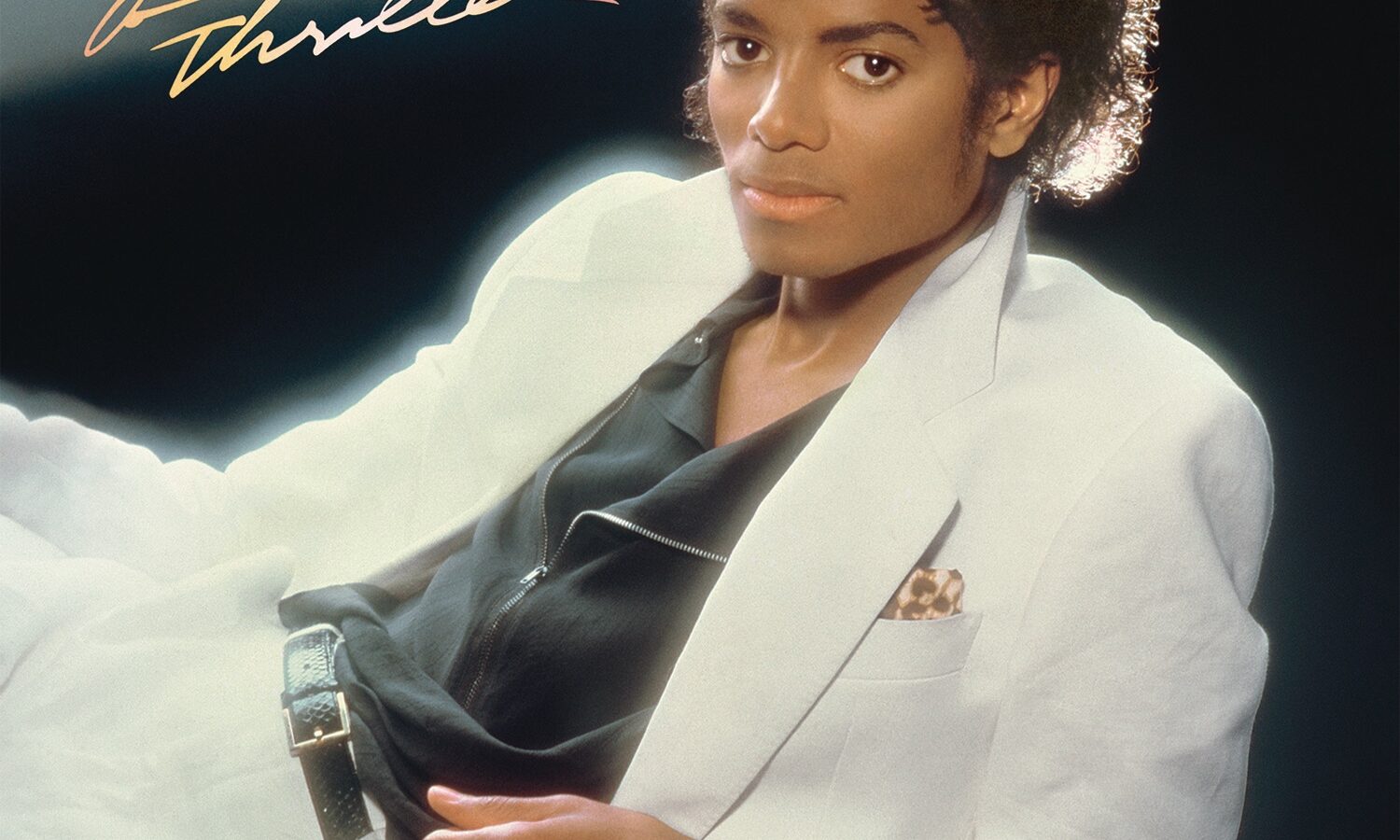
Los Angeles. October 3, 1982. A Sunday. Quincy Jones, the producer behind Ray Charles, Frank Sinatra, and jazz legend Count Basie, is finishing a follow-up to Off the Wall, the album that made Michael Jackson a household name. Jones has set out, as he put it, to “save the recorded music industry.”
The business is in freefall. Billboard has reported that record shipments declined by 50 million copies between 1980 and 1982. Just two months earlier, employees across CBS Records, the parent company of Jackson’s label Epic, took to calling August 13, 1982 “Black Friday.”
The Washington Post confirmed the next day that CBS had laid off 15 percent of its staff, possibly as many as 300 people. “Half of the marketing department was let go at Epic,” recalled Dan Beck, the label’s VP of merchandising. “It was very upsetting because nothing like that had ever happened before.”
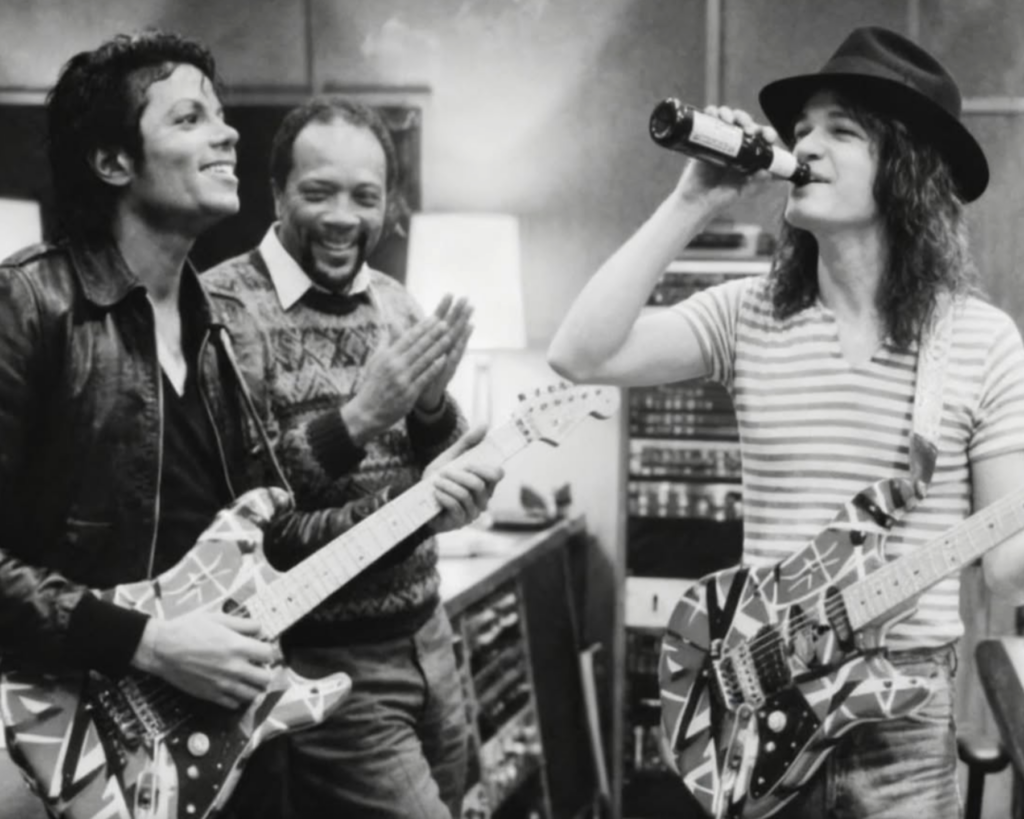
Jackson has written the song. Jones needs a guitarist to complete the sound. He has tried Pete Townshend of The Who. Townshend turned it down and recommended Eddie Van Halen. Jones picks up the phone.
Eddie Van Halen, lead guitarist of the rock band Van Halen, is in his backyard studio when it rings. Bad connection. He cannot make out who is calling. He hangs up. The person calls back. Van Halen’s patience runs out.
“What the fuck you want, you asshole?”
“It’s Quincy Jones.”
“Sorry, sorry.”
Van Halen knows the name. Jones has an unusual proposition: come to Westlake Audio at 8447 Beverly Boulevard in Los Angeles, play a guitar solo on a new Michael Jackson record, and do it without pay. Van Halen’s credit, Jones warns, may not even appear on the finished product. Van Halen’s manager does not know about the call. Neither does his band.
Van Halen is still not entirely sure it is Jones. “I’ll tell you what,” he tells him. “I’ll meet you at your studio tomorrow.”
The next day, Van Halen drives over to the studio. “And lo and behold, when I get there, there’s Quincy, there’s Michael Jackson and there’s engineers,” he recalled. “They’re makin’ records!” He sits down with the track, and within minutes decides he needs to change it.
“I listened to the song, and I immediately go, ‘Can I change some parts?'” recalled Van Halen. “I turned to the engineer and I go, ‘OK, from the breakdown, chop in this part, go to this piece, pre-chorus, to the chorus, out.’ Took him maybe 10 minutes to put it together. And I proceeded to improvise two solos over it.”
Jackson is not in the room. He is down the hall recording narration for the E.T. storybook. Van Halen has rearranged someone else’s song without asking. He is just finishing the second solo when Jackson walks in.
“I didn’t know how he would react to what I was doing,” said Van Halen. “So I warned him before he listened. I said, ‘Look, I changed the middle section of your song.'”
Jackson listens. He turns to Van Halen and says, “Wow, thank you so much for having the passion to not just come in and blaze a solo, but to actually care about the song, and make it better.”
After the session, Jones sent Van Halen a thank-you letter. He signed it “the fucking asshole.” Van Halen framed it. Jones offered two six-packs of beer. Van Halen’s response: “Actually, I brought my own, if I remember right.” As for the time it took, Van Halen said, “It was about 20 minutes out of my life.”
That exchange, fused together in a single room in a recording studio in Los Angeles in 1982, became “Beat It.”
From The Wiz to Westlake
The partnership that made “Beat It” began on a film set in 1977.
Jones was musical director for The Wiz, the all-Black reimagining of The Wizard of Oz that cast a 19-year-old Michael Jackson as the Scarecrow. Jackson arrived on set having memorized not just his own lines but those of every other cast member. “Michael dove into the filming of The Wiz with everything that he had,” Jones wrote. “Prior to filming, Michael and I were working at my home and he asked if I could help find him a producer to work with him on his first solo album from Epic.”
“I didn’t so much fall in love with Michael through his records,” Jones explained. “In fact, it might have been just the opposite. I had always been a fan, but I became so impressed with him as a person during The Wiz. That’s when I began to look at him through different eyes.”
“Michael was doing his lines and he kept mispronouncing the name Socrates,” Jones recalled. “He called him So-crate-ease and nobody would correct him. When they took a break, I took him to the corner and said, ‘Michael, it’s Sock-ra-tease.’ He looked at me with these big wide eyes and said, ‘Really?’ And it was at that moment that I said, ‘Michael, I’d like to produce your album.'”
“It was that wonderment that I saw in his eyes that locked me in,” Jones wrote. “I knew that we could go into completely unexplored territory.” They made Off the Wall together in 1979.
Rolling Stone called the album “a triumph for producer Quincy Jones as well as for Michael Jackson” and declared it “discofied post-Motown glamour at its classiest.” The review named Jackson “the Stevie Wonder of the Eighties.”
The Grammys disagreed. Off the Wall received a single nomination for Best Male R&B Vocal Performance. It won but Jackson was insulted. “I felt ignored by my peers and it hurt,” he wrote. “I said to myself, ‘wait until next time’ — they won’t be able to ignore the next album.” He told Rolling Stone that same year: “I’ve been told over and over that black people on the cover of magazines doesn’t sell copies… Just wait.”
“To penetrate, you have to go for the throat in four, five, six different areas: rock, AC, R&B, soul,” he told Rolling Stone. That became the blueprint for Thriller.
“Michael is someone who God really touched on the shoulder,” Jones said. “When someone comes along with that much talent and spirit, everyone around him has to go rise to the occasion. The standards just have to go to 150%.”
Jones assembled his core team, songwriter Rod Temperton and engineer Bruce Swedien, and set out to make the album the industry needed. Album sales were declining. MTV, which had launched in 1981, was playing almost exclusively rock music and refusing to air Black artists.
They worked under a tight timeline. “With two months to get Thriller done, we dug in and really hit it,” Jones said. “Michael, Rod, the great engineer Bruce Swedien and I had all spent so much time together by now that we had a shorthand, so moving quickly wasn’t a problem.”
Jones was also listening to what was happening around him. When Prince’s 1999 was released in October 1982, midway through the Thriller sessions, Jones played it for the team. Keyboard programmer Brian Banks later recalled that Jones told them he wanted its “big, bitey chord sound,” but “bigger.”
Nine songs were recorded for the album. As the sessions neared completion, Jones made a critical decision. Several tracks were not meeting his standards. He dropped four of the weakest and brought in four replacements: “Human Nature,” “P.Y.T. (Pretty Young Thing),” “The Lady in My Life,” and one more he needed Jackson to write from scratch.
That same month, not one record by a Black artist appeared in the Top 20 of either the Billboard 200 or the Hot 100 for three consecutive weeks. Billboard called it the lowest point for Black music on the pop charts in modern history. Jones needed a song that would transcend colour. That was what he was asking Jackson to write.
“I told Michael that we needed a black rock ‘n’ roll tune, a black ‘My Sharona,’ and a begging tune for the album,” Jones said. “I said, let’s do a ghetto rock and roll song.”
“He came back with ‘Beat It.'”
“A Black ‘My Sharona'”
Jackson already knew what he wanted it to be. “Before I wrote ‘Beat It,’ I had been thinking I wanted to write the type of rock song that I would go out and buy,” he said. “But also something totally different from the rock music I was hearing on Top 40 radio at the time.”
He wrote the song. Then he held onto it. “While we were making Thriller, I even held on to ‘Beat It’ for a long time before I played it for Quincy,” Jackson recalled. “He kept telling me that we needed a great rock song for the album. He’d say, ‘Come on, where is it? I know you got it.’ I like my songs but initially I’m shy about playing them for people, because I’m afraid they won’t like them and that’s a painful experience.”
“He finally convinced me to let him hear what I had. I brought out ‘Beat It’ and played it for him and he went crazy,” Jackson wrote. “I felt on top of the world.”
“I love Quincy. He’s a wonderful guy to work with, and I remember him telling me to write a song that I would enjoy, you know, with an edge,” Jackson recalled. “So I went in my room and wrote ‘Beat It.’ I don’t know why, but I did.”
“I wanted to write a song, the type of song that I would buy if I were to buy a rock song,” Jackson said. “That is how I approached it and I wanted the kids to really enjoy it, the school kids as well as the college kids.”
“We knew he’d come up with the nitroglycerin,” Jones said when he heard what Jackson wrote.
“My objective,” Jackson said, “is I’m telling them… don’t fight, turn the other cheek. I mean, it’s your brother we killing.”
To give that message a rock sound that all radio stations could not ignore, Jones called Eddie Van Halen.
On October 4, 1982, Van Halen arrived at Westlake Audio, 8447 Beverly Boulevard, for a single three-hour session. Jones set the terms immediately. “I’m not gonna sit here and try to tell you what to play,” he told Van Halen. “The reason you’re here is ’cause of what you do play.”
Toto guitarist Steve Lukather, who had been working on “Beat It,” heard that Van Halen was coming in to add the solo. He responded accordingly. “When they told me Eddie was playing on it, and they were trying to do a crossover record, I whipped out the Marshalls and did a wall of fucking sound,” Lukather recalled. Jones sent it back: the guitars were too heavy for R&B radio. Lukather switched to Fenders and recorded it again.
Jones wrote that “at one point during the session the right speaker burst into flames. How’s that for a sign?”
They finished the album and gathered in the studio to listen to the test pressing. It sounded terrible. Too much material had been pressed onto the record. The grooves were too tight, the sound too thin. “Michael was in tears,” Jones recalled. They took two days off. Then, over the next eight days, they remixed the entire album, one song per day.
“One thing that I think worked for us is we didn’t have time for paralysis from analysis,” Jones said. “We made Thriller in eight weeks. And everything was just right. If you just get out of your own way and let that force go to work, that’s what happens.”
The Thriller album was released on November 30, 1982. Six weeks earlier, “The Girl Is Mine,” a duet with Paul McCartney, had been released as the lead single — a calculated move to reach across more genres before it was physically available for sale. It entered the Billboard 200 at number 11, a debut that gave no hint of what was coming. It stalled at number five for three weeks while the music industry watched and waited.
Then “Billie Jean” was released on January 2, 1983 and picked up by MTV, expanding Jackson’s reach into rock and suburban audiences. “That was the video that broke the colour barrier,” said Ron Weisner, Jackson’s co-manager.
Breaking the Wall
“Beat It” followed on February 14. Epic’s head of promotion Frank Dileo had decided to release it while “Billie Jean” was still climbing the charts. “Frank said, ‘Let’s release another single; we’ll blow their minds,'” recalled Epic VP of marketing Ron McCarrell. During the week of December 18, 1982, Billboard had already reported “Beat It” as one of the top three adds at rock radio, alongside Sammy Hagar’s “Your Love Is Driving Me Crazy” and Bob Seger’s “Shame on the Moon.”
Jackson knew what the video had to be. “I felt ‘Beat It’ should be interpreted literally, the way it was written, one gang against another on tough urban streets,” he wrote. “It had to be rough.” He chose the director himself. “I loved the way he told a story in his work,” Jackson wrote of Bob Giraldi. “We went over things, my ideas and his ideas, and that’s how it was created. We played with the storyboard and molded it and sculpted it.”
Giraldi was a maker of TV commercials, such as Miller Lite, McDonald’s, and Dr Pepper, who had never directed a music video. Jackson hired him because of how he told stories. The switchblade image, Giraldi explained, came from somewhere else entirely. “That came from a story I heard when I worked in a factory one summer. A real tough kid from Jersey told me that he’d witnessed two guys who had their wrists tied and they held switchblades, and only one came out, and not too well. It was based on that little fable.”
What was never in dispute was whose idea the cast was.
“Michael liked my idea and decided he was going to include the Crips and Bloods, which I thought was insane,” recalled Giraldi. The Crips and Bloods were Los Angeles’s two most notorious rival street gangs, whose conflict had defined the city’s gang violence for over a decade. “He went out and he got ’em through, I guess, the LAPD’s gang squad and he convinced them that, with enough police presence, this would be a smart and charitable thing to do; get them there to like each other and hang with each other for two days doing the video.”
“Michael was always about peace,” said Giraldi. “He was always about some sort of peace offering. That was his idea and the cops did go along with it.”
The record company was not willing to fund it. “I ended up paying for ‘Beat It’ and ‘Thriller’ because I didn’t want to argue with anybody about money,” Jackson wrote. “I own both of those films myself as a result.” The total cast numbered 159. Jackson paid $150,000 out of his own pocket.
Filming took place in El Barrio, Los Angeles. The video opens inside a diner, then progresses with two gangs approaching from opposite ends of the street. Jackson arrives as the peacemaker, uniting them through dance before the knife fight can finish.
Jackson was clear about who the real performers were. “They’re rebels, but rebels who want attention and respect,” he said. “Like all of us, they just want to be seen. And I gave them that chance. For a few days at least they were stars.”
Jackson later acknowledged what “Beat It” had been designed to do, stating, “We did go after a rock type of song with ‘Beat It.’ We got Eddie Van Halen to play guitar because we knew he’d do the best job. Albums should be for all races, all tastes in music.”
The video premiered on MTV on March 31, 1983.
“Michael and MTV rode each other to glory,” said Jones.
The commercial effect of the video was immediate. A Cash Box retail survey from June 1983 found that MTV’s rotation of Jackson and Prince videos was driving sales increases of up to 40 percent at some stores. Lee Erickson, assistant manager and rock buyer at Tower Records in Campbell, California, said, “White buyers that like to know Eddie Van Halen is on a record. We’re mostly taken over by metal in this town, but one of the two main rock stations is playing ‘Beat It.'”
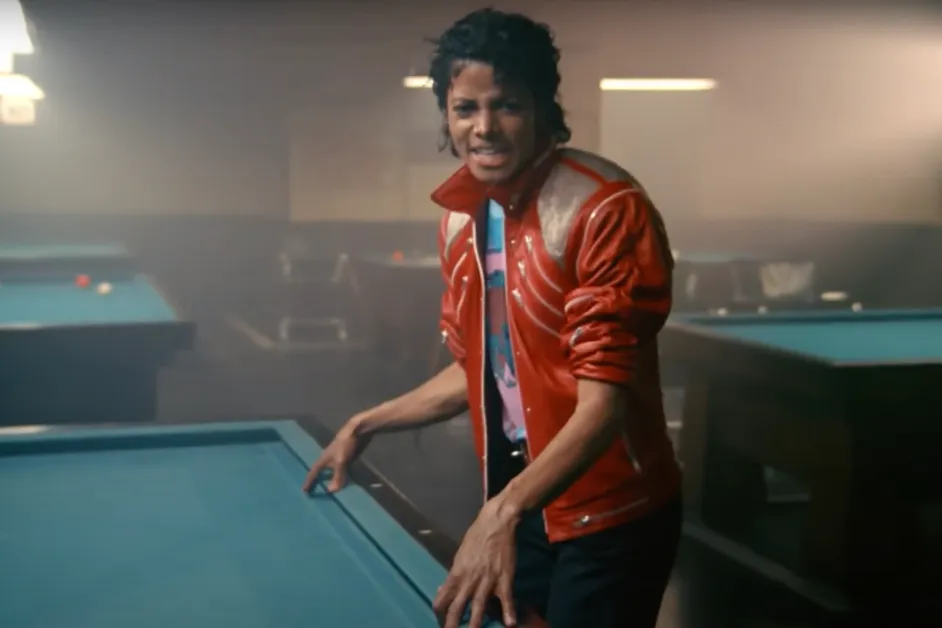
A Van Halen fan in a metal suburb buying a Michael Jackson record. That had never happened before.
Van Halen found that out for himself. He was browsing the Sherman Oaks Tower Records when “Beat It” came on over the store sound system. “The solo comes on, and I hear these kids in front of me going, ‘Listen to this guy trying to sound like Eddie Van Halen,'” he recalled. “I tapped him on the shoulder and said, ‘That IS me!’ That was hilarious.”
Thriller went on to become the best-selling album of all time, dominating the charts for 37 consecutive weeks. Van Halen’s own album 1984 was poised to reach number one when Jackson’s Pepsi commercial, in which his hair caught fire, sent Thriller surging back to the top. “Our album was just about ready to go No. 1 when he burned his hair in that Pepsi commercial,” Van Halen recalled. “And boom, he went straight to No. 1 again.”
“Beat It” reached number one on the Billboard Hot 100 on April 30, 1983, staying there for three weeks. It was also Jackson’s first Billboard rock chart hit, reaching number 14 on Mainstream Rock. For a period, “Billie Jean” and “Beat It” occupied the top five simultaneously.
At the 1984 Grammy Awards, Jackson won eight awards, including Album of the Year, Record of the Year for “Beat It,” and Best Male Rock Vocal Performance. Four years earlier, Off the Wall had received a single nomination. He had said to wait until next time. This was the next time.
“In the music business, every decade you have a phenomenon,” Jones said. “In the ’40s you had Sinatra, in the ’50s Elvis, in the ’60s the Beatles, in the ’70s the innovation of Dolby, despite the best efforts of Stevie Wonder and Elton John. In the ’80s you had Michael Jackson. He was the biggest entertainer on the planet.”
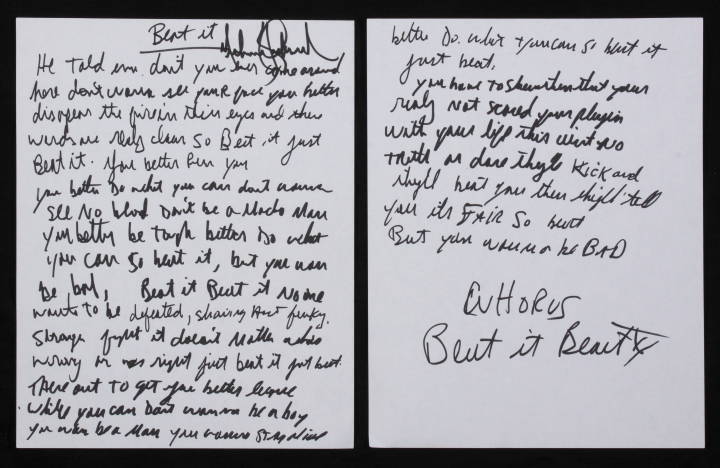
Lyrically: Beat It by Michael Jackson
“‘Beat It’ was written with school kids in mind,” Jackson wrote. “I’ve always loved creating pieces that will appeal to kids. It’s fun to write for them and know what they like because they’re a very demanding audience. You can’t fool them. They are still the audience that’s most important to me, because I really care about them. If they like it, it’s a hit, no matter what the charts say.”
He was direct about what the song meant. “The lyrics of ‘Beat It’ express something I would do if I were in trouble,” he wrote. “Its message — that we should abhor violence — is something I believe deeply. It tells kids to be smart and avoid trouble. I don’t mean to say you should turn the other cheek while someone kicks in your teeth, but, unless your back is against the wall and you have absolutely no choice, just get away before violence breaks out. If you fight and get killed, you’ve gained nothing and lost everything. You’re the loser, and so are the people who love you. That’s what ‘Beat It’ is supposed to get across. To me true bravery is settling differences without a fight and having the wisdom to make that solution possible.”
“Beat It” is one of four songs on Thriller that Jackson wrote entirely on his own, alongside “Billie Jean,” “Wanna Be Startin’ Somethin’,” and “The Girl Is Mine.” Jones asked for a rock song. Jackson wrote one. Van Halen made it sound dangerous.
Charles Shaar Murray, reviewing the single in the New Musical Express in April 1983, heard something more layered on first listen: “a touchingly anti-macho song winningly designed to set off the new lightly-more-macho Jackson stance as revealed in recent videos and sleeves.” The song preaches walking away. The packaging sold toughness. Murray noted the irony was “further compounded by big, buffalo-eating power chords and a risky, squibbling solo” from Van Halen.
There is tension before the song starts and it’s in the title. “Beat it” is something you say to brush off or dismiss someone. Jackson takes that phrase, that insult, and flips it into instruction.
They told him, “Don’t you ever come around here”
“Don’t wanna see your face, you better disappear”
The fire’s in their eyes and their words are really clear
So beat it, just beat it
The opening verse is direct and immediately sets the scene. A person is surrounded. The threat is real with “the fire’s in their eyes and their words are really clear.” The line “their words are really clear” removes the most common excuse for violence — miscommunication. No one misheard anything. No one was confused. The choice to leave is not failure. It is strength.
You better run, you better do what you can
Don’t wanna see no blood, don’t be a macho man
You wanna be tough, better do what you can
So beat it, but you wanna be bad
The real enemy in the second verse is not the other gang. It is the act of toughness. “Don’t be a macho man.” Then the admission: “but you wanna be bad.” Jackson knows the pull. He just asks you to be bigger than it.
Just beat it (beat it), beat it (beat it)
No one wants to be defeated
Showin’ how funky and strong is your fight
It doesn’t matter who’s wrong or right
Just beat it (beat it), just beat it (beat it)
Just beat it (beat it), just beat it (beat it, uh)
The chorus is where the song does Jackson’s work. “No one wants to be defeated” is an acknowledgement of the instinct that makes walking away feel like losing. “Showin’ how funky and strong is your fight” insists there is value in restraint. Then: “It doesn’t matter who’s wrong or right.” Being right changes nothing when the outcome is blood.
They’re out to get you, better leave while you can
Don’t wanna be a boy, you wanna be a man
You wanna stay alive, better do what you can
So beat it, just beat it (rrr)
The third verse circles back to the song’s core meaning. “Don’t wanna be a boy, you wanna be a man” inverts the macho code. Leaving the fight is maturity.
You have to show them that you’re really not scared
You’re playin’ with your life, this ain’t no truth or dare
They’ll kick you, then they’ll beat you, then they’ll tell you it’s fair
So beat it, but you wanna be bad
This is not a game. The stakes are your life. “You have to show them that you’re really not scared” is not about being brave. It is about composing yourself under pressure. Then the cruelest line presents itself: “They’ll kick you, then they’ll beat you, then they’ll tell you it’s fair.” The violence is physical and verbal, and apparently justified. And still: “but you wanna be bad.” Jackson is not lecturing. He is asking you to choose.
The song’s anti-macho message and its rock sound are not in contradiction. They are the point. Jackson does not ask you to be soft. He asks you to be smart about your actions. Which is the hardest thing to consistently accomplish.
The Crips and Bloods did it.




What does this song mean to you?
Share your thoughts on this song.