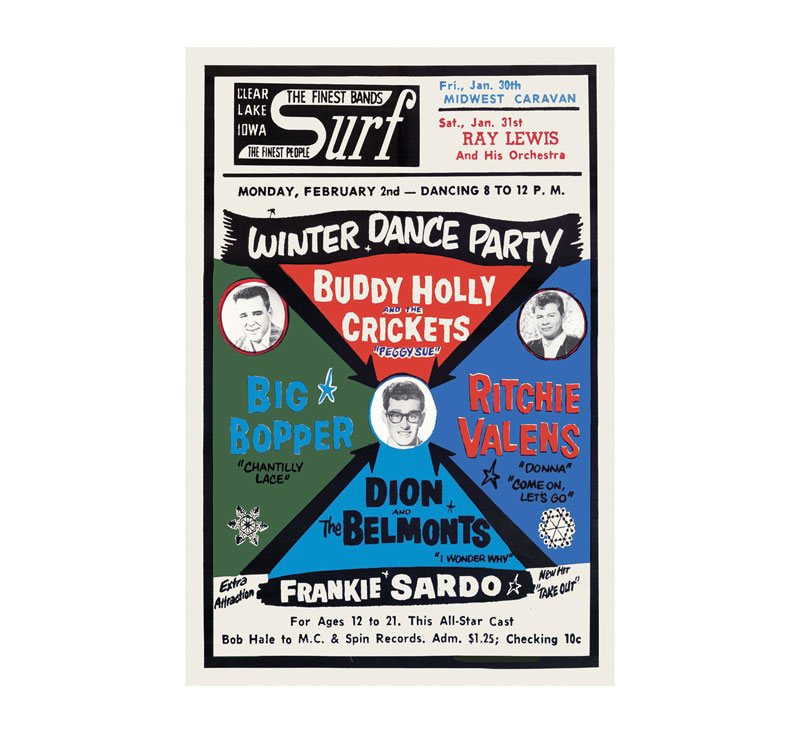
On the night of Monday, February 2, 1959, Buddy Holly, Ritchie Valens, and J.P. “The Big Bopper” Richardson were at the Surf Ballroom in Clear Lake, Iowa, midway through the “Winter Dance Party,” a twenty-four-city tour across the Midwest. Inside, over 1,100 “enthusiastic fans” packed the floor. Outside was shivering cold.
All three were young, all three were rising, and all three had already changed what American music sounded like. Buddy Holly was 22. Ritchie Valens was 17. The Big Bopper was 28. Buddy Holly’s “That’ll Be the Day,” Ritchie Valens’ “La Bamba,” and The Big Bopper’s “Chantilly Lace” had already found their way into jukeboxes and onto radio stations across the country.
The ten shows leading up to the Surf Ballroom were met with frustration. The “Winter Dance Party” had earned the nickname “Tour From Hell.” Temperatures reached thirty-five below zero and the reconditioned school buses kept breaking down. With no heat, the musicians huddled under blankets and burned newspapers to keep warm. Holly’s drummer Carl Bunch suffered severe frostbite and was hospitalized. By the time they reached Clear Lake, Holly was exhausted, Richardson had the flu, Valens was sick with a cold, and they were running out of clean clothes.
After their sets, Holly was out of patience and decided to charter a plane to fly ahead to Fargo, North Dakota for their next show in Moorhead, Minnesota. He wanted to rest and do his laundry. A 1947 Beechcraft Bonanza was arranged, but it only had room for the pilot and three passengers. Holly took one seat. Richardson took another after Holly’s bassist Waylon Jennings gave up his seat. Valens won the third from Holly’s guitarist Tommy Allsup in a coin toss. When Jennings told Holly about the change, Holly scoffed and said, “I hope your ol’ bus freezes up.” Jennings replied, “Yeah? Well, I hope your ol’ plane crashes!”
Carroll Anderson, manager of the Surf Ballroom, drove Holly, Valens, and Richardson to the Mason City Municipal Airport. They arrived around 12:40 a.m. on February 3. As light snow began to fall, pilot Roger Peterson took off from runway 17 at 12:55 a.m. and ascended into the sky, only to descend “a couple of minutes” later, crashing in a cornfield five miles northwest of the airport.
This was the day the music died.
The trip to Fargo was expected to take about three and a half hours. When no word of the plane’s arrival came, Jerry Dwyer, owner of the flying service, set out to search for the aircraft, though early morning fog delayed him for several hours. The wreckage was found at approximately 9:35 a.m. and Dwyer radioed the discovery to authorities on an open channel. A ham radio operator overheard the transmission and contacted the local station.
The news spread fast.
Within the hour, radio broke the news. By early afternoon, television networks and newspapers across the country had reported the tragedy.
“We interrupt this program for a special news bulletin. Three young singers who soared to the heights of show business on the current rock and roll craze were killed today in the crash of a light plane in an Iowa snow flurry. The singers were identified as Ritchie Valens, 17, Buddy Holly, 22, and JP Richardson, known professionally as the ‘Big Bopper.’ The aircraft chartered from the Dwyer Flying Service crashed near Mason City,” said KRIB Mason City disk jockey Bob Hale. “The pilot, Roger Peterson of Clear Lake, Iowa, was also killed. The three singers had appeared at the Surf Ballroom in Clear Lake, Iowa last night and were on the way to Fargo, North Dakota. Their small chartered plane crashed in a lonely farmyard… Cause of the crash was due to inclement weather conditions.”
Among those who learned the news was a thirteen-year-old paperboy in New Rochelle, New York, 1,200 miles away, delivering the afternoon papers door to door. His name was Don McLean.

A long, long time ago
Don McLean was born on October 2, 1945, and raised in New Rochelle, New York. His severe asthma frequently isolated him from school. “Weeks and weeks, stuck in the house, looking at kids playing outside,” McLean recalled. “I developed different than they did.”
The isolation awakened his love for music. “One of the advantages of having asthma is that it kept me out of school for long periods,” McLean said. “I was able to develop another Don McLean that wasn’t programmed by the school system.”
Isolated at home, McLean found an unlikely music teacher in his grandmother. Together they listened to Elvis records, and she would harmonize along to The Jordanaires. “You sing a little and I’ll harmonize with you,” she told him. That was how McLean learned harmony.
At thirteen, McLean took a job delivering newspapers for the New Rochelle Standard-Star. This led him to purchase his first guitar, a Martin, from the local music store called the House of Music. McLean would bring home records by Elvis Presley, Little Richard, Chuck Berry, and Bo Diddley, playing each one repeatedly. To his father, rock and roll was, as McLean put it, “the lowest thing you could ever do” and “the worst things my father could ever imagine.”
“As a paperboy, I cut open the stack of papers on February 3, 1959, and saw that Buddy Holly had been killed in the plane crash. The next day I went to school in shock, and guess what? Nobody cared,” said McLean.
“It was my guy who was killed, Buddy was now dead. I was in absolute shock, and I read the whole story. I think I might have actually cried. It was that personal,” said McLean. “I felt like you lost your first love or you broke up with your first girlfriend, that dark, horrible thing that comes over a teenager, and it’s like the end of the world. All of a sudden, you get this horrible death, personally affecting me with this pain that I never had experienced before. So it just hurt. Can’t intellectualize it. It hurt me. And I was so touched and moved by this beautiful face, and nobody talked about him, because he was dead. Americans didn’t talk about dead people. Onward.”
Two years later, his father died. McLean was fifteen. “I was very sad when my father passed away,” McLean said, “but I also realized I could do anything I wanted.”
“When my father died, home left me. You can imagine how important music became to me, creating something out of myself,” said McLean. “Once I had the guitar going, this folk thing started. I’d just write songs and follow my instincts. And I started playing around town. I would plan a concert almost every month. It was now about 1964, so I was about 18, and I had quit school ’cause I wanted to be a singer.”
McLean had been writing letters to folk music artist Pete Seeger since age fourteen, and Seeger wrote back with advice that stuck. “Don’t try to learn too much,” Seeger told him. “Do a few things very, very well. Don’t try to learn a lot of things.”
In 1967, he spotted a small advertisement in the New York Times. “It said, ‘Pete Seeger sings for Hudson River sloop,'” said McLean. “I got in my car, and it was a little concert in Garrison, New York, directly across from West Point. Seeger, he’s playing his banjo on this plywood stage and the one microphone, and then during a break, I introduced myself, and he knew who I was because I’d been writing him since junior high school. And he liked me and he asked me to be on a concert in 1968. And I got right involved with that, right away.”

“He took me under his wing and brought me around and had me open for him or be a guest on his show, and then he put this gang of singers together, and I was part of that. Suddenly, I’m in this whole world. It’s art, it’s recordings, it’s live performing. Seeger took us to the Newport Folk Festival in 1969. That was a big deal… Van Morrison, James Taylor, Muddy Waters was there. Somehow or other, they let the Everly Brothers come to Newport. Rock ‘n’ roll. Wow. They came on stage, and they were incredible… I knew that the Everlys were very close to Buddy Holly. So after the show was over, I had to say hello to them. So I went to Phil Everly, and I said, ‘You know, I know that you knew Buddy Holly. Could you tell me a little bit about him and what happened?’ He said, ‘We were very good friends. Buddy decided to take a plane to get out ahead of the tour to get his laundry done.’ ‘He died for dirty laundry,’ I thought to myself. Wow. Man, he’s a human being with a sack of dirty clothes. Gee, the whole thing started coming back. Front and center, it was absolutely haunting me now,” said McLean.
McLean kept performing, playing colleges, folk clubs, and coffeehouses wherever he could get a booking. For two years he attempted to secure a record deal, only to be rejected by thirty labels. “I received a large number of painful rejections,” McLean said. “It was tough on me and my nerves, I was angry, but finally got that first record out.” Mediarts Records said yes to a three-album deal. McLean recorded Tapestry in Berkeley, California in 1969.
Before the album’s release, McLean had earned his following one show at a time, playing clubs, coffeehouses, and colleges. He had also appeared on Pete Seeger’s Sounds of Summer in Nyack, New York, and on Sesame Street.
Tapestry was released in October 1970 with Cash Box declaring, “Don McLean is one of the most brilliant new songwriters around. His music is fresh and inventive, and his lyrics, frightfully realistic. Don sings of love and castles and dreams, and is equally convincing with all. The album contains 11 magnificent tracks all woven together by voice and music to produce indeed, a tapestry… This album is destined to become a musical landmark.”
“Pop-folk, composer-performer impresses with this, his disk debut, based upon a compelling program of his creative music, some moving love stories and some biting commentaries on the world situation of today. With liner notes by Pete Seeger, and words of praise by Lee Hays (Weavers), McLean is a bright new talent that could bust through fast as a heavy chart artist. ‘And I Love You So,’ ‘Castles in the Air,’ and ‘Tapestry’ are among the stand-out material,” wrote Billboard in its review of the album.
Despite positive reviews, the album gained little attention and didn’t chart. The America he was performing in was changing fast.
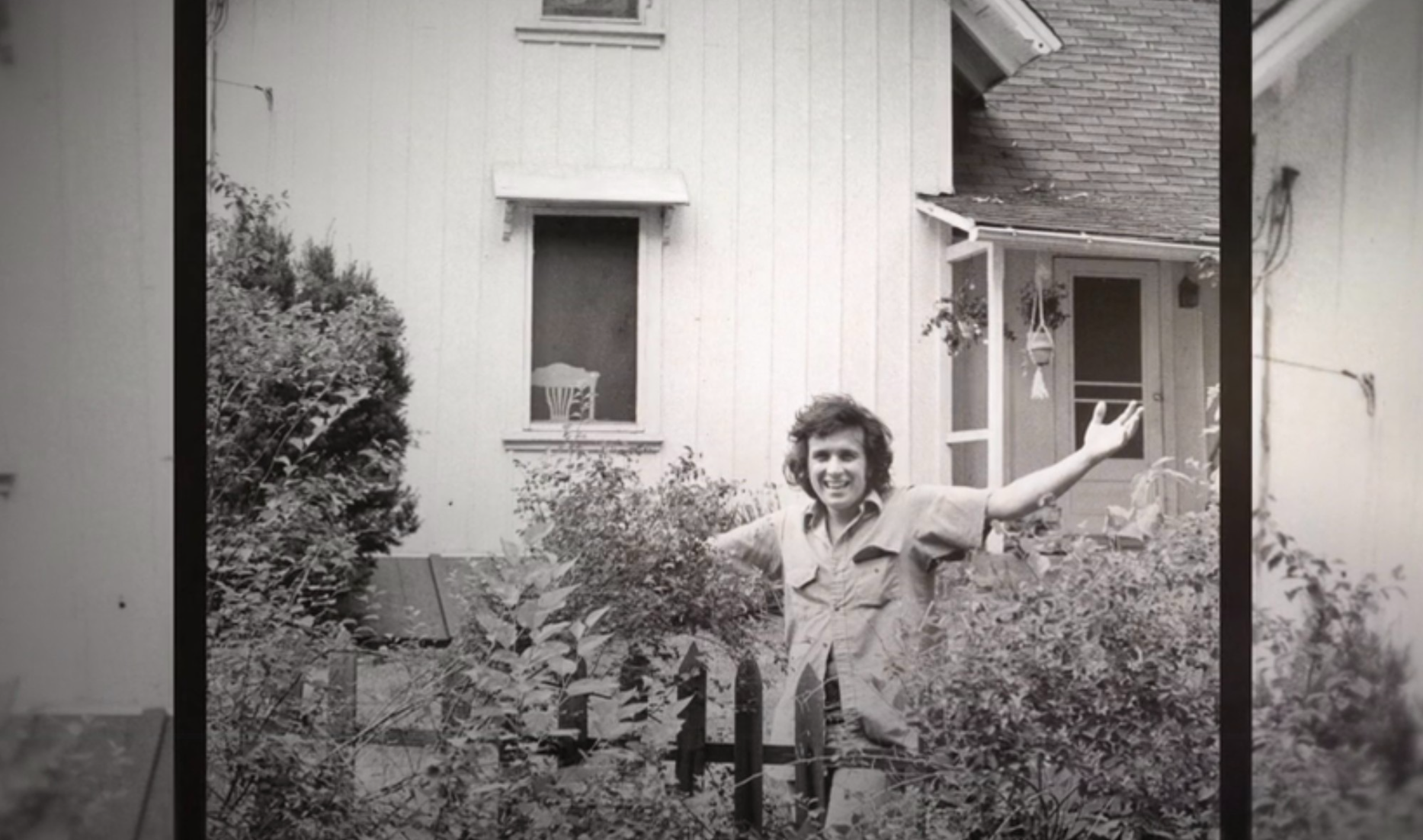
To write his second album, McLean moved into a gatehouse in Cold Spring, New York, owned by his business manager, James Bennenson, Jr. “I had no money at the time,” McLean said.
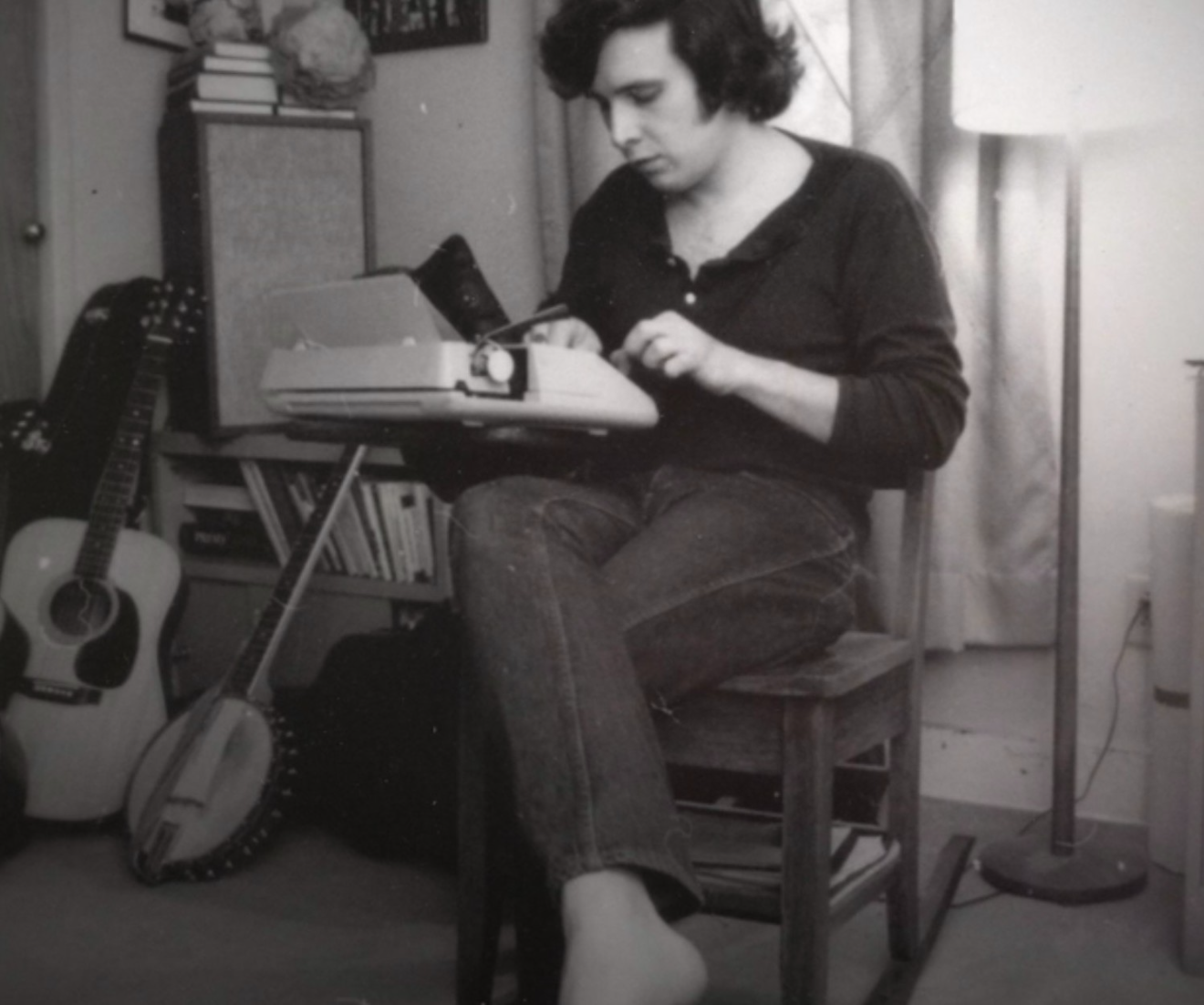
“Up on the second floor, there was a tiny little bedroom, and there was a chair I put rockers on, and I would rock on that thing and type on my little typewriter and write songs,” said McLean. “I was writing furiously now. I was inspired by the people that I met. The artists, the writers, the scientists, the political people… and I’m making Tapestry in 1969 in Berkeley, California and there’d be a small riot every day I was making that record. They’re gassing the guys coming to the sessions, like every day. So I’m thinking, it’s crazy. What’s going to happen to the country now? Things are getting worse.”
“We’d had numerous assassinations throughout the ’60s. The Kennedy assassination. Martin Luther King. And RFK. We had the war in Vietnam. Rage against Nixon and the chaotic insanity that was out there. It broke up families, tearing the whole place apart. The country was in an advanced state of psychic shock. Drugs everywhere. Everybody’s smoking dope and sleeping with everybody else. And all this bedlam and riots and burning cities. And I’m always standing back trying to read the signs. What’s this mean? And try to put it somehow in my simple way into some of these songs,” said McLean.
“I want to write a song about America but I don’t want to write a song like anybody ever wrote about America before. I wanted to write a song about the new America, which is rock and roll, which is people’s involvement in politics and the connection between all that,” said McLean.
“I was working on this second record, but I wasn’t happy with it. And so I said, ‘I gotta have a big song about America.’ I just really knew I wanted to do this. One day I was up there sitting on the little bed, and I turned this tape recorder on, and… I just started singing… ‘A long, long time ago’.”
“I said, ‘Whoa! What is that? This whole thing was coming up in me, for all those years before of thinking of Buddy, and it all came out right through to ‘the day the music died.’ Every single word I wrote just came like a genie out of a bottle.’ And I said to myself, ‘Wow, I got something,'” said McLean.
“I was building it. I could hear it. I could feel it that something was going on. Bigger than me. I was trying to create some sort of abstract, dreamlike story about America,” said McLean. “I was working on this ‘American Pie’ song, and I had eight or nine songs that were going to go on the album, and now the question was how to make a good record out of it.”
“So a couple of months later I came up with the chorus, and three months later I wrote the verses. Took me about two hours,” stated McLean. “They were all set to the same melody, and the last verse was slowed down like the first verse, and then it was done.”
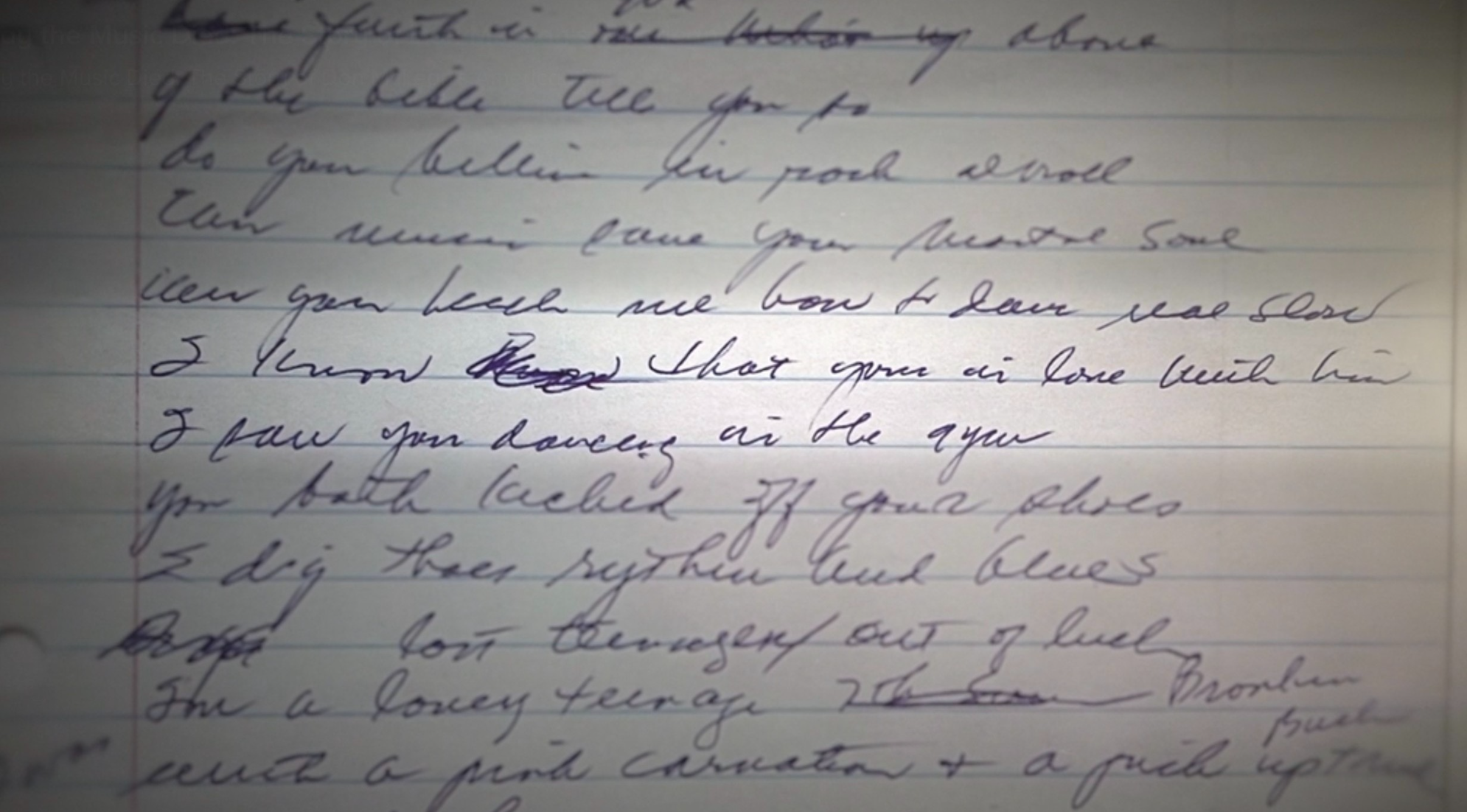
On Friday, March 12, 1971, McLean opened for Laura Nyro at St. Joseph’s College’s Field House in Philadelphia before a crowd of 3,200. He decided to test the newly written and unfinished song with the audience. The reaction to the song was, according to McLean, “not much, ok… The song was so different that they hadn’t heard anything like it.”
That summer, an acoustic version aired on Pete Fornatale’s show on New York’s WNEW-FM, with a live simulcast on WPLJ-FM, the same week the Fillmore East closed its doors for the last time.
During production, Mediarts switched distribution to UDC, Inc., a subsidiary of United Artists. By July 1971, United Artists had purchased Mediarts outright, one of the labels that had originally rejected him.
In late May 1971, McLean, producer Ed Freeman, and a few session musicians rehearsed for two weeks without nailing the song. At the last minute, pianist Paul Griffin was brought in.
“And they put my guitar in his earphones. And I hit that thing hard, and I play it loud,” said McLean. “And all of a sudden, Griffin, he starts playing this thing. He’s going, ‘Whoa!’ And he starts playing the piano like a gospel stride piano. Paul Griffin, he came in at the last moment, and Hail Mary pass, saved the whole dang thing.”
“American Pie” was recorded on May 26, 1971, at Studio A of the Record Plant in New York. The song ran eight minutes and forty-two seconds.
“When they finished, I just hit the talk back, and I said, ‘Y’all better come in here and take a listen to this’,” said Ed Freeman. “I think the only thing that we were in agreement about, is that we were both fiercely committed to this song being a masterpiece. We were not leaving the studio until this thing was brilliant, and we didn’t, and it is.”
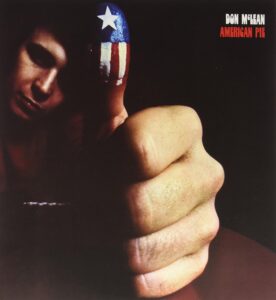
The album “American Pie” was released on October 24, 1971, followed by the double A-side single two weeks later on Friday, November 12.
When the song was released, “American Pie” “took over the airwaves and the consciousness in a way that few records had done before or since…. Here was a pop phenomenon that grabbed the public’s attention not so much with chords as with words,” said critic David Browne in the New York Times.
“His first album for United Artists is a sensitive, lyrical collection of original material, the essence of Don McLean,” wrote Billboard. “‘Vincent,’ a stirring plea for understanding of the work of Van Gogh, appears to be autobiographical in part. FM programmers should hear ‘Till Tomorrow,’ ‘Empty Chairs’ and of course the title cut, ‘American Pie.'”
“American Pie” entered the Billboard Hot 100 the week ending November 13, 1971 at number 164. “Don McLean- American Pie (4:21)… One of the demand cuts from McLean’s chart climbing LP, the title song has been edited to reasonable length and the material, beautifully performed by the artist/writer is in the mainstream of contemporary pop music,” stated Billboard.
“Don McLean is a sure-shot big star in the making,” declared Billboard‘s Nat Freeland.
“Everything took off like a rocket… American Pie blew up the world,” said McLean.
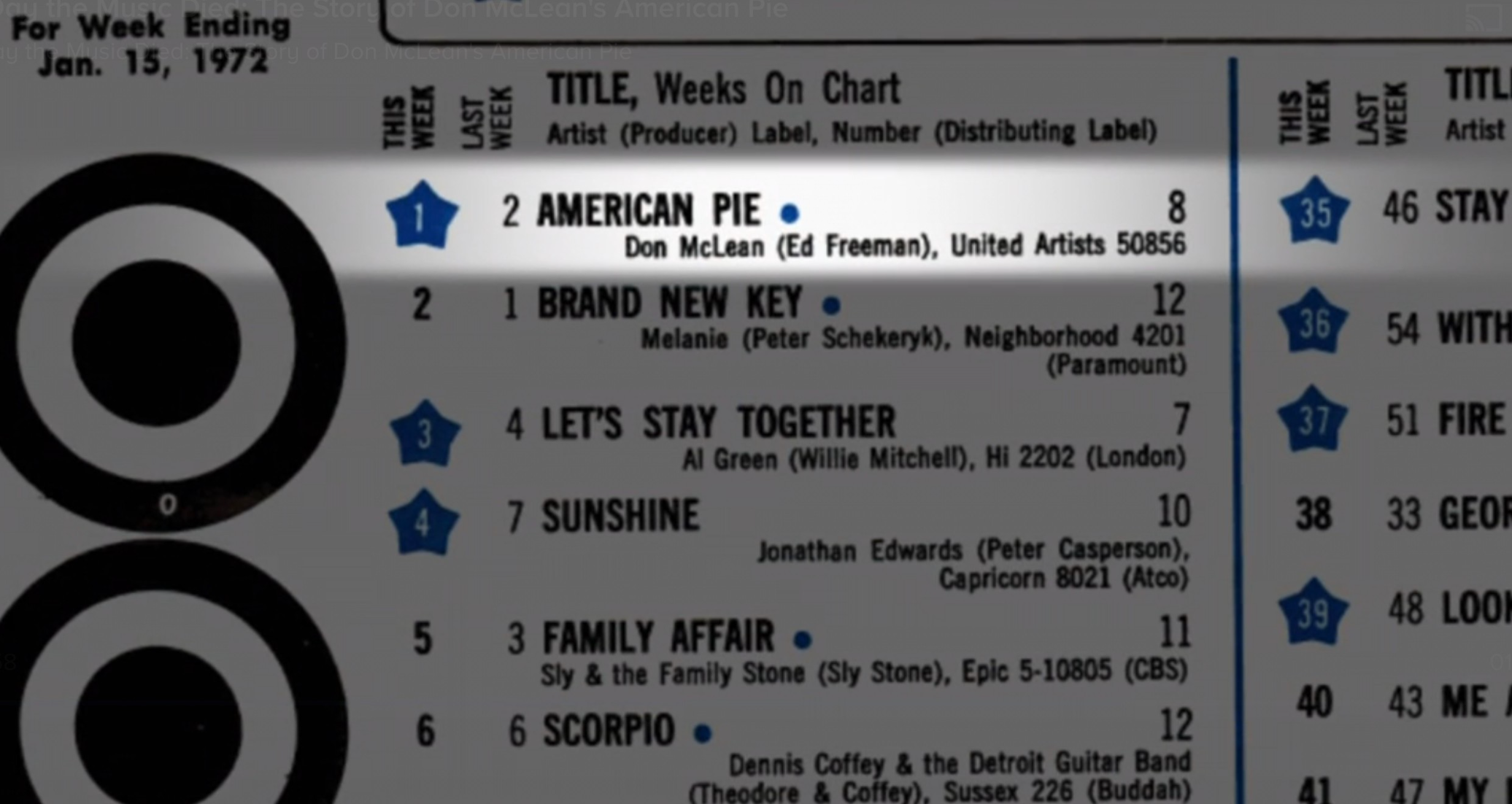
The song charted within a month, entered the top 10 by mid-December and topped the Billboard Hot 100 on January 15, 1972, overtaking “Brand New Key” by Melanie and “Family Affair” by Sly & the Family Stone. “American Pie” held that position for four consecutive weeks, at the time becoming the longest song ever to reach the number one spot.
“Without it, many of us would have been unable to grieve, achieve closure, and move on. Don saw that, and wrote the song that set us free,” stated Freeman. “American Pie was really encapsulating the experience for a whole generation. We were witness to the death of the American dream. We went through both Kennedys being shot, Malcolm X, Martin Luther King, Vietnam. Hippies thought we were going to take over the world. Love and Peace. It didn’t happen. For me, American Pie is the eulogy for a dream that didn’t take place. It was real important that way. I think we all needed it.”
Lyrically: American Pie
When “American Pie” was released, the lyrics were completely dissected. The song had people thinking, reflecting, and debating. It became a cultural controversy.
“It’s all a matter of interpretation! You can listen to it for its musical value – for its melodic content; or, you can spend countless hours trying to interpret its more subtle meanings. But which every way you cut it, Don McLean’s ‘American Pie’ has to be one of the most controversial songs ever written. So much so, that AM stations have been programming it in its entirety-and the full version runs well over 8 minutes,” wrote Cash Box after “American Pie” was released. “The only clue that McLean hasn’t hidden from us is that the album was dedicated to the late Buddy Holly… All we can be sure of is that ‘American Pie’ can mean almost anything until Don McLean tells us otherwise.”
Bob Dearborn, a radio DJ from WCFL Chicago, did a 25-minute syndicated special based upon the lyrics of “American Pie.” He told listeners they could write in for a five-page explanation of the song’s lyrics and received over 40,000 requests.
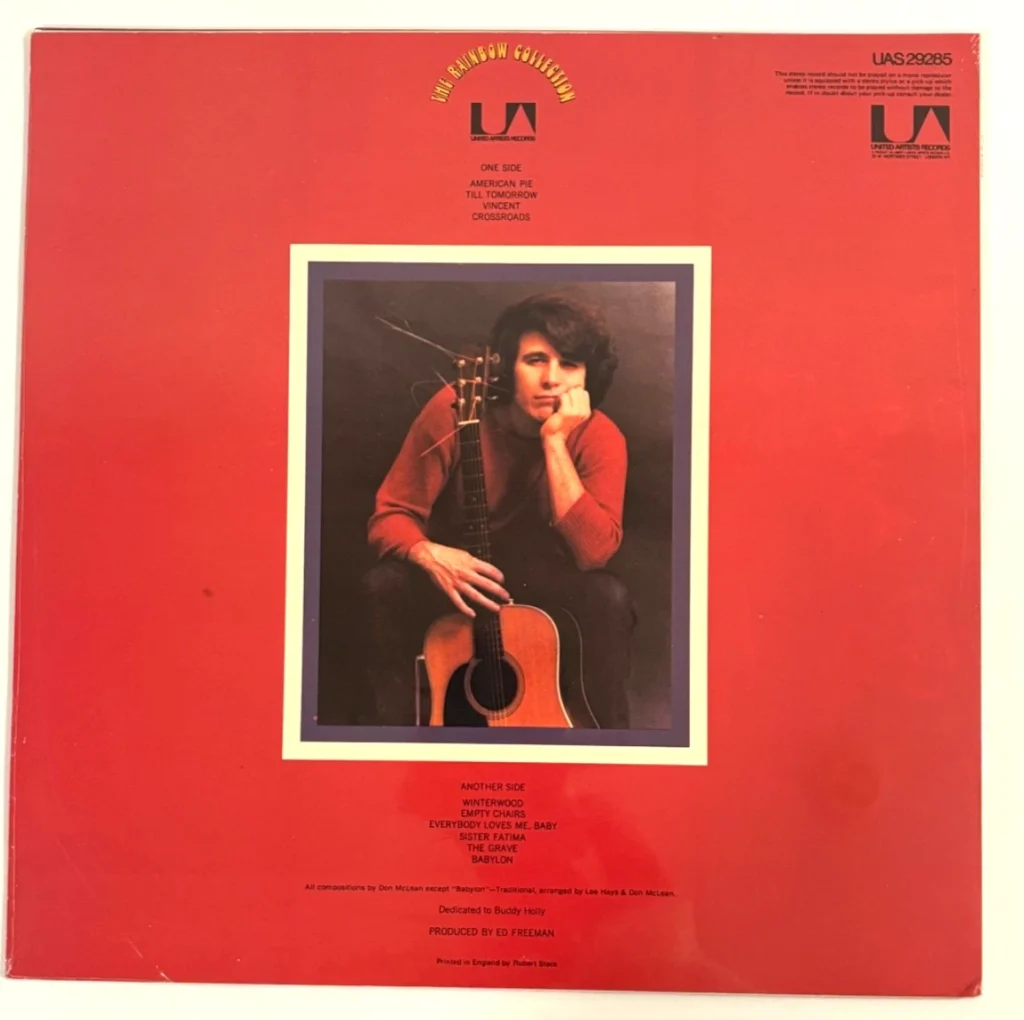
“Seldom does a popular song stimulate so much interest and controversy by its lyric content, but it’s happened with ‘American Pie.’ Major publications such as Life and Time magazines have seen fit to print brief articles acknowledging the mystery of the song. Music trade publications, teachers, theologians, disc jockeys, even the man on the street have taken the time and interest to speculate on the song’s true meaning. Don McLean himself offers little by way of explanation. However, he does concede that Buddy Holly, a recording star of the late 1950s, was the only singer he ever idolized, and the American Pie album is dedicated to Buddy Holly. This information is the starting point, the key to understanding,” said Bob Dearborn.
Time Magazine called the song an instant classic that “mixes the good sounds from 1960s jukeboxes with the bad news from 1960s headlines.” Life stated the lyrics of “American Pie” “a melodic and melancholy summing up of the recent history of pop music.”
“People ask me if I left the lyrics open to ambiguity,” said McLean. “Of course I did. I wanted to make a whole series of complex statements. The lyrics had to do with the state of society at the time. The song is an indescribable photograph of America that I tried to capture in words and music.”
“It’s about America,” McLean said. “Buddy Holly’s death is what I used to try to write the biggest possible song I could write about America. And not a ‘This Land Is Your Land’ or ‘America, the Beautiful’ or something like that. I wanted to write a song that was completely brand new in its perspective.”
A long, long time ago
I can still remember how that music
Used to make me smile
And I knew if I had my chance
That I could make those people dance
And maybe they’d be happy for a while
But February made me shiver
With every paper I’d deliver
Bad news on the doorstep
I couldn’t take one more step
I can’t remember if I cried
When I read about his widowed bride
But something touched me deep inside
The day the music died
“The first verse of the song is biographical,” said McLean. “I’m trying to do a kaleidoscopic, dream-like, impressionistic, yet understandable thing… Buddy was like a lost brother or somebody that died in the war… there was this yearning I had in me always, and I could never talk to anybody about it, because it was just all in me.”
“So the death of Buddy Holly gave me the concept that I was then able to build into a song,” recalled McLean. “I brought Buddy back to life, and he brought me back to life.”
The news of the February 1959 plane crash spread so fast that Buddy Holly’s pregnant wife, María Elena, first learned of his death from a television report. The shock caused her to miscarry the following day. The tragedy led to what became known as “the María Elena rule,” requiring that names of the deceased be withheld from the public until next of kin have been officially notified.
So, bye-bye, Miss American Pie
Drove my Chevy to the levee, but the levee was dry
And them good ol’ boys were drinkin’ whiskey and rye
Singin’, “This’ll be the day that I die This’ll be the day that I die
McLean stated that the chorus for the song came “from God knows where in my head.”
“Bye Bye Miss American Pie” references one-time mentor Pete Seeger’s “Bye Bye, My Roseanna.” McLean originally penned the song as “Miss American apple pie” but decided to remove the fruit reference, thus coining the phrase “American Pie,” which didn’t exist before he wrote the song.
The line “This’ll be the day that I die” was inspired by John Wayne’s character, Ethan Edwards, in the 1956 film The Searchers, which also influenced Buddy Holly’s song “That’ll Be the Day.”
Did you write the book of love,
And do you have faith in God above,
If the Bible tells you so?
Now do you believe in rock and roll,
Can music save your mortal soul,
The lyrics “Can music save your mortal soul?” McLean stated, “See that’s the theology in me coming out. In the church, they only talk about your immortal soul. I’m saying can the music save your mortal soul. As a man, now being alive!”
And can you teach me how to dance real slow?
Well, I know that you’re in love with him,
‘Cause I saw you dancin’ in the gym,
You both kicked off your shoes,
Man, I dig those rhythm and blues.
I was a lonely teenage broncin’ buck,
With a pink carnation and a pickup truck,
But I knew I was out of luck
The day the music died.
“This is all me… Seeing other kids being happy and hearing the music going on behind them, and seeing other things happen that I wasn’t a part of,” said McLean. “Yeah, I was a lonely teenage broncin’ buck. Now, that’s a takeoff of having bronchial asthma. I was broncin’ but I was still a stallion.”
For the lyrics “With a pink carnation and a pickup truck,” McLean said, “Sure, I went to a lot of proms but never had a pickup truck. But I could have anything I wanted in my songs!”
Now, for ten years we’ve been on our own
And moss grows fat on a rollin’ stone
But that’s not how it used to be
When the jester sang for the king and queen
In a coat he borrowed from James Dean
And a voice that came from you and me
Oh, and while the king was looking down
The jester stole his thorny crown
The courtroom was adjourned
No verdict was returned
And while Lenin read a book on Marx
The quartet practiced in the park
And we sang dirges in the dark
The day the music died
“Now, for ten years we’ve been on our own / And moss grows fat on a rolling stone.” These lyrics are about the death of McLean’s father in 1961 when he was 15, and how he gained weight during this time. This coincides with when McLean started to write “American Pie.”
McLean stated that Elvis wasn’t the “king,” Janis Joplin wasn’t the “girl who sang the blues,” and Bob Dylan wasn’t the jester. The “marching band” refers to the military-industrial complex, while “sweet perfume” was his euphemism for tear gas being used. “Lennon read a book on Marx” is accurate and applies to both John Lennon and Vladimir Lenin, with “Eight miles high and falling fast” being a reference to a song by The Byrds called “Eight Miles High.” The “forward pass” came from the lyrics of “Bottle Up and Go” by Josh White.
Helter skelter in a summer swelter
The birds flew off with a fallout shelter
Eight miles high and falling fast
It landed foul on the grass
The players tried for a forward pass
With the jester on the sidelines in a cast
McLean noted that “we’re out in the middle of an endless universe. None of us are important except to each other. And we are all lost in space… because the war was hotter than it ever was before.” This war was the Vietnam War and the opposition to it.
Oh, and there we were all in one place
A generation lost in space
The lyrics also seek some “happy news,” but there is none to be experienced. “I got the bad news in the front of the song, now I’m asking her for some happy news at the end of the song, ‘But she just smiled and turned away’… she knew something, but she wasn’t going to say anything. She doesn’t give me any good news,” said McLean.
The “sacred store” was the House of Music on Main Street, where McLean purchased records and his first guitar.
And the three men I admire most
The Father, Son, and the Holy Ghost
They caught the last train for the coast
“Even God has been corrupted. He’s going to Los Angeles,” said McLean. Los Angeles is the “coast” mentioned in “caught the last train for the coast.”
“American Pie” has been inducted into the Grammy Hall of Fame and named a “Song of the Century” by the Recording Industry Association of America (RIAA) and the National Endowment for the Arts.
“There’s a circularity to the song because I’m dealing with the music in the beginning and then all this stuff has happened,” McLean explained. “I’m going back to the sacred store to find the music, and the music wouldn’t play. So, it’s a circle.”
“‘American Pie’ presents an abstract story of McLean’s life from the mid-1950s until the end of the 1960s, and at the same time it represents the evolution of popular music and politics over these years, from the lightness of the 1950s to the darkness of the late 1960s, but metaphorically the song continues to evolve to the present time. It is not a nostalgia song. ‘American Pie’ changes as America, itself, is changing,” states McLean’s website.


What does this song mean to you?
Share your thoughts on this song.