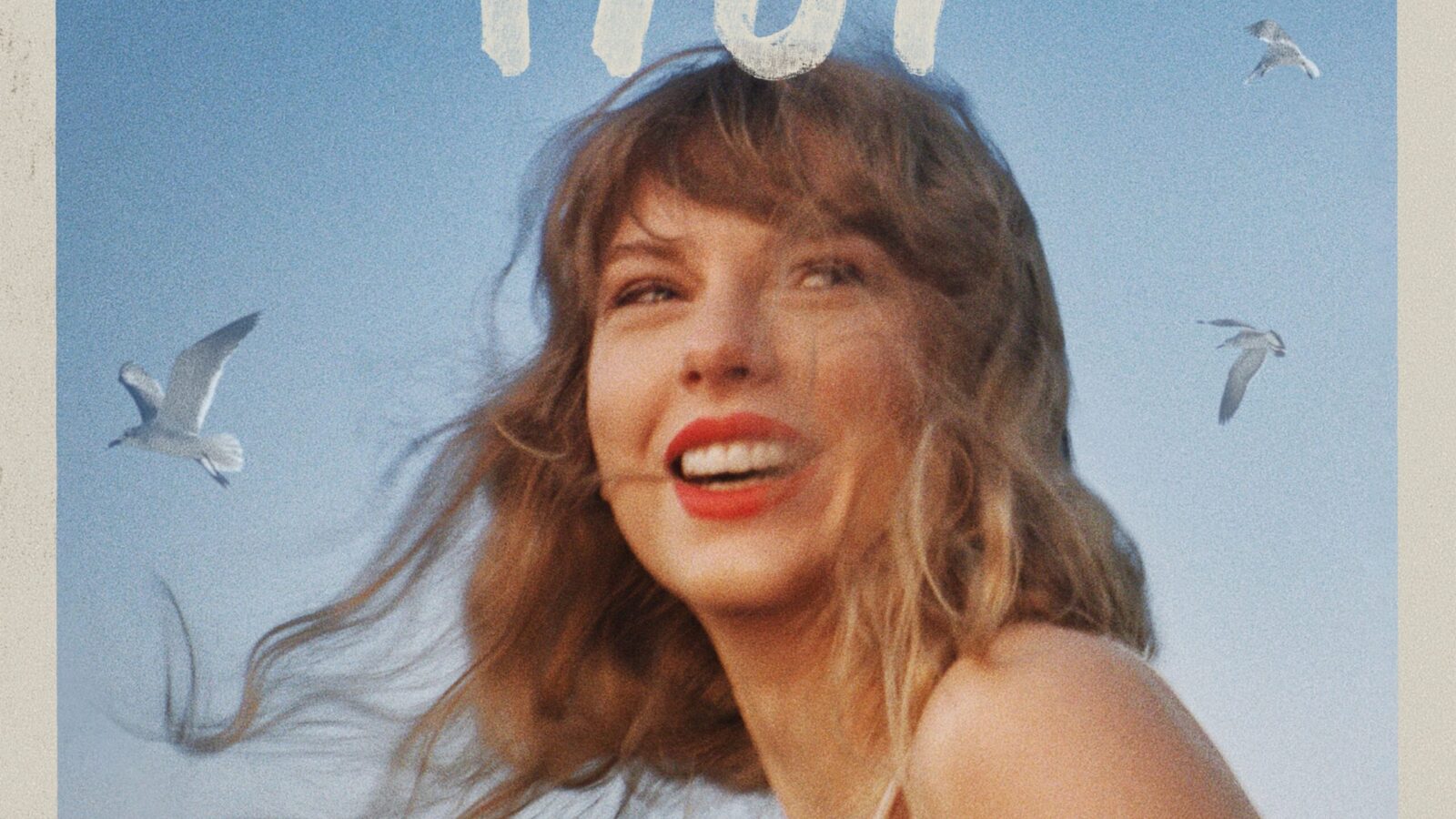
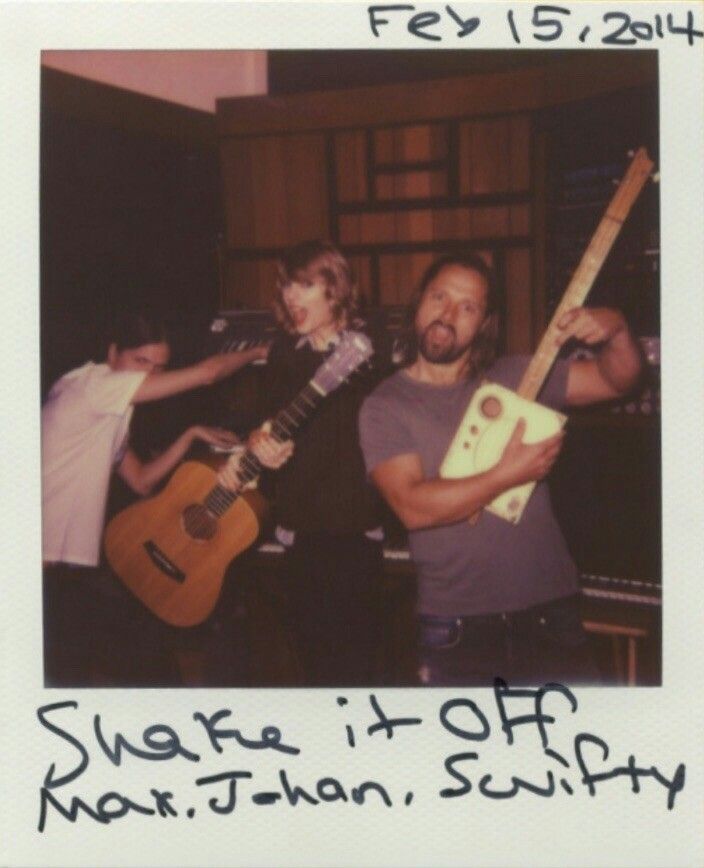
It is Friday, February 14, 2014. Inside Conway Recording Studios in Los Angeles, Taylor Swift is in a room with two Swedish producers. Max Martin, the man behind Britney Spears’s “…Baby One More Time” and Katy Perry’s “Dark Horse,” sits at the mixing console. Karl Johan Schuster, who goes by Shellback, starts stomping his feet on the wooden floor. Then claps. Then stomps again.
That is the sick beat.
Martin and Shellback loop the stomping drum-and-clap pattern. Shellback reaches for a Mellotron. He selects a brass preset. “I found a brass sound on it and started playing something deliberately bad,” said Shellback. “‘That’s really great,’ Martin said immediately.”
Swift had called Martin and Shellback her “absolute dream collaborators.” “I’ve never been so challenged as a songwriter,” she said. “I’ve never learned so much.”
Swift hums over the loop. That night, back home, she writes the first and second verses. The next day she brings them back to the studio. They write the bridge together, a chant-y cheerleader call-and-response that Swift loves. They spend the rest of the day on vocals and the day after recording backgrounds.
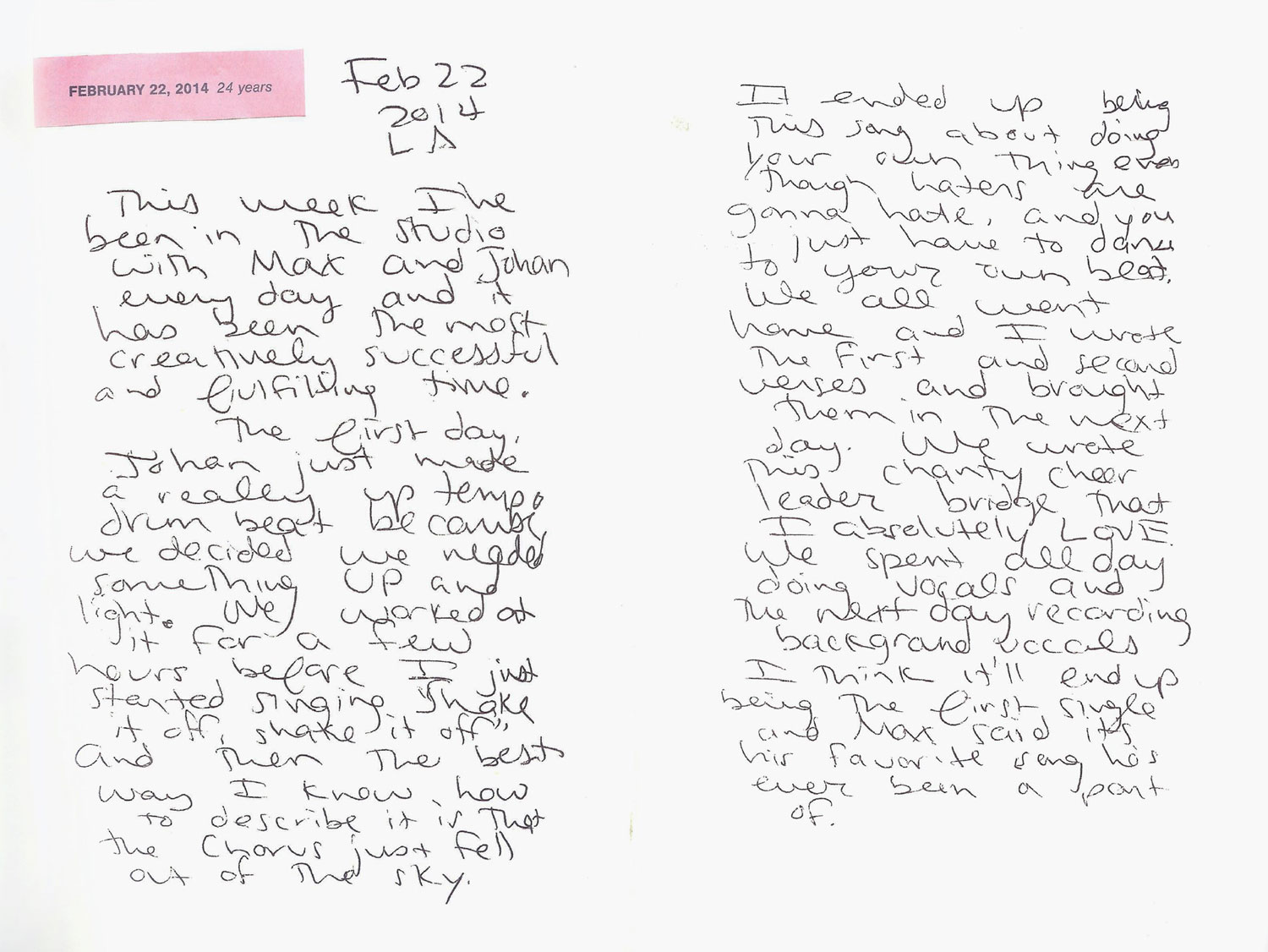
Eight days later, on February 22, 2014, Swift sat down to reflect on the entire week in her journal: “I just started singing ‘shake it off, shake it off.’ And then the best way I know how to describe it is that the chorus just fell out of the sky. It ended up being this song about doing your own thing even though haters are gonna hate, and you just have to dance to your own beat. I think it’ll end up being the first single and Max said it’s his favorite song he’s ever been a part of.”
Six months later, “Shake It Off” would debut at number one on the Billboard Hot 100.
The Pinnacle Departure
In seven years of her professional career, Taylor Swift had released four albums, sold more than 20 million records in the United States alone, and won the Grammy for Album of the Year at 20, at the time the youngest artist ever to do so. She had crossed from country to pop radio without abandoning either. She had headlined arenas on multiple continents, fuelled by a fanbase that called themselves Swifties. No country artist had done what she had done at the speed she had done it. Not Dolly, Shania, Faith, Tim, or Garth.
On her 2012 album Red, the most commercially successful album to carry a country label in a decade, Swift worked with Max Martin and Shellback on three songs: “We Are Never Ever Getting Back Together,” “I Knew You Were Trouble,” and “22.” On a 16-track album that ranged across country, folk, and rock, those three were pure pop. Swift would later call “I Knew You Were Trouble” “a signal flare.” The other two were pointing in the same direction.
“At a certain point, if you chase two rabbits, you lose them both,” said Swift.
The numbers told a different love story. On the Country Airplay chart, Taylor Swift and Fearless had each sent five singles into the top 10. Speak Now sent four. Red sent none to number one. “We Are Never Ever Getting Back Together” peaked at number 13, the first Swift country single ever to miss the top 10.
On November 6, 2013, Swift stood on the stage at Bridgestone Arena in Nashville to accept the Country Music Association’s Pinnacle Award, a rare honour recognizing a country artist who had “undeniably redefined the pinnacle of success in the genre.” It had been given once before, to Garth Brooks in 2005. The list was two names long.
Faith Hill, Tim McGraw, Brad Paisley, Rascal Flatts, George Strait, and Keith Urban appeared on stage to present it. McGraw spoke first. “It seems like only yesterday that Faith and I asked a very talented 17-year-old young lady with a hit called ‘Tim McGraw’ to be our opening act,” he said. “We’ve all seen her grow up into a beautiful woman and a truly global superstar.”
Swift took the stage and told the room how it had all started. Scott Borchetta, the founder of Big Machine Records and the man who signed Swift at 15, had called her at 16. Could she be on the road in two days to open for Rascal Flatts? She started screaming. Then came Brad Paisley, nine months on the road, sitting on a speaker by the side of the stage watching him every night. Then Keith Urban. Then Tim and Faith.
“You’re not only rewarding my hard work and exhaustion,” she said. “You’re rewarding the hard work and exhaustion of my family and my label and anyone who works with me and most of all the fans who filled stadiums.”
Country music had given her its highest honour. Where was she to go at 23?
What the room did not know was that Swift had already spent the better part of a year in the studio recording her next album, one that would be “blatant pop music.”
Swift was direct about which rabbit she decided to chase. By February 2014 she turned 24 and was inside Conway Studios. “Shake It Off” was one of the last two songs produced for 1989. “Blank Space” was the other. By the time she wrote it, the album had already been largely built.
When the album was complete, she played it for Borchetta. He pushed back. “This is extraordinary,” Borchetta told her. “It’s the best album you’ve ever done. Can you just give me three country songs?”
Swift’s answer: “Love you, mean it. But this is how it’s going to be.”
When she told Borchetta the album was pop, he went, in her words, through “all the stages of grief, the pleading, the denial.” One question stood out. “Can we put a fiddle on ‘Shake It Off?'”
She said no.
In March 2014, Swift cut her hair and moved from Nashville to New York City. From the soothing country to the energetic city.
The album was nearly complete. In June, Mark Romanek, the director behind Johnny Cash’s “Hurt” and Jay-Z’s “99 Problems,” directed the music video for “Shake It Off” over three days in Los Angeles.
The concept was Swift’s. She told Romanek she wanted “a paean to the awkward ones” and to be “the individualist dork in the midst of these established genres.” “It takes a long time to figure out who you are and where you fit in in the world,” Swift told Rolling Stone. The video depicted Swift attempting and failing at ballet, breakdancing, twerking, and cheerleading alongside professional dancers. She was not trying to fit in to any mold. That was the point.
In June, Borchetta set the stage and the expectations, stating, “Fans are going to love it. Will country stations play a complete pop song just because it’s her? No.”
The week leading up to August 18, Swift seeded her almost 11 million Instagram followers with cryptic photos, teasing the live stream date without naming it. On the Friday before, she hired a skywriting plane to spell out “TAYLOR SWIFT 8/18 5PM YAHOO” above New York City. The Swifties documented everything.
When “Shake It Off” dropped that month, country radio programmers were unsurprised. One programmer, quoted in Billboard, said Swift’s last true Nashville track was 2010’s “Mean,” a song about a music critic who wrote a scathing review of her Grammy performance with Stevie Nicks. Fletcher Hayes of WWQM Madison was sharper: “Did Linda Ronstadt fans want to hear her Nelson Riddle Orchestra jazz albums on top 40?” George King of Townsquare Media said his adult top 40 station would play “Shake It Off” but added, “I’m not looking at it as a country song. It’s her prerogative.”
“Mean” was written for one critic. “Shake It Off” was written for all of them.
By August 2014 she was pop.
The Announcement
On Monday, August 18, 2014, at 5:30 p.m. Eastern, Swift appeared on a worldwide live stream held on Yahoo and sponsored by ABC News. She was ready to present her new identity and music.
“I spent two years making 1989,” she said. “Two years gives you enough time to grow and change and let things inspire you. I was listening to a lot of late ’80s pop music and how bold those songs were and how that time period was a time of limitless possibilities.”
She named the album after the year she was born. She announced that “Shake It Off” was the lead single. The music video premiered simultaneously.
Within minutes, Big Machine released the song to radio stations across the U.S. Downloads went live the next day.
“Shake It Off” debuted at number one on the Billboard Hot 100 for the week ending September 6, 2014. It was the 22nd song in the chart’s history to debut at number one and was Swift’s 60th Hot 100 hit. The only female act with more was Aretha Franklin, with 73.
Swift performed “Shake It Off” live on television for the first time at the MTV Video Music Awards on Sunday, August 24, 2014.
The reception to “Shake It Off” was mixed on release. Billboard critic Jason Lipshutz, writing the week the single dropped, called the transition “brazen” and “jarring” but landed on a verdict of success: “with ‘Shake It Off,’ Swift proves why she belongs among pop’s queen bees: As you may have guessed, the song sounds like a surefire hit. Swift will probably catch some flak for moving away from her bedrock sound, but she has never colored inside the lines. And, as ‘Shake It Off’ shows, she can handle the criticism.”
Jem Aswad’s Billboard album review, published November 1, made the framing sharper. “If her new single, ‘Shake It Off,’ was the official breakup letter, 1989 is the coming-out party, because it makes Red sound like Reba McEntire.”
Randall Roberts of the Los Angeles Times praised the sound as “perfect pop confection” but called the lyrics shallow and politically tone-deaf. The Guardian’s Molly Fitzpatrick said the lyrics fell short of Swift’s songwriting abilities. Rolling Stone‘s Rob Sheffield placed 1989 inside an ’80s tradition of pop stars following a sprawling epic with a deliberate quick-change experiment, comparing Swift’s move to Prince after Purple Rain. NME‘s Matthew Horton wrote that Swift’s aim was “fixed squarely on the pop throne recently vacated by the AWOL Rihanna.”
The music video drew 42 million YouTube views in its first week. By the end of the premiere night, rapper Earl Sweatshirt had already posted on Twitter that the video was “inherently offensive and ultimately harmful” and was “perpetuating black stereotypes.” He stated he had not watched it and did not need to. Romanek responded that Sweatshirt’s not having seen the video “invalidates his observations from the get-go,” and called the piece “a massively inclusive” and “satirical” work. Swift did not respond. She decided to shake it off.
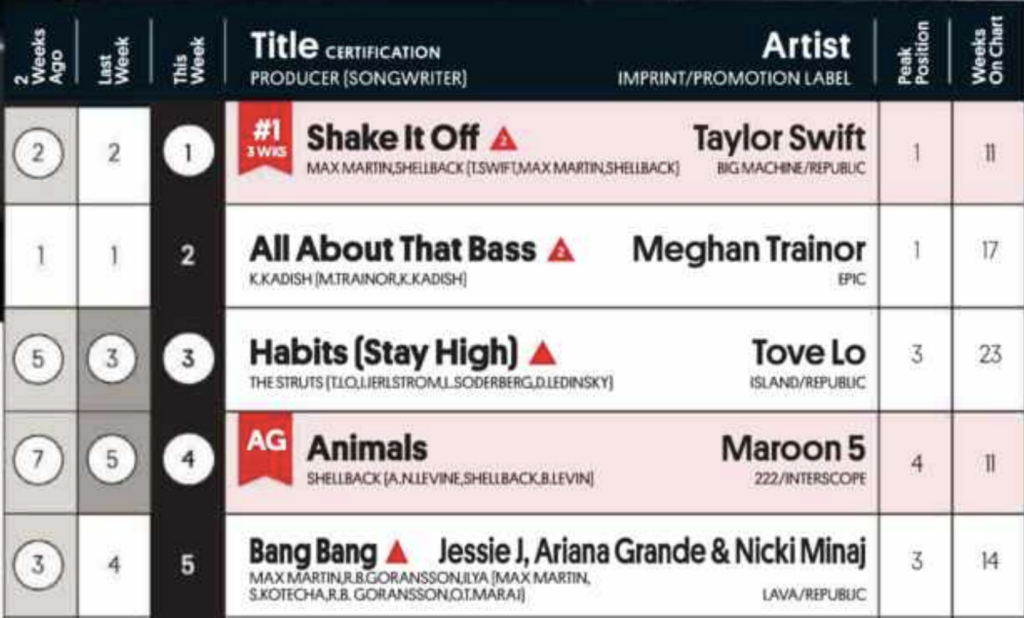
“Shake It Off” was not released to Spotify until September 18, 2014, a full month after its YouTube and iTunes launch. When it finally arrived, it leapt from number 21 to number one on the On-Demand Songs chart with a 122 percent jump to 4.3 million U.S. streams in one week.
That fall, Swift hosted the 1989 Secret Sessions. She had spent months monitoring social media, hand-selecting exactly 89 Swifties. She invited them to her homes in Los Angeles, Nashville, New York, and Rhode Island, and to her hotel room in London. They signed NDAs and their phones were confiscated at the door. Swift played the album from her iPhone, explaining each song personally. She baked the cookies herself. As Swift later said, they went back out into the world and kept their promises. They didn’t talk about lyrics. They didn’t spoil the secret for other fans.
The song spent two consecutive weeks at number one on the Hot 100, then dropped to number two, where it held for eight straight weeks. It returned to number one in its tenth charting week, and spent one more week at the top when 1989 was released on October 27, 2014. The song had four non-consecutive weeks at number one in total.
When 1989 dropped on October 27, it sold 1.28 million copies in its first week. It was the biggest opening week for any album since 2002. Swift became the only artist with three million-selling weeks. “Shake It Off” returned to number one on the Hot 100 the same week.
By December 2014, Billboard named Swift Woman of the Year and gave her the cover.
Reflecting on the album that “Shake It Off” had introduced, Swift was direct. “This album is a rebirth for me.”
Lyrically: Shake It Off by Taylor Swift
“Over the last few years I’ve learned a very important lesson,” Swift said in her release-day press statement. “We cannot control what people say about us, but we can control how we react to it. We can let it get to us, make us bitter, even drive us insane, or we can shake it off.”
Swift had written “Mean” in 2010. That song, from Speak Now, had been directed at a critic from what she herself called “a victimized” perspective. The line of thinking was: why are you picking on me? Why can I never do anything right in your eyes?
Four years later, she picked the topic back up. In an interview with NPR‘s Melissa Block in October 2014, Swift framed “Shake It Off” as the proactive sequel. “Mean” had been defeat. With “Shake It Off,” she “really wanted to kind of take back the narrative, and have more of a sense of humor about people who kind of get under my skin.”
“Fast-forward a few years and ‘Shake It Off’ is like, ‘You know what? If you’re upset and irritated that I’m just being myself, I’m going to be myself more, and I’m having more fun than you so it doesn’t matter,'” Swift told Billboard in December 2014.
Shellback would later recall that Swift wrote the lyrics in 30 minutes.
The first verse drops straight into what “people say”:
I stay out too late
Got nothing in my brain
That’s what people say, mm-mm
That’s what people say, mm-mm
I go on too many dates
But I can’t make ’em stay
At least that’s what people say, mm-mm
That’s what people say, mm-mm
For Swift, the lines were crafted from her own experiences. The tabloids had spent years documenting her whereabouts, questioning her intelligence, and treating her relationships as a flaw in her character. But Swift wrote the lyrics so anyone can relate to them with their own version of “what people say.” The girl being told she is too much. The person being told they couldn’t make it work. The middle schooler who doesn’t fit in.
The song is about ignoring the noise. But the lyrics keep quoting the noise. “That’s what people say” appears four times in eight lines. The people talking are not absent from the song. They are its foundation and the repetition is the point. Swift is not pretending the noise doesn’t exist. She is acknowledging it, naming it, and then choosing not to be defined by it.
“I’ve had every part of my life dissected — my choices, my actions, my words, my body, my style, my music. When you live your life under that kind of scrutiny, you can either let it break you, or you can get really good at dodging punches. And when one lands, you know how to deal with it. And I guess the way that I deal with it is to shake it off,” Swift told Rolling Stone.
“This song was something I wrote as a coping mechanism for what I deal with. Like, I can’t walk to the grocery store without some element of it being scrutinized. That’s not just my life, that’s everywhere,” said Swift. “Question is, how do you deal with that without getting in fights all the time, becoming bitter? You have to learn how to shake things off. Even now, like after the song’s out, when I feel upset about something sometimes I’ll go and listen to that song and be like, you wrote this, you have to live by it. You have to learn to let things go.”
The answer comes in the next lines:
But I keep cruisin’
Can’t stop, won’t stop movin’
It’s like I got this music in my mind
Sayin’, “It’s gonna be alright”
The music in her mind is louder than everything else. For Swift it is literal. For most people, it’s the internal voice that keeps them going. Their sense of self. Their values. Their purpose. The thing that stays constant when everything outside is loud and critical. Regardless of the noise, keep going.
‘Cause the players gonna play, play, play, play, play
And the haters gonna hate, hate, hate, hate, hate
Baby, I’m just gonna shake, shake, shake, shake, shake
I shake it off, I shake it off (whoo-hoo-hoo)
Heartbreakers gonna break, break, break, break, break
And the fakers gonna fake, fake, fake, fake, fake
Baby, I’m just gonna shake, shake, shake, shake, shake
I shake it off, I shake it off (whoo-hoo-hoo)
No matter who is coming at you, whether it be the players, haters, heartbreakers, or fakers, the answer is the same. Shake it off. “You can shake really anything,” Swift said. “There’s so many things. Hair, hands, hips, ankles.” There are many ways to let things go and find the energy to keep moving.
The song shifts from all the chatter to a reinvention. Confident. Quick. In control of the direction.
I never miss a beat
I’m lightnin’ on my feet
And that’s what they don’t see, mm-mm
That’s what they don’t see, mm-mm
I’m dancin’ on my own (dancin’ on my own)
I make the moves up as I go (moves up as I go)
And that’s what they don’t know, mm-mm
That’s what they don’t know, mm-mm
The first verse quoted what they say. The second verse is what they don’t see and don’t know. While others talk, the decision to move on is already made.
The chorus repeats as a reminder to be strong while others continue with the noise. Then the song breaks form entirely to spoken word.
Hey, hey, hey
Just think, while you’ve been gettin’ down and out about the liars
And the dirty, dirty cheats of the world
You could’ve been gettin’ down to this sick beat
My ex-man brought his new girlfriend
She’s like, “Oh my God!” but I’m just gonna shake
And to the fella over there with the hella good hair
Won’t you come on over, baby? We can shake, shake, shake (yeah)
Yeah, oh, oh
The “Hey, hey, hey” is an interruption within the flow of the song and is where Swift is speaking directly to the listener. The “you” in the bridge is not Swift’s critics. It is anyone who has been getting down and out, those feeling defeated by the noise from liars and the cheats, “You could’ve been getting down to this sick beat.” This is the shift in perspective. While you were suffering and letting them take up space in your head, you could have been dancing to “this sick beat,” which is the “music in my mind.”
The two parts are connected. The first says “stop suffering.” The second shows what that looks like in practice.
The final chorus repeats and loops back to the core message, but with one notable addition. Swift sings “I shake it off (you got to).” What had been personal becomes instructive. The song is not just what Swift does. It is what she is empowering the listener to do.
The song opens with “that’s what people say.” It closes with “you got to.” What begins as something imposed from the outside ends as something chosen from within. The song does not tell you the noise will stop. It tells you that you are the one who decides what it does to you.
“I’ve had people say things to me like, ‘When my mom died, I listened to this every single day to help me get out of bed,'” Swift told Billboard. “And then I’ve had people say, ‘I danced to this drunk at a wedding reception.'”
“Shake it off” can mean survive your grief or celebrate your joy. The song meets you where you are. It was built that way.
“The message in the song is a problem I think we all deal with and an issue we deal with on a daily basis. We don’t live just in a celebrity takedown culture; we live in a takedown culture. People will find anything about you and twist it to where it’s weird or wrong or annoying or strange or bad. You have to not only live your life in spite of people who don’t understand you, you have to have more fun than they do,” said Swift.
“It’s not just me who deals with gossip. It’s not just me who deals with, kind of, how human beings treat each other on a day-to-day basis,” said Swift. “It’s happening to everyone everywhere, so I figured why not make a song that is about dealing with that, letting go of it, and comes from a place of strength, and also makes people want to dance.”
At the 57th Annual Grammy Awards in February 2015, “Shake It Off” was nominated for Record of the Year, Song of the Year, and Best Pop Solo Performance. It did not win. Swift shook it off. Max Martin, who built the beat on a Conway Studios wooden floor, won Producer of the Year.



What does this song mean to you?
Share your thoughts on this song.