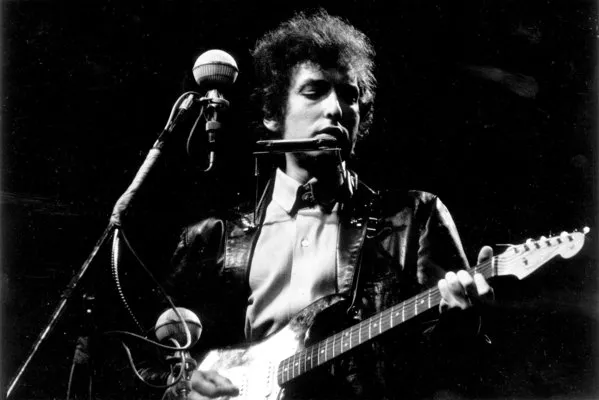
Mid-1965. New York City. The sixth floor of 799 Seventh Avenue, Columbia Records headquarters. Columbia is in the middle of a move. The label's parent company, CBS, has finished its new building on Sixth Avenue and the word has come down from above: no clutter. Shaun Considine, Columbia Records' coordinator of new releases, is doing a final sweep of what remains of the A&R department. He sees a stack of records and demos in a junk pile and goes through them. He almost missed it. Among them is a test pressing of a song recently recorded at Studio A. It's six minutes long. Columbia's sales and marketing team had already sent a memo pulling it from release because of its length. Radio typically plays three-minute singles. The song is Bob Dylan's "Like a Rolling Stone" and it was left on its own. Almost completely unknown. Just like its author once was.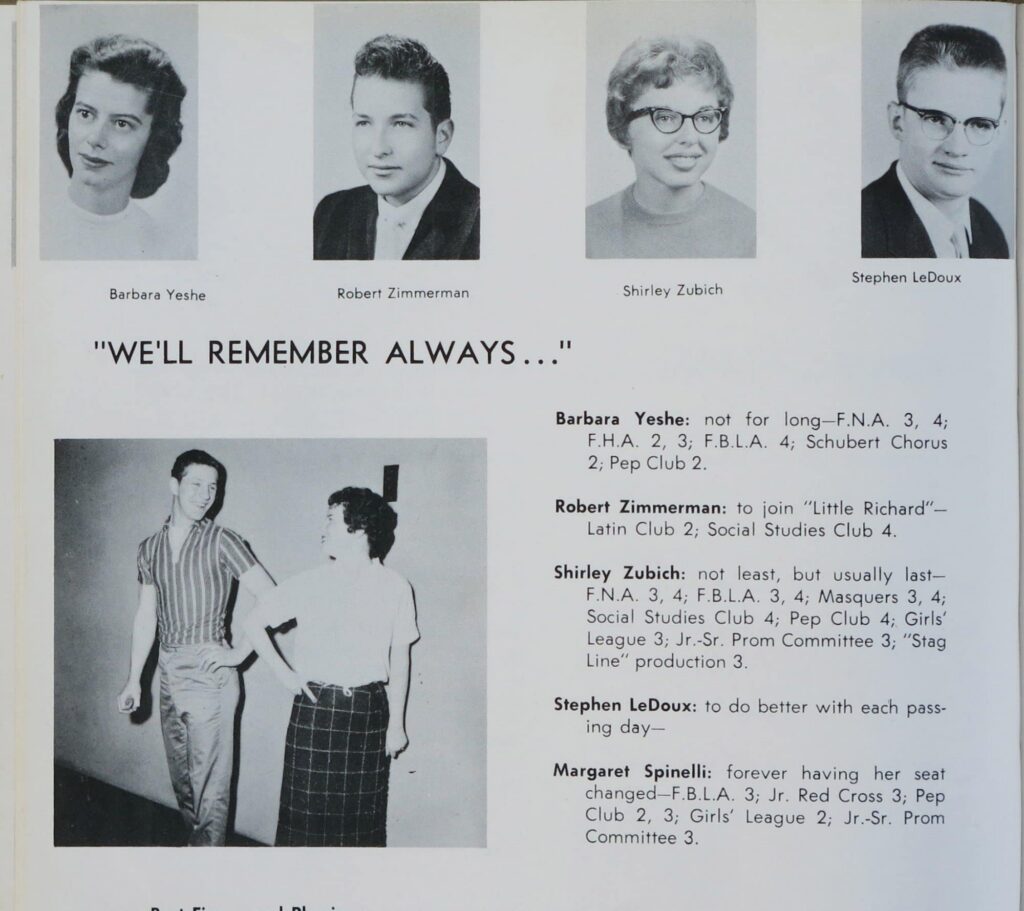 Asked by his high-school yearbook to name his ambition, Dylan wrote the words: "To join Little Richard." "It was the sound that got to me. It wasn't who it was, it was the sound of it," said Dylan. "The first time I heard rock and roll radio, I felt it was pretty similar to the country music which I've been listening to. I formed a couple of groups growing up and we rehearsed and played and where we could play, there wasn't much opportunity to really break out of that area." "I really can't say the girls took a liking to me or not from playing around town. The first girl that ever took a liking to me, her name was Gloria Story. Gloria Story. I mean, that was her real name. The second girlfriend was named Echo. That's pretty strange. I've never met anybody named Echo. I serenaded her underneath the ladder that went up to her window. Both these girls, by the way, brought out the poet in me," said Dylan. In September 1959, aged 18, he enrolled at the University of Minnesota on a scholarship. This lasted six months. "I didn't agree," said Dylan. "I flunked out. I read a lot but not the required readings."
 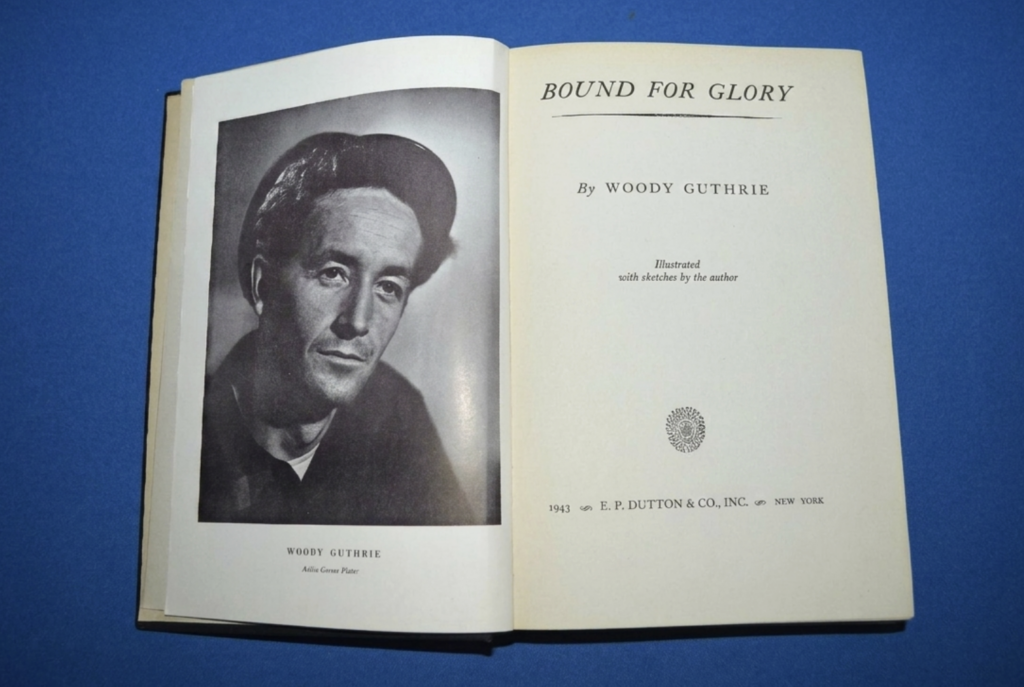 After discovering Woody Guthrie's autobiography, Bound for Glory, Dylan became consumed by everything Guthrie represented. "Woody Guthrie had a particular sound, and besides that, he said something to go along with his sound. That was highly unusual to my ears," said Dylan. "He was a radical. His songs had a radical slant. That's what I wanna sing. I'm gonna sing that. You could listen to his songs and learn how to live." "The songs of Woody Guthrie ruled my universe," Dylan wrote. "But before that, Hank Williams had been my favorite songwriter, though I thought of him as a singer, first." His close friend David Whittaker recalled him listening over and over again, day after day, to a recording of Guthrie's half-hour epic ballad "Tom Joad." He spent months becoming Bob Dylan, performing at The Scholar coffeehouse in Minneapolis and the Purple Onion in St. Paul. "Why it became that particular name, I really can't say. The name just popped in my head one day," said Dylan. "I mean, I just don't feel like I had a past and I couldn't relate to anything other than what I was doing at the present time." The name was not taken from the Welsh poet Dylan Thomas, as was widely assumed. "It's a name of my family," he explained. "It's my uncle's family. It's not my father's name. It's the name of my mother's side of the family and it's spelled D-i-l-l-o-n. I changed it from there." Woody Guthrie had been confined to Greystone Hospital in New Jersey since 1954, dying from Huntington's disease. One night in December 1960, Dylan called. The ward doctor told him Guthrie was too sick to come to the phone. Dylan turned to his friend David Whittaker and said: "I'm going to see him. I'm going to New York right now." "I just got up one morning and left," Dylan said. "I'd spent so much time thinking about it I couldn't think about it anymore. I stood on the highway during a blizzard snowstorm believing in the mercy of the world and headed East, didn't have nothing but my guitar and suitcase. That was my whole world." In January 1961, he climbed into a four-door Pontiac with a fellow folk singer named Fred Underhill and headed east. On January 24, 1961, the car came to a full stop on the other side of the George Washington Bridge. He was nineteen years old. "The big car came to a full stop on the other side and let me off," Dylan wrote. "I slammed the door shut behind me, waved good-bye, stepped out onto the hard snow. The biting wind hit me in the face. At last I was here, in New York City, a city like a web too intricate to understand and I wasn't going to try." He walked forty blocks south to Greenwich Village. Within hours he was at Cafe Wha? on MacDougal Street, passing the basket for coins. He told the crowd: "I been travellin' around the country, followin' in Woody Guthrie's footsteps." "I was there to find singers, the ones I'd heard on record — Dave Van Ronk, Peggy Seeger, Ed McCurdy, Brownie McGhee and Sonny Terry, Josh White, The New Lost City Ramblers, Reverend Gary Davis and a bunch of others — most of all to find Woody Guthrie," Dylan wrote. "New York City, the city that would come to shape my destiny. Modern Gomorrah." He eventually found Guthrie not at Greystone Park Hospital, where he was confined during the week, but at the home of Bob and Sidsel Gleason in East Orange, New Jersey. Every Sunday, Bob Gleason would drive to the hospital, sign Guthrie out, and bring him home. "We spend the day listening to music and reading his mail, making tapes," Sidsel Gleason wrote in a letter from 1960. "We try always to have something planned." The folk scene came through the Gleasons' apartment regularly. Pete Seeger, the folk singer, activist and co-founder of the Newport Folk Festival, was among those who passed through. Dylan had found his way there after travelling to the Guthrie family home in Coney Island, Brooklyn. Eleven-year-old Nora Guthrie answered the door. "He looked kind of dusty," she recalled. "He said, 'I'm here to see Woody Guthrie.' I said, 'He's not home,' and I closed the door and ran back to the TV." Eventually, thirteen-year-old Arlo let him in. "I thought he was kinda cool," Arlo said later. "I could tell by his boots he wasn't coming by to sell something." Dylan gave Arlo a harmonica lesson. The babysitter pointed him toward New Jersey. On Sunday, January 29, 1961, five days after arriving in New York, Dylan arrived at the Gleasons' apartment, where the door was always open to the folk community. Cisco Houston, a fellow folk singer and friend of Guthrie's, was there, chatting about his own illness. Ramblin' Jack Elliott was trying to cheer proceedings up. It was, by all accounts, a somewhat dismal afternoon. Dylan sat quietly on the floor by the couch where Guthrie lay, frail and palsied. When he finally sang a few songs, the old master was impressed. Guthrie had one thing to say after Dylan left. "He's a talented boy," one of those present recalled Guthrie saying. "Gonna go far." Dylan sent his friends back in Minneapolis a postcard. "I know him and met him and saw him and sang to him. I know Woody — Goddamn." Two weeks later, Dylan wrote "Song to Woody." The original manuscript, a sheet of yellow legal paper in Dylan's own hand, reads: "Written by Bob Dylan in Mills Bar on Bleecker St in New York City on 14th day of February for Woody Guthrie." He had written it on Valentine's Day.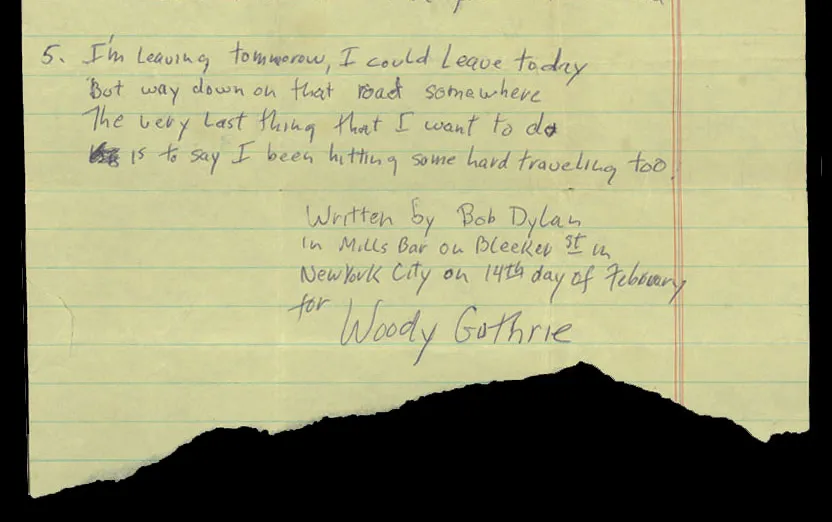
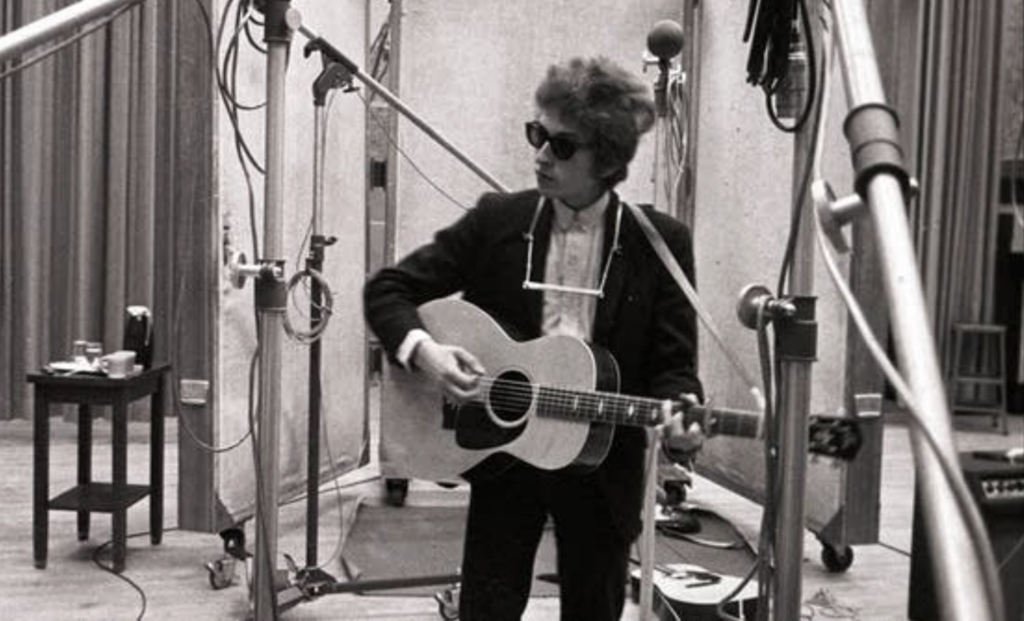
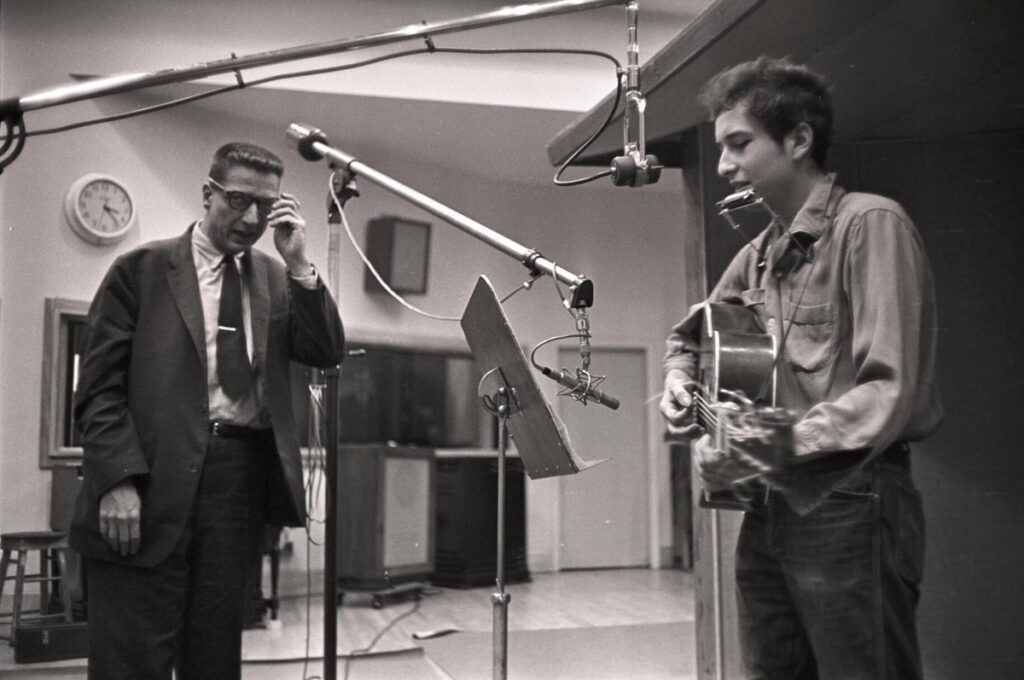 On the day the review appeared, Dylan was at Columbia Records, having been invited by folk singer Carolyn Hester to play harmonica on her debut album. Her album was being produced by John Hammond, Columbia's director of talent, the man who had signed Benny Goodman, Count Basie, Billie Holiday, and Aretha Franklin. "Bob starts in on the harmonica and John turns and looks at him and couldn’t take his eyes off the great character," said Hester. Hammond offered Dylan a contract on the spot and it was signed on October 25th, 1961. "When I met him, the review had just come out of the New York Times of the set I played at Gerde's the previous night. I hadn't seen the article and he asked me right then and there whether I wanted to record for Columbia Records. I thought it was almost unreal," said Dylan. "I didn't tell anybody for a bit because I almost wasn't sure it was happening myself. So, I don't think I really told anybody until I actually went through with the sessions." "When Bob was signed in '61, he really changed the whole image of Columbia Records," said John Hammond. "It was Sing Along with Mitch, it was Johnny Mathis, it was the tried and the true. And suddenly, Bob came along with a revolutionary outlook for a new generation." "He was a guy who was, in his way, a revolutionary. He was talking about race discrimination, which was a taboo subject. He was talking about war profiteers. He was talking about all the things that were no-nos that you couldn't talk about in the pop music business, but he talked about them," recalled Hammond. "And he didn't like the people who controlled the industry in this country, and he figured I was an honest man, so he signed with me." Dylan recorded his self-titled debut album at Studio A in two sessions on November 20 and 22, 1961. The sessions lasted just three hours and cost Columbia $402. The thirteen songs included "Song to Woody," "House of the Risin' Sun," and "Talkin' New York." "When I did make that first record, I used songs which I just knew, but I hadn't really performed them a lot. I wanted to just record stuff that was off the top of my head and see what would happen," said Dylan. "The mystery of being in a recording studio did something to me, and those are the songs that came out," said Dylan. "When I got the disc, I played it, and I was highly disturbed. I just wanted to cross this record out and make another record immediately. I thought I'd recorded the wrong songs, and I'd already written a few of my own maybe that I thought maybe I should have stuck on there. I was way past that record. Or part of me was just saying that I didn't want to record that record anyway, that I just did it. I didn't want to give away anything that was really, you know, dear to me or something." Columbia's own album liner notes described him as "a major new figure in American folk music" who had, in less than a year in New York, "thrown the folk crowd into an uproar."
 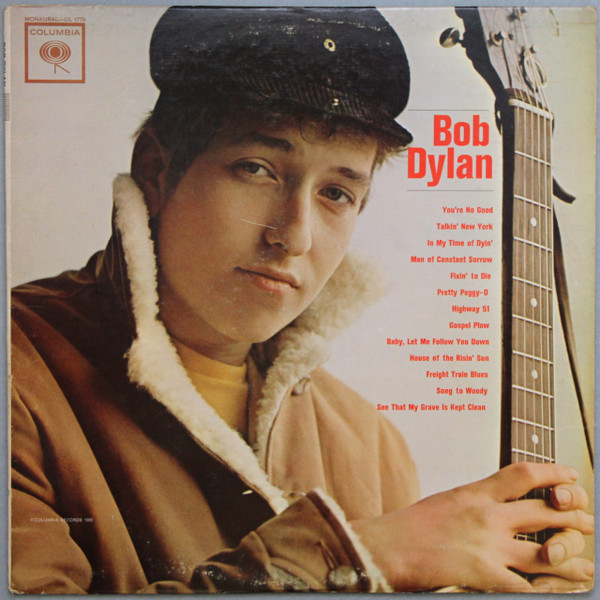 The album was released on March 19, 1962. Hammond's bosses at Columbia were not impressed. The vice president called it "the most horrible thing he'd ever heard in his life." They called Dylan "Hammond's folly" as the album sold less than 5,000 copies. When asked about his future plans, Dylan closed his eyes, shifted his hat, and said: "I would buy a couple of motorcycles, a few air-conditioners and four or five couches." Regardless of sales, Dylan kept writing. "I wrote them anywhere I was. You could write about a subway or a cafe or wherever, you know," said Dylan. "You could write them talking to somebody else, you know, and be scribbling down a song." "I did everything fast. Thought fast, ate fast, talked fast and walked fast. I even sang my songs fast," said Dylan. "I needed to slow my mind down if I was going to be a composer with anything to say." On the afternoon of April 16, 1962, fellow singer-songwriter David Blue was with Dylan when he began putting a new song together. "About five o'clock, Bob pulled out his guitar and a paper and pencil," Blue recalled. "He began to strum some chords and fool with some lines he had written for a new song. Time passed and he asked me to play the guitar for him so he could figure out the rhymes with greater ease. We did this for an hour or so until he was satisfied. The song was 'Blowin' in the Wind.'"
 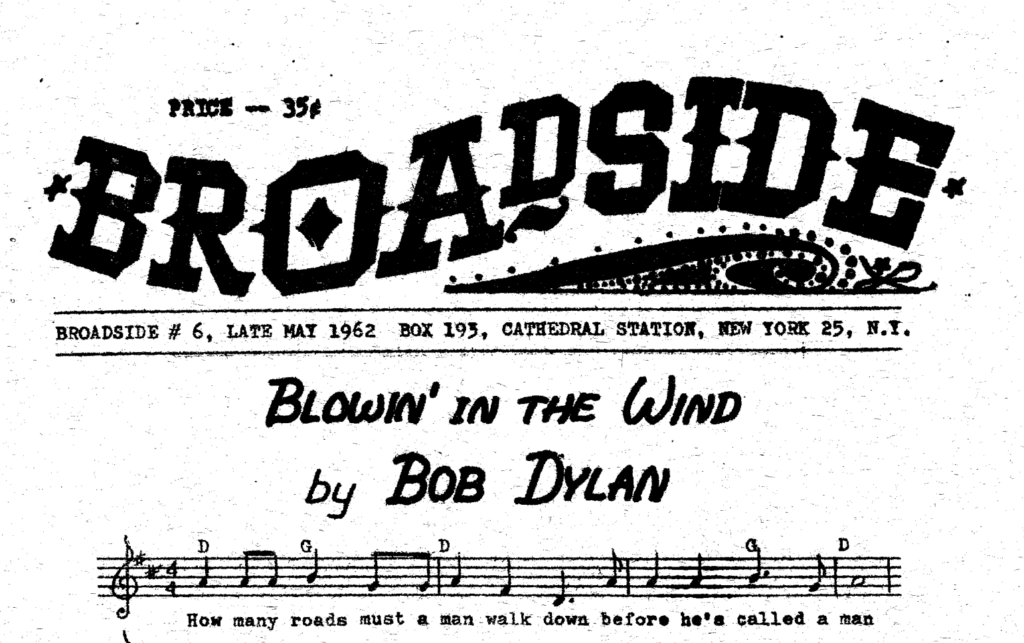 That evening, Dylan and Blue brought it to Gerde's Folk City, where Gil Turner, a folk singer and one of the founding editors of Broadside magazine, was hosting the Monday night hootenanny. They fought their way through the crowd and down to the basement to wait. When Turner came downstairs on a break, Dylan caught his eye. "I got a song you should hear, man," Dylan said. He sang it for Turner right there in the basement. "Bob sang it out with great passion," Blue recalled. "When he finished there was silence all around. Gil Turner was stunned." Turner learned the chords on the spot. "I've got to do that song myself," he told Dylan. "Now." He went upstairs, taped the words to the mike stand, and performed it that same night to the full crowd. "Ladies and gentlemen," he told the audience, "I'd like to sing a new song by one of our great songwriters. It's hot off the pencil and here it goes." When he finished, the entire audience stood and cheered. Dylan stood at the back of the room watching. "Bob was leaning against the bar near the back, smiling and laughing," Blue remembered. The song had only two verses. Within days, Dylan added a third. He also went back in Studio A and began work on his second album. "I didn't really know if that song was good or bad. It just felt right," Dylan said. "I needed to sing it in that language, which is a language that I hadn't heard before, but I didn't really know if it had any anthemic quality or anything." The following month, "Blowin' in the Wind" appeared in the sixth issue of Broadside. "'Blowin’ In The Wind' - for which an alternative title might be 'How Many Roads' - is the third song by Bob Dylan which we have published. Only 20 years old, some consider him to be the nearest composer we have had to Woody Guthrie in recent years," Broadside reported. On August 9, Dylan legally changed his name from Robert Allen Zimmerman to Bob Dylan. When a journalist later asked him to prove it, he reached for his draft card. "Dig my draft card, man," he said. "Bob Dylan." Dylan had a growing reputation that caught the attention of Albert Grossman, the co-founder of the Newport Folk Festival and the person responsible for bringing together the folk band Peter, Paul and Mary. He spent months convincing Dylan he needed stronger representation. On August 20, 1962, Dylan signed a management contract with Grossman. "He was kind of like a Colonel Tom Parker figure, all immaculately dressed every time you see him. You could smell him coming," said Dylan. Colonel Tom Parker was Elvis Presley's manager, famous for his tight grip on every aspect of Presley's career. In December 1962, Columbia released a single from the sessions. It was not an acoustic folk record but an electric rock and roll track called "Mixed-Up Confusion," reportedly written in a cab on the way to the studio. Cash Box reviewed it in February 1963 and described "snappy keyboard and percussions," calling it "a sparkling folk-blues romp." It was Hammond who had put the whole thing together, assembling jazz musicians rather than rock players. It failed to chart and was quickly pulled. Dylan later dismissed it: "I didn't arrange the session. It wasn't my idea." On May 27, 1963, The Freewheelin' Bob Dylan was released. It contained "Blowin' in the Wind," "Don't Think Twice It's Alright," and "A Hard Rain's A-Gonna Fall." Grossman immediately brought "Blowin' in the Wind" to Peter, Paul and Mary. When their version was released as a single in June 1963, it sold 300,000 copies in its first week and reached number 2 on the Billboard Hot 100. Dylan's name crossed from the folk underground into mainstream America.
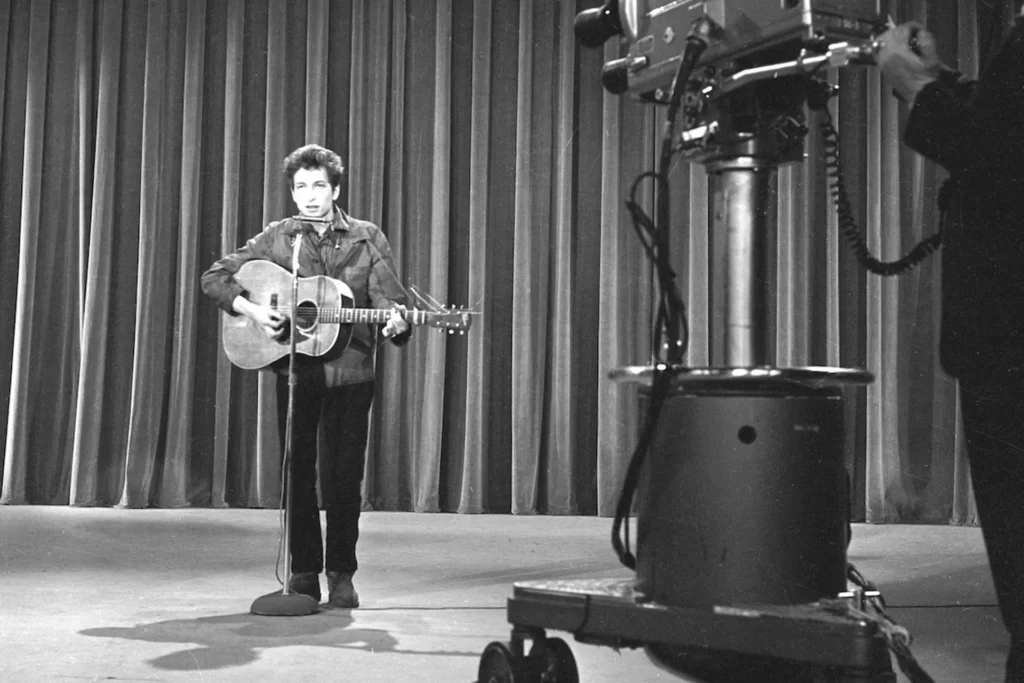 Then came The Ed Sullivan Show. With 21 million viewers every Sunday night, it was the biggest stage in American television. Dylan was booked for May 12, 1963. He chose to perform "Talkin' John Birch Paranoid Blues," a talking blues song about a man consumed by anti-communist paranoia that he ends up reporting himself to the FBI. Grossman had auditioned the song for producer Bob Precht the previous week. Precht approved it. At Saturday's rehearsal, Sullivan approved it too. Then, after the Sunday rehearsal, Stowe Phelps, the editor of program practices for CBS television, ruled the song could not air. Dylan was told it was too controversial and asked to perform a different song. "No," Dylan said. "This is what I want to do. If I can't play my song, I'd rather not appear on the show." He walked off the set. The New York Times reported that a spokesman for CBS said "we have no comment" on the matter. The decision received widespread media attention for days, helping to establish Dylan's reputation as an uncompromising artist.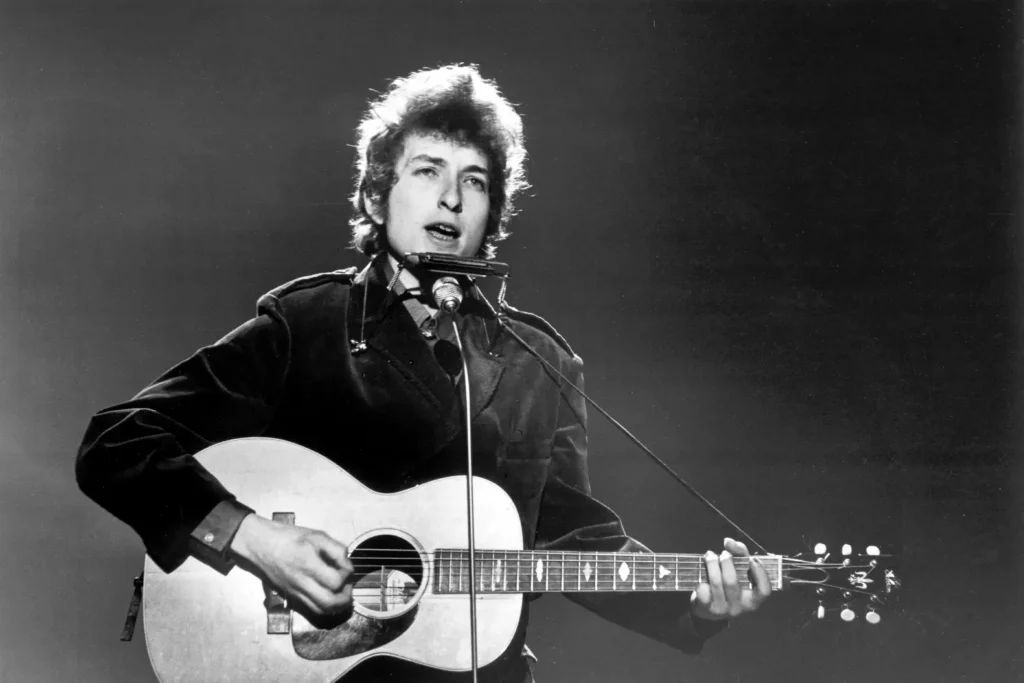
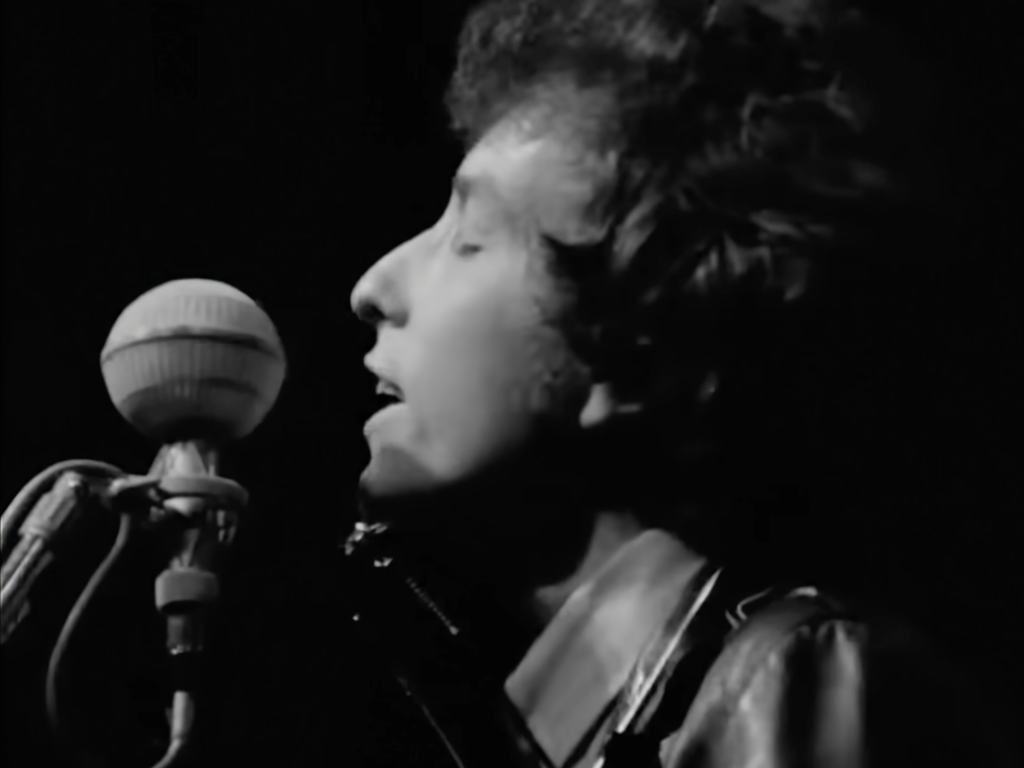
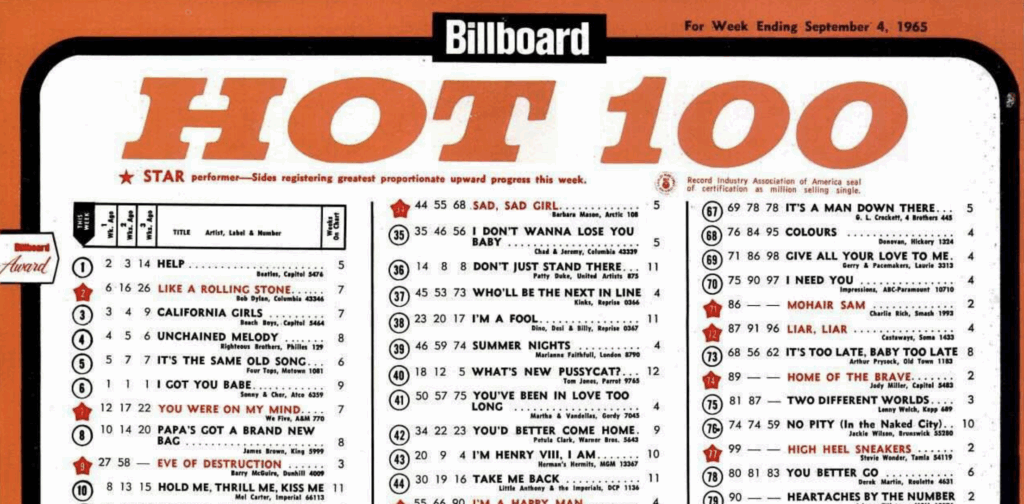 Within the first week, the Cash Box Radio Active Chart showed "Like a Rolling Stone" being added by 33% of surveyed stations, placing it alongside the Four Tops, the Beach Boys, James Brown, and the Miracles. A Los Angeles DJ called it "the hottest single in town." KHJ's Robert W. Morgan told his audience that Highway 61 Revisited was his favourite record, adding: "and I might dig it even more if I could understand it." By September, music publisher Jack Mass was telling Billboard that the demand for folk-rock was so explosive that 48 different artists had recorded cover versions of Dylan songs in a single month. Seven of his songs were simultaneously on the charts. "In all my years as a publisher, I've never seen such activity for one writer. I've got people calling me for his material!" Highway 61 Revisited was reviewed by Billboard with a single word: "A blockbuster." Cash Box described his influence as spreading "his highly personal musical gospel across the length and breadth of the land." "I've never been that kind of performer that wants to be one of them, you know, like one of the crowd. I don't try to endear myself that way. Now, do performers look for applause? Yeah, yes and no. It really depends what kind of performer you are," said Dylan. "You know, you leave somebody in a kind of in a spellbound way, and I don't know. It's, there's a lot of things going on when there's a performer on stage and there's an audience out there." Three years and three months earlier, Dylan was a complete unknown. In April 1962, Billboard had written: "Dylan, when he finds his own style, could win a big following."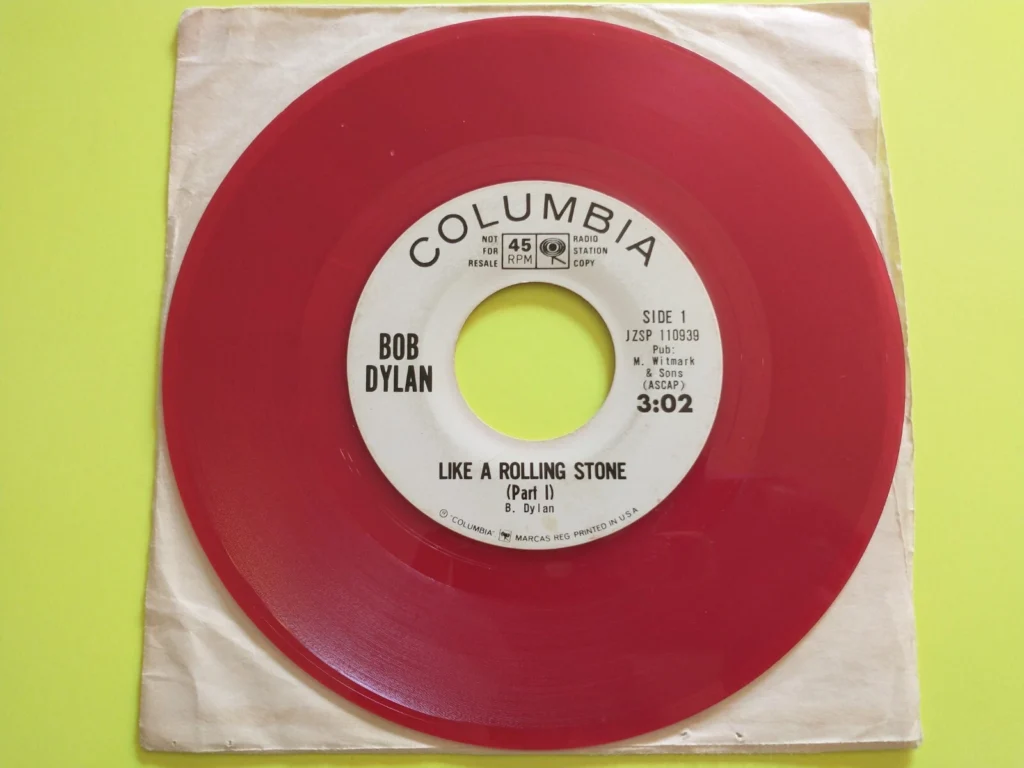
 The song has never been confirmed as being about any one person but is believed to have been inspired by the life of Edie Sedgwick, one of "Andy Warhol's Superstars." Sedgwick arrived in New York in 1964 with a trust fund and became the undisputed "It Girl" by spring 1965. Sedgwick starred in his underground films, including Poor Little Rich Girl. That August, Vogue featured her as one of the city's "Youthquakers." She was at the peak of her fame when "Like a Rolling Stone" was recorded. Within two years, she would spiral into drug addiction and fall out publicly with Warhol. Dylan watched all of it. The song tells the story of a person's fall from prestige and what comes after.
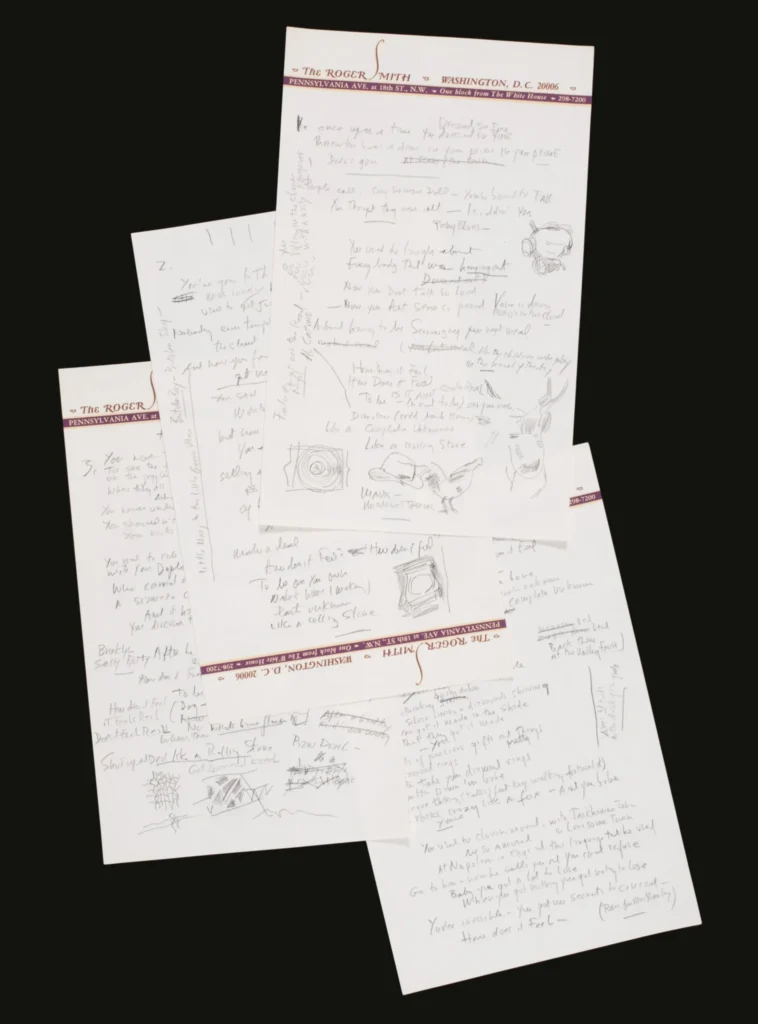 Bob Dylan's handwritten lyrics for "Like a Rolling Stone" sold at a Sotheby's auction in 2014 for $2 million. Sotheby's called it "the only known surviving draft of the final lyrics for this transformative rock anthem." The near-final draft included doodles and discarded rhymes, including "Dry vermouth, you'll tell the truth." The line "like a complete unknown" sits beside another discarded note in the margin: "Al Capone." In 2004, Rolling Stone magazine named "Like a Rolling Stone" the greatest rock and roll song of all time. Dylan has since been inducted into the Songwriters Hall of Fame and the Rock and Roll Hall of Fame, and in 2016 he accepted the Nobel Prize for Literature in Stockholm, where he said, "I don't have to know what a song means. I've written all kinds of things into my songs. And I'm not going to worry about it — what it all means." The song landed differently on different people. "When I heard 'Like a Rolling Stone,' I wanted to quit the music business, because I felt: if this wins and it does what it's supposed to do, I don't need to do anything else," said Frank Zappa. Paul McCartney said it "seemed to go on and on forever. It was just beautiful. He showed all of us that it was possible to go a little further." Bruce Springsteen described the opening snare shot as the sound of someone who "kicked open the door to your mind." Dylan needed none of the accolades to know what he had made. "'Rolling Stone' is the best song I wrote," he said. "I boiled it down, but it's all there."
No Direction Home
Robert Allen Zimmerman was born on May 24, 1941, in Duluth, Minnesota, the elder son of Abraham Zimmerman, an appliance dealer, and his wife Beatrice. They called him Bobby. When he was six, the family relocated 75 miles north to Hibbing, a small mining town where his father's brothers had already settled. Hibbing had once been somewhere. The Hull-Rust iron ore mine had made it one of the wealthiest communities in the country. By the time the Zimmermans arrived, the ore was mostly gone. What was left behind was a sense that something was happening somewhere else. "It looked like any other town out of the 40s or 50s, just a rural town. It was on the way to nowhere, and you probably couldn't find it on a map," Dylan recalled. "Maybe three blocks one way and maybe three blocks the other way, and that was like a main street where all the department stores were, the drugstores. That's about it." "When I was about 10, I started playing the guitar. I found a guitar in the house that my father bought," said Dylan. "I found something else in there, this kind of mystical overtones. There was a great big mahogany radio. It had a 78 turntable when you opened up the top. And I opened it up one day, and there was a record on there, a country record, that's a song called 'Drifting Too Far From Shore.' The sound of the record made me feel like I was somebody else. And that I was maybe not even born to the right parents or something." He was drawn to Hank Williams, Muddy Waters, and Little Richard. He was drawn to anything that sounded like it came from somewhere else. He ran away from home when he was 10, 12, 13, 15, 15½, 17, and 18. He was caught and brought back all but once. Asked by his high-school yearbook to name his ambition, Dylan wrote the words: "To join Little Richard." "It was the sound that got to me. It wasn't who it was, it was the sound of it," said Dylan. "The first time I heard rock and roll radio, I felt it was pretty similar to the country music which I've been listening to. I formed a couple of groups growing up and we rehearsed and played and where we could play, there wasn't much opportunity to really break out of that area." "I really can't say the girls took a liking to me or not from playing around town. The first girl that ever took a liking to me, her name was Gloria Story. Gloria Story. I mean, that was her real name. The second girlfriend was named Echo. That's pretty strange. I've never met anybody named Echo. I serenaded her underneath the ladder that went up to her window. Both these girls, by the way, brought out the poet in me," said Dylan. In September 1959, aged 18, he enrolled at the University of Minnesota on a scholarship. This lasted six months. "I didn't agree," said Dylan. "I flunked out. I read a lot but not the required readings." After discovering Woody Guthrie's autobiography, Bound for Glory, Dylan became consumed by everything Guthrie represented. "Woody Guthrie had a particular sound, and besides that, he said something to go along with his sound. That was highly unusual to my ears," said Dylan. "He was a radical. His songs had a radical slant. That's what I wanna sing. I'm gonna sing that. You could listen to his songs and learn how to live." "The songs of Woody Guthrie ruled my universe," Dylan wrote. "But before that, Hank Williams had been my favorite songwriter, though I thought of him as a singer, first." His close friend David Whittaker recalled him listening over and over again, day after day, to a recording of Guthrie's half-hour epic ballad "Tom Joad." He spent months becoming Bob Dylan, performing at The Scholar coffeehouse in Minneapolis and the Purple Onion in St. Paul. "Why it became that particular name, I really can't say. The name just popped in my head one day," said Dylan. "I mean, I just don't feel like I had a past and I couldn't relate to anything other than what I was doing at the present time." The name was not taken from the Welsh poet Dylan Thomas, as was widely assumed. "It's a name of my family," he explained. "It's my uncle's family. It's not my father's name. It's the name of my mother's side of the family and it's spelled D-i-l-l-o-n. I changed it from there." Woody Guthrie had been confined to Greystone Hospital in New Jersey since 1954, dying from Huntington's disease. One night in December 1960, Dylan called. The ward doctor told him Guthrie was too sick to come to the phone. Dylan turned to his friend David Whittaker and said: "I'm going to see him. I'm going to New York right now." "I just got up one morning and left," Dylan said. "I'd spent so much time thinking about it I couldn't think about it anymore. I stood on the highway during a blizzard snowstorm believing in the mercy of the world and headed East, didn't have nothing but my guitar and suitcase. That was my whole world." In January 1961, he climbed into a four-door Pontiac with a fellow folk singer named Fred Underhill and headed east. On January 24, 1961, the car came to a full stop on the other side of the George Washington Bridge. He was nineteen years old. "The big car came to a full stop on the other side and let me off," Dylan wrote. "I slammed the door shut behind me, waved good-bye, stepped out onto the hard snow. The biting wind hit me in the face. At last I was here, in New York City, a city like a web too intricate to understand and I wasn't going to try." He walked forty blocks south to Greenwich Village. Within hours he was at Cafe Wha? on MacDougal Street, passing the basket for coins. He told the crowd: "I been travellin' around the country, followin' in Woody Guthrie's footsteps." "I was there to find singers, the ones I'd heard on record — Dave Van Ronk, Peggy Seeger, Ed McCurdy, Brownie McGhee and Sonny Terry, Josh White, The New Lost City Ramblers, Reverend Gary Davis and a bunch of others — most of all to find Woody Guthrie," Dylan wrote. "New York City, the city that would come to shape my destiny. Modern Gomorrah." He eventually found Guthrie not at Greystone Park Hospital, where he was confined during the week, but at the home of Bob and Sidsel Gleason in East Orange, New Jersey. Every Sunday, Bob Gleason would drive to the hospital, sign Guthrie out, and bring him home. "We spend the day listening to music and reading his mail, making tapes," Sidsel Gleason wrote in a letter from 1960. "We try always to have something planned." The folk scene came through the Gleasons' apartment regularly. Pete Seeger, the folk singer, activist and co-founder of the Newport Folk Festival, was among those who passed through. Dylan had found his way there after travelling to the Guthrie family home in Coney Island, Brooklyn. Eleven-year-old Nora Guthrie answered the door. "He looked kind of dusty," she recalled. "He said, 'I'm here to see Woody Guthrie.' I said, 'He's not home,' and I closed the door and ran back to the TV." Eventually, thirteen-year-old Arlo let him in. "I thought he was kinda cool," Arlo said later. "I could tell by his boots he wasn't coming by to sell something." Dylan gave Arlo a harmonica lesson. The babysitter pointed him toward New Jersey. On Sunday, January 29, 1961, five days after arriving in New York, Dylan arrived at the Gleasons' apartment, where the door was always open to the folk community. Cisco Houston, a fellow folk singer and friend of Guthrie's, was there, chatting about his own illness. Ramblin' Jack Elliott was trying to cheer proceedings up. It was, by all accounts, a somewhat dismal afternoon. Dylan sat quietly on the floor by the couch where Guthrie lay, frail and palsied. When he finally sang a few songs, the old master was impressed. Guthrie had one thing to say after Dylan left. "He's a talented boy," one of those present recalled Guthrie saying. "Gonna go far." Dylan sent his friends back in Minneapolis a postcard. "I know him and met him and saw him and sang to him. I know Woody — Goddamn." Two weeks later, Dylan wrote "Song to Woody." The original manuscript, a sheet of yellow legal paper in Dylan's own hand, reads: "Written by Bob Dylan in Mills Bar on Bleecker St in New York City on 14th day of February for Woody Guthrie." He had written it on Valentine's Day. Greenwich Village
The Greenwich Village in lower Manhattan that Dylan had arrived in was already the centre of folk music, with singers, acoustic musicians, poets, and activists finding work in over 20 clubs in a five-block area. For months, Dylan absorbed everything the Village had to offer. He couch-surfed, played wherever anyone would let him, and passed around a basket for coins. He played Cafe Wha?, the Gaslight, the Fat Black Pussycat, and Gerde's Folk City. The coffee houses on Bleecker and MacDougal were packed every night with people who believed that songs could change something. Dylan played Guthrie songs, traditional ballads, whatever was needed. "Do you know what Dylan was when he came to the Village?" Liam Clancy, whose Irish folk group the Clancy Brothers had been one of Dylan's own influences, recalled. "He was a teenager, and the only thing I can compare him with was blotting paper. He soaked everything up." On September 29, 1961, Robert Shelton of the New York Times reviewed Dylan performing at Gerde's Folk City. "A bright new face in folk music is appearing at Gerde's Folk City," Shelton wrote. "Although only 20 years old, Bob Dylan is one of the most distinctive stylists to play in a Manhattan cabaret in months." He described Dylan as resembling "a cross between a choir boy and a beatnik," with "a cherubic look and a mop of tousled hair he partly covers with a Huck Finn black corduroy cap. His clothes may need a bit of tailoring." His voice was "anything but pretty." Shelton noted, "When he works his guitar, harmonica or piano and composes new songs faster than he can remember them, there is no doubt that he is bursting at the seams with talent." Shelton closed Dylan's first review with one final line. "Mr. Dylan is vague about his antecedents and birthplace, but it matters less where he has been than where he is going, and that would seem to be straight up." On the day the review appeared, Dylan was at Columbia Records, having been invited by folk singer Carolyn Hester to play harmonica on her debut album. Her album was being produced by John Hammond, Columbia's director of talent, the man who had signed Benny Goodman, Count Basie, Billie Holiday, and Aretha Franklin. "Bob starts in on the harmonica and John turns and looks at him and couldn’t take his eyes off the great character," said Hester. Hammond offered Dylan a contract on the spot and it was signed on October 25th, 1961. "When I met him, the review had just come out of the New York Times of the set I played at Gerde's the previous night. I hadn't seen the article and he asked me right then and there whether I wanted to record for Columbia Records. I thought it was almost unreal," said Dylan. "I didn't tell anybody for a bit because I almost wasn't sure it was happening myself. So, I don't think I really told anybody until I actually went through with the sessions." "When Bob was signed in '61, he really changed the whole image of Columbia Records," said John Hammond. "It was Sing Along with Mitch, it was Johnny Mathis, it was the tried and the true. And suddenly, Bob came along with a revolutionary outlook for a new generation." "He was a guy who was, in his way, a revolutionary. He was talking about race discrimination, which was a taboo subject. He was talking about war profiteers. He was talking about all the things that were no-nos that you couldn't talk about in the pop music business, but he talked about them," recalled Hammond. "And he didn't like the people who controlled the industry in this country, and he figured I was an honest man, so he signed with me." Dylan recorded his self-titled debut album at Studio A in two sessions on November 20 and 22, 1961. The sessions lasted just three hours and cost Columbia $402. The thirteen songs included "Song to Woody," "House of the Risin' Sun," and "Talkin' New York." "When I did make that first record, I used songs which I just knew, but I hadn't really performed them a lot. I wanted to just record stuff that was off the top of my head and see what would happen," said Dylan. "The mystery of being in a recording studio did something to me, and those are the songs that came out," said Dylan. "When I got the disc, I played it, and I was highly disturbed. I just wanted to cross this record out and make another record immediately. I thought I'd recorded the wrong songs, and I'd already written a few of my own maybe that I thought maybe I should have stuck on there. I was way past that record. Or part of me was just saying that I didn't want to record that record anyway, that I just did it. I didn't want to give away anything that was really, you know, dear to me or something." Columbia's own album liner notes described him as "a major new figure in American folk music" who had, in less than a year in New York, "thrown the folk crowd into an uproar." The album was released on March 19, 1962. Hammond's bosses at Columbia were not impressed. The vice president called it "the most horrible thing he'd ever heard in his life." They called Dylan "Hammond's folly" as the album sold less than 5,000 copies. When asked about his future plans, Dylan closed his eyes, shifted his hat, and said: "I would buy a couple of motorcycles, a few air-conditioners and four or five couches." Regardless of sales, Dylan kept writing. "I wrote them anywhere I was. You could write about a subway or a cafe or wherever, you know," said Dylan. "You could write them talking to somebody else, you know, and be scribbling down a song." "I did everything fast. Thought fast, ate fast, talked fast and walked fast. I even sang my songs fast," said Dylan. "I needed to slow my mind down if I was going to be a composer with anything to say." On the afternoon of April 16, 1962, fellow singer-songwriter David Blue was with Dylan when he began putting a new song together. "About five o'clock, Bob pulled out his guitar and a paper and pencil," Blue recalled. "He began to strum some chords and fool with some lines he had written for a new song. Time passed and he asked me to play the guitar for him so he could figure out the rhymes with greater ease. We did this for an hour or so until he was satisfied. The song was 'Blowin' in the Wind.'" That evening, Dylan and Blue brought it to Gerde's Folk City, where Gil Turner, a folk singer and one of the founding editors of Broadside magazine, was hosting the Monday night hootenanny. They fought their way through the crowd and down to the basement to wait. When Turner came downstairs on a break, Dylan caught his eye. "I got a song you should hear, man," Dylan said. He sang it for Turner right there in the basement. "Bob sang it out with great passion," Blue recalled. "When he finished there was silence all around. Gil Turner was stunned." Turner learned the chords on the spot. "I've got to do that song myself," he told Dylan. "Now." He went upstairs, taped the words to the mike stand, and performed it that same night to the full crowd. "Ladies and gentlemen," he told the audience, "I'd like to sing a new song by one of our great songwriters. It's hot off the pencil and here it goes." When he finished, the entire audience stood and cheered. Dylan stood at the back of the room watching. "Bob was leaning against the bar near the back, smiling and laughing," Blue remembered. The song had only two verses. Within days, Dylan added a third. He also went back in Studio A and began work on his second album. "I didn't really know if that song was good or bad. It just felt right," Dylan said. "I needed to sing it in that language, which is a language that I hadn't heard before, but I didn't really know if it had any anthemic quality or anything." The following month, "Blowin' in the Wind" appeared in the sixth issue of Broadside. "'Blowin’ In The Wind' - for which an alternative title might be 'How Many Roads' - is the third song by Bob Dylan which we have published. Only 20 years old, some consider him to be the nearest composer we have had to Woody Guthrie in recent years," Broadside reported. On August 9, Dylan legally changed his name from Robert Allen Zimmerman to Bob Dylan. When a journalist later asked him to prove it, he reached for his draft card. "Dig my draft card, man," he said. "Bob Dylan." Dylan had a growing reputation that caught the attention of Albert Grossman, the co-founder of the Newport Folk Festival and the person responsible for bringing together the folk band Peter, Paul and Mary. He spent months convincing Dylan he needed stronger representation. On August 20, 1962, Dylan signed a management contract with Grossman. "He was kind of like a Colonel Tom Parker figure, all immaculately dressed every time you see him. You could smell him coming," said Dylan. Colonel Tom Parker was Elvis Presley's manager, famous for his tight grip on every aspect of Presley's career. In December 1962, Columbia released a single from the sessions. It was not an acoustic folk record but an electric rock and roll track called "Mixed-Up Confusion," reportedly written in a cab on the way to the studio. Cash Box reviewed it in February 1963 and described "snappy keyboard and percussions," calling it "a sparkling folk-blues romp." It was Hammond who had put the whole thing together, assembling jazz musicians rather than rock players. It failed to chart and was quickly pulled. Dylan later dismissed it: "I didn't arrange the session. It wasn't my idea." On May 27, 1963, The Freewheelin' Bob Dylan was released. It contained "Blowin' in the Wind," "Don't Think Twice It's Alright," and "A Hard Rain's A-Gonna Fall." Grossman immediately brought "Blowin' in the Wind" to Peter, Paul and Mary. When their version was released as a single in June 1963, it sold 300,000 copies in its first week and reached number 2 on the Billboard Hot 100. Dylan's name crossed from the folk underground into mainstream America.Young Man in a Hurry
Billboard placed Dylan on its "Folk Artists to Watch" list in January 1963, alphabetically between Bonnie Dobson and Cynthia Gooding. A few months later, Peter Yarrow of Peter, Paul and Mary was telling the magazine that Dylan is "the most important new folk voice in America." By spring, six major artists, Joan Baez, the Kingston Trio, Peter, Paul and Mary, Odetta, Judy Collins, and the New World Singers, were all recording his song "Don't Think Twice, It's All Right." Billboard ran the headline: "Dylan: Young Man in a Hurry." In July 1963, Billboard's "Pop Spotlight" reviewed The Freewheelin' Bob Dylan and closed with two words: "Watch this one." Then came The Ed Sullivan Show. With 21 million viewers every Sunday night, it was the biggest stage in American television. Dylan was booked for May 12, 1963. He chose to perform "Talkin' John Birch Paranoid Blues," a talking blues song about a man consumed by anti-communist paranoia that he ends up reporting himself to the FBI. Grossman had auditioned the song for producer Bob Precht the previous week. Precht approved it. At Saturday's rehearsal, Sullivan approved it too. Then, after the Sunday rehearsal, Stowe Phelps, the editor of program practices for CBS television, ruled the song could not air. Dylan was told it was too controversial and asked to perform a different song. "No," Dylan said. "This is what I want to do. If I can't play my song, I'd rather not appear on the show." He walked off the set. The New York Times reported that a spokesman for CBS said "we have no comment" on the matter. The decision received widespread media attention for days, helping to establish Dylan's reputation as an uncompromising artist.The folk-poet laureate of the nation
The 1963 Newport Folk Festival, held from Friday, July 26 to Sunday, July 28, drew 47,000 people across three days, a new record. On the first evening, Dylan called Peter, Paul and Mary, Pete Seeger, Joan Baez, folk singer Theodore Bikel, and The Freedom Singers to the stage for a choral rendition of "Blowin' in the Wind," followed by a collective singing of "We Shall Overcome." A record dealer at the festival ran out of Dylan albums on the first day. He shook his head and told the Cash Box reporter: "I just didn't know how big he was." The Cash Box review did not hedge. "The acclaimed hero of the fete," it read, "was a 22-year-old writer-singer-guitarist-harmonica player from Hibbing, Minn., called Bob Dylan." He had "completely captured the imagination of the audience and performers alike with his hard-driving talkin' blues style and biting, topical songs of protest." The review noted that Dylan "like a displaced Bowery Boy, the sandy-haired, lanky youth, who wore the same pair of bluejeans and mustard-stained workshirt for most of the Festival, ranks as the logical successor to Woody Guthrie as the folk-poet laureate of the nation." The media reporting on Dylan used language of religion. Billboard wrote that Dylan had "brought on an intensity in the folk world bordering on worship" and had "walked away from all the major folk festivals as unchallenged champion." Newsweek wrote in November 1963 that his concerts drew "sellout crowds, mostly high school and college students to whom Dylan is practically a religion." By February 1964, Billboard wrote that his name was "sacred with folk followers." The folk world had not merely embraced Bob Dylan. It had crowned him. Newsweek asked folk-singer Joan Baez what she made of him. "There's a lot about Bobby I don't understand," she said. "But I don't care. I understand his words. That's all that matters." Dylan's viewpoint was shorter. "I am my words," he told Newsweek. https://www.youtube.com/watch?v=MCjGSbm2LFc A month later, on August 28, 1963, Dylan performed at the March on Washington on the National Mall, sharing the podium with Joan Baez, Peter, Paul and Mary, Mahalia Jackson, and Marian Anderson. In front of 250,000 people, Dylan performed "Only a Pawn in Their Game" solo and joined Baez for "When the Ship Comes In." Peter, Paul and Mary performed "Blowin' in the Wind." Dylan recalled: "I looked out at the podium, I looked out at the crowd, and I remember thinking to myself, man, I've never seen such a large crowd." Martin Luther King Jr. delivered his "I Have a Dream" speech that afternoon. "I was up close when King was giving that speech," said Dylan. Dylan finished recording The Times They Are A-Changin' in October 1963. On November 22, President John F. Kennedy was assassinated in Dallas. In January 1964, Columbia released The Times They Are A-Changin', Dylan's most political record and his first consisting entirely of original songs. Recorded with just acoustic guitar and harmonica, the album contained "The Lonesome Death of Hattie Carroll," "With God on Our Side," and "Only a Pawn in Their Game." Dylan said that the title track "was definitely a song with a purpose." "I wanted to write a big song, with short concise verses that piled up on each other in a hypnotic way. The civil rights movement and the folk music movement were pretty close for a while and allied together at that time." The liner notes were an extended poem in which Dylan described Hibbing as "a dyin' town" and wrote that Woody Guthrie "was my last idol / because he was the first idol / I'd ever met / face t' face." When someone asked him why he sang such depressing songs, he answered: "they're nothin' but the unwindin' of my happiness." The notes also posed a question: "how does it feel t' be an idol?" Dylan's answer: "it'd be silly of me t' answer, wouldn't it...?" Cash Box called it the work of a singer "who jumped from semi-obscurity to national fame" and predicted the album "could skyrocket." It peaked at number 20 on the Billboard chart, Dylan's highest position to that point. By the time it was released, he was already moving on. In February 1964, Dylan headed out onto the New Jersey Turnpike with road manager Victor Maymudes, folk musician Paul Clayton, and Pete Karman. Although hailed as the voice of his generation, he had rarely traveled outside the eastern United States. The three-week journey was his first real look at the heart of the country. Following the road trip and a springtime trip to Europe, he returned to Columbia's Studio A on June 9. Between 7:30pm and 10:00pm, while polishing off a couple of bottles of Beaujolais, Dylan recorded fourteen original compositions in a single session. Eleven made the album. Among the three left off was a song called "Mr. Tambourine Man." Dylan held it back. At the Newport Folk Festival in July 1964, Dylan performed almost entirely new, unreleased material from an album that did not yet exist. He opened with "All I Really Want to Do," moved through "Chimes of Freedom" and "To Ramona," joined Baez for "With God on Our Side," and closed with "It Ain't Me Babe." The song was a direct, repeated rejection of being what someone needs you to be. The folk world wanted a spokesman. The album had not yet been released. The message arrived first. Another Side of Bob Dylan was released on August 8, 1964. The title was not a metaphor. There were no protest songs. No finger-pointing. No topical anthems. Instead the songs were personal, including "It Ain't Me Babe," "My Back Pages," "Chimes of Freedom." Cash Box predicted it would skyrocket. But Sing Out! editor Irwin Silber complained in an open letter that Dylan had "somehow lost touch with people" and was caught up in "the paraphernalia of fame." The Byrds had recorded "Mr. Tambourine Man" in January 1965, before Dylan's version was even released, working from an early demo obtained by their manager, Jim Dickson. Their version came out in April 1965 and topped the Billboard Hot 100, Columbia's first number one single since January 1963. Dylan's reaction: "Wow, man, you can even dance to that!" Bringing It All Back Home followed on March 22, 1965. Side one, fully electric. Side two, acoustic. It contained "Subterranean Homesick Blues," "Maggie's Farm," "It's All Over Now, Baby Blue," and Dylan's "Mr. Tambourine Man." When asked about the decision to use electric backing on "Subterranean Homesick Blues," he was direct. "That was entirely my own doing," he told NME. "Nobody talked me into it. Just so happens that we had a lot of swinging cats on that track, real hip musicians." He was also clear about the difference between himself and the industry's understanding of what he was: "I record albums. I wouldn't, and couldn't, record a single." He would also describe the evolution in his writing in terms that had nothing to do with genre or commercial strategy. "The songs I was writing last year were what I call one-dimensional songs," he said. "But I'm trying to make my new songs more three-dimensional. There's more symbolism, and they're written on more than one level." Billboard wrote, "Dylan followers are becoming more and more numerous while his folk fans become even more loyal. Mark up another winner." Billboard's campus correspondent described students who drove from five surrounding colleges to hear him perform as "their apostle."Bigger than Big Ben
By the spring of 1965, Dylan was no longer just the most important figure in American folk music. He was an international phenomenon. His first British concert tour, in April and May 1965, had been arranged by agent Tito Burns, who beat out bids from Brian Epstein, the manager of The Beatles, and Harold Davison, Britain's leading concert promoter, to secure the booking. The Albert Hall date on May 9 sold out within two hours of the box office opening. Dylan agreed to add a second date. NME asked John Lennon to introduce Dylan to British readers. Lennon obliged. The Beatles, who were the biggest act in the world in 1965, had bought tickets to the show. "Providing nothing crops up in the meantime, we'll be there digging Dylan with the rest of 'em," Lennon said. On the opening day of the British tour, April 30, sitting at the Savoy Hotel, Dylan told an NME journalist: "I've sat back and seen all these crazes come and go, and I don't think I'm more than a craze. In a coupla years time I shall be right back where I started — an unknown." The journalist, closing his notebook, wrote: "If he appears on stage and decides to stand on his head and not play a note during his entire tour, he'll still be loved. His fans will probably read something into it." By May 1965, he had four albums and two singles simultaneously on British charts, with four LPs in the top 20. Billboard's London correspondent wrote that Dylan had received "the kind of newspaper publicity which launched the Beatles into the really big time 18 months ago." In late May, a full-page advertisement in Cash Box ran with the headline: "Now Bob is bigger than Ben in London." The photograph showed Bob Dylan holding an electric guitar. The folk world that had crowned him as its laureate was now watching their poet sell out concert halls across two continents. At Sheffield City Hall on the opening night of the British tour, Dylan performed alone, acoustic, in front of an audience that loudly applauded at the opening bars of every song they recognized. The NME review ran alongside a full-page advertisement: "the New CULT LEADER DYLAN." The review headline: "Dylan didn't do a thing wrong." Dylan did not think of himself as a folk singer. He thought of himself as a writer. "All I do is write songs and sing them," he told Cavalier magazine in July 1965. "I can't dig a ditch. I can't splice an electric wire. I'm no carpenter. All I do is write songs and sing them." He said it twice.The sessions
Five weeks after the final British tour date, Billboard had run a front page story declaring: "With Bob Dylan as the stimulus and the Byrds as disciples, a wave of folk-rock is developing in contemporary pop music." A Columbia advertisement on the same page read: "Bob turned the tide and reversed the English wave." Three days later, Dylan walked into Columbia's Studio A to begin recording his sixth album, Highway 61 Revisited. In the room were Mike Bloomfield on guitar, Paul Griffin on piano, Joe Macho Jr. on bass, Bobby Gregg on drums, and Bruce Langhorne on tambourine. The producer was Tom Wilson, who had discovered Odetta and produced John Coltrane. Also present was Al Kooper, a 21-year-old musician who had been invited by Wilson to watch. The lyrics Dylan brought with him had been written on letterhead from the Roger Smith Hotel in Washington, D.C. The sessions took place on June 15 and 16, 1965 and produced one song. "There was no way in hell I was going to visit a Bob Dylan session and just sit there like some reporter from Sing Out! Magazine," Kooper wrote. "I resolved that not only was I going to go to that session, I was going to play on it." "I said to Tom Wilson, 'Why don't you let me play the organ, I got a great part for this,' which was total bullshit. And Tom Wilson said, 'Oh, man, you don't play the organ. You're a guitar player.' I said, 'I got a really good part for this. I can play it.' He said, 'Al.' And just then someone came and got him to take a phone call that came in for him. So he didn't say no," said Kooper. "At that point, he really could have just busted me and got me back into the control room. But he was a very gracious man. And so he let it go. They started playing it back. After about a verse or two, Bob said to Tom Wilson, 'Hey, turn the organ up.' And Tom Wilson said to Bob, 'Oh, man, that guy is not an organ player, he's just—' And Bob said, 'I don't care. Turn the organ up.'" Of the fifteen takes recorded, the fourth take from the second day was chosen as the final version. Six minutes and thirteen seconds.Shaun saved it from the junk pile
When the edited tape was played for Dylan and his manager, they immediately agreed it would be a hit. However, Columbia’s sales and marketing team initially opposed releasing the song due to its six-minute length, which was far longer than the average three-minute length of a single that played on national radio. A memo was sent out by the sales team stating the song was to be moved from an "immediate special" to an "unassigned release," unsure of when a release date would happen. Columbia was in the process of moving into CBS's new building on Sixth Avenue and informed staff that clutter would not be allowed at the new location and to discard unimportant items. Shaun Considine, a coordinator of new releases for the label, said: "During my last trek through what remained of the A&R department, I was invited to sort through a stack of records and demos that were to be junked. Among them I discovered a gem: a studio-cut acetate of 'Like a Rolling Stone.' Carefully packing it into an empty LP jacket, I carried it home and that weekend played it more than once in my apartment. The effect was the same as it had been the first time I had experienced it. Exhilaration. Heart pounding. Body rolling, followed by neighbors banging on the walls in protest. Then, on Sunday evening, it came to me. I knew exactly where the song could be fully appreciated." Considine took the acetate to Arthur, Manhattan's hottest new club. He asked the DJ to play it during a free moment, noting that it was rather long and that he should feel free to stop it if the people got bored. "At around 11 p.m., after a break, he played the acetate. The effect was seismic. People jumped to their feet and took to the floor, dancing the entire six minutes. Those who were seated stopped talking and began to listen. 'Who is it?' the D.J. yelled at one point, running toward me. 'Bob Dylan!' I shouted back. The name spread through the room, which only encouraged the skeptics to insist that it be played again, straight through. Sometime past midnight, as the grooves on the temporary dub wore out, the needle began to skip." The next day, on Monday, staff meetings were quickly called as New York City radio stations WMCA and WABC demanded to know when their copy of the new Bob Dylan record was arriving. On July 15, a month after its recording, "Like a Rolling Stone" shipped to stores and DJs, with the official release day set for Tuesday, July 20, 1965. "Like a Rolling Stone definitely broke through somewhere. I didn't feel like radio had ever played a song like that before. I know I'd never heard a song like that before. And everything I'd done up to that point had led up to writing a song like that just effortlessly," said Dylan.Newport 1965
Five days after its release, Dylan performed it live for the first time at the Newport Folk Festival in Newport, Rhode Island. He walked out with a black leather jacket, an electric guitar, and the Paul Butterfield Blues Band. Dylan played "Maggie’s Farm," then "Like a Rolling Stone," followed by "Phantom Engineer." Many fans were upset, many booed because they felt he had left his folk roots behind and "sold out" to rock music. Some listened while others didn’t know how to respond. His set lasted 15 minutes and Dylan then left the stage. He was the headliner. "I was thinking that somebody was shouting, 'are you with us? Are you with us?' And, you know, I don't know what that supposed to mean. I had no idea why they were doing it," recalled Dylan. "I don't think anybody was there having a negative response to those songs, though. Whatever it was, whatever it was about, it wasn't about anything that they were hearing." "You could not understand the words, and I was frantic. I said, get that distortion out. It was so raspy. You could not understand a word. And I ran over to the sound system, get that distortion out of Bob's voice. 'No, this is the way they want to have it.' I think, God damn it, it's terrible. You can't understand it. If I had an axe I'd chopped the mic cable right now," said Pete Seeger. After a few minutes, he returned with his acoustic guitar to perform "It’s All Over Now, Baby Blue" and ended with the crowd cheering to "Mr. Tambourine Man." The Billboard review of Dylan's performance at the 1965 Newport Folk Festival noted that "for a brief moment it seemed that he had lost the support of his followers. Shouts from non-Dylan attendees that he go back to the 'Ed Sullivan Show,' or that he shun the electric guitar, brought cheers. The indication was that many in the audience felt that he wasn't the same Bobby of a year ago — that perhaps he's turned too commercial for the folk purists." The review did not end with the booing. "Dylan, with the air of one who relishes controversy, soon had the crowd in his palm. A particularly moving rendition of his 'Tambourine Man' brought it to its feet with cheers for more." "Like a Rolling Stone" peaked at number 2 on the Billboard Hot 100 and number 1 on the Cash Box Top 100. It remained on the charts for twelve weeks. What kept it from number one on Billboard was "Help!" by the Beatles. Billboard called it "as off-beat as his 'Subterranean Homesick Blues' with the same hit potential." Cash Box called it "a funky, rhythmic ode which proclaims the artist's philosophy of rugged individualism" and suggested record store owners charge a premium: "Since Dylan is fast becoming the nation's number one folk-song idol, and his following is multiplying by the score, why not program his new disk, charge a premium price for it and give it a shot? He took the number one slot away from the Beatles in England. They just can't get the message into the standard three-minute time! Worth trying." Within the first week, the Cash Box Radio Active Chart showed "Like a Rolling Stone" being added by 33% of surveyed stations, placing it alongside the Four Tops, the Beach Boys, James Brown, and the Miracles. A Los Angeles DJ called it "the hottest single in town." KHJ's Robert W. Morgan told his audience that Highway 61 Revisited was his favourite record, adding: "and I might dig it even more if I could understand it." By September, music publisher Jack Mass was telling Billboard that the demand for folk-rock was so explosive that 48 different artists had recorded cover versions of Dylan songs in a single month. Seven of his songs were simultaneously on the charts. "In all my years as a publisher, I've never seen such activity for one writer. I've got people calling me for his material!" Highway 61 Revisited was reviewed by Billboard with a single word: "A blockbuster." Cash Box described his influence as spreading "his highly personal musical gospel across the length and breadth of the land." "I've never been that kind of performer that wants to be one of them, you know, like one of the crowd. I don't try to endear myself that way. Now, do performers look for applause? Yeah, yes and no. It really depends what kind of performer you are," said Dylan. "You know, you leave somebody in a kind of in a spellbound way, and I don't know. It's, there's a lot of things going on when there's a performer on stage and there's an audience out there." Three years and three months earlier, Dylan was a complete unknown. In April 1962, Billboard had written: "Dylan, when he finds his own style, could win a big following." Lyrically: Like a Rolling Stone by Bob Dylan
In January 1964, the liner notes of The Times They Are A-Changin' had posed a question: "how does it feel t' be an idol?" Dylan's answer at the time: "it'd be silly of me t' answer, wouldn't it...?" Eighteen months later, he made it the chorus. By the summer of 1965, Dylan's songs were everywhere on the charts, just not in his own voice. "A lot of my songs, they were becoming hits for other people. There was The Byrds had a big hit. Some group called The Turtles had some hit. Sonny and Cher had a hit with a song of mine. People were sort of writing that jingly, jangly kind of song, which seemed to have something to do with me," said Dylan. "I didn't really like that sound, or the folk rock, whatever that was. I didn't feel I had anything to do with it. It got me thinking about the Billboard charts and the songs which become popular, which I hadn't thought of that before." Behind the songs, the machine that turned recordings into value was operating at full efficiency. "Al Grossman was the first successful folk manager who knew how to make money out of the singers," said Izzy Young, the "Godfather of Greenwich Village" and owner of The Folklore Center. "He would own the recording studio. He would own the music publishing company. He would own Bob Dylan. He would own Peter, Paul, and Mary. He would sell a Bob Dylan song to Peter, Paul, and Mary, who would sing on a recording in his studio, which he was getting the rights. So he would get a salami. He had a salami technique going. He would get a piece of the action from six or seven different directions." When Dylan returned home from the British tour he was exhausted and realized his songs were being used to build a genre he did not recognize by a machine he had not made. He was just playing his part. He sat down and wrote. The result was "Like a Rolling Stone." "The most honest and straight thing which I thought I'd ever put across that reached popularity — there's been a few. 'Blowin' in the Wind' was to a degree, but I was just a kid. I didn't know anything about anything at that point. I just wrote that. And that wasn't it, really. 'Mr. Tambourine Man' — I was very close to that song. I kept it off my third album just because I felt too close to it to put it on. But if you're talking about what breakthrough it is for me, I would have to say, speaking totally, it would be 'Like a Rolling Stone.' Because I literally quit singing and playing, and I found myself writing this song. It's a long piece of vomit, twenty pages long, and out of it I took 'Like a Rolling Stone' and made it as a single. And I'd never written a song like that before. And it suddenly came to me that that was what I should do," said Dylan. During a press conference at KQED in San Francisco on December 3, 1965, a reporter asked Dylan: "In a lot of your songs you're hard on a lot of people. Like in 'Like a Rolling Stone,' you're pretty hard on the girl, and in 'Positively 4th Street,' you're pretty hard on the supposed friend. Are you hard on them because you want to torment them or because you want to change their lives?" Dylan answered: "I want to needle them." Later another reporter asked whether his songs were ever about real people. "Sure they are," Dylan said. "They're all about real people." Asked if he meant particular people, he answered: "Sure. I'm sure you've seen all the people in my songs at one time or another." "Like a Rolling Stone" marked an evolution for Dylan as he shifted away from his acoustic roots and embraced electricity in his sound. Highway 61 Revisited is an album of nine songs, eight of them electric. This shifted the genre's expectations. "It wasn't called anything, just a rhythm thing on paper about my steady hatred directed at some point that was honest. In the end it wasn't hatred, it was telling someone something they didn't know, telling them they were lucky. Revenge, that's a better word," said Dylan. "I had never thought of it as a song, until one day I was at the piano, and on the paper it was singing, 'How does it feel?' in a slow motion pace, in the utmost of slow motion following something. It was like swimming in lava. In your eyesight, you see your victim swimming in lava. Hanging by their arms from a birch tree. Skipping, kicking the tree, hitting a nail with your foot. Seeing someone in the pain they were bound to meet up with. I wrote it. I didn't fail. It was straight." Dylan has actively deflected who this revenge is directed at. "Sometimes the 'you' in my songs is me talking to me," he told Spin magazine. "Other times I can be talking to somebody else. It's up to you to figure out who's who. A lot of times it's 'you' talking to 'you.' When I say 'I' right now, I don't know who I'm talking about." The New York world Dylan was moving through in 1965 offered a unique cast of characters. Andy Warhol's Factory was the artist's Manhattan studio and social hub. Warhol turned unknowns into superstars and discarded them just as quickly. It was a visible stage for exactly the kind of rise and fall the song describes. The song has never been confirmed as being about any one person but is believed to have been inspired by the life of Edie Sedgwick, one of "Andy Warhol's Superstars." Sedgwick arrived in New York in 1964 with a trust fund and became the undisputed "It Girl" by spring 1965. Sedgwick starred in his underground films, including Poor Little Rich Girl. That August, Vogue featured her as one of the city's "Youthquakers." She was at the peak of her fame when "Like a Rolling Stone" was recorded. Within two years, she would spiral into drug addiction and fall out publicly with Warhol. Dylan watched all of it. The song tells the story of a person's fall from prestige and what comes after.Once upon a time you dressed so fine Threw the bums a dime in your prime, didn't you? People call say 'beware doll, you're bound to fall' You thought they were all kidding you You used to laugh about Everybody that was hanging out Now you don't talk so loud Now you don't seem so proud About having to be scrounging your next mealDylan opens the song as a story with "once upon a time." The word "doll" indicates the subject is a woman, one who dressed fine and threw money around in her prime. She dismissed every warning. The ones she was laughing at were not strangers on the street. They were right beside her. She was laughing at her own world, thinking she was better than. By the time the verse ends she is no longer talking so loud and scrounging to survive.
How does it feel, how does it feel? To be without a home Like a complete unknown, like a rolling stoneThen the chorus arrives. The question Dylan pondered in the January 1964 liner notes is now being asked directly, twice. How does it feel to have nowhere to go, no one to connect with, no place to rest. Just keep moving on, like a rolling stone. https://www.youtube.com/watch?v=mGm22XKxyjw
Ahh you've gone to the finest schools, alright Miss Lonely But you know you only used to get juiced in it Nobody's ever taught you how to live out on the street And now you're gonna have to get used to it You say you never compromise With the mystery tramp, but now you realize He's not selling any alibis As you stare into the vacuum of his eyes And say do you want to make a deal?"Miss Lonely" is named for the first and only time. She went to the finest schools but they taught her nothing about living outside that world. The "mystery tramp" and the "vacuum of his eyes" pull her toward a compromise and the deal she has to consider making.
How does it feel, how does it feel? To be on your own, with no direction home A complete unknown, like a rolling stoneThe same question returns, asked twice again. But now there is a name to attach to it. Miss Lonely is on her own, with no direction home. Lost. Alone. A complete unknown, still moving on.
Ah you never turned around to see the frowns On the jugglers and the clowns when they all did tricks for you You never understood that it ain't no good You shouldn't let other people get your kicks for you You used to ride on a chrome horse with your diplomat Who carried on his shoulder a Siamese cat Ain't it hard when you discovered that He really wasn't where it's at After he took from you everything he could stealThe jugglers and the clowns played their role by doing tricks whenever she was watching. The moment she looked away, their frowns told a different story. She never turned around to see it. The chrome horse and the diplomat with his Siamese cat were the props of a materialistic world. The discovery came only after he had taken everything he could. If the diplomat is Warhol, the falling out between Sedgwick and Warhol unfolded almost exactly as the verse describes. Warhol built her up through the Factory, and when her usefulness and status faded, he moved on to the next Superstar. "Everybody in New York is laughing at me. These movies are making a complete fool out of me. Everybody knows I just stand around in them doing nothing and you film it and what kind of talent is that?" said Sedgwick, as Warhol recalled. Warhol's reply: "But don't you understand? These movies are art!" By then she was also running out of her trust fund money.
Ahh princess on a steeple and all the pretty people They're all drinking, thinking that they've got it made Exchanging all precious gifts But you better take your diamond ring, you better pawn it babe You used to be so amused At Napoleon in rags and the language that he used Go to him he calls you, you can't refuse When you ain't got nothing, you got nothing to lose You're invisible now, you've got no secrets to concealAll the pretty people in power, looking down on those with less, having a good time is the lingering image of the world she once lived in. Now, the fantasy is over and she must sell her diamond ring as a last resort. The power has now reversed. Napoleon in rags, a fallen emperor, is someone she used to find amusing. Now he is someone she goes to. Then the message of the song arrives. When you have nothing, you have nothing to lose. You're invisible now. There are no secrets left to hold on to. You can stop the act. You are free.
Bob Dylan's handwritten lyrics for "Like a Rolling Stone" sold at a Sotheby's auction in 2014 for $2 million. Sotheby's called it "the only known surviving draft of the final lyrics for this transformative rock anthem." The near-final draft included doodles and discarded rhymes, including "Dry vermouth, you'll tell the truth." The line "like a complete unknown" sits beside another discarded note in the margin: "Al Capone." In 2004, Rolling Stone magazine named "Like a Rolling Stone" the greatest rock and roll song of all time. Dylan has since been inducted into the Songwriters Hall of Fame and the Rock and Roll Hall of Fame, and in 2016 he accepted the Nobel Prize for Literature in Stockholm, where he said, "I don't have to know what a song means. I've written all kinds of things into my songs. And I'm not going to worry about it — what it all means." The song landed differently on different people. "When I heard 'Like a Rolling Stone,' I wanted to quit the music business, because I felt: if this wins and it does what it's supposed to do, I don't need to do anything else," said Frank Zappa. Paul McCartney said it "seemed to go on and on forever. It was just beautiful. He showed all of us that it was possible to go a little further." Bruce Springsteen described the opening snare shot as the sound of someone who "kicked open the door to your mind." Dylan needed none of the accolades to know what he had made. "'Rolling Stone' is the best song I wrote," he said. "I boiled it down, but it's all there."Enjoyed this? Get next Tuesday’s.
One song explained, every Tuesday. Free, forever.


